Sunday, January 5, 2014

Miming After Midnight

Clowns after midnight? Pshaw. Mimes are the true masters of silent midnight terror. Take a look at one of the best covers I've discovered recently - an unheard of novel, The Mime (HB Jove, 1978), by an unknown writer, Tony Profumo. And dig that tagline - Was she possessed by Eros - or by Satan? Spectacular!


Friday, January 3, 2014

My Favorite Horror Reads of 2013

This year was the year I thought I had been dropping the ball on writing actual reviews of books I read. I found plenty of great horror covers to post, sure, but as far as reading, it seemed like I was slowing down, hitting too many snags with just okay books but not finding that something special I just had to share. But then I looked through this year's posts and saw that I'd really read some great books and short stories. Some were surprisingly satisfying rereads, and some were new and welcome to my pantheon of favorites. All would be stellar additions to your own bookshelves! Click on links to read my full reviews.

The Bad Seed by William March. The pitch-perfect exposé of a child's clinical sociopathy.
Borderlands edited by  Thomas F. Monteleone. One of the major anthologies of horror, filled with challenging, imaginative, unsettling short works.
The Brains of Rats by Michael Blumlein. Scalpel-sharp stories of medical madness and domestic doom.
Carrie by Stephen King. She still packs a powerful psychic punch after all these years.
Cast a Cold Eye by Alan Ryan. A quiet, cozy, creepy Irish ghost story.
Childmare by A.G. Scott. A teenage riot in sleepy London town.
Cold Moon over Babylon by Michael McDowell. Vengeful Southern ghosts, alternately quiet and grotesque.
Night Visions 3: The Hellbound Heart edited by George R.R. Martin. Stellar example of 1980s short horror fiction thanks to Clive Barker, Ramsey Campbell, and Lisa Tuttle.
The Penguin Book of Vampire Stories edited by Alan Ryan. Spectacular tales of the vampire from ages past and present.
Red Dragon by Thomas Harris. Unparalleled popular fiction that dives deep into the pool of psychopathia.

Aaand one alternate: The Hunger by Whitley Strieber, a rich, violent, seductive novel of vampirism.

Additionally, I hit the jackpot several times throughout the year, scoring dozens of paperbacks at a local yearly book fair, while on vacation driving throughout Colorado, a random day at a regular haunt, and a brief Christmas visit to my hometown and the used bookstore I worked at while in college.


So you can see I've got plenty of reading material for 2014 - again, some rereads and some all-new to me - coming up, a review of a fairly well-known '80s horror novel in the next few days...

Thursday, January 2, 2014

French Paperback Horror, Part Deux

Quelle horreur! And it continues, these covers for French translations of some terrific vintage horror (for more, much more of these as well as artist info, go here). For their splatterpunk magnum opus The Scream (1988), Skipp & Spector get a Heavy Metal-esque cover, pretty fitting considering the metal mayhem contained within.

Ah, The Cipher! Here, Kathe Koja's stunning debut novel becomes "Breach of Hell," fitting, although the cover image doesn't quite capture the amorphous quality of the cipher itself, which was basically a nothing... Still, creepy cool.

A simplistic, not too impressive rendition of Fletcher and Jaffe, the warring spiritual duo in Barker's 1989 novel of the fantastique, The Great and Secret Show.

Holy shit is that terrifying. And erotic. And terrifying. Nice work! Don't know this book by the recently late Gary Brandner, who is most famous for writing The Howling (1977).

A glorious rendition of the images contained in Poppy Z. Brite's essential 1993 short story collection, variously known as Swamp Foetus and Wormwood. I believe the title translates as "Stories of the Green Fairy," that being an old literary term for absinthe - clearly visible and ready for the imbibing. Watch out for Kali though!

This noxious cover reminds me that I really need to reread The Fog since I really member nothing about it; the James Herbert classic from 1975 is highly praised for being a pure pulp delight in Steve King's Danse Macabre. But you knew that.

A gorgeously Gothic and evocative work of art for Straub's 1980 novel. "La terre l'ombre," if my high school French serves, could've been the translated title.

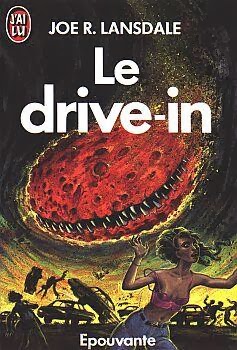
Last but not least, Lansdale! Lurid and lusty. Lovely!

Monday, December 30, 2013

Paperback Horror: French Editions

Mon Dieu! Imagine my delight upon discovering these French editions of classic horror novels. French covers seem more likely to feature art that corresponds to the novel they adorn. J'ai Lu ("I read") is a French publisher, while "Épouvante" means "terror," so you can guess what's going on here.

At top is Joe Lansdale's blistering The Nightrunners (1987), and its French title translates nicely as "Children of the Razor."

Although this cover might look generic - snakes n' skulls! - both title (translating as "Scales") and image are relevant to the story John Farris tells in 1977's All Heads Turn As the Hunt Goes By.

"Mindless" - a perfect translation of Bad Brains, Kathe Koja's second novel from Dell/Abyss, published in '92, about a failed artist whose vision and imagination are being assaulted by a silvery nightmare.

1980's Firestarter's title was simply changed to Charlie, the little girl's name, which I like a lot as it links up with Carrie, Cujo, and Christine.

The black-and-white photos here of blank-eyed men make me think of the various kinds of WWII survivors, which Clive Barker touches upon in his first novel The Damnation Game, from 1985.

I haven't read Ramsey Campbell's 1986 novel The Hungry Moon, but I love how this cover evokes his gloomy, opaque, quiet style of horror.

This is kinda-sorta what's going on in Brian Hodge's third novel Nightlife (another Dell/Abyss title, from 1991); while it does involve some creature transformation, I don't remember any boobs.

Sometimes the French covers aren't so accurate; Nightwalkers, from '79, is a somber, ambiguous "werewolf" novel, and the subtle prose of Thomas Tessier is rarely if ever used for this kind of graphic monster shock.

A severed head adorning this cover for Song of Kali, Dan Simmons's seminal 1985 work of exotic horror? Mais oui.

And androgynous punk vampires, no doubt about it - this has got to be Poppy Z. Brite's classic first novel from 1992, Lost Souls (the French title is a literal translation this time).

More, as they say, to come!

Friday, December 20, 2013

Friday I'm in Love 3: George Ziel Gothic Cover Art

The late George Ziel was a paperback cover artist extraordinaire. I can't get enough of his style, and his work for the Gothic romance craze of the late 1960s and early '70s has become nearly iconic. Here are some dark, lovely Gothic ladies to enjoy, and for more about Ziel the man and the artist, be sure to visit Lynn Munroe Books, Unobtanium 13, and The Midnight Room.


Monday, December 16, 2013

Cry for the Indians, Die for the Indians

Unlike darker Native American spirits the manitou and the wendigo, Malsum apparently only made an appearance in horror fiction via this 1981 title, by unknown author Gerald John O'Hara. Malsum sounds like a pretty nasty guy, so I can see how he'd have his own horror novel. Except "malsum" is a tribal word for "wolf," (it is also of course the name of a Swedish black metal band) so I don't know why the publisher decided to go with this utterly freaky portrait of a rabid, mutilated, blank-eyed deer. Nice work though.

Wednesday, December 4, 2013

Blackwater V: The Fortune by Michael McDowell (1983): A Newborn Baby with Wild Wolves All Around It

The Caskey family saga may be coming to a close but you wouldn't know it by the activity seen in this fifth volume of the Blackwater series, The Fortune (Avon, May 1983). Miriam Caskey is indeed amassing her family's fortune by hiring a Texas oil company to drill into the Perdido swampland on their property, after her estranged mother, the ever-mysterious Elinor, reveals that beneath its inky roiling depths there are pools of crude worth countless riches. How does she know? She just does. Meanwhile Queenie Strickland receives her erstwhile son Malcolm back into the family's bosom after being assumed missing in action, or even dead, after running away four years earlier.  Miriam's sister Frances gives birth to a daughter, and Frances's husband Billy Bronze oversees the accounting books of the Caskey mill, astonishing each family member by declaring just how much money they have during these post-WWII years.

However not everything is going so swimmingly for every Caskey: Elvennia Caskey, known as Sister, is distressed to learn that her husband Early Haskew - who married Sister in The Levee - will soon be home from Germany, after helping the Allies building bridges. She has no interest in seeing him again: "Why in the world did so many people die in the war, and Early's coming back alive!" Sister enlists the help of their longtime black servant, Ivey Sapp, but this results in a humiliating accident (see the broken bottle at the bottom of the steps on the Avon cover, illustrated by Wayne D. Barlowe). Poor Billy Bronze fears Frances is growing apart from him and their newborn baby Lilah, and even though he accompanies his sister-in-law Miriam on the profitable business trips to Texas, he grows insecure about his position in the Caskey brood. Once, he was the golden boy: 

When he set his mind to something, he walked right in at the door and did it. When he had got it into his head to become part of the Caskey family, he had picked out a marriageable daughter, wooed her, won her, married her, and got her pregnant in order to produce more Caskeys. The Family 's admiration for him was unbounded.

1985 Corgi UK edition, cover art by Terry Oakes

But now Frances disappears each afternoon to swim deeply and luxuriously in the Perdido waters, leaving her daughter to the care of Elinor... much as Elinor had given up her first daughter, Miriam, to her own mother-in-law Mary-Love in the first volume. What happens to Frances as she visits those watery depths (illustrated nicely above, for the 1985 Corgi UK paperback cover)? She becomes almost a different person, something different altogether, which Billy notices. Sadly he is to have no part of her rejuvenation, and knows he will soon lose her. The day was chilly, but she was barefooted, bareheaded, and naked beneath her loosely gathered robe, having just come in from her swim. When he first saw her, she was smiling and radiant. But the smile faded the moment she glimpsed him the dimness of the corridor.

Reading The Fortune over several months, putting it down for a couple weeks then picking it up again, I found it middling in the series. As is his wont, Michael McDowell takes his time telling this story, focusing on details that some readers might find irrelevant or overly slight; even in this slim volume - not even 200 pages - the narrative is leisurely, with only a few spikes of real melodrama and mild horror. Tension is lacking in spots but that makes it kind of a cozy, informal historical read. As ever he's good at interpersonal relationships, drawing out the peculiarities of his characters and their insecurities, and he's best at evoking darkness and dread. Which I wish there had been more of... especially this:

Throughout the series, McDowell has whispered hints of a non-human origin for Elinor, a nature which has been passed on to Frances - witness Frances's strange supernatural revenge upon a rapist in The War. Their mythic kinship to one another and to the Perdido River speaks of Jungian shapeshifters, of ancient legends about the dark powers of women and water... and the children they bear. Lilah is not the only offspring Frances bears one night in The Fortune; there is another child too, one that Zaddie, Ivey Sapp's daughter, catches the merest glimpse of when assisting in the childbirth:

Zaddie turned to turn out the light, but as she was turning she glimpsed a second head emerging smoothly from Frances's quietly heaving body. It was greenish-gray, and it seemed to wobble. Zaddie saw two wide-open, perfectly round filmy eyes, and two round black holes where a nose ought to have been...

Two-volume hardcover
Science Fiction Book Club, 1983

Can there be any doubt where this strange creature will find its home, that it shares its mother's and grandmother's inhuman heritage, and that its mother will leave behind all the Caskeys and join it? We know when Elinor places this mewling newborn into Frances's arms for the first time:

"What's wrong with her?" Frances asked. "Why is she crying like this?"
"She's drowning," said Elinor.
"Drowning?!"
"In the air. She needs to be in water..."