Showing posts with label charter books. Show all posts

Tuesday, February 7, 2023

The Damnation Game by Clive Barker (1985): Gambling's for Fools

Another reread of a famous Eighties horror novel, in which I ask the time-honored question: does it hold up lo these many decades later?

If you've followed Too Much Horror Fiction at any time over the past 13 (!!!) years, you'll know Clive Barker is one of my lodestars of genre fiction, up there in my own personal pantheon with H.P. Lovecraft, Stephen King, and Harlan Ellison. It's not just Barker’s fictional writings that have influenced and inspired me, but also the many interviews and intros to other books he did in which he discusses his beliefs about what horror (and other speculative fictions) is about, can do, and what it reveals about our humanity, our culture, our desire for something more than our daily lives. Given that I started reading him as a high school student in 1987, Barker's world has had an untold impact on me, both within the genre and out.


Reading the 1988 Sphere UK paperback poolside

First published in hardcover in the UK in 1985 and then in 1987 in the US, The Damnation Game (Charter Books paperback, July 1988, Marshall Arisman cover art), was anticipated on both sides of the Atlantic as a major novel debut. Barker was the enfant terrible of then-contemporary horror fiction, after his 1984 collection of genre-expanding stories, Books of Blood, were propelled by that famous Stephen King quote. Barker was ready to take over the mainstream. Its impetus was maybe more commercial than artistic; short story collections have always been seen as "lesser" product by publishers. As the editor of Sphere Books told Barker after unexpected success with Books, "Now do something sensible and write a novel... something we can really sell!"

A somber, gloomy, somewhat subdued tale of men and their debts, desires, and debaucheries, The Damnation Game helped affirm Barker's place at the top of the Eighties horror pantheon. For many years this was Barker's sole "horror" novel, in that it had none of the unique fantastical world-building that he would become known for in such subsequent epics as Weaveworld (1987), The Great and Secret Show (1989), and Imajica (1991). After rereading Books for this blog, I then reread The Hellbound Heart and Cabal, so I figured I'd continue chronologically with this guy. I read Game several times over 30 years ago, recall liking that Barker had made the leap from short story to novel, that the detailed eye he had for transgressive terrors was not lost in this longer format.

Hell is reimagined by each generation. Its terrain is surveyed for absurdities and remade in a fresher mold; its terrors are scrutinized and, if necessary, reinvented to suit the current climate of atrocity; its architecture is redesigned to appall the eye of the modern damned.


Paperback promo from publisher

The opening chapter, set in bombed-out Warsaw, crackles with dread and enormity, yet with a strange sense of freedom to be gained from playing games, chancing fate, plying one's wits against a devilish opponent—ideas Barker returns to again and again. In his mind this faceless gambler began to take on something of the force of legend. Then the narrative shifts to the 1980s, where we meet protagonist Marty Strauss, a thirty-something prisoner doing time for a botched robbery, debts owed from gambling, life lost, security van empty. Offered parole if he accepts the could-be-more-dangerous-than-prison job of bodyguard for world famous industrialist Joseph Whitehead, Marty accepts, wary though he is. 

He doesn't know Whitehead is hiding out in his vast, well-secured London estate, with laconic bodyguard Mr. Toy and a menagerie of dogs, from the mysterious Mamoulian, aka The Last European—the fellow from the opening. What follows is Marty learning the truth of Whitehead's wealth, why his teen daughter Carys is a junky, and other unsavory facts about a world of woe just a whisper's breath away.


Weidenfeld & Nicolson, first UK hardcover 1985
Cover art by Geoff Shields

Whitehead's revelation to Marty about his and Mamoulian's history in those WWII ruins contain a mystery as something few Americans truly grasp. Various set pieces underscore Barker's notions of the existential dread of nothingness ("nothing is essential") so at odds with the more common horror dichotomy of good and evil, Heaven and Hell, God and the Devil. The two young American missionaries who appear at the end, empty-headed Chad and Thomas, offer a somewhat witty addition to the grim proceedings; they can only interpret what they're seeing through the inanities of Christianity, their Pastor Bliss, their hunger for the Deluge to wash all sinners away. In Chad's mind waters—red, raging waters—mounted into foam-crested waves and bore down on this pagan city.


Barker in 1985

Much, perhaps most, of Barker's appeal was and is his ability to pluck beauty from the monstrous; his prose style, sleek and polished, unhurried and measured, is informed by classic continental literature and film, with imagery inspired by European cinematic masters such as Cocteau, Antonioni, Bunuel, Fellini, Fassbinder. There is a pathetic dinner sequence with Whitehead's aged cronies and available young women drinking copious amounts of wine in a brightly-lit room, decorated only by a grotesque painting of the Crucifixion, that seems right out of a socialist satire about the insipid appetites of the rich. The old man had wanted to see him naked and rutting.

The scenes with Breer the Razor-Eater, Mamoulian's dogsbody, and his unholy passions pedophilia, cannibalism, necrophilia, whose rotting body as a reanimated corpse parallels in physical form the moral corruption in the characters around him, are pure classic Clive:

...something in his chest seemed to fail, a piece of internal machinery slipping into a lake around his bowels. He coughed and exhaled a breath that made sewerage smell like primroses... He was moving into a purer world—one of symbols, of ritual—a world where Razor-Eaters truly belonged.

My signed hardcover. See the water damage at bottom?
I let my own mother take this to the beach to read
and she left it on her blanket and the tide came in.
NEVER LEND BOOKS.

All Barker's strengths are on display, scattered throughout the book. Irony, opposites, contrasts: delicate petals falling onto human wreckage, cities laid to waste beneath spring skies, "death at laughing play in a garden of bone and shrapnel." Barker has always delighted in such contradictions, believing they get at a truth unreachable by simple black-and-white binaries. This approach lends an air of maturity to the proceedings, a sophistication rarely seen in the horror offerings on the same shelf. I recall reading the US hardcover when it came out, and indeed that format made this gruesome tale somehow respectable.

The notion of "nothingness" as a final terror is one Barker would address in various works throughout his career. Here, we have the room in Mamoulian and Breer's hideout—who has kidnapped children in the cellar shiver—which Marty discovers.

This wasn't the adventure he'd thought it would be; it was nothing. Nothing is essential... all of it was like a fabrication. A dream of palpability, not a true place. There was no true place but here. All he'd lived and experienced, all he'd taken joy in, taken pain in, it was insubstantial. Passion was dust. Optimism, self-deception.... Color, form, pattern. All diversions—games the mind had invented to disguise this unbearable zero. And why not? Looking too long into the abyss would madden a man.


Sphere reprint, 1988, Steve Crisp art invoking
The Thing—

yet also referencing a moment in the novel

As I said above, I don't think Americans have a concept like existential nothingness the way people who were close to the atrocities of WWII were. Maybe I'm generalizing, but that's my serious impression; not for nothing is Mamoulian nicknamed "the Last European." He remembers the horrors. As a young guy myself with some intellectual pretensions of my own beginning to sprout, Barker appealed to me precisely because he used horror as a way to get at deeper truths about human nature, not simply as a vehicle for cheap thrills and messy bloodshed.

Oddly, unlike the Books of Blood excesses of surreality and guttural fears, Barker only refers to atrocities—he literally keeps using that word, "atrocities"—rather than regaling us with more poetic descriptors as only he can. Early on, some gruesome dog deaths play a large part in a scene of confrontation (and resurrections; the creatures would've looked spectacular in a practical-effects kind of way in a movie), particularly now knowing what a dog-lover he is—a cheap shot at unsettling readers? As I said: Damnation Game was his bid for success, and so perhaps he felt he had to tone down his tendency to terrorize readers with things never before imagined. 

Worms, fleas, maggots—a whole new entomology congregated at the place of execution. Except that these weren't insects, or the larvae of insects: Marty could see that plainly now. They were pieces of flesh. He was still alive. In pieces, in a thousand senseless pieces, but alive.


French translation, 1989—a depiction of one of the book's most potent scenes

On this reread I found the novel somewhat—dare I say?—tame, believe it or not. In his bid for bestsellerdom, Barker eschews the epic flights of fancy and imagination that so marked his previous output for a more mainstream narrative, the Faustian deal gone bad (of course there are no Faustian deals that go well). Stretched out over 430 pages, the bizarre imagery he conjures up loses its impact and the story falters. Yes, there are very good set-pieces of perverse gore and grue, and the secret history of Whitehead and Mamoulian's long relationship is darkly fascinating, but pages of irrelevant detail, unfocused narrative, and a somber tone slow the proceedings into a dreary crawl. Rather than emboldening him to stretch out for the long haul, it seemed this novel format constrained Barker's visions. These are all first-novel problems, indeed.

Perhaps that was the problem: later, longer works show him in stronger form as he unlooses chains and breathes free. Damnation Game isn't a total loss, and I see from Goodreads reviews that many fans enjoyed it; esteemed horror critic S.T. Joshi called it "a sparklingly flawless weird novel." I wouldn't tell first-time Barker readers to start with this novel, however, not at all. His next book, Weaveworld, would begin his successful foray into the unique, epic dark fantasy that he'd mine again and again. While there were aspects of the book I found satisfyingly horrific, and he is still one of my top fave-raves of all time, I think The Damnation Game may be best read and enjoyed by Clive Barker completists.

Tuesday, October 1, 2019

Even Clive Barker Would Flinch: The Horror Paperbacks of Gene Lazuta

Late '80s and early '90s horror writer Gene Lazuta was born on this date in 1959. Lazuta wrote several paperback originals under pseudonyms (as well as a mystery series), but did not continue his career as a horror author; indeed, you can see his professional bio here. While the cover art is striking and in keeping with totemic pulp horror imagery—drippy typeface, fangs, skulls, hands crawling out of eyes—I haven't read any of these titles, and I don't think I've seen any in the wild when I'm out haunting used bookstores, so I can't tell you whether Barker would actually flinch or not! Bloodshot Books reprinted 1992's Vyrmin in 2016.


Saturday, July 28, 2018

She Wakes and A Cold Blue Light: Recent '80s Horror Reads

Hola amigos, I know it's been a long time since I rapped at ya, but I've been real busy here. Been buying paperbacks like crazy, in and out of town, and have even had time to read a few. Unfortunately nothing has blown me away, a real bummer, but here are two brief reviews of the titles I've finished this summer.

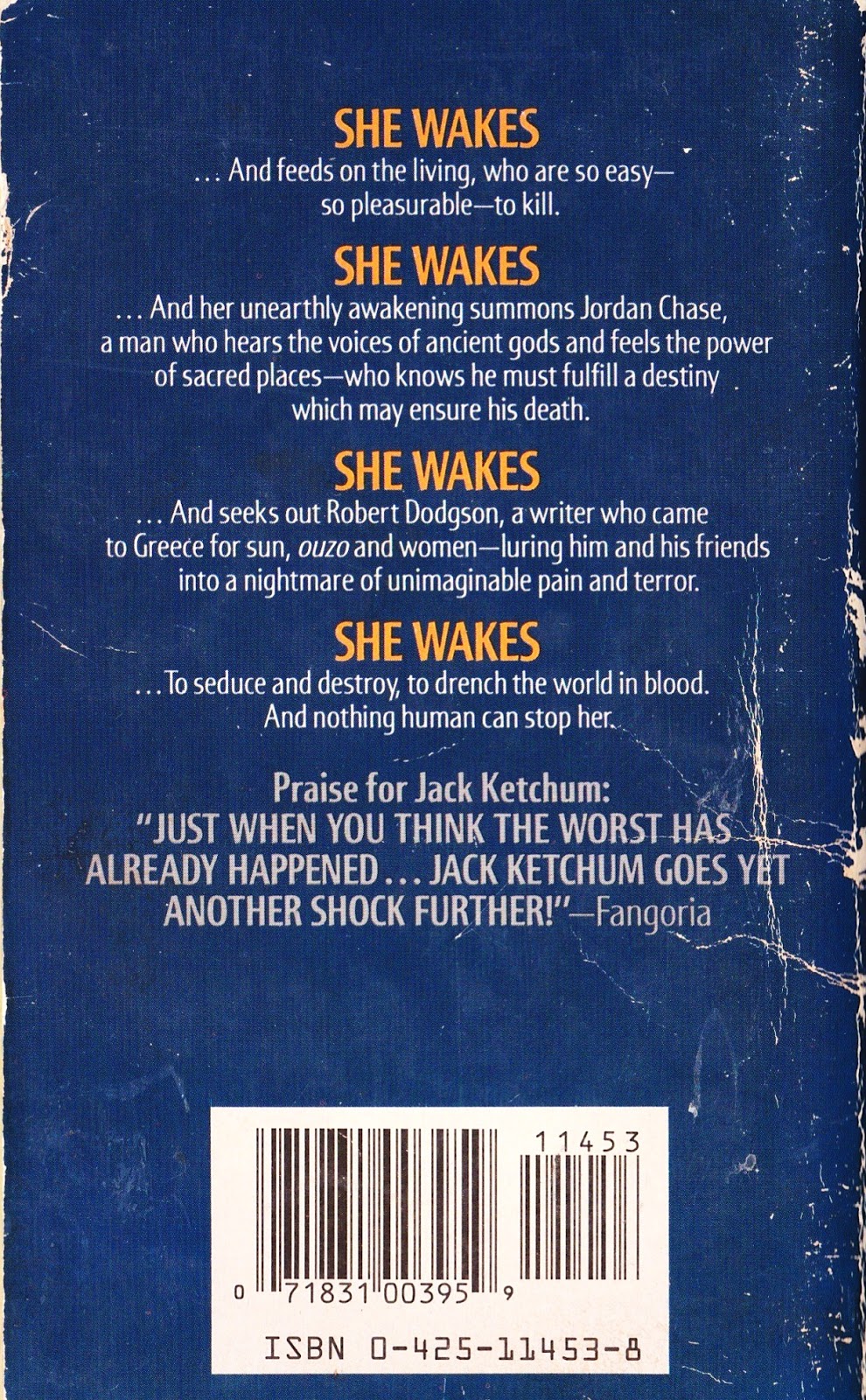
While at first I was kind of digging She Wakes, the late Jack Ketchum's novel from 1989 published by Berkley Books, as it neared its end I realized I'd long lost any sense of enjoyment. Pretentious and mean-spirited, Ketchum seems to be floundering a bit in this rather overlooked title in his oeuvre. A supernatural story set in a well-depicted Greece, the She of the title is of course an ancient scary goddess ravenous for sex and death in the guise of vacation fling. You know how it goes. Characterization is dull and hollow, prose is Hemingway lite, and scares and/or creepiness marginal. The unrelenting conviction that made Girl Next Door and Off Season such horror powerhouses is missing.

I do like the at times despairing tone of Ketchum's style—He felt a moment of impotent fury. These were all good people. They didn't deserve this. None of them did—because it gets at my understanding of horror: that terrible things happen to good people for no reason. I mean, that's life, right? I'm not crazy about horror in which awful people get a dreadful comeuppance; that seems a cheap satisfaction. And while zombies and gore and flesh-eating appear in the last quarter of the story (a few sex scenes are written pretty well too in a sort of erotic horror manner), they produce no horrific frisson; no, it's just there, and it did nothing whatsoever for me. Lots of time drawing characters together for what promises to be a doozy of climax, but it is dead on arrival, muted, overwrought, even distasteful in an ugly way.

Apparently Ketchum wanted to try his hand at a "Stephen King style" work instead of his usual non-supernatural fare, but She Wakes is NOTHING like a King work, so I don't know what he (or the publisher?) was thinking. The combo of Ketchum's clipped, existential sentences and malevolent mythology, intriguing at first, adds up to nothing. I'm not surprised Ketchum gained genre fame only years later; his style, affect, and approach were pretty much the opposite of what was going on in horror writing at the time (although I suppose it bears the vaguest similarities to Simmons's Song of Kali). Despite a few interesting tidbits scattered throughout—his evocation of the Greek landscape and its people is admirable, but I mean come on, it's no Colossus of Maroussi!—She Wakes is a real miss.

In late summer of last year, three men and two women came to Aubrey House, each seeking something intensely personal. Five separate houses, if you will, all of them haunted.

1983's Charter Books original A Cold Blue Light, by fantasy writing team Marvin Kaye and Parke Godwin, is a title I searched for awhile; I'm not sure exactly why. I think I liked the vibe the title and cover had, implying a chilly tale of atmospheric hauntings ("beckoning horror," anyone?). Another riff on Haunting of Hill House, you got your investigators all up in what was a summer rental for backstory folks who went mad. Back-cover copy really sells it:

Psychically speaking, it's a whole new equation. Good, Evil, God, Heaven or hell—I doubt that any of those words have much relevance in Aubrey House.

Didn't know anything about the authors, looked them up, they don't write at all the kinds of fiction I pay attention to. Which is ironic because Cold Blue is engagingly written, smart, insightful, sharp and observant—a party scene early in the story promised a bright, modern '80s novel of witty banter, solid characterization, believable motivation, paranormal skepticism, metaphysical ramblings (last two things not my favorite but I'll make an exception if there's some real creepiness to be had)—but there are absolutely no scares whatsoever until maaaybe the final couple pages. Cold Blue was a solid read otherwise, yet I can't recommend it as any kind of horror fiction. The authors were simply going through generic motions for commercial reasons. There's a sequel, I might buy it for completist reasons only.


Saturday, October 31, 2015

Halloween Horrors, ed. by Alan Ryan (1986): Midnight... All Night

Happy Halloween, one and all! On this day of days I offer up a mixed bag of treats: Halloween Horrors (Charter Books/Oct 1987), one of Alan Ryan's several horror anthologies from the 1980s. Each short story is set at Halloween, of course, which allows for mining of all its myth and legend for the background details. You'll recognize all the familiar faces tonight, masked or unmasked, peering out at you from the pages, eager to have you step inside for a surprise, take one, won't you, or two, maybe three or more...

1988 Sphere paperback, UK

First up is "He'll Come Knocking at Your Door" by Robert McCammon. I've read this one before, in his 1990 anthology Blue World. It has a decent setup and payoff (intimate payment for townspeople's good fortune required by... someone) but, again, suffers from what I like least about McCammon: his square, earnest, almost dopey style; he's the John Denver of '80s horror. If he just took his gloves off more often, like he does in the stories final images—and even those could've been honed to a sharper edge–I'd like his stuff more. Ah well. On to "Eyes" from Charles L. Grant, a writer I can appreciate in the abstract but in the literal act of reading his stories, not always. But here his allusive, understated style fits a tale of grief and guilt and horror wrapped up tight together. A father can't forget or forgive when it comes to the death of his disabled son. The kicker is ironic, tragic, unshakeable. I think I'm gonna call this kinda thing heartbreak horror.

  Strieber: Hates Nixon

Whitley Strieber's "The Nixon Mask" is a droll satire of that ol' crook Richard Nixon. As a peek into the machinations of high office it's kind of funny, but Tricky Dick's paranoia gets the best of him. I liked the tone of this one, absurdist humor turning into horror, Ballardian big deals going on and on that have nothing to do with the people supposedly served and in fact the Watergate break-in is okayed on this eve. What happens when Dick Nixon wears a Dick Nixon mask? Oh, it's riddle wrapped in a mystery inside an enigma. I dug this one myself but I don't know how much mileage it'll have to a reader born after, say, the Carter administration. "Samhain Feis" by Peter Tremayne delves into Celtic Halloween lore, has some nice scenery in the desolate Irish countryside, a bit of deserved comeuppance in the end. No biggie.

"Trickster," from Steve Rasnic Tem, hits true emotional notes absent from other works here. A man mourns his dead brother, who from childhood was an incorrigible practical joker, distrusted by his own family thanks to truly horrible pranks (like pretending to be dead or even pretend-killing a baby relative. Hilarious!). Murdered on Halloween night a year earlier, our protagonist reminisces about how their lives growing up and growing apart. This Halloween he thinks—improbably, impossibly—he sees his brother out cavorting in a Halloween parade in San Francisco, where he'd died, and spends a hallucinatory night chasing after this phantom. "Trickster" feels like a story about real people, written by someone who's been there. It's sad at moments and that final trick really stings. Another case of heartbreak horror.

1986 Doubleday hardcover

Editor Ryan's own contribution, "The Halloween House," doesn't display the careful sophistication of his other tales I've enjoyed; I suppose that wouldn't have fit this story of randy teens exploring a haunted house. An original idea there at the end, absurd even, but some nice horror imagery of a house, er, melting; otherwise it's as trite as its title. Guy N. Smith's "Hollow Eyes" gets a big no from me, some old dad complaining about his daughter's shifty, ugly boyfriend, searching for them during a Halloween rave-up, all wrong, no go, return to sender. "Three Faces of the Night" is Craig Shaw Gardner's  ambitious and complex tale, told in three time frames, of love and college parties. The two don't mix.
"Pumpkin" from crime writer Bill Pronzini (pictured) delves into Halloween and harvest lore, not bad but not memorable.

Weird Tales scribe and HPL pal Frank Belknap Long gives us "Lover in the Wildwood," a tale of criminal lust in the backwoods; somewhere I can here the Crypt Keeper cackling and I wish someone would just shut him up. "Apples" is Ramsey Campbell's minor chiller about kids stealing fruit from an old man's garden. Campbell gets kids' dynamics right and the climax offers a nice frisson of nausea and creepiness, I mean I hate raw apples too (She'd spat out the apple and goggled at it on the floor Something was squirming in it). Not one of Campbell's best but a highlight of this anthology. The concluding story is from Robert Bloch, is a mean-spirited little gem of a neighborhood's trick-or-treat session gone horribly wrong. "Pranks" seems light-hearted at first but grows in menace till its great reveal removes all doubt of malicious intent.

Okay then, now for the final trick: for my money the star of this Halloween Horrors is Michael McDowell's (pictured above) "Miss Mack." The first of his few short stories, it is as sure and capable as any of his novels, simply condensed to an essence of cruel terror. I read it several years ago and it's haunted me ever since, which is surprisingly rare. Our Miss Mack is a beloved schoolteacher in Pine Cone, Alabama (also the setting of The Amulet) who befriends young Miss Faulk, recently hired by Principal Hill. But Principal has designs on this lovely innocent girl and cannot bear the fast, intimate friendship between the two women. Stoked by jealousy and, okay, yes, the occult secrets of his mother, Principal Hill puts a hex on Miss Mack. McDowell writes so well, his quiet evocation of locale and character so confident and matter-of-fact, you won't want the story to end. And in a way it doesn't. The final sickening, maddening horror upends all human notions of time and place, and without those, what are we? Lost in a night that never ends looking for a place that does not exist. When she waked, it was night—still Halloween night. "Miss Mack" has become a favorite of mine from the '80s era.

1988 Severn House hardcover, UK

While enjoyable overall, I do wish Halloween Horrors had a few more tricks to play on readers; many of the stories are slight, mild, unremarkable. Still, a cheap copy is worth searching for, as a couple treats indeed have a razor blade tucked within...

Thursday, September 18, 2014

Victim of Agony: The Horror Paperbacks of Florence Stevenson

I am not much sure who Florence Stevenson is but going by these paperbacks of hers written throughout the late '60s, '70s and into the horror heyday of the 1980s, she wrote the gamut: quiet horror, Gothic horror, witches, vampires, even cat lady horror--I love Ira Levin's blurb on Ophelia (Signet/Apr 1969): "fresh, delectable, refinedly sexy."
Amazon lists dozens of her paperback novels. The cover art on all of these offers much to be enjoyed, from the creepy-kid vibe of A Feast of Eggshells (Signet/Dec 1969--and don't miss that body at the bottom of the stairs) to the proto-paranormal romance imagery of Moonlight Variations (HBJove/Jan 1981), or the delicious bosomy Gothic of The Curse of the Concullens (Signet Gothic/Nov 1976) and The Witching Hour, to the luridly overdone '80s covers for Household (Leisure/Mar 1989) and The Sisterhood (Leisure/Oct 1989).


I found only the most basic biographical info on a romance site; if anyone knows anything more, let us know. And oh yeah, if you've read any of these too!

Wednesday, July 2, 2014

In a Dark Country, Red Dreams Stay with You: The Horrors of Dennis Etchison

Dennis Etchison (born Stockton CA, 1943) didn’t set out to be a horror writer. While Etchison has been referred to as a writer of “dark fantasy” or of “quiet horror,” in an interview with journalist Stanley Wiater in Dark Dreamers (1990), the author states that he found himself in the horror genre “sort of by accident.” Etchison began writing and publishing science fiction stories in the 1960s, but as the short genre fiction market changed he found his work gained more acceptance in the burgeoning horror fiction field of the 1970s.

With his bleak, pessimistic, often quite violent tales of people drifting through a modern world of lost highways and all-night convenience stores, mistaken identities and secret sociopaths, how could Etchison have ended up anywhere but the horror shelves? His enigmatic yet striking stories gained plaudits from Stephen King, Ramsey Campbell, Charles L. Grant, and Karl Edward Wagner, and were published in two paperback collections by Berkley Books, 1984’s The Dark Country and 1987’s Red Dreams (both originally put out by specialty horror publisher Scream/Press several years prior, both with inimitable J.K. Potter covers).

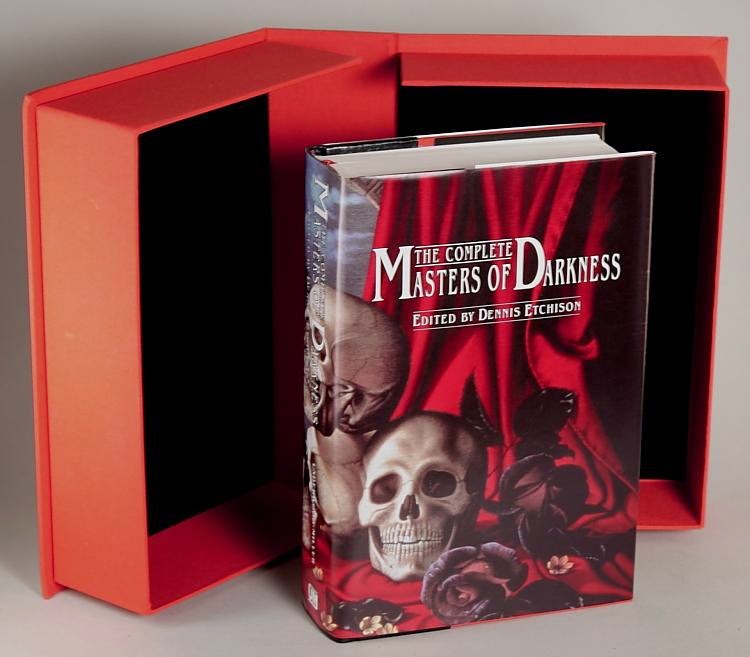
By the end of the 1980s Etchison had become a highly regarded editor as well, gathering brilliant and blisteringly horrific tales of all styles and voices from his most talented peers for the anthologies Cutting Edge (1986), Masters of Darkness (3 vols., 1986–1991), and MetaHorror (1992). If all that weren’t enough, under his pseudonym Jack Martin (a character with that name appears in many of his tales) he wrote novelizations for films by both John Carpenter and David Cronenberg! Let’s face it: Etchison may not have grown up wanting to be a horror writer per se, but he certainly knows his way around the oft-maligned genre. In his introduction to Cutting Edge, he gives a shorthand lesson in the failures of genre fiction during the modern era: Tolkien, Heinlein, and Lovecraft impersonators who refused to engage with the fracturing contemporary world around them. None of that for Etchison.

Like Stephen King, Etchison had many of his short works appear in low-rent 1970s men’s magazines, as well as The Magazine of Fantasy & Science Fiction, and various horror anthologies edited by Charles L. Grant, Stuart David Schiff, and Kirby McCauley. These are the stories you’ll find in The Dark Country and Red Dreams. As one might have guessed, his horror stories could also be classified as “soft” science fiction (as he noted to Wiater) as well as crime/noir fiction. Anyone who’s read widely in these fields will know that those genre lines overlap and blur . His paperbacks may have been marketed as modern horror—witness the blurbs and taglines on them, all “blood-curdling” and “master of the macabre” and so on—but Etchison took all those influences and crafted his own particular type of dark, speculative fiction.

What’s truly important, and why Etchison should still be read today, is that his stories are crafted with a true writer’s care; he infuses his work with a literary sensibility, not a pulp one. As someone who loves horror fiction but doesn’t only read horror fiction, I find this quite refreshing. He can be bloody and violent, he can be quiet and intimate, he can be challenging and oblique, but he always uses his own unique template. Etchison’s not afraid to utilize a sort of experimental style to delineate the crumbling psyche of a doomed character. Occasionally his allusive prose and his sleight-of-hand skill at misdirection can mitigate the impact of some stories, so I find a careful approach to him works best. Etchison shows; he does not tell. His work stands out from other ’80s horror because of that; that first rule of writing is often the first one jettisoned by horror writers.

Etchison often sets his fictions in the desert highways and late-night byways of his home state; he knows well this empty land and the darknesses therein. Etchison is very good at writing scenes of shocking violence, but his fiction doesn’t rely on them, as so many horror writers do. There is much psychological violence, distress, dismay, a sense of things being not quite right, of a person not quite at home, wandering lost along a dark highway—and then meeting someone, or something, at the end of the night...

Of his two major collections, I am most partial to The Dark Country. While Red Dreams has its dark gems, the stories in the earlier collection seem darker, meaner, both more graphic and more effectively subtle. “The Late Shift,” one of his most lauded and original works which was first published in Kirby McCauley’s seminal anthology Dark Forces (1980), reveals a sinister source for those poor souls working the graveyard shift in 7-11s and gas stations and diners. Poor souls indeed.

The icy merciless horrors of “Calling All Monsters,” “The Dead Line,” and “The Machine Demands a Sacrifice,” which form what Ramsey Campbell calls in his introduction “the transplant trilogy... one of the most chilling achievements in contemporary horror.” Blurring SF and horror in a vaguely Ellisonian manner, Etchison offhandedly imagines a future (?) of living bodies at the service of some (mad) science, evoking specifically Dr. Moreau’s House of Pain. The sentence “This morning I put ground glass in my wife’s eyes,” begins “The Dead Line,” its no-nonsense, amoral tone invoking the hardboiled writers of the 1930s. More please!
“It Only Comes out at Night,” like its generic title, is a traditional horror piece, as is “Today’s Special,” but each is tightly written, offering horror fans the poisonous confections they love. The frigid vengeance of “We Have All Been Here Before” and especially “The Pitch” is quite satisfyingly nasty. Along with his talent for straightforward storytelling, Etchison has a skill for diversion, letting the reader think a story going’s one way when—record scratch—it goes somewhere else entirely. To wit: “Daughter of the Golden West,” which begins as a Bradbury-esque fantasy of three college-age men (the collection is dedicated to Bradbury) and ends with a revelation of one of California’s greatest tragedies. It’s a gruesome delight.

The title story won the 1982 British Fantasy Award and the World Fantasy Award for best short fiction. Nothing SF or noir or supernatural about this piece at all; it reads more like an autobiographical piece of an inadvertently nightmarish vacation. Jack Martin’s friends callously and drunkenly exploit locals at a Mexican beach resort, then he’s forced to face a fate dealt at random. This is not the kind of story you expect to find in a book with the little “horror” label on its spine, but does that even matter? It’s spectacular, mature and disturbing about everyday matters that can spiral out of control.

While The Dark Country is where the gruesome edge of Etchison’s blade resides, Red Dreams is its quieter sibling, but no less unsettling or insightful for that. The late great Karl Edward Wagner, in his intro, opines that Etchison’s nightmarish fiction is one made of loneliness, “of an individual adrift in a society beyond his control, beyond his comprehension, in which only sheeplike acceptance and robotlike nonawareness permit survival.” Ya got that right, K-Dub!

These are stories for grown-ups, their fears of age and insignificance—like the protagonist of “The Chair,” who attends his 20-year high school reunion and is called again and again by the wrong name, every time different, till one person gets it all too right. The father in “Wet Season” has faced a parent’s worst nightmare but then... it gets worse. “Drop City,” while overlong, is a noir/horror mash-up, slowly—perhaps too slowly—building to an impressionistic finale. A man wanders into a bar and discovers his life might not be anything he can remember. If the readers pays close attention, the ending will seem eerily familiar. "The Smell of Death" has a physician-heal-thyself angle inside its early '70s disaster SF setting; male/female relationships are in Etchison's spotlight (a common practice in his work) in "On the Pike," which has a young couple checking out the freakshow tent at a dilapidated carnival, one of them egging the performers on and on...

The thematically ambitious “Not from Around Here” finds Etchison in a quiet Phildickian mode as he slowly introduces us to a near-future and a religious cult whose texts provide perfect insight and pleasure. A lifelong movie fan, Etchison’s future world includes movies never made save in a film geek’s fevered imagination, works like, “Carpenter’s El Diablo, De Palma’s The Grassy Knoll, Cronenberg’s Cities of the Red Night, Spielberg’s Talking in the Dark...”  (That’s rich, Etchison having Spielberg make a movie called “Talking in the Dark,” since that’s one of Etchison’s best horror stories!). I found it rather too leisurely in the telling, taking a long detour before getting to the real meat of the tale, but I dug the litany of classic movie actresses names that operate as a sort of exorcism for the protagonist, an acceptance as the promises of the cult are kept.

That "Talking in the Dark," the opening story, is probably the most horror-genre typical story in Red Dreams. A fan gets to meet his favorite horror writer! You know how writers hate being asked the utterly banal question “Where do you get your ideas?” (“Poughkeepsie” is Harlan Ellison’s eternal answer)? Here Etchison answers it. Sure, the inspiration’s real life; writers are regular people too. Except when they’re not. The blackly comic and bloodily conclusive scene sinks its teeth in.

Another favorite is “White Moon Rising,” a murder-on-coed-campus (shades of King’s “Strawberry Spring”) that fragments character POV as it climaxes. It originally appeared in Whispers, and was a standout of realistic horror amidst the dark fantasy included in that landmark anthology. But more than a handful of the stories in this collection are like stylized little writer's exercises, with the use of second-person narration, vague hints at interpersonal trauma, and existential-y questions of life and facing death; this is why Red Dreams had less of an impact on me than Dark Country. Still, both books should be in the serious horror fan's collection.

The fiction of Dennis Etchison insinuates and intimates, brimming with allusions that seem to go right up to the point of comprehension and then dissipate, leaving your imagination tingling, realizing that fully facing his horrors might leave you wishing you hadn’t. Intelligent yet jittery with fearsome anxiety, horrific without clichéd stupidities, the stories found in Red Dreams and especially in The Dark Country will reward 21st century horror readers and remind them that the 1980s were a boom for the genre, as it was breaking away from its pulp past and pointing the way to a petrifying—and wholly unavoidable—future.
 
(This post originally appeared in slightly altered form as part of "The Summer of Sleaze" on the Tor.com website)