Tuesday, June 4, 2013

Borderlands, edited by Thomas F. Monteleone (1990): Wake Up in the Night with a Fear So Real

An admission: I almost didn't read this one back in the day. The cover art of a skeleton driver at the wheel almost turned me off Borderlands (Avon, Nov 1990), the first in the anthology series edited by Thomas F. Monteleone. At that time I was just so over skulls and skeletons on covers, thinking that whatever was inside was just as cliched and tiresome. But I finally succumbed to that wonderful blurb from Peter Straub, had already enjoyed Wagner, Klein, and Lansdale, and so found Borderlands to be a terror treasure trove, stuffed with inventive, colorful, eclectic stories I remember fondly - well, I remember fondly that I enjoyed them almost 25 years ago. I've been wanting to revisit and review Borderlands since I began this blog more than three years ago....would it hold up on this reread?

Some of the titles have jumped around in my head for ages, as did a few of the authors names, both because some became favorites and others because they seemed to become nothing. What Borderlands offers is stories that feature all kinds and styles of horror, from the non-supernatural to the otherworldly, from the quiet whisper to the shockingly violent, from dark fantasy to urban realism, psychological thriller to fairy tale, gritty suspense to gothic decadence. There's something here for the proverbial everyone. This means you.

The tone is set, wisely, with the first story, "The Calling." It's by the recently late David B. Silva, who edited one of the essential horror magazines of the 1980s, The Horror Show (many of the writers in this antho sold their first stories to Silva). Grim and despairing and all too real: a man caring for his mother as she slowly succumbs to cancer. This is horror of humiliation and embarrassment, failure and resentment. With a delicate yet graphic touch, Silva deftly explores what we choose to ignore. The ending is the essence of horror. And I just learned "The Calling" won the 1990 Bram Stoker Award for best short story; no surprise there.

"Scartaris, June 28th" is Harlan Ellison in Deathbird Stories (1975) mode: What happens to gods after their last believers die? Here Ellison's anger and impatience are tempered by a more forgiving, more understanding nature. A nameless man wanders the globe, giving a cessation of suffering to some, simply a hard time to others who deserve to be confronted about their outmoded beliefs. Ellison drops arcane comparative mythology knowledge on the reader and it'll help if you know who Arne Saknussemm is. Ellison's story is the most sophisticated and ambitious of works here and it contains some of his finest-ever writing.

(Speaking of Ellison, Borderlands was also my very first introduction to Poppy Z. Brite, whom Ellison lauded to the sky and back. "His Mouth Will Taste of Wormwood" is a goth-punk update of Lovecraft's "The Hound," both factors endearing her to me at once. I wrote about this story here.)

1994 reprint from White Wolf, cover art by Dave McKean 

It was a pleasure to reread tales I'd half-remembered: "Muscae Volitantes" by Chet Williamson, but mostly unforgotten since I've been plagued by the titular condition for years. A husband's lover threatens to reveal the truth to the wife. Surely the husband can see his way out of this untenable position? And things get wonderfully, maniacally surreal in "Oh What a Swell Guy I Am," a story Monteleone happened upon out of the hundreds of unsolicited manuscripts he received. Jeffrey Osier, a regular contributor to small press mags like Deathrealm and The Horror Show, possesses a strong, passionate prose style; his bizarre images are conveyed fully formed, which resonated uncomfortably with me. In a good way. The title... is literal. Oh man, is it literal.

A quick stop in lycanthropy land, in which Les Daniels upends who's monster and who's man; like his other fiction, "By the Light of the Silvery Moon" uses standard horror tropes with wit and irony but is no less the horrific for it. Pure entertainment. John Shirley's "Delia and the Dinner Party" is part child's-eye view of the titular event and splatterpunk reveal, while Nina Kiriki Hoffman's creepy short-short "Stillborn" reminded me just a bit of the underseen 1990 film The Reflecting Skin, children obsessed with... well, no spoilers!
 
Ed Gorman's (above) "The Man in the Long Black Sedan" has a family man in the grip of madness - or utter calm rationality? - confront a most innocuous villain in a motel room. Gorman is more known for his crime fiction but wrote quite a few pulp-horror novels under the name Daniel Ransom. Likewise, "Suicide Note" by Lee Moler isn't necessarily horror but more dark erotic suspense, a man obsessed with carnality till the very end of life.

In a more general vein, two looming specters over horror fiction of this era appear in Borderlands: religious fundamentalists and sexual abuse/incest. Today these topics seem a little shelf-worn in fiction, tropes that inexperienced or lazy writers can trot out and use to push readers' buttons all too easily (it's not just in genre lit either you can be sure). But when these themes starting appearing in horror fiction it signaled efforts to make horror more serious, more real, more involved with the world at large than retreating into the vagaries of the imagination à la Lovecraft, say. These themes date Borderlands but negate it little.

Bizarre hands indeed

Fortunately their appearances here are for the most part handled with intelligence. And, yes, irreverence: Joe R. Lansdale's "By Bizarre Hands" trades in both businesses, riding the edge of irreverent black humor and down-home horror in his own inimitable style as a pedophiliac preacher/conman drives the dusty roads of Texas looking for simple-minded girls he can "save" with the Good Lord's help. Joe's story ends Borderlands on a very high note, no surprise there. And "The Good Book" from G. Wayne Miller works the Lord works in mysterious ways just right, I thought.

A handful of contributions leave the reader spooked but bewildered, such as "The Pounding Room" by Bentley Little (above). An author whose only work I've read have been this story, twice now. Neither read has gotten me interested in reading more of his stuff, but that's me. Obviously lots of readers like the inexplicability of this story, this style, revealing the unbelievable horrors that lurk behind, beyond, beneath the mundane. But to what end? Perhaps that's the point: the horror of incomprehension. He would become one of the big paperback horror writers of the turn of the century but oh well.

Nazis, chemical pollution, and the nightmare of a homeowner's lawn care make John DeChancie's "The Grass of Rememberance" an intriguing read; the connection of these disparate elements didn't quite come together for me. "Alexandra," from '80s anthology essential Charles L. Grant, was quite good but again, the ultimate intent seemed to dance away from me at the last moment. A subtle and powerful woman befriends an Oxrun Station physician. Cool, but you all know Charlie: it's what he leaves out that is probably the most important aspect of his fiction. Sometimes I wish he'd just left it in.

Works from my faves: several times Karl Edward Wagner (above) has written sensitively of the fallout of the Vietnam War; in "But You'll Never Follow Me" a veteran still beholden to his war-torn battlefield ethic must now deal with his aging, ailing parents. It's a sad, sad story, without a trace of the unreal, and the climax hits a lot harder today than it did in 1990. Read it, and see what I mean. Ouch.

In "Evelyn Grace," by Thomas Tessier, a young man feels up a female corpse in a funeral home. Then things get weird. This one ends with very nearly the most objectionable word in the English language... and it is oh so right. Another one outta the park for Tessier; he's batting 1.000 here at TMHF. The ever-welcome-but-rarely-seen T.E.D. Klein contributed one of his few short stories of the '90s, "Ladder." Fate is a gamesman, a wordsmith, trailing an Irishman as he travels the globe. Klein's sense of place and locale is impeccable, and his brand of Borgesian wordplay tickle the intellect but unsettle it too; surely we are not gamepieces for an idle god...

One of the more infamous short stories of its day - the impact of which I've never forgotten even if the specifics were vague - "Stephen" ruminates upon bodily disfigurement in several disturbing ways, none of which resort to the supernatural. Elizabeth Massie (above) knows that while it was once proper to look away from the physically unfortunate, we all want to stare. And stare she does, unblinking, sympathetic, but without pity. Anne Zaccaria volunteers at a nursing home for the disabled and learns to confront her own deformities - not of the body but of her mind, her past, her family - thanks to the title character. "Stephen" is perhaps the most emotionally wrenching tale in Borderlands, never faltering in places where a lesser writer may have stumbled into grotesque tastelessness - well, I suppose there's some grotesque tastelessness here, but that's life. Excellent stuff, and another Bram Stoker Award winner, for best long fiction.

When I solicited material for what I hope will be the first of many volumes, I made it clear I didn't want stories that employed any of the traditional symbols and images of the genre. I wanted writers to expand the envelope, to look beyond the usual metaphors, and bring me something new... They are all extremely well-written. Some stories will dazzle, while others will quietly subvert, but they will all reach down and grab for the soft parts.

So says Tom Monteleone (above) in his intro, and he really deserves kudos for his editing skill here - and I don't have room to go into everything included. There is an air of conviction in all the stories; every one means business, even the "lesser" stories. No juvenile hijinks mar the carefully crafted terrors, no lapses in the write stuff to break the spells cast. Even the tales that get under the skin in a surreal yet inexplicable manner are serious in intent and purpose but without that sense of literariness of, say, 1988's Prime Evil; it's not so high-minded as that anthology. Borderlands (and the subsequent volumes, of which I own only the second today) promises to take us far, and it does, oh it does. What you will see there you've not seen elsewhere, but it's a one-way trip. So be warned: you'll have to find your way back on your own.

Friday, May 31, 2013

To Walk the Night

Here's a recent acquisition thanks to a fan of TMHF. Enjoy! It's taking me forever to write up a review of the great 1990s anthology I finished this week. Coming soon...

Thursday, May 23, 2013

Isobel (1977): The Rowena Morrill Cover Art

Glorious and sublime, this cover art truly embodies the classic era of horror paperbacks. Artist Rowena Morrill gives us virtually everything we want - demons, winged creatures of the night, alligator people (with boobs!), creepy landscape, and yes, a naked lady - for Jane Parkhurst's 1977 occult/witchcraft novel Isobel (which I haven't read), and can you believe it was Morrill's first cover? How would one ever top this?!


Friday, May 17, 2013

Pick One and Die: More Playboy Paperbacks

And here I was thinking I'd already found the best in canine carnage cover art! Foolish me. Playboy Paperbacks went for the throat with The Accursed (Dec '82) and The Haven (1977). Who knew the entrance to the underworld was paved with bathroom tiles?

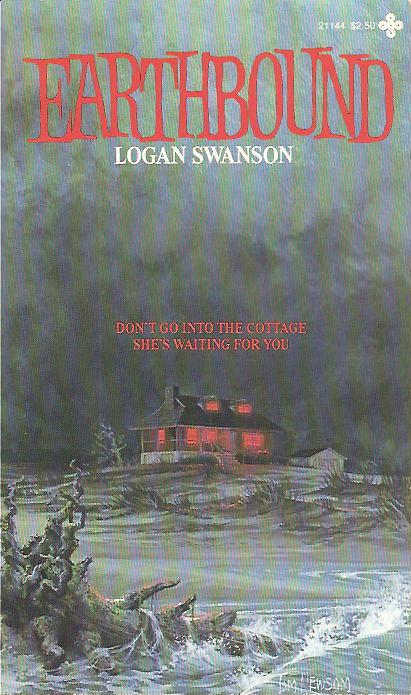
Standard creepy kids cover with The Banished (Nov '81), while the moody Earthbound (Sep '82) is excellent; Swanson is a Richard Matheson pseudonym.

Another monster?! Oh Hellstone (Jan 1981), you tease.

Then we get the starkly named Hex (May '80), Death (Aug '82), Nightmares (Sep '79), Terrors (Jul '82), and Horrors (Oct '81) all but the first quiet-horror anthologies. I love that they're actual photos! Blood and bone, baby, that's all you need. And a refrigerator magnet alphabet.


Tuesday, May 14, 2013

Build Me a Woman: The Horror of Playboy Paperbacks

During the early 1980s, the Playboy empire, perhaps unsurprisingly, extended its reach into the paperback pulp fiction market, publishing dozens of horror, occult, fantasy, science fiction, and crime novels under its Playboy Paperbacks imprint. Not all were paperback originals, simply reprints of books sometimes published years before. I've long seen the little icon on various titles I've picked up in the last couple years, on even "respectable" stuff like anthologies edited by Charles L. Grant and Stuart David Schiff. Here however I want to focus here on the tawdrier side of their cover art, that very retro conflation of horror and cheesecake that you know Playboy could do right.

Satyr (1981) hits a couple uncomfortable notes but how could you think such a title wouldn't? This cover is amazing though in its utter tackiness. Linda Crockett Gray wrote half a dozen or so horror novels, some later published by Tor in the 1980s; I've got one or two but haven't read them.

Blood Wrath (June 1981) kinda freaks you out with its Revlon model going all crazy eye killah on you. Whither hast thou gone, Chester Krone?

Darker Places (Dec 1980) features some gender, er, politics I'm not sure I wanna parse. Is the woman clad in a negligee trying to defend herself from a psycho killer, or is the male - veins bulging in his bare forearm, nice obvious allusion! - protecting himself from a desperate, crazed, suicidal woman, prefiguring Fatal Attraction? Parke Godwin has at least written lots of SF/F.

Night Screams (Mar 1981) could trade in some ambiguity with those luscious lips and perfect teeth, engaged in some playful bit of - oh, that tagline... nope. Pronzini and Malzberg collaborated on several crime thrillers which I've yet to read.

On the Eight Day (June 1981) God built a woman? I dunno, I thought He'd already had that covered. Lawrence Okun, no bible scholar he.

The Wanting Factor (1980) makes me wonder where I can get one of those gold t-shaped pendants.

Image of the Beast (1979) Farmer wrote mostly SF but this novel is apparently based on Gilles de Rais, so of course, you know, fuck yeah. Love the vampire lady, don't know what she's got to do with the story though.

The Shaman (Mar 1982) isn't too lurid but back 30 years ago it was probably still fairly scandalous for women to have all-over tats.

I've saved the best for last. This gorgeous cover for Siren (May 1982) - the only good image I could find of the book on all the internets - is captivating (natch). Love the turquoise eyes! Compare this cover to the shit Tor reprint one. Ouch.

More to come...

Friday, May 10, 2013

Book Sale Horror Haul

Every year the Wake County Libraries hold an enormous book sale at the North Carolina Fairgrounds. This is the third year I've gone and it is to die. These are all the books I bought yesterday... for $36. Most are in near-mint condition as they've been in storage for decades. I'm sure you can imagine my anticipation and excitement as I scoured the packed tables, and the sense of satisfaction I felt when I found a perfect copy of The Howling Man, the long out-of-print Tor collection of Charles Beaumont, a mint first-edition The Cellar (for archival purposes of course), the rest of the Shadows series which I needed, The Best of Masques, a slim volume packed with awesome writers, and a handful of Year's Best Horror from the '70s thru' the '90s. Not to mention Tessier, Bloch, Campbell, King...

Like an airplane hangar filled with books

I really cleaned out the selection of horror fiction - which was, to my disappointment, mixed in with science fiction this year (which my girlfriend attributed to the fact that we bought practically the whole horror section last year). So now I've got to reorganize my entire horror library to fit in these great new titles... and don't even think to ask me the question of when I'm gonna find time to read 'em!

Monday, May 6, 2013

Shock Rock, edited by Jeff Gelb (1992): The Great Rock'n'Roll Swindle

Brimming with monstrous mash-ups of horror and rock'n'roll, Shock Rock (Pocket Books, Jan 1992) takes the old-timey preacher scare that rock is the Devil's music not as a warning but as fait accompli. In his introduction, Jeff Gelb (editor of the long-running Hot Blood erotic horror series) points out the long relationship between rock'n'roll and horror movies and comics - so why not horror fiction (Alice Cooper says the same thing in his forward)? "At last count, less than half a dozen horror novels have attempted to meld rock and horror thematically," Gelb notes. Well, I think there is a reason for the rarity: that intertwining works wonderfully well for album covers and song lyrics, but it generally produces less than stellar horror fiction. Such is the case, sad to say, with Shock Rock.

I passed on Shock Rock when it was published, and my instincts were right. Most of the 20 tales Gelb assembled are, to not put too fine a point on it, adolescent and amateurish (I know, I know, you could describe a lot of rock'n'roll the same way and so think I'm being a hypocritical snob when I criticize the stories thusly). While there is a splatterpunk energy, too many are dorky and earnest, an outsider's imagining of what it's like to be a rock star, a drug addict, or a teenage rebel. And no Poppy Z. Brite?! She's one of the few horror writers of that era to have written with any sensitivity or authenticity about how music informs characters' lives and thoughts.

Thomas Tessier's "Addicted to Love" stands out as the best story of the lot, as its pure clear notes soar high above the cluttered, tuneless din of the rest of Shock Rock. Workaday Neil Jensen is a thoughtful music fan who likes - lives for - challenging, edgy, exciting rock music. He meets a woman at a show by The Bombsite Boys (a fictional band, well-named), a woman who tells him she likes Public Image and The The, The Cure and The Adverts.

Neil felt a tremor of excitement. If she could appreciate groups like those, she had to have some musical intelligence. He bought her a drink, reminding himself not to get his hopes up to high. He had been disappointed before, every time.

Then he gets her home, and she wants to hear a particular song, a song that is not challenging, edgy, or exciting. She wants to hear it over and over again.... Tessier can write, and has written convincingly about the music scene before, in his first novel The Nightwalker. Placing Tessier's prose within the same pages as Rex Miller's or Paul Dale Anderson's or Michael Garrett's is unfair; it only highlights how clumsy are their attempts to meld rock and horror.

1994 Pocket Books sequel

Other stories worth reading: "Vargr Rule" by Nancy Collins, a nicely sleazy werewolf tale, which contains one of the antho's most surprising scenes; Richard Christian Matheson's taut and fatalistic "Groupies," about you-know-what; and definitely "Requiem" from Brian Hodge. He creates a pretty believable art/prog-rock band of the 1970s and '80s, Grendel, who all die in a plane crash, leaving behind countless grieving fans and a rumored concept album about the Knights of the Round Table. "You Know They've Got a Helluva Band" from Stephen King mines baby-boomer dead rocker territory in a fairly by-the-numbers manner. Jimi Hendrix features in "Voodoo Child" - well, duh - Graham Masterton's contribution. It has a nicely personal vibe, a sadness about the passing of time and wild youth. "Flaming Telepaths" ends the antho, former punk singer John Shirley's swipe at smug televangelists - one of 1980s horror fiction's go-to villains.

Cooper and Shirley, 2001

The fault of Shock Rock is that too many of the authors simply have no feel for the written word, or for capturing human speech patterns and motivations; they may as well be re-telling a moldy-oldy EC Comics story, only adding more sex and graphic violence but no depth. Slapdash and junky, most don't even show a particular feel for rock'n'roll other than its most obvious trappings of sexist excess, substance abuse, and amps that go to 11. To me, that's the most shocking thing of all.

Sunday, May 5, 2013

And the Night When the Wolves Cry Out

Here's some moody werewolf cover art for you, thanks to good old George Ziel. I've been remiss in my posting, but I finished a '90s horror antho last week and have slooowly been working up my review. Till then...

Friday, April 19, 2013

Cold Grinding Grizzly Bear Jaws: More Zebra Horror Cover Art

More cover art wonders strange and appalling for you, thanks to one of horror fiction's preeminent publishers throughout the 1980s, Zebra Books. Behold the splendors of half-skulls and full skulls, of rivulets and baths of blood, of innocence threatened and demons aroused. Deadly Nature got its mojo risin', no?

Daniel Ransom is the pseudonym of crime writer Ed Gorman. These two covers absofuckinglutely rule, classic horror fiction cover art goodies in effect.

Another pseudonym - one might begin to get the idea some writers didn't wanna be known as pulp horror writers! - Jack MacLane is really Bill Crider. Goodnight Moon is still on my to-read shelf, so I don't quite get the "moom" reference. Blood Dreams is one of those nicely reductive horror titles that really crack me up in their dunder-headed obviousness.
 
Grim Reaper by the unlikely-named O'Neil Denoux looks more like a pulp crime novel (oh, I spy the initials "WT" and see that it's our old pal William Teason!); The Evil One is beyond generic; The Doll, I mean, horror publishers knew they couldn't go wrong with that image, not ever. Sometimes I wish I could look at their sales charts - did this shit really work?

Author Joseph Citro is a well-respected regional writer; I've got one of his early '90s horror novels that has lots of critical blurbs - and not the generic "couldn't put it down" kind either - but I haven't read him.

Wow did Stephen Gresham get the Zebra red carpet when it came to cover art!

And *record scratch* these two are too unfocused and too overdone, respectively, to warrant much interest. I mean, gimme a little subtlety, right? Just a little now and then. I mean I don't ask for much do I?

Monday, April 15, 2013

King Misery

Always loved this author photo from the dustjacket of the original Misery hardcover (Viking, June 1987). Here I am not even a year later recreating  - or trying to - the same pose for my high school literary magazine, in which an award-winning story of mine was published. Well, "published." Look close and tell me what horror fiction was on my shelves back in the day!