Showing posts sorted by relevance for query book of the dead skipp. Sort by date Show all posts

Thursday, March 25, 2010

Book of the Dead, edited by John Skipp & Craig Spector (1989): How Far Can Too Far Go?

Everybody knows something about the world of the walking dead.

Long, long before this current mania for everything zombie-related, but well after George Romero had made his mark on the modern horror film—that is, helped invent the modern horror film—a bunch of upstart horror writers decided that a world in which the zombies won would be a great setting for horror short stories. Imagine all of these in one place: an anthology of apocalypse, a collection of cannibalism, a grimoire of gore, even; stories so intensely graphic, relentless, and artistically uncompromising that the tepid, comforting bestselling "horror" novels of Koontz and Saul and Andrews would collectively melt off the shelves next to it. Zombie stories would show us the way, by facing our ugliest fears head-on, to a braver new world. Or so they wished in 1989. Me too.

Editors Skipp & Spector

That's how splatterpunk editors/authors John Skipp and Craig Spector envisioned Book of the Dead (Bantam Books/July 1989), according to their chummy, if a little self-serving, introduction, "On Going Too Far, or, Flesh-Eating Fiction: New Hope for the Future." They link Nagasaki and Hiroshima and the Kennedy assassination and the Manson murders and Vietnam TV carnage with the emergence of Night of the Living Dead, and they might not be wrong. They're right when they say turning a blind eye to such horrors can never prevent them. I can appreciate their lofty goals and certainly think genre fiction can address important and everyday issues; I also think - as does every other horror fan - that this genre gets no respect. Alas, too many of the stories here go too far in the most adolescent way, in the most obvious and tritest manner possible. But that said, many others make a solid, lasting impression, which is why I'm talking about this book decades later. 

Mark V. Ziesing hardcover 1989

Skipp and Spector wanted social relevance comparable to Dawn of the Dead, but most of the authors went with, What's the grossest thing I can think of? Well, you know how Fulci movies all have eye trauma? Book of the Dead revels in penis trauma. "A Sad Last Love at the Diner of the Damned," by Ed Bryant (otherwise a decent piece), "Home Delivery" by Stephen King (has its moments), "Mess Hall," by Richard Laymon (ugh), and opener short "Blossom" by Chan McConnell (pseudonym of David J. Schow), all feature this charming conceit. Probably more, but those were the handful I just reread after about two decades.

The dead deputy reached down and grasped Bertie's penis, fingers wrapping around the thick base and the scrotum. With one powerful yank, he pulled back and up, the flesh giving way, tearing like rotten fabric. The zombie's arm came up and Bertie's abdomen and stomach opened like someone had jerked the seam on a full Ziploc bag of lasagna.


David J. Schow and Joe R. Lansdale (pictured in 2008): two splatterpunk stalwarts who loom large, and whose tales here use apocalyptic religious imagery to make the (now cliched) believers-as-zombies analogy. Schow goes grosser-than-thou in the inventively, outrageously gross and ironic - a fat kid who eats zombies! - "Jerry's Kids Meet Wormboy." His experience as a writer of men's military adventure tales comes in handy in this undead survivalist setting.  Lansdale's overlong but energetic "On the Far Side of the Cadillac Desert with Dead Folk" (yeesh!) has not just zombies but bounty hunters and cowboys and killer nuns. Yep, Lansdale's beloved hand-to-hand combat is in full effect. Neither story is scary but each goes for broke. These guys were the cult punk-kings of mid-to-late '80s horror, definitely two of my fave-rave writers from the day.

Horror critic, biographer, and editor Douglas E. Winter's (above) contributes "Less Than Zombie," which is of course a parody of Bret Easton Ellis's seminal work of disaffected-to-the-point-of-sociopathy '80s youth, Less Than Zero. Here he gets Ellis's tone just right but with a nice twist. Listen:

Summer. There is nothing much to remember about last summer. Nights at clubs like Darklands, Sleepless, Cloud Zero, The End. Waking up at noon and watching MTV. A white Lamborghini parked in front of Tower Records. A prostitute with a broken arm, waving me over on Santa Monica and asking me if I'd like to have a good time. Lunch with my mother at the Beverly Wilshire. Jane's abortion. Hearing the Legendary Pink Dots on AM radio. And, oh yeah, the thing with the zombies.

Ramsey Campbell deports himself well with a thankfully short and simple tale of door-to-door zombivangelists, "It Helps If You Sing." "Eat Me," Robert McCammon's solid contribution that ends the anthology, wonders sadly how zombies love - and went on to win the 1989 Bram Stoker Award for best short story. The lesser-known writers also deliver the ghoulie goods: Les Daniels ("The Good Parts" indeed!), Philip Nutman, Steve Rasnic Tem, Glen Vasey, Steven R. Boyett. Buy Book of the Dead if you find it cheap but don't pay those collectors' prices for it. Despite any faults, this is an essential '80s/'90s horror anthology.

In a way, Book of the Dead - and its almost superior 1992 sequel, Still Dead - paved the way for the current appreciation of zombie fiction and movies and all kinds of pop-cultural references. Watching both Zombieland and Land of the Dead and the like got me thinking, Jeez, I've seen this approach before, in the Skipp & Spector collections. But in a way they didn't; I doubt few if any of the folks buying Max Brooks's World War Z or Pride and Prejudice and Zombies and/or the DVDs of said films, not to mention comics and video games, have any inkling these books even ever existed. They've been out of print since practically the day were published. The '90s? As Bart Simpson said, I never heard of 'em. But zombies? They're scratching at your windows and doors even now. But it's just the neighbor kids on a zombie walk. Oh well, whatever, never mind.

And all I've got to say about the cover is, oh, look, a big ol' typo: George R. Romero.

Friday, April 2, 2010

Still Dead: Book of the Dead 2, edited by John Skipp & Craig Spector (1992): Everything that Dies Someday Comes Back

What distinguishes Still Dead: Book of the Dead 2 from its 1989 predecessor? Easy: better stories, better writers, more gore, weirder gore, surreal gore, and women. It really is that simple. In the three years that separate the two John Skipp and Craig Spector-edited zombie-thologies, in which every story is contained within the George Romero universe of zombie hell, several female horror writers had published well-received shorts and debut novels. Kathe Koja, Nancy A. Collins, Elizabeth Massie, Roberta Lannes, and perhaps most well-known of all, Poppy Z. Brite, are all accounted for in Still Dead, and it makes all the difference. Their stories here are original, inventive, risky, and astonishingly well-written. Nobody's trying to self-consciously out-gross anyone else, or prove how splatterpunk they are, or show how flip and casual they can be about brain-eating, dead children, and evisceration. Thank zombie Jebus for that.

Mark V. Ziesing hardcover, 1992

To wit: Massie gets down-home with graphic zombie sex in "Abed," and Collins brings the goth-punk kids to the show in "Necrophile." Koja's "Prince of Nox" imagines the other side: her protagonist becomes a zombie who, sadly, still maintains some semblance of sentience and goes on a quest to rescue his damned brethren. Nancy Holder presents a liberal zombie-theology in "Passion Play," in which an old German town wants to use a zombie as Christ in its traditional performance so it can be truly and literally crucified. Nice little Easter-appropriate twist at the end, too.
The lead-off story, "The Old Man and the Dead" from Mort Castle, by whom I've never read anything else, is one of my favorites in modern horror. Prefiguring the current bestselling craze of melding zombies with classic literature, Castle imagines a man - quite obviously Ernest Hemingway if you paid attention in your first-year literature class - who encounters in Spain the horror not of World War I, but of the walking dead.

"I don't think I like this," Adam Nichols said. "I don't think I like it at all."
"I am sorry, but what you like and what you dislike is not all that important, if you will forgive me for saying so," Miguel said. "What does matter is that you are a good shot. You are one of our best shots. So, if you please, shoot some of these unfortunate dead people."

Love. It. Douglas E. Winter returns with another grim parody of (then-) contemporary hip-lit, "Bright Lights, Big Zombie" (You are not the kind of zombie who would be at a place like this at this time of the morning), and Dan Simmons, a schoolteacher before becoming a full-time writer, takes "This Year's Class Picture" to autobiographical heights (or depths). The surreal gore turns up in Brooks Carruthers' "Moon Towers," to which I still remember the climax 20 years later; famed cartoonist Gahan Wilson has "Come One, Come All," a sort of Bradbury/Sweeney Todd mash-up, and Skipp and Spector themselves present an odd poem, "The Ones You Love."

But really this tome is owned by "Calcutta, Lord of Nerves," Poppy Z. Brite's darkly poetic rumination on the nature of zombiedom and a strangely beautiful city besieged by filth and decay both natural and not. There's no real plot, just a decadent, luxurious, and deliciously gross sensibility:

The dead like pussy too. If they are able to catch a woman and disable her enough so that she cannot resist, you will see the lucky ones burrowing in between her legs as happily as the most avid lover. They do not have to come up for air. I have seen them eat all the way up into the body cavity. The internal female organs seem to be a great delicacy, and why not? They are the caviar of the human body. It is a sobering thing to come across a woman sprawled in the gutter with her intestines sliding from the shredded ruins of her womb, but you do not react. You do not distract the dead from their repast.

It's this sort of acceptance of horror and death that makes the tales of Still Dead believable, makes them linger, makes them sting; despite their visions of the human body in extremis, these stories are still about people, about men and women who matter-of-factly witness the worst the world has to offer, and continue on. It's not just the the dead who come back; it's living people too.

But I'm still not crazy about this cover, either.

Wednesday, February 14, 2024

Wet Work by Philip Nutman (1993): Too Tough to Die

In 1993, in my early 20s, I was working in a giant chain bookstore known as BookStar in Cary, NC. It was basically a Barnes and Noble (who eventually bought, rearranged, and then closed down the store), guys had to wear ties and dress pants, like it was fucking church. Several of my coworkers were horror fiction fans, both of the modern and classic variety, and we wasted many a working hour talking about the genre while ignoring our shelving duties. At this time the horror mass-market paperback boom was beginning its downhill swing, although I well recall the publication of many a serious title around then: Animals by John Skipp & Craig Spector, Lost Souls by Poppy Z. Brite, After Age by Yvonne Navarro, Skin by Kathe Koja, Grimscribe by Thomas Ligotti, The Golden by Lucius Shepard, as well as the continuing, final titles from the Dell/Abyss line. And in June came Wet Work, published by Jove Books, the first novel from young British author and journalist Philip Nutman.

I already knew the author's name from various Fangoria articles as well as a few of his short stories. They were good, smart, effective, and I remember shelving fresh new copies of Wet Work and thinking it might be worth a read. The critical blurbs came not from, you know, the newspaper reviewers but from fellow horror scribes like Clive Barker, Kathe Koja, Douglas E. WinterNancy A. Collins, Skipp n' Spector themselves, and Stephen King as well (although we've  learned how unreliable a King quote can be). All a good sign to me!


And yet—I didn't read it. My taste for the genre was waning some; sure, I was rereading some favorites but not really keeping up any longer. Like I said, I could tell the boom was slowing down, despite some interesting works arriving. This was when I was getting into my hardboiled/crime/noir phase, James Ellroy, Jim Thompson, Woolrich, Cain, Chandler, James Lee Burke. Tastes change, you gotta go where your heart leads you.

So when I finally got around to Wet Work last week, I wasn't sure if it was gonna read like a last gasp or a fresh breath. Turns out, it was neither, and it didn't need to be: it's simply a briskly-told horror novel of a zombie apocalypse. Ignore the "epic terror" comparison to The Stand on the cover; compared to King's mammoth-sized tome, Wet Work is a wee little rodent, scurrying about busily while getting the job done in a fraction of the pages.

It's radiation from a comet that sets things off, akin to the space probe origins of the zombies in the original Night of the Living Dead. Sections of the first half resemble the early parts of the 1978 Dawn of the Dead, although these characters don't know yet that they're dealing with the undead. All this is no ripoff or plagiarism, however: Wet Work is an expansion of a Nutman short story of the same name, and it was first published in 1989 in the essential undead anthology Book of the Dead, borne upon us by Skipp n' Spector. A major work of the splatterpunk movement, it featured stories all written in the ghoulish universe of Romero's (then-) trilogy of zombie horror movie classicks.

2005 reprint by Overlook Connection Press

Any consumer of popular entertainment, horror or not, will be right at home in the familiar environs of Nutman's various characters and settings: secret military assassins, rookie cops, seasoned cynical cops, adults with dying parents, the lovelorn, the alcoholic, the teenage dirtbag, the cheating rich, the drug dealer, the junkie, DC/NYC, the airport, the strip club, the lab, the White House. Nothing to criticize, really; Nutman fills in color and detail no matter where he's describing. It's all as immediate as any movie or TV show, slick but not shallow, but not overladen with heavy meaning or a desire to upend tradition. His prose is lean, cynical, our tale starting off with the whitehotwhiteheat italics and ...ellipses... so beloved of the splatterpunks, what better way to get to the meat of the matter?

Skipping in well-played rhythms, Nutman shuffles his plotlines well, not lingering too long on any one locale. This is a skill I wish more horror writers had mastered: the thrust of narrative, the propulsion of story, the ability to convey movement in time forward while invoking a sense of impending doom overall. Nutman's background as a film historian has to account for his crisp, capable hand at this task, as the novel is cinematic as hell. Horror violence and gunplay action mingle here expertly.

Nutman didn't write another novel, I'm not sure why and couldn't find out, but did write comic books and more short stories, collected in 2010's Cities of Night. He died just over 10 years ago; it's a little sad to see all these encomiums from his colleagues praising his talents and to know he wouldn't add to his bibliography. Maybe with the end of the paperback era he just couldn't get another publisher interested in a full-length horror novel? I also feel bummed because in spring 1994 I attended a comic book convention in Durham with a coworker pal, and saw Nutman himself engaged in a lively conversation with one of the movie memorabilia sellers, and I thought, hey, you should go chat with him, tell him you liked his stories... but I did not! Damn.

Overall Wet Work is a short sharp shock of splat fiction, never dwelling too long on any character(s), moving at a brisk pace as the end of the world approaches. Not that the story is shallow or insipid, it's just that Nutman knows that we know how the story goes, and isn't trying to reinvent the wheel. His fresh take on zombie myth isn't exactly mind-blowing, but it is interesting enough to keep even a seasoned horror fic fan reading to the bleak, downbeat ending. Who'd want it any other way?

Thursday, July 14, 2011

Splatterpunks: Extreme Horror, edited by Paul Sammon (1990): The Filth and the Fury

We're all aware of the origins of the term "splatterpunk" aren't we? Feels like I've covered it a million times before, and if you have any interest in horror fiction you probably have a fairly good idea of its practitioners and artistic aims already. But just like every offshoot of a mainstream genre, people disagree over its identification and meaning. Basically, "splatterpunk" describes a small faction of horror writers in the 1980s and early 1990s who, while bestselling horror (or "horror") novelists were offering cozy, polite thrills to unadventurous readers, wanted to shake up conventional generic expectations. And they kinda pissed off quiet horror writers like Charlie Grant, Dennis Etchison, and even Robert Bloch himself with their "there are no limits" attitude.
For me, though, not solely gore for gore's sake were the splatterpunks; this wasn't just shock tactics without substance. No, these young writers wanted to fuse extreme violence and horror (the "splatter") with a confrontational social sensibility (the "punk") to provide a countercultural, more streetwise take on our collective fears at the end of the century. It was not just extreme violence and viscera and degradation - psychological insight into alienated characters was as essential as blood-on-the-walls-and-ceiling taboo-smashing. Outsiders are now insiders; listen to what they have to say...

Editor and film critic Paul Sammon, who'd previously produced documentaries on Platoon, Dune, and most famously Blade Runner, was so enamored of the movement he put together Splatterpunks: Extreme Horror. And even though virtually every author in this anthology states that they are not splatterpunks, it's obvious the stories themselves are, and that's really all that matters. They're willfully ugly and despairing and silly and angry and unflinching, sometimes all at once. This book was pretty much my jam back in the day; I remember eagerly buying my trade paperback copy of it at the 1991 Weekend of Horrors Fangoria Convention in New York City, and it's never left my collection.

Me in NYC 1991; in that bag is this book!

After a short intro from Sammon, the bar is set very high with the first story: Joe R. Lansdale's utterly harrowing "Night They Missed the Horror Show." I've read this several times over the years and it never fails to feel like a solid punch in the gut. Redneck racism, one of Lansdale's staples, is exposed in all its soulless and dehumanizing excess. He pushes our snouts right into the rawest filth. It'll leave you feeling hollowed out and horrified. Is it art? It's unforgiving and the bleakest of the bleak, so... yes? Yes. A modern classic it is.

Lansdale his ownself

One of the few non-American writers in the movement was the esteemed (and bestselling) Clive Barker. But of course. His Books of Blood changed the nature of horror fiction in the 1980s. "The Midnight Meat Train," with its ludicrously graphic title, is one of his most vividly realized and icily graphic tales: a city that feeds on innocent lives, a race that exists solely so that humanity can ignore it, a god that demands the ultimate fealty, a man whose urge to know leads to a horrible new life. Another classic:

It was a giant. Without head or limb. Without a feature that was analogous to human, without an organ that made sense, or senses. If it was like anything, it was like a shoal of fish. A thousand snouts all moving in unison, budding, blossoming, and withering rhythmically...

"Film at Eleven," from actual unapologetic splatterpunk John Skipp, of Skipp & Spector fame, springboards from the on-air TV suicide of Pennsylvania politician R. Budd Dwyer and the spousal abuse of a diehard Oprah fan. The final effect of eternal recurrence seems almost cruel, but it implies that justice does not come easy. Not bad. I've written before of my appreciation for Douglas E. Winter's zombie parodies of contemporary literature, and here it's "Less Than Zombie." Capturing Bret Easton Ellis's style of anomie and privileged rich-kid sociopathy perfectly - And, oh yeah, the thing with the zombies - it ironically prefigures Ellis's American Psycho. It's also the first time I encountered the curb stomp, nearly a decade before American History X.
Recently deceased splatter film connoisseur Chas. Balun presents an essay, "I Spit in Your Face: Films That Bite," on the most extreme gore movies of the day: loverly films such as Henry: Portrait of a Serial Killer, Nekromantik, Last House on Dead End Street, and Roadkill. He warns "hipsters" not to act too blasé when confronting these flicks; they'll knock those sniggering grins right back through their teeth, or something. Awesome.

Freak-show fiction became something of a thing after Katherine Dunn's masterful Geek Love (1989) was published, and that's where "Freaktent" comes in: Nancy A. Collins is a solid writer which gives the story a real grounding for its natural physical atrocities: Images of children twisted into tortured, abstract forms like human bonsai trees swam before my eyes. Mediocre TV horror-movie director Mick Garris sleazes it up with "A Life in the Cinema," about hack horror director who adopts a soul-and other things-sucking monstrous turd baby for his next exploitation flick; it's a real charmer. The lost chapter from Ray Garton's Crucifax is presented here, so grotesque his publisher excised it from its paperback edition, but I seriously prefer "Sinema," which appeared in Silver Scream. Read that one instead.

Hugo Award-winning Martin in the 1970s

Although today he's known as an outrageously popular fantasy author, George R.R. Martin wrote a matter-of-factly horrific science-fiction story in 1976 which is included here, "Meathouse Man." It's the oldest story collected, but it's also one of the very best, an emotionally complex story of a man, his work, and unrequited love. Oh, and zombie sex on distant planets called corpseworlds. Probably the best-written and most affecting piece in the anthology: He slept with a ghost beside him, a supernaturally beautiful ghost, the husk of a dead dream. He woke to her each morning.

Spector, Lansdale, Matheson, Schow, Garton, McCammon, & Skipp:
Yes, The Splat Pack c. 1986/7

TV writer Richard Christian Matheson (yes, the son) contributes two of his short-short fictions, "Red" and "Goosebumps." Short sharp shocks, nicely done. Reminds me that I'm still trying to find a decent copy of his collection Scars and Other Distinguishing Marks, which I lost ages ago. Another British writer, Philip Nutman, who interviewed many filmmakers for Fangoria mag, presents a grim picture of the bloody-minded no-future youth of his home country in "Full Throttle." Tough stuff; I can practically see the young Tim Roth and Ray Winstone carousing in a movie version.

Also included are solid stories of varying grit and grisliness by Edward Bryant ("While She Was Out," years later made into a film), Wayne Allen Sallee ("Rapid Transit," first in a trilogy of short urban terror tales), and Roberta Lannes ("Goodbye Dark Love," which I'd first read in Cutting Edge) also feature, each probing the depths of contemporary non-supernatural horror with an emphasis on character. The worst in the anthology is truly Rex Miller's "Reunion Moon," which I'll not even describe except to say it's a piece of shit.

Splat poster boy David J. Schow is not included here for various reasons, as Sammon explains, but it's just as well because I prefer his non-splat work. I thought J.S. Russell was a Schow pen name but it's not; Russell's "City of Angels" reads just like one of Schow's stories, so I think it was a fair guess: Porqy, he's got this thing about the nuts and how they're the "bestest part"... he's been talking about baby nuts for days. "I figure," he says, "they got to be more tender. Tastier, like lamb or baby corn," and pops them in his mouth like wet jelly beans.

Splatterpunks finishes with Sammon's 75-page (!) essay on the movement, "Outlaws." While it's unearned and ridiculous to compare these writers to hallowed transgressors like de Sade, Baudelaire, William Burroughs, Harlan Ellison, J.G. Ballard, as he does, trying to give weight to a fleeting literary moment that was named as an inside joke, he certainly helped me get to reading lots of those folks back then. It's okay to simply be a graphic yet thoughtful horror writer but I guess he didn't feel that way. He includes an extensive splat reading list and influences (and presciently notes that Ballard's Crash would be a perfect David Cronenberg, uh, vehicle).

Like a lot of anthology editorials of its day, "Outlaws" is overwrought and overly generous to the practitioners. Virtually none of the authors appreciate the label, and only a handful are still active today. Only Garton and Lansdale continue to publish well-received novels; Skipp is only recently back after a long hiatus; Barker has slowed down his publishing pace considerably. These authors transcended the style. A lot of splatterpunk might seem like a shallow, adolescent pose, a "look how gross and rebellious I can be" kinda thing, but plenty of it has heart and attitude—and guts—to spare.

Monday, March 8, 2010

The Light at the End by John Skipp & Craig Spector (1986): Midnight Graffiti

Horror writing duo - yes, duo - John Skipp and Craig Spector stormed the horror fiction field in 1986 with this paperback original about vampires in the New York subway system, The Light at the End. "Unique, funky, masterful," states the back cover, always the place to go for truth in advertising, "It's a guitar riff fingered by Satan, bizarre graffiti splashed in blood." Uh, what? This is the kind of novel that wants to impress you with its attitude, casual and swaggering, and it might work if you were a teenager (like me) when you first read it.

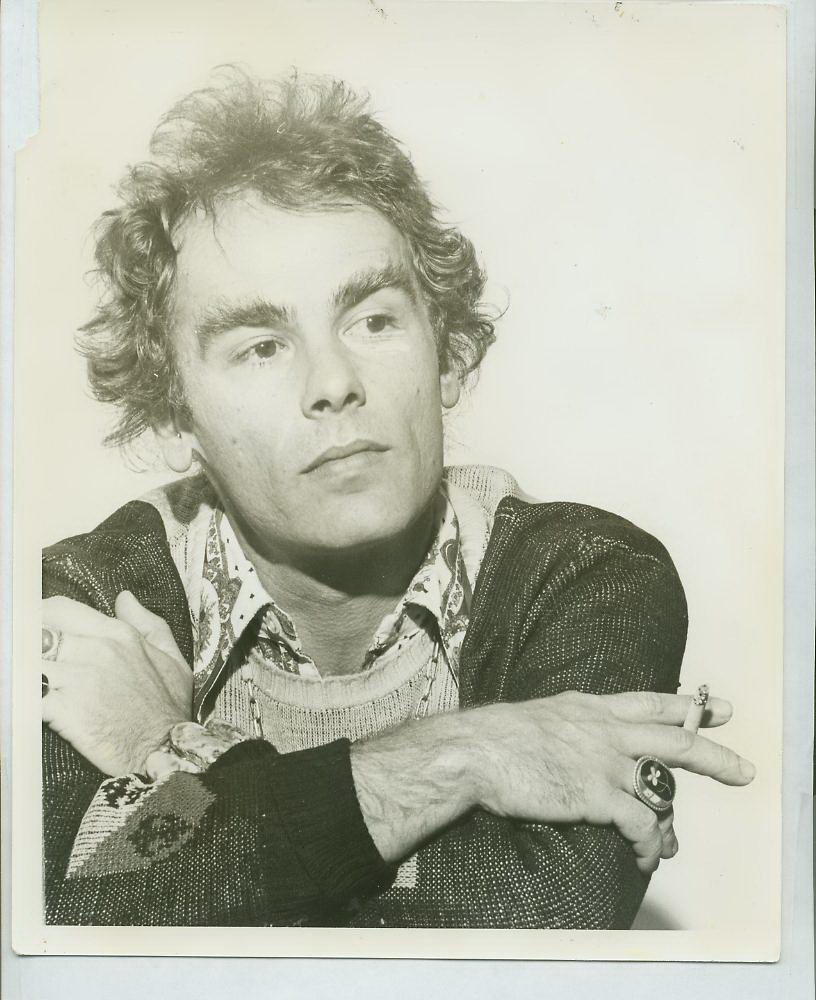
But it's still kind of a fast fun read today, even if it tries too hard to be cool with lots of smart-ass, ironic knowing humor, its bike-messenger protagonist and tough cops and gothy streetwise ladies - so, maybe Taxi Driver meets Quicksilver meets The Craft meets Fright Night (woah, S&S wrote the novelization for that)? Yeah, cool. Silvery-red cover with graffiti-style font, but who's that vampire dude think he is? Dean Stockwell?!

Skipp and Spector put out a handful of pretty cool collaborations and edited the essential zombie anthology Book of the Dead in 1989 before splitting up to pursue solo projects. They spear-headed that whole splatterpunk movement which ruled horror for a red-hot minute (the "splat pack"), pissed off the old guard like Robert Bloch and Charles L. Grant, and then disappeared for quite a few years (although I'd swear someone like Chuck Palahnuik owes a debt to it, and definitely Bret Easton Ellis's American Psycho). I've still got a fondness for these guys, obviously, so more on 'em is coming, particularly Book of the Dead and its sequel, 1992's Still Dead. Irony-free, I promise.

Monday, August 16, 2010

Ruby Jean Jensen: The Paperback Covers

I haven't read word one of Ruby Jean Jensen's paperback original horror novels of the 1980s, published by Zebra Books (Z for dead last) and I probably won't ever. But I have to give props to whoever was doing her book covers back in the day because these are some freaky and unsettling images. I think my favorite is the above Home Sweet Home (ugh, really?) from 1985, which adds some bloodshot eyeballs to one-up Mrs. Bates. And boy do I love skulls with hair! Thanks be to artist Richard Newton for this one.

Baby Dolly (1991) Evil babies and dolls! They were everywhere in this era. But of course. The delightful Little Miss Zombie has a review here.

Lost and Found (1990) Another staple of '80s horror, the utterly generic title. I kinda like this cover, actually. Is she an albino or a statue come to life? Who knows but I find the pinpoints of light for eyes wonderfully malevolent.

Wait and See (1986) Gotdamn you have to admit eyeballs in skulls are effin' terrifying. But the hair overplays the hand, as it were. You just gotta laugh, right? Right?

Best Friends (1985) Now we even have animal skulls. I heard this in my head as a kid would say it, Best Fwends. I think a very young Andy Richter modeled for this one.

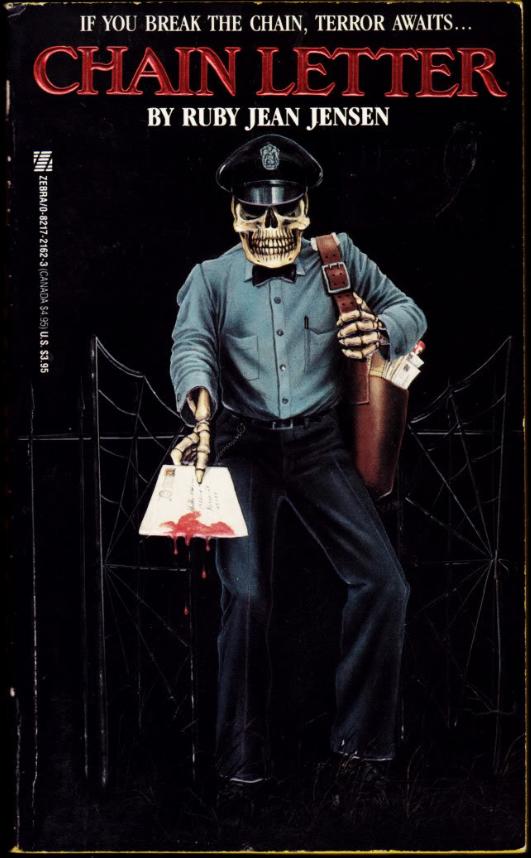
With a glorious cover by David Mann, the 1987 novel Chain Letter reminds me of a story I wrote when I was 12 about a newspaper boy who gets run over by a drunk driver; the driver rushes home without reporting the accident and tries to shrug it off, doesn't report the crime. Of course said drunk driver is also a subscriber to the newspaper so he's awakened later that night when his doorbell rings and he answers it to find.... well, you figure it out.

Smoke (1987) leaves me pretty underwhelmed because that's not really smoke, is it? It's like a green fog that will turn into a genie any minute. At least the artist, Mann again, is reading the books he's designing the covers for.

Victoria (1990) gives us two more dolls bent on evil. Or just one? Oh, I don't know.

Yes, they're utterly ridiculous and anyone over the age of 13 caught reading one should die of embarrassment but they really capture the essence of paperback horror originals that took up so much rack space in bookstores, drugstores, grocery checkout lanes (I can still recall one of a skeleton kid on a trike with a shiver), only to turn up at yard sales and thrift stores worn out and ready to fall apart. Undiscerning readers would trade these in for credit at the used bookstore I worked at and yes, I looked down my nose upon them while I eagerly devoured the latest King, Barker, Kathe Koja, Skipp and Spector, Brian Hodge, Joe Lansdale, Hot Blood, Borderlands, or Splatterpunks anthology. Snob, you say? Who, moi?