Sunday, January 28, 2024
Latest Titles in Valancourt Books' Paperbacks from Hell Line: Two by Jere Cunningham
Wednesday, January 24, 2024
Fine Frights: Stories That Scared Me, ed. by Ramsey Campbell (1988): A Feast of Fiends
Campbell has assembled a dozen stories that he has deemed his favorites, and are actually only "a sampling" of the short works that have scared him over the years. Some of the names readers of science fiction will recognize more than horror fans, some stories are decades old and virtually forgotten, while others are—were—contemporary of the time but had not yet made their bones. I can assure you that, whenever a particular story was written is of no matter; these are top-flight tales of terror, with (almost) each one containing masterful soul-freezing moments of fear, unease, or shock.
Two of the best authors of the day are represented: Karl Edward Wagner's classic "More Sinned Against" has been one of my personal favorite horror tales since I first read it back when I was in high school, when it appeared in David J. Schow's essential 1988 antho Silver Scream. Two people trying to make it in the sleazy show-biz environs of Eighties El Lay, with all the ups and downs that requires. This bit of comeuppance is rife with Hollywood grit 'n' glamour, and what happens after the glitter fades. The ending is a total banger, unforgettable lo these many decades later. Candace couldn't have endured it all if it weren't for her selfless love for Rick, and for the coke and smack and pills and booze.
Thomas Ligotti's "The Greater Festival of Masks" is from his Songs of a Dead Dreamer, just after its small press pub in 1985, but prior to the mass market release; only then would his name would gain more and more recognition. All the Ligottian trademarks are here: nameless city, crooked streets, eerie moonlight, shops of bizarre accoutrements, and reflections upon identity and reality. This is not my favorite Ligotti story, but its essence of the esoteric is so strong, so pervasive, its climax so uncanny, I can see why Campbell chose to include it. For these are the declining days of the festival when the beginning and the end, and the old and the new, the existent and the nonexistent all join in the masquerades.
Dating from the early years of the 1900s, both "Thurnley Abbey" by Perceval Landon and "The Necromancer" by Arthur Gray work wonders with the musty trappings of classic ghost stories. While the former has to be one of the most anthologized around, Campbell notes in his little intro that he found many of his readers didn't know Landon's story at all; Gray's work is a brief, erudite, M.R. James-style spooker. While these old-fashioned tales-within-tales can, to some modern readers, seem a little dusty and remote, I can assure you they retain their ice-cold powers. "I know that my heart stopped dead, and my throat closed automatically."
"The Fifth Mask" by British author Shamus Frazer (pic above) is certainly a precursor to the output of both Campbell and Ligotti. A nervous man reminisces over double whiskies about a frightful occurrence from his boyhood, when he and a pal, on the Fifth of November, were out and about pranking while wearing masks, which was the style at the time (published originally in 1957, there are several uses of the n-word to describe said masks here). But someone has beat them at their own game of disguise... The entire dank and anxious mood is one that must have affected Campbell greatly, because many of his works have precisely the same vibe. She was as thin as her voice, dressed all in black... there was a stucco wall behind her, patched and discoloured as a gravestone, and the ghosts of winter trees rising above and losing themselves in the twilight.
"The War is Over" by David Case is original to this anthology, so maybe Campbell commissioned it. It is grim. Case wrote two cult horror/Gothic novels, Fengriffen and Wolf Tracks (1971 and 1980 respectively, both back in print from, who else, Valancourt Books), but was not overly prolific. This tale is set just after WWII, but the main story is one of enemy soldiers. This one has teeth and no mercy. "The brave soldier was not then so brave. He pleaded, he begged. He called upon God. Soon he could no longer plead with words, for he had no tongue."
From 1963, "The Horror at Chilton Castle" by Joseph Payne Brennan (above) is, I believe, fairly well-known among horror aficionados. I first read it some 10 or 12 years ago, and haven't forgotten it. Brennan was a respected mid-century horror/fantasy writer whose work stretches back to the Weird Tales era; his "Slime" is one of the great novellas of pulp horror ever. Here, Brennan evokes time-honored horror tropes with his narrator traveling through Europe looking for his ancestors. He hopes to visit the legendary Chilton Castle, to which his family has distant connection.
Not last, but least: John Brunner's "The Clerks of Domesday" is not completely terrible, I get the chilling implications of the narrator's paranoid delusions, but found the execution tedious. Brunner was connected to the New Wave of SF of the late Sixties and Seventies with prophetic novels such as Stand on Zanzibar, The Shockwave Rider, and The Sheep Look Up, and while this story seems to fit his dour predictions and predilections, it was the only one I struggled to finish. It had never been published prior to Fine Frights and has never been reprinted again.
Our final story is from the mighty Philip K. Dick (above), an early work, dated 1954, entitled "Upon the Dull Earth." If at first it is obscure, it will become haunting and forlorn; Dick's powers at evoking an emotional response was there from the beginning of his career. A young couple, angels, stars, an alternate plane of reality; a myth of the underworld, and lost in it. Dick's long interest in spiritual lives, esoteric religion, heretical beliefs, day-to-day reality versus cosmic illusion: all here. It was a terrified reflection that showed out of the mirror above the bowl, a face, tear-stained and frantic. The face was difficult to catch—it seemed to waver and slide. Grey eyes, bright with terror.
There you have it! And it should be no surprise that Ramsey Campbell has assembled such a high caliber anthology; the various styles of horror represented gives the book a wide appeal. It's a no-brainer: Fine Frights is a fine feast, a repast of morbid morsels that belongs on the shelves of any and all paperback horror collectors.
Tuesday, December 5, 2023
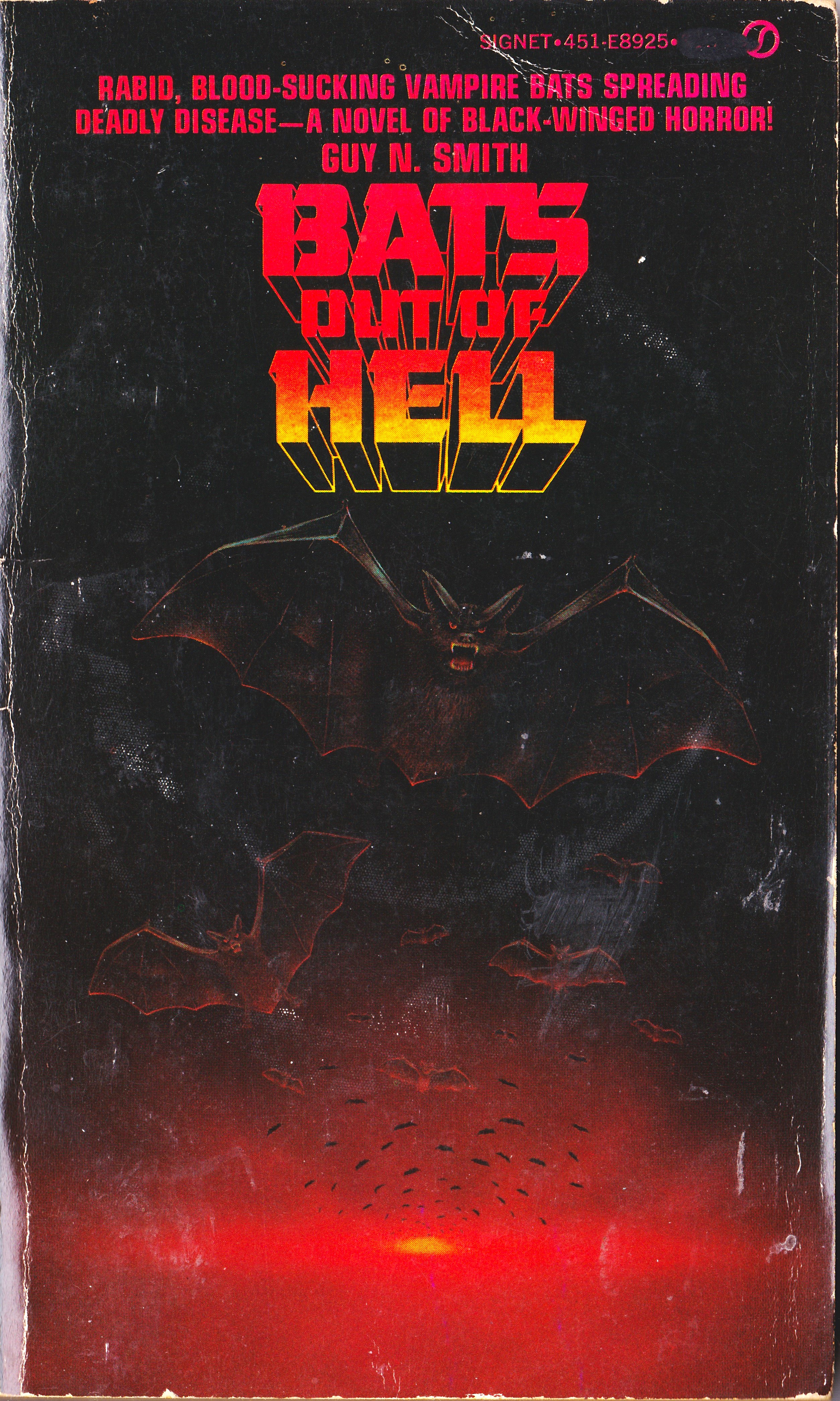
Bats Out of Hell by Guy N. Smith (1978): Wings of Pain Reach Out for You
We begin in a science lab at the Midlands Biological Research Center, smack-dab middle of beloved tourist spot Cannock Chase, acres of natural land. Against the wishes of the locals, this "ugly scar on the landscape" now is filled with scientists studying disease, ostensibly "to benefit the good of all mankind Except for... for this!" That emphatic "this" refers to the study subjects of Professor Brian Newman: bats. The poor experimental animals locked in cages, have been injected with disease, in a rage, flying futilely about, dying paralyzed, ugh, poor things. I'll let manly Prof. Newman himself explain the method to the madness:
"The virus is a mutated one caused by experimenting. I've tried to determine the difference between bacterial and viral meningitis... I've never known the disease lead to madness or such awful agony. And I have created a new horror. A mutated virus! God knows how it happened... my God, how far could it spread... even humans? It doesn't bear thinking about!"
Newman's pulp hysteria is calmed by sensible on/off gal-pal and fellow scientist Susan Wylie, as she notes this disease, is trapped inside the cages with the bats, surely nothing bad will happen, there's no way it can escape, they can wait till the creatures die off, be cremated, and Newman will admit to his superiors that his experiment was a failure. How big of him! Then Susan and he argue over their romantic entanglement after he breaks their date for that night; then Newman and his boss Haynes argue, all the while, many of the enraged bats are dying in agony beside them. Its eyes seemed to meet his, and they glittered accusingly, with sheer malevolence. Blaming Man, as though in its last seconds it understood.
I'm sure you can see where this is going...

1985 reprint, NEL, Terry Oakes cover art
Newman has broken his date with Susan to hook up with Fiona at a local pub, and of course Susan sees them together. Next morning at the lab, before Susan arrives, he notices the death rate of the bats has slowed and the creatures still alive seem more agitated than ever. Newman again ponders what he hath wrought:
Whereas earlier he had been repulsed, he now experience a morbid fascination almost to the point of being hypnotized. He had crated something, death in a form that had not hitherto existed. It was all his doing... This was different, exciting. Death could occur at any second.
Well, dear reader, here comes the part we've been waiting for. Susan arrives and is cool and dismissive towards him—how dare she! It's back to professional relationship only. Newman's masculinity is so shattered by this he of course cries "You bitch!" and cracks her in the face. Enraged, Susan attacks him, and Newman falls against the glass bat cage and breaks it wide open... and the last living disease-bearing animals have their escape at last. Wow, can you say toxic masculinity?
Smith now embarks on the time-honored tradition of vignettes of bat swarms attacking hapless British (specifically Birmingham) citizens in farms, banks, churches, wherever. Now, as noted, the bats are spreading a gruesome disease that causes agonizing pain, insanity, and paralysis; they are not blood-suckers out looking for a treat. Authorities are called in, Newman wants to accept responsibility—there's a novel idea!—as the bats wreak their havoc. The media have a field day and call out Newman by name, putting his life at risk. Vigilantes patrol the streets as thousands die from contagion. Cities burn, armored tanks fire upon citizens who try to gather in protest of the stay-at-home directive. Petty politicians rise up with conspiracy theories. What will it take to stop the bat epidemic? It's all a little unsettling to read these days!
There was no antidote.
Nothing on God's earth could save you.
Monday, November 27, 2023
The Revenant by Hugh Zachary (1988): The Night They Drove Old Dixie Down
Zachary has written a charming haunted-house tale, readable and engaging, that has more in common with PG-rated horror than adult fare like Hell House (1971) or The House Next Door (1978). I'd say the tone is more akin to something to Eighties movies like Poltergeist or House: there are spooky/scary scenes to be sure, but tempered by Zachary's good-natured style. And unlike the aforementioned Gwen, in Green, which was rife with sexual exploit, The Revenant is about as spicy as a vintage television commercial, coyly "fading to black" whenever the adults close the bedroom door. Jean got into the shower with Vance and washed his back—among other things—and for about thirty minutes forgot about ghosts...
Our protags are the Whitneys: husband Vance and wife Jean, and their two very young daughters, Ridey and Min. The girls are slightly precocious for their ages, but Zachary keeps them from becoming an annoyance to readers—like myself—who find children in horror fiction poorly depicted, by verisimilitude. The girls' dialogue has the ring of truth to it, perhaps from Zachary actually listening to his own grandchildren, who are mentioned in the book's dedication. Younger Ridey has something akin to a psychic pipeline to the supernatural shenanigans going on, saying things like "He doesn't like it" or "He broked it" when the adults are discussing amongst themselves what in the world could be causing their unexplained problems. But Ridey has always been a little "off," born as she was with a rare, fortunately treatable, brain condition. The center section of the infant's brain had been a vast, frightening void.
There's more, though, but I don't need to go into it all. Gothic standards like hidden rooms, torture chambers, secret journals, evil secrets, all now exposed to the rational airs of the late 20th century. It got a bit Jebus-y for my taste at the end, with the psychic family friend arriving to provide spiritual assist as an amateur exorcist, well-worn Bible in her hand. Even though he's dealing in basic tropes of pulp haunted house horror, Zachary's prose, honed by decades of writing fiction of all stripes, is fresh, familiar, convincing. He keeps things lively right to the end. And while you'll run into a dated notion more than once—I suppose the marital politics aren't exactly progressive, he's like your granddad, isn't he?—he never devolves into crudity or idiocy, like so many other paperback horror originals.
I've read worse novels by more famous authors. With its tension well-mounted between modern people who just want to live in the now and seemingly still-fresh Civil War wounds from crimes committed long ago, The Revenant might not quite be a Southern Gothic, but it's not far off. Hugh Zachary brings a smooth, professional vibe to all the proceedings, even and especially when you notice the nicely time-worn notes of unease begin to be plucked. "You are not going to do this to us," she said softly, speaking to the night, to the sudden chill, to the feeling of uneasiness that had come over her so suddenly. This was her house, her home...
Thursday, August 17, 2023
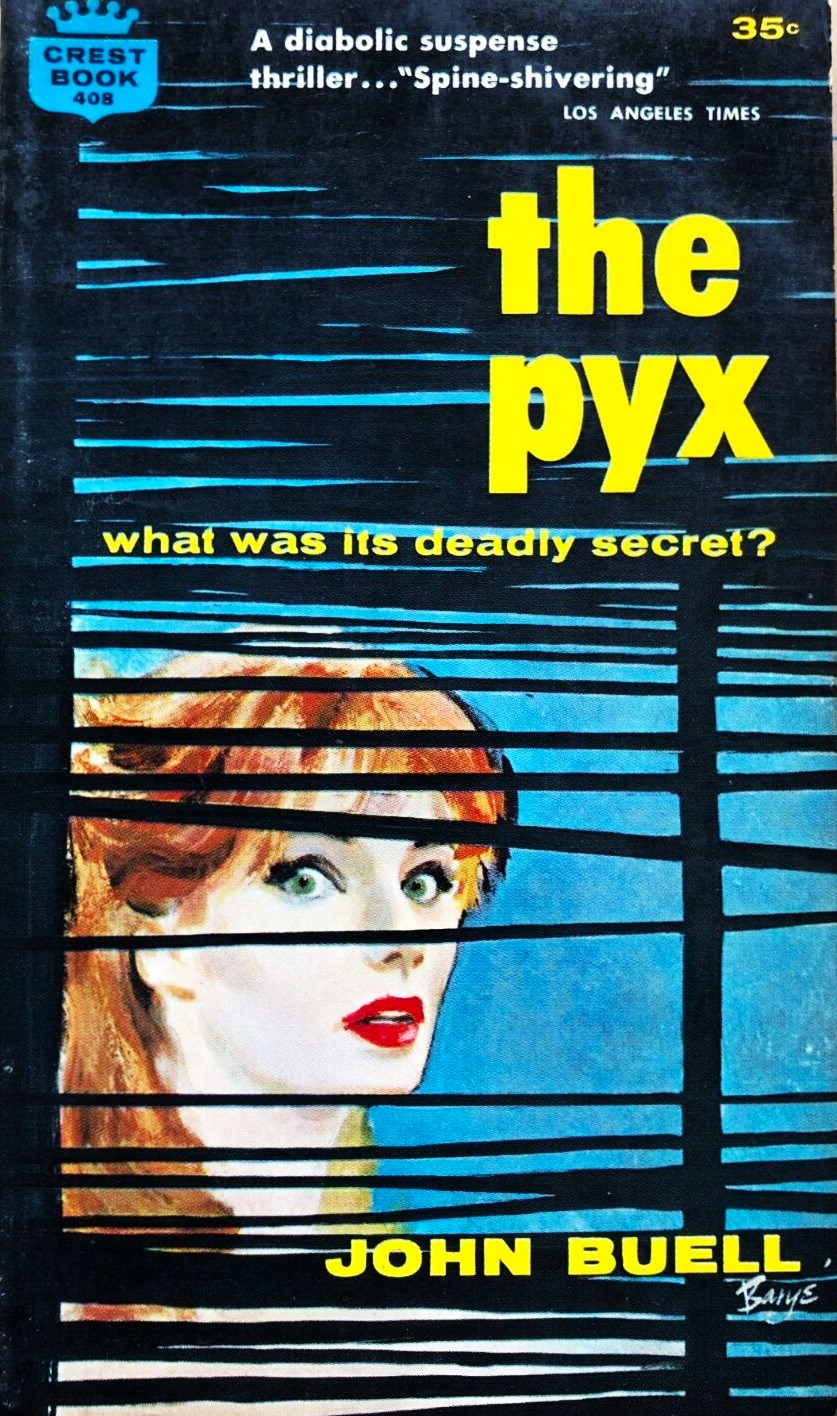
The Pyx by John Buell (1959): She's Like Heroin to Me
John Buell (1927 - 2013), a little-known Canadian author and professor, is a fine, insightful writer, starting his book off with a bang and drawing the reader right in with a nice grasp of place and character. A woman has dropped from an apartment window several stories high, accident or suicide no one knows, but it's Detective Henderson's job to find out. Now, you've seen and read this tale a thousand times. And in all the years I've known about The Pyx, reading about the movie version with Karen Black, the words "occult" and "satanic" always filtered about it. I don't know what a pyx is, who does, Buell knew no one really would so its definition is at the beginning of the book: in Catholic ritual, it's a little vessel that holds the Host. Sure, whatever.
What a pyx is not, however, is a little demon or genie or ghostie or ghoulie that I, in my religious ignorance, had originally idly wondered it may be. And if there is any "occult" or "satanic" to be found here, it sailed entirely over my head. But I went back and reread the penultimate chapter, the ultimate confrontation between Henderson and the guilty party, and I suppose I could see where Buell was hinting at some "otherworldly" aspect to his narrative ("Die? I can't die. I'm immortal."). The very last line put me in mind of Ray Russell or William Peter Blatty, but only in an indirect way.
Too much of this story is coy and reticent, since it deals with a sex worker with a drug problem and it was written in the late Fifties by a Canadian: referring to actual sex acts or drug-taking logistics is simply out of the question in those pre-Naked Lunch days, and the impact of this sordid work is muted almost beyond comprehension. Those cover blurbs announcing "eerie" and "powerful" and "the secret" and "climax of diabolic evil" are so much hot air, alas (I can't speak at all to the Graham Greene reference, I mean I know who he is, but in this context, not really).
A few scattered moments of violence, sure, but nothing you wouldn't have seen elsewhere in the era. For the most part, despite some rock-solid prose on Buell's part, I found it a standard detective story, populated with the typical various lowlife characters, flashbacks to the dead girl's life and hopes and failures, you know what I mean. I've seen good reviews of The Pyx online, sure, I'm glad people dug it, but for me, it really missed the vein. But that cover, man...
Wednesday, March 22, 2023
Latest Titles in Valancourt Books' Paperbacks from Hell Series: Two by Thomas Tessier
Grady and I love both these books, and are thrilled to be getting them out to the reading public once again! While there is no set publication date yet, Valancourt did release the cover art, as seen above. Don't they look incredible?! Be sure to visit their website for any and all information about pre-ordering and whatnot.
Okay, back to reading!
Thursday, March 9, 2023
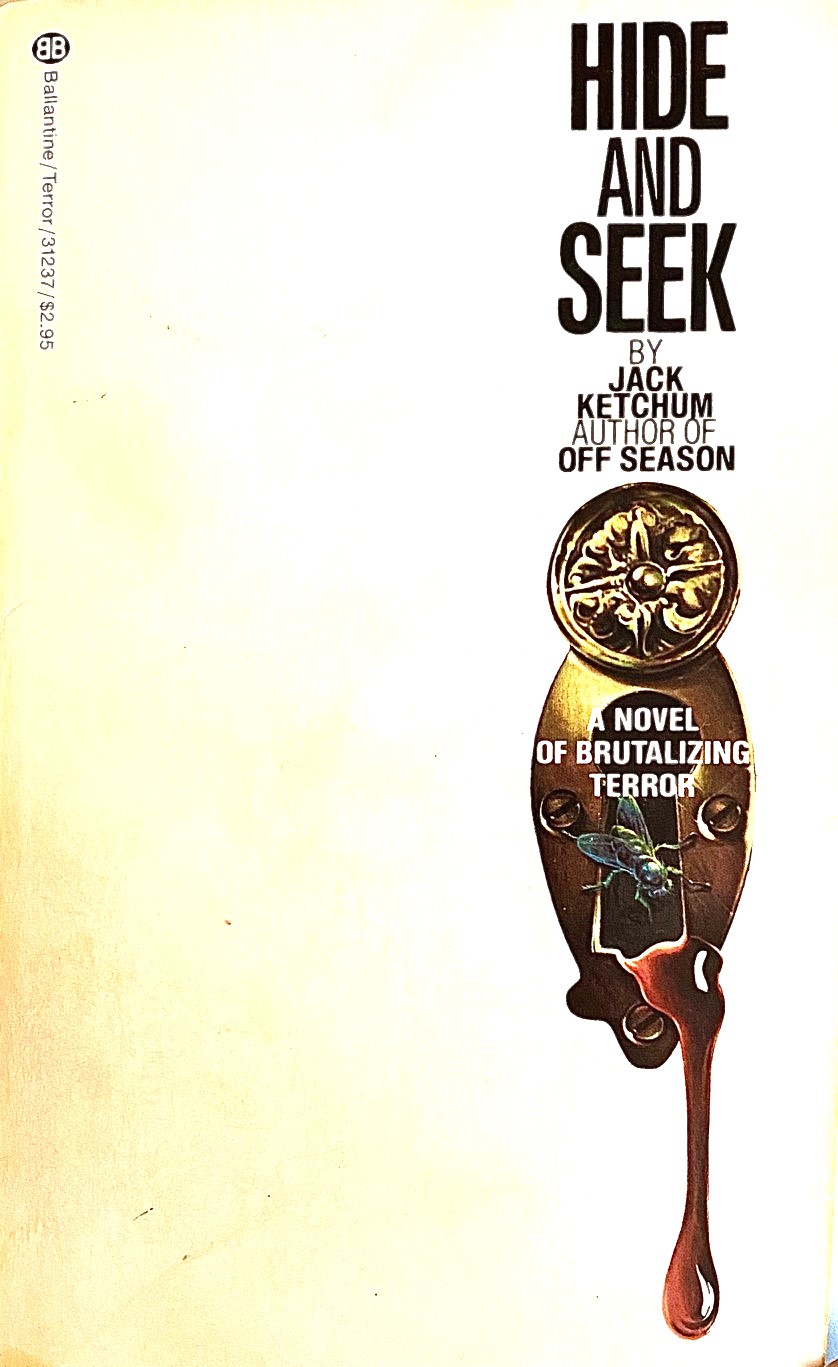
Hide and Seek by Jack Ketchum (1984): Linger on Your Pale Blue Eyes
Dan is of course completely besotted with Casey, and reluctantly hangs out with Steven and Kimberly too just to be with her. Steven loves Casey but has settled for Kimberly; this is a fact known by all. They drink beer, hit the beach, skinny-dip, shoplift, pull dumb pranks. They laugh a lot but nothing's really funny. Dan meets Casey's father, who seems a broken man, and learns of a horrific tragedy in the family' life. Dan and Casey have sex in a graveyard. Just like in a classic noir novel, Casey is the femme fatale, but she's most fatal to herself; that tragedy
has caused her to be reckless, which is what frightens, and yet attracts,
our narrator. In the Middle Ages, they'd have burned her at the stake.
Ketchum builds tension well in the book's first half, with short declarative sentences, simplistic dialogue, and that sense of fatalism permeating everything—the kind of thing crime noir is known for. I appreciate his attempt at writing a horror novel that incorporates other genre elements, to infuse his stories with a grimy grindhouse slasher feel combined with tentative attempts at character detail, but to what end? I was really into the long fuse of the set-up, wondering what character flaw would trip the deadly spring I knew just had to be poised over the characters' heads. And then Ketchum reveals it, and all the goodwill built up by his careful tightening of the noose is spent. "Hide and seek. Just the way we used to play it when we were kids. But we play it in the Crouch place."
I'm going to talk freely about what happens in the second half of the story, so I guess a spoiler warning is warranted from here on.
The novel is too "talky" and 90% horror-free for a horror novel, while the origins of its violence too hokey for a crime novel. And Ketchum is so damn solemn about everything. Lighten up, Francis! He invests too much seriousness in that trite finale, a lot of po-faced silliness that squanders all that great suspense he worked so hard to build up. A giant dog in the caverns beneath the house eating people? Monstrous Ben and Mary Crouch living down there in the earth? In a schlockier horror novel, sure. But all this time spent laying down a prosaic reality, hinting at horrors in the future that cannot be avoided, alluding to human flaws that will lead to tragedy, and then it's just some B-movie monster ripping people apart in gory, yet somehow bland detail. It's not as dumb as Laymon, you can tell Ketchum cares a lot, but it's still thin gruel for a seasoned reader.
In the Eighties, fat horror novels were the rage; books that featured lots of characters, situations, settings, plots, conflicts, and blood and scary scenes splashed throughout. Ketchum bothers with none of that. Not even 200 pages, Hide and Seek is a novella padded out to get to even that length. With this bare bones approach, he must have felt like a man without a country back then. No one really wrote this style of book, and the reason is: it doesn't work. Hide and Seek just doesn't work, not as horror, not as crime, not as coming-of-age. Why push your readers through to an end where you rip the characters apart, ostensibly for the moral of "the world is a horrible place but I think I've learned to cope"?
Ketchum has a great reputation in the field, as a mentor and as a mensch, and his death was mourned by everyone who loves the genre. But this second novel is failed ambition, a concoction that promises terrifying delights but in the end delivers little of real interest, almost negating itself. This was the fourth book I've read by Ketchum, and while not as bad as She Wakes, Hide and Seek is a step down from, and a little derivative of, his brutal and grueling debut, 1980's Off Season. The more I thought about it the more I felt it was like a writing exercise, a very first draft, a practice session to prepare for the real thing.
Eventually Ketchum would come into his own and define his own style with The Girl Next Door—the real thing—but I'm realizing I haven't liked even his books that I consider successful. From what I've read about his later novels, many seem to be extreme scenarios of sexual violence and cruelty mixed with that fatalistic philosophy and slow build-up. Never say never, of course, but I doubt I'll be picking up one of his other books any time soon.
Monday, February 27, 2023
Tricycle by Russell Rhodes (1983): Crimin' Simon
Perpetually riding around the school grounds on his squeaky tricycle, Simon weirds out students and faculty alike. Susanne tells Chris he's got a hateful look on his punchable little face too. And also, what of the recent accidental deaths of several promising teenage boys there? And why does Mrs. Karen Catterby, Arthur's smokeshow of a wife and Simon's mom, have such a bad reputation on campus? And suddenly taken such a liking to Chris himself?
Featuring one of the grandest of all Paperbacks from Hell-era covers, by the fantastic Lisa Falkenstern, Tricycle (Pocket Books, August 1983) by Russell Rhodes, seems to promise Bad Seed levels of Creepy Kid Horror. That's a pretty tall order. Can it deliver?
The setting of a preparatory school was fine with me. Personally I'm fond of tales of professors and academics and college/university life in horror, so that was one point in the book's favor. Then there are a couple illicit sex scenes get things going nicely, that's good too. After the one that opens the novel, a fiery, helpless death: "I'm dying," he cried, "I'm dying!" Holding his face, the flaming boy whirled around in tight circles. His lungs gulped a last searing breath, then exploded within him as he toppled forward into the inferno. Okay, we're rolling right along!
But I noticed some issues soon after. Chris is kind of a wienie, and his attempts at teaching seem condescending; his feelings of inadequacy don't evoke much sympathy in the reader. Our author is more concerned with the banal gossip cocktail party
chatter of rich academic folk ("I don't care what you say, Linda, slacks and that blouse don't belong at the Academy. The thing's open practically to her navel"), which sure can be entertaining, but at the expense of other aspects—like horror itself. There's a lot of pages spent on literary classroom discussions—Shakespeare, Hemingway, other fine fellows, etc.—and a burgeoning friendship between Chris and Lucas, the student assigned to read aloud for him and assist in his coursework. Of course that leads to twinges of baseless gay panic!!1!
As (slasher-style and post-coital) deaths mount, Chris slowly starts to suspect the incredible: He, Christopher Hennick, at one time big man on campus, was at the mercy of a little five-year-old. Fear gripped him. It was all so very simple, so logical, so inevitable. I mean, all that goddamn squeaking of the tricycle wheels following him around, what other conclusion could he make?!
The tale reaches its climax in the school as the suddenly raging waters of the Connecticut River surge over the grounds, rising into the halls and stairwells and gym, where Christopher must battle his unseen enemy alone after everyone else evacuates. And oh shit, now a fire's started! In this last section, Rhodes delivers what I found it to be a convincing and well-staged finale, with some decent mounting suspense and a couple plot twists. Nothing revolutionary, you'll probably see 'em coming, even if some don't quite seem to square with what has been happening all along.
Rhodes, who was an adman by trade while he also produced fiction, writes with a serviceable, polished pen, and while nothing ever made me cringe, nothing sparkled for me either. He misses lots of opportunities he's set up for himself. Too often, Rhodes writes at a remove, like he's afraid to get granular as we say today. When Chris is trapped alone in a classroom with rattlesnakes, I was sure the rattlesnakes Chris hears would be revealed as an auditory prank on his blindness, but no: they're real. Yet Rhodes makes only a half-hearted attempt at conveying such distinctive creatures, which have to rank among the most frightening and fearsome on all the earth. "You know the rattlesnake, or Crotalina," the boy continued, "represents the highest type of serpent development and specialization."
Same with Milton, Chris's seeing-eye German Shepherd, another distinctive animal that Rhodes seems reluctant to include the interesting particulars of (I will warn you, the poor dog is killed eventually). Susanne disappears. Tricycle is definitely market fodder, commercial unit shifter, designed to give minimum thrill for maximum profit, an adman's idea of "horror." Rhodes's other titles seem like standard thrillers of the Seventies, spies, KGB, technology, super-hot ladies who have it all and want more, with back cover copy like "bizarre orgies, brain-searing terror, and the nightmare secret of Hitler's human experiments," awesome, I guess, but not my kinda thing at all.
It's easy to tell the author isn't a horror writer, probably wasn't even particularly interested in the genre; as I said, Tricycle was simply another title in the glut of paperbacks saturating book racks of the day. The novel's intensity level reaches about that of a TV-movie, desiring to be nothing more than a paycheck for Rhodes and a couple hours' diversion for the reader. I didn't expect much more, and honestly expected much less.
Tricycle is not a forgotten horror classic, and is better characterized as a suspense thriller especially since the ending wraps up the preceding events all too neatly. (When someone shouts "Satan's whore!" you'll wish that was a literal thing rather than just a misogynist slur.) Rhodes doesn't offer up much creepy atmosphere or dread, there is nothing supernatural going on, but the book did keep me turning pages over a few snowy days. Okay, okay, I skimmed here and there, don't think I missed much.
That yellow Hamlyn UK edition from 1985 is creepy, but just doesn't have that je ne sais quois of Simon bearing implacably down on you on the Pocket Books version, an image I found deeply unsettling when I saw it on the supermarket book racks as a kid. Alas, Simon isn't even close to being in the Creepy Kids Hall of Fame, but with an all-timer cover like this, Tricycle definitely belongs in your paperback horror library.
Tuesday, February 21, 2023
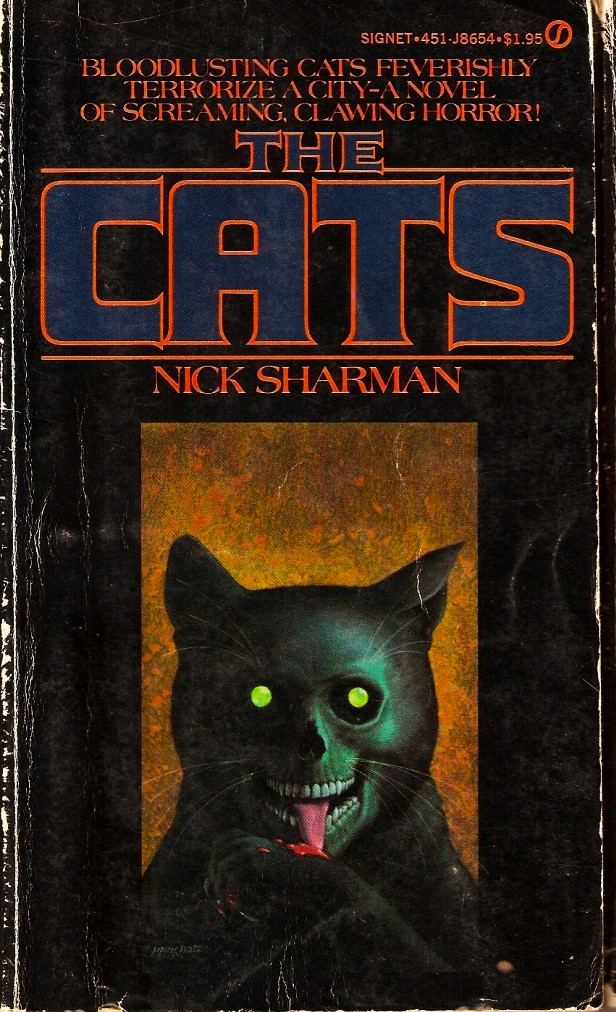
The Cats by Nick Sharman (1977): Apocalypse Meow
Scott Grønmark was his name and writing pulp horror paperbacks under the pseudonym "Nick Sharman" was his game. Born in Oslo, Norway, in 1952, he was working in the PR department of New English Library (which is why of course he had to use a pseudonym) when he began his published career with The Cats. It was originally published by NEL in 1977 (below), and then by Signet in America in May 1979. Subsequently he wrote six or seven novels, only one under his real name. Notoriety came Grønmark's way some years back when internet wags postulated that he was the person responsible for the infamous sleaze-horror "classic" Eat Them Alive, which wasn't so; you can read his response here.
An early entry into the animal attack publishing craze led, of course by Jaws and The Rats, The Cats offers up most, but not all, of the usual template, even though the subgenre had only been going on a couple years by 1977. Most characters are irritable, stuffy, smug, and/or macho. Or American, for no reason I could discern. Victims run the gamut of British society, briefly introduced, quickly dispatched. Requisite cynicism about politicians while the mighty military comes in swinging their dicks. Science is responsible for the poor kitties' condition. There isn't even a love interest, believe it or not, but there is an attempted rape—about the only woman who appears (the assault is prevented at the last second). Two sets of estranged fathers and sons lend a tad bit of character conflict. One human is afflicted by the same disease as the cats have, maybe there's a psychic connection too, an addition I found intriguing.
I wish Grønmark had attempted to give his rampaging cats a smidge of personality. We all know cats in our personal lives who are more interesting than some people in our social circles. Imagine if he'd spent just a chapter on the creatures themselves, even just a couple kitties, perhaps even inspired by then-bestselling juggernaut Watership Down—recall how Richard Adams did marvels with cuddly rabbits! That would've given this slight 154-page novel some much needed ballast as well as some empathy for innocent animals.
But that's not what this book is or wants to be. Despite several vivid attacks early on, Grønmark doesn't seem to have much energy to inject his tale with anything but the driest essentials. There's little spark in the proceedings, not even anything but the most workmanlike approach to feline slaughter. Prose is competent, serviceable, but lacking any real juice. He simply keeps the narrative going faster and faster but with diminishing results, I mean I've kind of already forgotten the specifics of the climax, such as it is, and the cute yet utter by-the-numbers final paragraphs fail to surprise. I did like the guy who tries in vain to fight back against the beasts with acid, is still overwhelmed, and croaks, as his last words, "Oh well, you can't win 'em all."
Previous Grønmark books I've read, The Surrogate and Childmare, were more entertaining, written with a bit more skill and conviction. As noted, The Cats was Grønmark 's debut novel, and I guess he simply didn't have the chops yet. (At least it led to a successful writing career, I'll give it that; he died in 2020 aged 68.) Unfortunately, I found The Cats lackluster, offering nothing fresh to the all-too-common cliches of animal-attack literature. If you're a collector, you'll want the Signet edition with that spectacular Don Ivan Punchatz cover, but unless you're an animal-attacks obsessive, you can probably leave the book on the shelf.
Tuesday, February 7, 2023
The Damnation Game by Clive Barker (1985): Gambling's for Fools
If you've followed Too Much Horror Fiction at any time over the past 13 (!!!) years, you'll know Clive Barker is one of my lodestars of genre fiction, up there in my own personal pantheon with H.P. Lovecraft, Stephen King, and Harlan Ellison. It's not just Barker’s fictional writings that have influenced and inspired me, but also the many interviews and intros to other books he did in which he discusses his beliefs about what horror (and other speculative fictions) is about, can do, and what it reveals about our humanity, our culture, our desire for something more than our daily lives. Given that I started reading him as a high school student in 1987, Barker's world has had an untold impact on me, both within the genre and out.
First published in hardcover in the UK in 1985 and then in 1987 in the US, The Damnation Game (Charter Books paperback, July 1988, Marshall Arisman cover art), was anticipated on both sides of the Atlantic as a major novel debut. Barker was the enfant terrible of then-contemporary horror fiction, after his 1984 collection of genre-expanding stories, Books of Blood, were propelled by that famous Stephen King quote. Barker was ready to take over the mainstream. Its impetus was maybe more commercial than artistic; short story collections have always been seen as "lesser" product by publishers. As the editor of Sphere Books told Barker after unexpected success with Books, "Now do something sensible and write a novel... something we can really sell!"
A somber, gloomy, somewhat subdued tale of men and their debts, desires, and debaucheries, The Damnation Game helped affirm Barker's place at the top of the Eighties horror pantheon. For many years this was Barker's sole "horror" novel, in that it had none of the unique fantastical world-building that he would become known for in such subsequent epics as Weaveworld (1987), The Great and Secret Show (1989), and Imajica (1991). After rereading Books for this blog, I then reread The Hellbound Heart and Cabal, so I figured I'd continue chronologically with this guy. I read Game several times over 30 years ago, recall liking that Barker had made the leap from short story to novel, that the detailed eye he had for transgressive terrors was not lost in this longer format.
The opening chapter, set in bombed-out Warsaw, crackles with dread and enormity, yet with a strange sense of freedom to be gained from playing games, chancing fate, plying one's wits against a devilish opponent—ideas Barker returns to again and again. In his mind this faceless gambler began to take on something of the force of legend. Then the narrative shifts to the 1980s, where we meet protagonist Marty Strauss, a thirty-something prisoner doing time for a botched robbery, debts owed from gambling, life lost, security van empty. Offered parole if he accepts the could-be-more-dangerous-than-prison job of bodyguard for world famous industrialist Joseph Whitehead, Marty accepts, wary though he is.
He doesn't know Whitehead
is hiding out in his vast, well-secured London estate, with laconic bodyguard Mr. Toy and a menagerie of dogs, from the mysterious Mamoulian, aka The Last European—the fellow from the
opening. What follows is Marty learning the truth of Whitehead's wealth,
why his teen daughter Carys is a junky, and other unsavory facts about a world of woe just a whisper's breath away.
Whitehead's revelation
to Marty about his and Mamoulian's history in those WWII ruins contain a
mystery as something few Americans truly grasp. Various set pieces
underscore Barker's notions of the existential dread of nothingness
("nothing is essential") so at odds with the more common horror
dichotomy of good and evil, Heaven and Hell, God and the Devil. The two
young American missionaries who appear at the end, empty-headed Chad and
Thomas, offer a somewhat witty addition to the grim proceedings; they
can only interpret what they're seeing through the inanities of
Christianity, their Pastor Bliss, their hunger for the Deluge to wash
all sinners away. In Chad's mind waters—red, raging waters—mounted into foam-crested waves and bore down on this pagan city.
Much, perhaps most, of Barker's appeal was and is his ability to pluck beauty from the
monstrous; his prose style, sleek and polished, unhurried and measured, is informed by classic
continental literature and film, with imagery inspired by European cinematic
masters such as Cocteau, Antonioni, Bunuel, Fellini, Fassbinder. There is a pathetic dinner sequence with Whitehead's aged cronies and available young women drinking copious amounts of wine in a brightly-lit room, decorated only by a grotesque painting of the Crucifixion, that seems right out of a socialist satire about the insipid appetites of the rich. The old man had wanted to see him naked and rutting.
The scenes with Breer the
Razor-Eater, Mamoulian's dogsbody, and his unholy passions pedophilia, cannibalism,
necrophilia, whose rotting body as a reanimated corpse parallels in
physical form the moral corruption in the characters around him, are pure classic Clive:
...something
in his chest seemed to fail, a piece of internal machinery slipping
into a lake around his bowels. He coughed and exhaled a breath that made
sewerage smell like primroses... He was moving into a purer world—one
of symbols, of ritual—a world where Razor-Eaters truly belonged.
I let my own mother take this to the beach to read
and she left it on her blanket and the tide came in.
NEVER LEND BOOKS.
All Barker's strengths are on display, scattered throughout the book. Irony, opposites,
contrasts: delicate petals falling onto human wreckage, cities laid to
waste beneath spring skies, "death at laughing play in a garden of bone and shrapnel." Barker has always delighted in such contradictions, believing they get at a truth unreachable by simple black-and-white binaries. This approach lends an air of maturity to the proceedings, a sophistication rarely seen in the horror offerings on the same shelf. I recall reading the US hardcover when it came out, and indeed that format made this gruesome tale somehow respectable.
The notion of "nothingness" as a final terror is one Barker would address in various works throughout his career. Here, we have the room in Mamoulian and Breer's hideout—who has kidnapped children in the cellar shiver—which Marty discovers.
This wasn't the adventure he'd thought it would be; it was nothing. Nothing is essential... all of it was like a fabrication. A dream of palpability, not a true place. There was no true place but here. All he'd lived and experienced, all he'd taken joy in, taken pain in, it was insubstantial. Passion was dust. Optimism, self-deception.... Color, form, pattern. All diversions—games the mind had invented to disguise this unbearable zero. And why not? Looking too long into the abyss would madden a man.
As I said above, I don't think Americans have a concept like existential
nothingness the way people who were close to the atrocities of WWII
were. Maybe I'm generalizing, but that's my serious impression; not for nothing is Mamoulian nicknamed "the Last European." He remembers the horrors. As a
young guy myself with some intellectual pretensions of my own beginning to
sprout, Barker appealed to me precisely because he used horror as a way
to get at deeper truths about human nature, not simply as a vehicle
for cheap thrills and messy bloodshed.
Oddly, unlike the Books of Blood excesses of surreality and guttural fears, Barker only refers to atrocities—he literally keeps using that word, "atrocities"—rather than regaling us with more poetic descriptors as only he can. Early on, some gruesome dog deaths play a large part in a scene of confrontation (and resurrections; the creatures would've looked spectacular in a practical-effects kind of way in a movie), particularly now knowing what a dog-lover he is—a cheap shot at unsettling readers? As I said: Damnation Game was his bid for success, and so
perhaps he felt he had to tone down his tendency to terrorize readers
with things never before imagined.
Worms, fleas, maggots—a whole new entomology congregated at the place of execution. Except that these weren't insects, or the larvae of insects: Marty could see that plainly now. They were pieces of flesh. He was still alive. In pieces, in a thousand senseless pieces, but alive.
On this reread I found the novel somewhat—dare I say?—tame, believe it or not. In his bid for bestsellerdom, Barker eschews the epic flights of fancy and imagination that so marked his previous output for a more mainstream narrative, the Faustian deal gone bad (of course there are no Faustian deals that go well).
Stretched out over 430 pages, the bizarre imagery he conjures up loses
its impact and the story falters. Yes, there are very good set-pieces of perverse gore and grue, and the secret history of Whitehead and Mamoulian's long relationship is darkly fascinating, but pages of irrelevant detail, unfocused narrative, and a somber tone slow the proceedings into a dreary crawl. Rather than emboldening him to stretch out for the long haul, it
seemed this novel format constrained Barker's visions. These are all first-novel problems, indeed.