Showing posts with label '90s. Show all posts

Saturday, February 15, 2025

Under the Fang, edited by Robert McCammon (1991): The World is a Vampire

Vampires, vampires, vampires! Loathsome creatures of the night stalking and snacking on humans across the globe! There's no escape! Whatever can we do?!

Nothing, it seems, or very little, to save ourselves. Thus is the setup for the stories in Under the Fang (Pocket Books, Aug 1991, cover by Mitzura), under the auspices of the Horror Writers of America coalition, with editing duties by iconic bestselling paperback author Robert R. McCammon. Akin to the zombie apocalypse anthos based on George Romero's movies, Book of the Dead (1989) and Still Dead (1992), (which of course hearken back to 1957's I Am Legend) all the stories exist in this new world, with each author bringing their own special methods of madness to the proceedings.

Virtually all the vampire anthologies published prior to the early Nineties were collections of classic stories, moldy golden oldies by the likes of Bram Stoker, Polidori, EF Benson, Crawford, Derleth, et al. Esteemed editor Ellen Datlow gave us Blood is Not Enough in 1989 and A Whisper of Blood in 1991, which featured all-new vampiric works by the cream of the genre's crop. I'll confess: I've read neither, even though I've owned them since Kurt Cobain was still alive. But those two volumes seem to be the first that showed that the old symbols and themes of vampire fictions could be given fresh new life at the end of the century. 

The vampires within Under the Fang exist on a spectrum of generic types: the typical night creeper; the almost-zombified monster driven mad by thirst; the brilliant military leader; the scientific sort looking for a way to walk in daylight; the Anne Rice decadent aesthete. Vampires have been dubbed cutesy nicknames, like "suckheads" and "fangers" and whatnot. That out of the way, let's get to the contents: McCammon gets a twofer, first with a metafictional introduction, in the guise of a doomed note from an unnamed narrator:

They've won. They come in the night, to the towns and cities. Like a slow, insidious virus they spread from house to house, building to building, from graveyard to bedroom and cellar to boardroom. They won, while the world struggled with governments and terrorists and the siren song of business. They won, while we weren't looking...

He handily sketches out the scope of the situation in a couple pages, setting us up for the tales to come. Second is his story "The Miracle Mile," of a family's drive to an abandoned season vacation spot and amusement park. Vampires have of course overrun it, and Dad is pissed. With his signature mix of corny sap and derivative horror, McCammon delivers perfectly cromulent reading material. It's just that I always find him square and dull and earnest, and not my jam whatsoever.

The recently-late Al Sarrantonio's "Red Eve" is an effective slice of dark, poetic fantasy in full Bradbury mode, which was common for him. I have no idea who Clint Collins is, but his brief "Stoker's Mistress" is a high-toned yet effective bit of metafiction about vampires "allowing" Bram Stoker to write his "ludicrous" novel Dracula... Shades of soon-to-be-unleashed Anno Dracula. Nancy A. Collins had already had her way with the vampires; "Dancing Nitely" is a perfect encapsulation of the modern image of the unholy creature: they all want to live in an MTV video scripted by Bret Easton Ellis. Contains scenes of NYC yuppies dancing under blood spray at an ultra-hip underground vamp bar, called Club Vlad, with a neon Lugosi lighting up its exterior. We may cringe looking back at it today, but back then this style was au courant du jour.

Late crime novelist Ed Gorman delivers an emotional wallop in "Duty," powerfully effective even though I was half-expecting how the turnaround was going to happen. I gotta try one of his full horror novels! Richard Laymon does his his usual schtick of adolescent ogling and rape fantasy scenarios rife with toxic masculinity in "Special," this story ends on an unexpected note of enlightenment. Better than other things I've read by him, but not enough to make me a fan. 

One of those writers whose byline makes me groan inwardly, J.N. Williamson (above), contributes a lengthy, pulp-prose-level Interview with the Vampire-esque work called "Herrenrasse" ("master race" in German, yuck) in which a hoity-toity vampire traps a potential Van Helsing in his apartment. They then engage in a lengthy dialogue of philosophical conceits of bloodsucking. Kinda cool, but Williamson's style can be pompous, overwritten in that pulpy, self-taught style that screams "show-off." Thomas F. Monteleone, he of the wonderful cutting edge Borderlands anthologies, contributes "Prodigal Sun," a brilliant vampire who had been an immunologist who now tries to cure their curse of bloodthirst. Well-written but so-so.

Together, Chelsea Quinn Yarbro and Suzy McKee Charnas pit their own fictional vamps—Count St. Germain and Dr. Edward Weyland, respectively—against one another in "Advocates," the most philosophically ambitious work here; no surprise, as both women approached the vampire as a concept in their other writings. Could've been better I felt, less than the sum of its parts.


Brian Hodge, 1991

On to the finest stories within: my favorite was Brian Hodge's "Midnight Sun," which is so well-conceived in scope and execution I daresay he could've written an entire novel using his scenario. Muscular and convincing, its setting of a military outpost in frozen wastes makes it a standout; the conflict, not only between humans and vampires but also between vampires themselves give the story a real moral heft. A close second was "Calm Sea and Prosperous Voyage," by Chet Williamson, in which a loving husband and wife experience tragedy and woe after escaping into a cabin in the woods. Tough, moving, unsettling stuff. 

Surprisingly, Lisa Cantrell (above), she of The Manse "fame," pulls out a little winner in "Juice." It ain't moonshine this good ol' boy is making a living from. "Does the Blood Line Run on Time?" by Sidney Williams and Robert Pettit, is one of the real bangers here, an action-adventure-horror offering that is oh-so Eighties in just the right way. Williams wrote a few horror paperbacks around then, and now I'm considering adding them to my want-lists.

Other stories here, by authors both known and unknown, run up and down the scale from ok sure fine to oh well whatever nevermind. This might not be the best antho of the era I've ever read, but the quality of prose is very high—this was the HWA, after all—even if the story itself doesn't quite succeed. Me, I could've done with some more graphic bloodshed/drinking, or classic Lugosi/Lee-style vamp action in the good old Les Daniels' tradition. No matter; your mileage may vary as well (PorPor Books enjoyed it maybe a smidgen more than I did). Overall, I'd say Under the Fang is an easy recommendation for your horror anthology and/or vampire fiction shelves.


Wednesday, February 14, 2024

Wet Work by Philip Nutman (1993): Too Tough to Die

In 1993, in my early 20s, I was working in a giant chain bookstore known as BookStar in Cary, NC. It was basically a Barnes and Noble (who eventually bought, rearranged, and then closed down the store), guys had to wear ties and dress pants, like it was fucking church. Several of my coworkers were horror fiction fans, both of the modern and classic variety, and we wasted many a working hour talking about the genre while ignoring our shelving duties. At this time the horror mass-market paperback boom was beginning its downhill swing, although I well recall the publication of many a serious title around then: Animals by John Skipp & Craig Spector, Lost Souls by Poppy Z. Brite, After Age by Yvonne Navarro, Skin by Kathe Koja, Grimscribe by Thomas Ligotti, The Golden by Lucius Shepard, as well as the continuing, final titles from the Dell/Abyss line. And in June came Wet Work, published by Jove Books, the first novel from young British author and journalist Philip Nutman.

I already knew the author's name from various Fangoria articles as well as a few of his short stories. They were good, smart, effective, and I remember shelving fresh new copies of Wet Work and thinking it might be worth a read. The critical blurbs came not from, you know, the newspaper reviewers but from fellow horror scribes like Clive Barker, Kathe Koja, Douglas E. WinterNancy A. Collins, Skipp n' Spector themselves, and Stephen King as well (although we've  learned how unreliable a King quote can be). All a good sign to me!


And yet—I didn't read it. My taste for the genre was waning some; sure, I was rereading some favorites but not really keeping up any longer. Like I said, I could tell the boom was slowing down, despite some interesting works arriving. This was when I was getting into my hardboiled/crime/noir phase, James Ellroy, Jim Thompson, Woolrich, Cain, Chandler, James Lee Burke. Tastes change, you gotta go where your heart leads you.

So when I finally got around to Wet Work last week, I wasn't sure if it was gonna read like a last gasp or a fresh breath. Turns out, it was neither, and it didn't need to be: it's simply a briskly-told horror novel of a zombie apocalypse. Ignore the "epic terror" comparison to The Stand on the cover; compared to King's mammoth-sized tome, Wet Work is a wee little rodent, scurrying about busily while getting the job done in a fraction of the pages.

It's radiation from a comet that sets things off, akin to the space probe origins of the zombies in the original Night of the Living Dead. Sections of the first half resemble the early parts of the 1978 Dawn of the Dead, although these characters don't know yet that they're dealing with the undead. All this is no ripoff or plagiarism, however: Wet Work is an expansion of a Nutman short story of the same name, and it was first published in 1989 in the essential undead anthology Book of the Dead, borne upon us by Skipp n' Spector. A major work of the splatterpunk movement, it featured stories all written in the ghoulish universe of Romero's (then-) trilogy of zombie horror movie classicks.

2005 reprint by Overlook Connection Press

Any consumer of popular entertainment, horror or not, will be right at home in the familiar environs of Nutman's various characters and settings: secret military assassins, rookie cops, seasoned cynical cops, adults with dying parents, the lovelorn, the alcoholic, the teenage dirtbag, the cheating rich, the drug dealer, the junkie, DC/NYC, the airport, the strip club, the lab, the White House. Nothing to criticize, really; Nutman fills in color and detail no matter where he's describing. It's all as immediate as any movie or TV show, slick but not shallow, but not overladen with heavy meaning or a desire to upend tradition. His prose is lean, cynical, our tale starting off with the whitehotwhiteheat italics and ...ellipses... so beloved of the splatterpunks, what better way to get to the meat of the matter?

Skipping in well-played rhythms, Nutman shuffles his plotlines well, not lingering too long on any one locale. This is a skill I wish more horror writers had mastered: the thrust of narrative, the propulsion of story, the ability to convey movement in time forward while invoking a sense of impending doom overall. Nutman's background as a film historian has to account for his crisp, capable hand at this task, as the novel is cinematic as hell. Horror violence and gunplay action mingle here expertly.

Nutman didn't write another novel, I'm not sure why and couldn't find out, but did write comic books and more short stories, collected in 2010's Cities of Night. He died just over 10 years ago; it's a little sad to see all these encomiums from his colleagues praising his talents and to know he wouldn't add to his bibliography. Maybe with the end of the paperback era he just couldn't get another publisher interested in a full-length horror novel? I also feel bummed because in spring 1994 I attended a comic book convention in Durham with a coworker pal, and saw Nutman himself engaged in a lively conversation with one of the movie memorabilia sellers, and I thought, hey, you should go chat with him, tell him you liked his stories... but I did not! Damn.

Overall Wet Work is a short sharp shock of splat fiction, never dwelling too long on any character(s), moving at a brisk pace as the end of the world approaches. Not that the story is shallow or insipid, it's just that Nutman knows that we know how the story goes, and isn't trying to reinvent the wheel. His fresh take on zombie myth isn't exactly mind-blowing, but it is interesting enough to keep even a seasoned horror fic fan reading to the bleak, downbeat ending. Who'd want it any other way?

Monday, May 30, 2022

The Bridge by John Skipp & Craig Spector (1991): The Ultimate Sin

The horror genre isn't generally thought of as being socially conscious, and historically was often seen as just the opposite. This has changed most notably in the last few years, but back in the Eighties and into the Nineties, horror entertainment was more a place to indulge in anti-social behaviors than in healthy ones. Famed splatterpunk duo John Skipp and Craig Spector, those "bad boys" of horror novelists, however, evinced an awareness of societal ills along with their penchant for depicting scenes of no-holds-barred graphic gore and violence in Eighties classicks like The Scream (1988) and The Light at the End (1986).

This aspect grew to the forefront by the time they published their ambitious second-to-last novel, The Bridge (Bantam Books/October1991/cover art by Lisa Falkenstern). This was adult, eyes-open horror, the guys were saying, writing about the here-and-now and not looking to horror for escape any longer: humans were no longer the sole items on the menu, for Earth itself (her self?) was on the chopping block. It was time to acknowledge that, ecologically, the planet was in dire straits.

Ecological horror stories were more a part of science fiction than horror (Skipp has often name-checked The Sheep Look Up, a 1972 dystopian novel by John Brunner, which depicts a world so polluted by human endeavors it is almost uninhabitable), but The Bridge is eco-horror in high gear. An impassioned plea for the state of our very planet that pulls no punches, it is an apotheosis of the authors' combined talents. That is, it has most of what's good about their work and some of what's bad, but it's all delivered with an earnest intensity. Dig the back-cover copy, which gives only a hint of what's lurking inside:

 
The good times start when two young redneck cousins, Boonie and Drew, working for Boonie's dad's dumping company, furtively chuck barrels of toxic waste into a nice secluded area in the Pennsylvania hinterlands, from the Black Bridge, a spot in the Codorus Creek (yes, a real place!). This is the breaking point, as S&S tell us in the pretentious italics that will run rampant throughout the novel, "a sin-eater since the Industrial Revolution, a chemical cessway" choked (illegally, of course) with the runoff of modern convenience: now a primordial stew giving birth to a new form of life, which S&S will dub "Overmind." And boy are we in trouble.

What results is so awful, so mind-bendingly terrifying, so rarefied and beyond man's ken that S&S have no choice but to revert to free verse poetry to describe it: 

born of poison
raised in poison
claiming poison for its own
it rose
a miracle of raw creation
hot black howl of life and
death intertwined and converted to
some third new option

 
2010 reprint, Leisure Books

And so on. It's "an enormous oily serpent" that "fractures physics, disembowels logic." It is made of rotting fish and broken barrels, the sludge and slurry of the creek, and it—the Overmind—wants the bodies and souls of us hapless littering mall-dwelling gas-guzzling dullards to wreak its vengeance. Host and parasite in one. Puppets of this sentient sludge. It devours and expels, creating a misshapen, oozing, zombie horde to act as avatars of our own destruction. It is the literal embodiment of the processes that created it: the greedy, insatiable eating machine. Shoveling resources in the one end, shitting poison out the other. A fat, blind, dying carcass, smothering all as it wallowed in its own excrement.

These grotesqueries on display are beyond reproach, offered up with spunky elan, gloopy and disgusting. This roiling mass of deformed life, "toxic ground zero," is eager to ingest everything it comes into contact with, to make it one with the Overmind. Reanimated bodies, human and helpless animal alike, march—or, more accurately, drive trucks filled with nuclear waste barrels—upon the unsuspecting small town of Paradise, PA: At the center of the only Hell that mattered. The Hell that mankind had created on Earth.

Our cast of characters is large, varied, as S&S dip down and then back up the social ladder. There are the aforementioned rednecks, duplicitous businessmen, young couples in love, a pregnant woman in crisis and her New Age friend, television reporters and crew, nuclear power plant workers, hazmat crew members, and teenage punk rockers. S&S keep things on the move, never lingering too long on any one narrative thread, spiking the wobbly narrative with odes to pain like a raggedy ratcheting metal fist, a screaming bonesaw violation so far beyond ordinary pain it boiled down endorphins and tortured the steam... blowtorching her mind into into crisp hyperclarity.

The Bridge is a perfect work of splatterpunk. And splatterpunk is not simply outrageous gore—it has heart, it has a conscience, an adolescent energy; it has raw primal emotions about injustice and disparity (y'know: punk) and the ironic confluence of the two is what made splatterpunk a thing. And if The Bridge has one thing, it's that: an emotional core of outrage, betrayal, injustice surrounded by a spiky, unruly, deeply pissed off surface eager to scrap, bringing mucilaginous pustular rotting amorphous tentacled things to a gunfight.
 
Our old buddy Harlan Ellison is surely one of the fathers of this righteous screed, as S&S shift into full-throttle, Deathbird Stories-style jeremiad mode, a kaleidoscopic apocalypse harrowing our souls, a beast screaming at the heart of the world. I was also reminded of the infernal parade in works like Clive  Barker's "Skins of the Fathers" and  Stephen King's "The Mist." Timely, modern movies like The China Syndrome, Network, and the soul-deadening BBC-TV movie Threads—which I first heard of when Spector mentioned it in Silver Scream—also have deep echoes here; I'm sure that was intentional, and it was all cool with me.

this bad boy had a soundtrack

The novel has faults, though, many. I read it when it came out, and the only thing I recalled before this reread was an awkward, lopsided vibe. This vibe remained: the set-up is bold and powerful, but there's no plot, only the one-way-ticket to oblivion, a downbound train doomed to destruction, peopled solely with folks in service to it. Hysteria and mania are at fever pitch; some readers may tire of the terse, melodramatic single-sentence paragraphs, or the overly earnest emotional outbursts, the endless fucking italics, or the glib, smart-alecky, even dated approach to violence, with a phrase like "Vlad the Impaler on a Funny Car Saturday" clunking in. None of the characters is the protagonist, per se, and none really come to life except when they're about to die, if even then. And the less said about the garden gnome orgy (pp. 260-261), the better! (Also: do not read past Chapter 60. Two very, very short pages follow, and they are from hunger and add not a drop to what you've just read.)

What we have then is a polemic aimed at the people who dump and poison without a backward glance or a twinge of remorse, who would use our environment, our home, as a dumping ground so they can fill their pockets. This ain't rocket science; S&S aren't saying anything particularly new. But that's not the point. The point is to deliver this oft-ignored message to the masses with a white-hot flaming sword, and that sword is The Bridge. It's not fully a novel; it's "a warnin' sign on the road ahead," as Neil Young once sang. But those people at fault will never read a book like this (although I wouldn't be surprised if some were Neil Young fans), and so S&S are left to include a long appendix filled with environmental tips n' tricks and the addresses of ecological organizations. It's (still, alas) up to us, and us only. 

It was a ring of thorns rising high into the viscid swirling fog... ten thousand barbed biting tendrils... taking on the appearance of armor. there were easily a hundred thousand bristling, glistening spikes pointing menacingly... pulling themselves up...

Despite those enumerated faults, I quite enjoyed my revisit to The Bridge; I was most often captivated by the book's gleeful passion, the commitment to its monstrous, unavoidable finale. And there’s no doubt eco-horror is more relevant than ever, which only added more sting to the proceedings. John Skipp and Craig Spector would only write one more novel after this, then quit for reasons I've never been able to ascertain—personal fallout? The waning of the paperback horror era? Creative differences? No matter, really. With one of the best, literally explosive, most disheartening climaxes in horror fiction of the era, The Bridge is an apex of the "new," early Nineties horror, delivered unto you without a care in the world—except saving it.

Horror was love, in this Brave New Hell: the capacity for caring, and for sharing pain.
To find oneself both in love and in Hell was more than torture, worse than madness.
It was tantamount to sin.

Friday, November 12, 2021

Christopher Pike Born on This Date, 1954


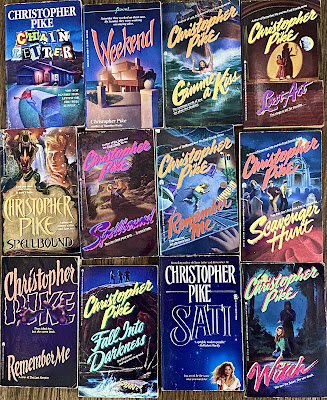
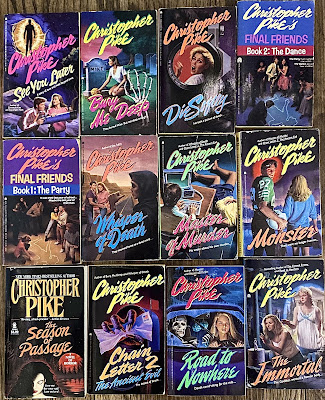
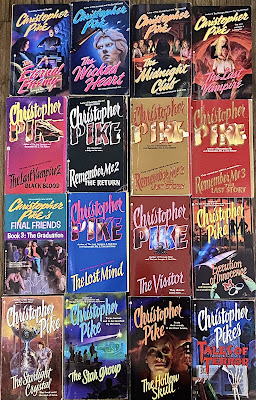
The pen name of New York City-born Kevin Christopher McFadden, Christopher Pike was one of the big-selling writers of young adult speculative fiction during the late Eighties and well into the Nineties. I well recall selling lots of these slim little paperbacks during my bookstore days back then. Published by Pocket Books under their YA imprint Pathway, his books popped off the shelves with his name featured in neon as well as distinctive, evocative cover illustrations, most by artists Brian Kotzky, Danilo Ducak, and Mark Garro. Die-cut peekaboo and stepback covers abound!

I was too old to read them myself, but I know Pike's books strike a real nostalgic chord for younger horror fans who later graduated to adult horror writers. Tor Books published his two adult novels, Sati (1990) and The Season of Passage (1992). Pike is famously reclusive, but a recent, illuminating interview can be found here. These paperbacks you see in this post are from my wife's collection; she's been buying them off and on for years!

Saturday, July 10, 2021

Intensive Scares: The Paperback Cover Art of J.K. Potter

Vintage horror fiction fans are well aware of American artist J.K. Potter, born Jeffrey Knight Potter in California on this date in 1956. His macabre photorealistic imagery decorated the covers of dozens of small-press hardcovers, various magazines, and plenty of paperbacks throughout the Eighties and beyond, most often for such genre heavyweights as Stephen King, Ray Bradbury, Ramsey Campbell, Dennis Etchison, Charles L. Grant, and Karl Edward Wagner, along with many other writers in the fantasy and science fiction fields as well. 

With its surrealistic blending of collage and contrasting elements along with ghostly hues and piercing eyes, Potter's art probably unsettled and attracted as many readers as it repelled! Here is a  sampling of his paperback work:


Wednesday, December 23, 2020

Dell Abyss Promo Materials, 1991-1993

Here's something I never expected to have in my horror collection: promotional materials from publisher Dell for their new imprint line of horror fiction, the (now-infamous) Abyss. What a treasure trove of archival artifacts! Big thanks go to Kathe Koja, author of the first book published in the line, The Cipher, from whom I purchased it some time ago. Yes, I've been meaning to post this stuff for ages! Really excited to share it with you guys...

In fact, early next year, it will be the 30th anniversary of Abyss (hell, remember when it was 20?). It was perhaps my favorite era in horror, since I had been delving deep into the genre for a few years but also wanted something modern, relevant, au courant, if you will. Having just turned 20, working in a used bookstore, in college, and reading, reading, reading, I was eager to sate my burgeoning intellectual curiosities with my favorite genre. Named for a famous Nietzsche quote and with the ambitious mission statement declaring "Abyss is for the seeker of truth, no matter how disturbing or twisted it may be. It's about people, and the darkness we all carry within," this new imprint fit the bill to perfection. I think I was their target audience precisely!


However I first heard of the line, either through Fangoria magazine or the wonderful catalogs from the Overlook Connection, I had The Cipher in my hands by spring '91 (although I believe I read it over the summer, after I'd read the second book published, Brian Hodge's "Miami Vice"-meets-Mr. Hyde mashup Nightlife). Revisiting those days is a delight. I really get such a horror fan thrill at peeking behind the curtain, seeing inside the publishing world and the marketing research that went into launching a new line of paperbacks. Book displays, postcards, bound book samples, publicity releases, and newsletters: this stuff speaks deeply to my archivist nature. 
 
 
Who can resist these Xeroxed pix of horror writers hanging out and signing books, giving background and insight on their novels, little personals deets and info nuggets and cut-out art and upcoming releases, all crammed in like a classic punk zine. I would have killed to have had access to this stuff back then.

 
In 1992 I went with my bookstore boss to a huge booksellers convention in Atlantic City, held in one of the casinos (I found the zombie-like hordes on the gambling floors disturbing). I was a little intimidated by the "business" of it, but I recall scoring some great swag, in particular a hardcover copy of Poppy Z. Brite's Lost Souls. I recall the person working the Dell table came over to me as I picked the book up, giving me the hard sell like "She's one of the hottest horror writers around right now, this is her first novel, and we're super excited about it!" I was like, "Man, I totally know who that is, I've been waiting for this!" Of course the person promptly insisted I take the book and tell my friends about it. I'm sure I did and I'm sure they didn't give a shit which is why I'm writing this blog for you lo these three decades later. So thank you and enjoy!