Showing posts with label novella. Show all posts

Wednesday, September 9, 2015

Unholy Trinity by Ray Russell (1967): The Grandest Guignol of All

This little Bantam paperback from 1967 seems slight and cheapthe Halloween-costumed models beyond silly, although making specific reference to the three novellas withinbut it packs a solid wallop of historical horror. Unholy Trinity collects Ray Russell's three greatest tales of the neo-Gothic, "Sagittarius," "Sanguinarius," and of course the much more well-known "Sardonicus," which was made into a 1961 film by notorious showman William Castle. Long a TMHF favorite, Russell was fiction editor at Playboy magazine during its height of 1960s influence, publishing Vonnegut, Bradbury, and others, so, you know, class (quite unlike the sleazy delights of his 1976 novel, the infamous Incubus). And class is what Russell brings to the proceedings, a triumvirate of history's most monstrous: Countess Bathory, Gilles de Rais, and Jack the Ripper (what, you say, no Vlad III? Nope) all appear. These monsters may be garbed in the finest raiment, but beneath they are as ghoulish, as diabolic, as unspeakable, as ever they have been.

As one can surmise from a 1985 dust-jacket photo of the author, his style is at once saturnine, urbane, regal even, with a wicked vein of dark humor and irony winding through. His work suggests a sophisticate's interest in pain and debasement, mitigated by the mists of history but also given weight by the fact these the events described actually happened (for the most part; "Sardonicus" is Russell's own literary conceit). Therefore it can be stated that one's sadism is sated while using the cloak of respectable historical detail as disguise... if you even care about that.

We begin with "Sanguinarius"—actually no, wait, we begin with an intro essay by Mr. Russell, "The Haunted Castle: A Confession." He recounts a taxing day as an editor in a modern office and upon returning home, exhausted by the existence of television, telephone, Dictaphone, typewriter, etc., and reading "smart, savvy stuff full of bright slang and hip allusion," he wants to relax with "one of those good old aromatic baroque tales, told in an unhurried, leisurely, painstakingly structured way, with plenty of unashamedly elaborate language." Of course Russell's read everything like that on his shelves (giving credence to Harlan Ellison's cry, "Who the hell wants a library full of books they've already read?"), so what's he do? He begins writing one himself! "Fevered with compulsion, totally absorbed," he produces first "Sardonicus," and within a short time the other two works within. Huzzah!

And so: "Sanguinarius" is a fictionalized first-person account of Countess Elizabeth Bathory, written in faux-16th century hand, detailing her descent into blood lust. From her entombment in a high Castle Csejthe room she writes this memoir, beseeching her Lord to hear her now that she's being punished for unimaginable deeds. In the village below, she writes, "no soul will dare display a thing of crimson." The marriage of the Bathory and Nadasdy lines brought together Hungarian royalty; she is expertly wooed by Count Ferencz Nadasdy (although it was probably an arranged marriage). Imprisoned Elizabeth writes of her and Ferencz's lovemaking, which gets Russell's pen flowing:

...for indeed to peaks of pleasure Ferencz led me, slowly to start with, step by timorous step, then setting out with more audacity, striving together, each succouring the other, climbing, first to one ledge, then to a higher, and then to yet a higher more dizzying ridge, finally to soar as if on wings to attain, both in the same heart-bursting moment, that cloud-capp'd ultimate point.

When Ferencz is called off to battle, Elizabeth mopes and mourns, unconsoled by "faithful old servant" Ilona, till one day Dorottya arrives. A beautiful young "woman of the wood" with the knowledge of healing herbs and ointments, she offers her services to the lonesome Countess. Things turn... heady. Ilona hears illicit cries in the night. You know how it goes. When Dorottya asks Elizabeth if she might bring others to cheer her, the Countess agrees, although slightly hesitant. What follows when of course Ferencz's sudden arrival home interrupts proceedings. Will it surprise the reader to learn that Dorottya is Ferencz's long-time mistress in unholy arts, that he sent her to Elizabeth at her time of weakness, and she was to be his wife's teacher in torture?

"And let us lead thee onward," added Dorottya, "to keen delights far stranger and more bold than those thou  has already savour'd..."
"Ay, wife" said Ferencz, "and be thou Bathory not but in name, but in hot deed, as well!"
"And let us seal this compact with a solemn pledge," Dorottya said, "a ceremonial bath to signalize our fealty to sin."

I think you know what kind of ceremonial bath is to follow. Russell doesn't attempt to make her a sympathetic character. Self-serving, oblivious, even if at times regretful, Bathory blames her husband  and Dorottya for developing her taste for blood and torture (even if such traits ran in her family). The little twist at the end is welcome, however; welcome, appropriate, refreshing even.

 "For who would be disposed to smile under the same roof with him who must smile forever?"

Sandwiched in the middle of the book is Russell's most famous work, "Sardonicus." In 18— (I've never been able to ascertain why that dash was used in dates in pre-20th century literature...) one Dr. Robert Cargrave, an esteemed English physician, is called to a mountainous region of Bohemia by an old friend, Maude Randall. She is now married to a man who calls himself Sardonicus and together they live in a castle, a "vast edifice of stone... cold and repellent... of medieval dankness and decay" which "strike[s] the physical and the mental eye as would the sight of a giant skull." Of course they do! Once there, Cargrave and Maude strike up their old friendship (never consummated) and then she introduces her husband, Mr. Sardonicus.

"The gentleman before me was the victim of some terrible affliction that had caused his lips to be pulled perpetually apart from each other, baring his teeth in a continuous ghastly smile. It was the same humourless grin I had seen once before: on the face of a person in the last throes of lockjaw. We physicians have a name for that chilling grimace, a Latin name... risus sardonicus."

 German edition, 1971

Sardonicus's backstory is a clever one, reaching back to creepy Eastern European folklore. He then reveals himself to be a diabolic mastermind, enlisting Cargrave's medical prowess to cure his wretched face while dangling a promise of bliss with Maudeor, failing in this, Sardonicus threatens the tortures of the damned for his platonic wife:

"Perhaps now you will better understand the necessity for this cure. And perhaps also you will understand the full extent of Maude's suffering should you fail to effect the cure. For, mark me well: if you fail, my wife will be made to become a true wife to me—by main force, and not for one fleeting hour, but every day and every night of her life, whensoever I say, in whatsoever manner I choose to express my conjugal privilege!" As an afterthought he added, "I am by nature imaginative."

It may not surprise you to find that Russell's attitude is one firmly set in the 1960s it was written in; the subtext of "Sardonicus" is like a recasting of the Playboy philosophy, that libertine stew of sex, sophistication, and rationality, in terms of the Gothic. In the end modern urban bachelor Cargrave outwits the violent, boorish cad and wins the woman. Sardonicus's comeuppance is utterly terrible and unutterably fitting. As I said: Playboy! Philosophy! No, really: whether you agree with my reading or not, "Sardonicus" is superb.

Playboy Press, 1971

The final piece, "Sagittarius," is a tale-within-a-tale, two men in an upper-class club exchanging bon-mots over cigars and Scotch. You know the scene. Elderly Lord Terrence and young Rolfe Hunt converse of "the series of mutilation-killings that were currently shocking the city, and then upon such classic mutilators as Bluebeard and Jack the Ripper, and then upon murder and evil in general..." You know, the yoozh. Lord Terry then launches into speculation: what if Mr. Hyde, of Stevenson fame, were real? And supposing that, what if he had sired a son? Then that conversation, about the twists and turns of good and evil in one soul, turns into Lord Terry's reminiscences about his younger days in turn-of-the-century Paris, when he knew a famous actor of Le Théâtre du Grand-Guignol named Sebastien Sellig.

Ah, the Grand-Guignol! Theatrical performances of death and dismemberment, madness and the macabre, that drew standing-room-only crowds to witness buckets of stage blood spurting about. A terrific setting for a horror tale, and for Russell to show off his erudition. Into this brew he mixes Hyde, Jack the Ripper, and as a pièce de résistance, Gilles de Laval, Baron de Rais, that 15th century butcher of children and occult dabbler, compatriot of Joan of Arc and a man of—but of course—wealth and taste. Mystery piles upon mystery, and young Rolfe Hunt has, in the story's final sentence, a mind-freezing realization...

In the street, I felt I had to make some utterance. "To think, I said, "that her last evening was spent at the Guignol!"
Sellig smiled sympathetically. "My friend," he said, "the Grand Guignol is not only a shabby little theatre in a Montmartre alley. This—" his gesture took in the world "—is the Grandest Guignol of all."

I spent several days entranced by Russell's imagination, the twists and insights, the decadence of an aesthete's intelligence, enchanted by his delicate yet precise prose used to describe the indescribable. Russell's affection for the wormy tropes of Gothic literature is clear; his facility with them dexterous; his ironic repositioning of them enlightening. Thus I can recommend Unholy Trinity without hesitation (in print as Haunted Castles). High-minded, cultivated, blackly ironic and delighting in the debauched and the deranged from the vantage point of the mighty, Russell is a trustworthy guide through this netherworld populated by crumbling castles, dank dungeons, torture chambers, bleak landscapes, and most terrifying of all, the unfathomable cruelties of the human mind.

Not from God above or Fiend below, 
but from within his own breast, his own brain, his own soul.

Wednesday, January 7, 2015

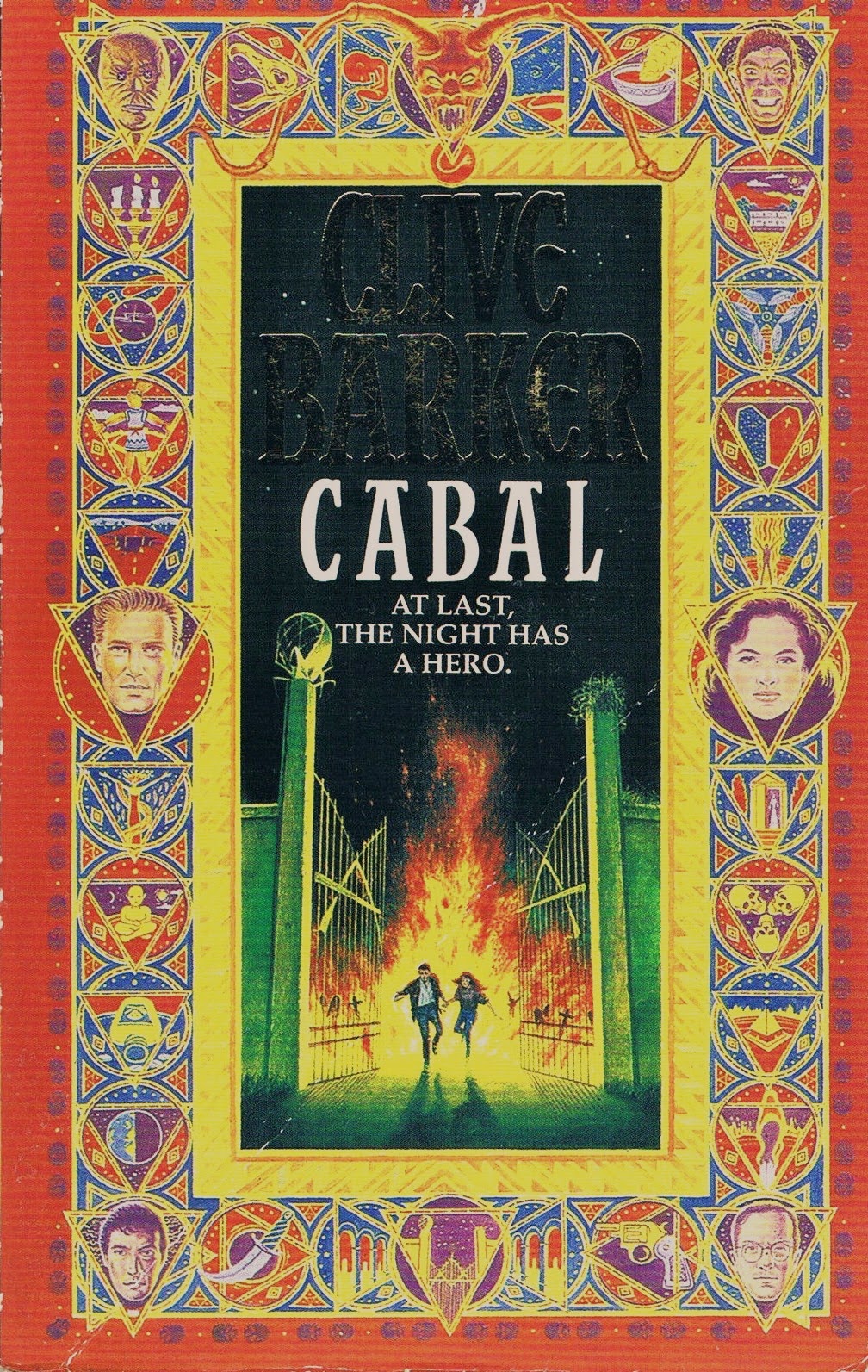
Cabal by Clive Barker (1988): Stand Me Up at the Gates of Hell

Weren't there, among those creatures, faculties she envied? The power to fly, to be transformed, to know the condition of beasts, to defy death?... the monsters were forever. Part of her forbidden self. Her dark, transforming midnight self. She longed to be numbered among them.

Another prime example of Clive Barker's consistent concern with monsters and the humans that dwell in their midst, Cabal came out at perhaps the height of his success as a bestselling horror author. The 250-page novella was published in hardcover in the US along with the stories from Books of Blood Vol. VI, while in the UK it was issued as a standalone title. Then a year later Barker began adapting this work for the screen as Nightbreed, the storied, troubled production of which probably most horror fans of that era are familiar with. I'd read Cabal twice but oh so long ago: once before the film was out in early 1990 and once not long after. A couple weeks ago I watched the recently released director's cut of Nightbreed and afterward reread Cabal. Not as a "compare and contrast" exercise, which is a bit too English Comp 101 for me, but the movie had gotten me thinking: how has a quarter century's passing affected my affinity for the Tribes of the Moon (a phrase found only in the film)? Would I still be as excited and eager about the Nightbreed as I am in this photo?

Clive Barker and me; he's signing my Nightbreed poster. 
January 1991

Spoilers! Cabal is the story of Aaron Boone, a young man on the run from his psychiatrist Dr. Decker, a secret madman who plans to blame Boone for his own serial killer crimes. Boone is being chased by Lori, the woman he left but who loves him still. If all that's not enough, Boone is attempting entry into a fabled world where the monsters live. It's a vast forgotten cemetery near an abandoned town called Midian in the Canadian wilds, a catacombed necropolis beneath the earth in which hide the monsters of myth and legend, exiled from a fearful, vengeful humanity. But Boone is not the monster Decker's convinced him he is... yet.

He'd heard the name of that place spoken maybe half a dozen times by people he'd met on the way through, in and out of mental wards and hospices, usually those whose strength was all burned up. When they called on Midian it was a place of refuge, a place to be carried away to And more: a place where whatever sins they'd committed--real or imagined--would be forgiven them. Boone didn't know the origins of this mythology nor had he ever been interested enough to find out. He had not been in need of forgiveness, or so he thought. Now he knew better...

Harper Collins, Toronto, 1989

Boone's entrance to Midian is foolhardy and near-fatal: a bite from a Breed member "more reptile than mammal" called Peloquin--who can instantly sense Boone's guiltless, Natural self--gives Boone a kind of immortality, which comes in handy when Decker brings the police force to Midian and they shoot Boone dead. But he's not dead. Now, as a walking dead man, he's become the Breed, and escapes the morgue. But his return bodes unwell for the inhabitants of Midian, who fear he will reveal them to Man. Boone defies the laws of the Breed when he rescues faithful Lori from blood-hungry Decker outside Midian's gates, which causes all sorts of problems. However, here in horror Boone's truest self's revealed:

In Decker's presence he'd been proud to call himself monster: to parade his Nightbreed self. But now, looking at the woman he had loved and had been loved by in return for his frailty and his humanity, he was ashamed. 
His will making flesh smoke, which his lungs drew back into his body. It was a process as strange in its ease as in its nature. How quickly he'd become accustomed  to what once he'd once have called miraculous. 

To make up for his folly Boone demands to see Baphomet, the Nightbreed god who created Midian as a haven for these creatures.  Following Boone, Lori gets a glimpse of a column of flame and:

There was a body in the fire, hacked limb from limb... this was Baphomet, this diced and divided thing. Seeing its face, she screamed. No story or movie screen, no desolation, no bliss, had prepared her for the maker of Midian. Sacred it must be, as anything so extreme must be sacred. A thing beyond things. Beyond love or hatred or their sum, beyond the beautiful or the monstrous or their sum. Beyond, finally, her mind's power to comprehend or catalog.

This meeting is a moment out of all man's primitive religions: the holy fire, the sacred other, that once seen cannot be unseen, and once experienced the profane is transformed. There is no going back. Boone is a Moses and Baphomet his Yahweh; prophecy foretold. Barker has always gotten good mileage out of this comparative mythology aspect of his fiction, mileage I'm always happy to travel. While Lovecraft parodied and satirized religious beliefs with his "Yog-Sothothery," Barker recognizes that humans have a need for transcendence, but not one that annihilates, one that transforms. Boone bravely embraces his true nature; he is no Outsider reaching out in cowering fear and touching a mirror.

And so the tale continues, and closes, with redneck cops--led by the truly odious Eigerman--and a gaggle of shotgun-wielding yahoos on loan from Night of the Living Dead descending on Midian thanks, again, to Decker. He's set on killing Lori, who now knows his secret. He loathes the Breed, cannot wait to participate in their destruction: "They were freaks, albeit stranger than the usual stuff. Things in defiance of nature, to be poked from under their stones and soaked in gasoline. He'd happily strike the match himself." They rout the Breed in a final confrontation that will create a new enemy and destroy another. Boone is renamed Cabal--"an alliance of many"--by Baphomet and ordered to rebuild ("You've undone the world. Now you must remake it"). Lori and Boone are reunited at last.

But the Nightbreed are not ended. Irony abounds, even until the very last line: "It was a life." Lori's words to Boone after he rescues her from death and gives her his Breed balm (heh, and yes, he does this figuratively and literally) are, "I'll never leave you," which the astute reader will recognize as the words in the opening paragraph, words Boone considers a lie. What does this irony mean? Barker knows how to leave readers wanting more by undermining expectations; the tale ends just as it's beginning!

Fontana UK movie tie-in, 1990

In a 1989 Fangoria interview with journalist/author Philip Nutman, Barker talked about the motivation in making Cabal a novella:
"I wanted to do the reverse of what I did in Weaveworld, which was to really cross the t's and dot the i's, give every detail of psychology and so on. In Cabal I wanted to present a piece of quicksilver adventuring in which you were just seeing flashes of things, Boone, Lori, the Breed, each character's psychology reduced to impressions. Part of the fun for me was to write it in short, sharp bites." 
I quote this because it explains what at first I disliked about Cabal on this reread: strokes were too broad; too much time giving impressions and not specifics; characters were moved about like a kid playing with action figures--so much to-ing and fro-ing! After the short sharp shocks of the Books of Blood and the epically-drawn dark fantasy of Weaveworld, maybe the novella format was not good idea. But as I read, Barker's writing grew in its conviction; he's more adept at the contradictions and ambiguities of murderers and marauders than he is with the banalities of everyday life. Still, some frustrations:
 
Decker's psychopathy could have been expanded; the creepiest moments belong to him, like when Ol' Button Face, the glib nickname Decker has for his killing mask/personality, chatters hungrily to him while it resides in his briefcase. The conflict of his inhumanity versus that of the Nightbreed is sketched in here and there, none more illuminating than when Barker writes of Decker: "The thought of his precious Other being confused with the degenerates of Midian nauseated him." Decker is a fascinating character; the witless police not so much.

Fans of the film looking for bizarre monstrosities will have to be satisfied with only glimpses of the Nightbreed. Unlike some of the detailed creatures that inhabited Barker's earlier short stories like "Rawhead Rex," "In the Skins of the Fathers," or "Son of Celluloid," the reader is given mostly impressions. With a surrealist's eye Barker gives us intriguing hints but doesn't belabor the descriptions. When Lori first descends into Midian:

...was it simply disgust that made her stomach flip, seeing the stigmatic in full flood, with sharp-toothed adherents sucking noisily at her wounds? Or excitement, confronting the legend of the vampire int he flesh? And what was she to make of the man whose body broke into birds when he saw her watching? Or the dog-headed painter who turned from his fresco and beckoned her to join his apprentice mixing paint? Or the machine beasts running up the walls on caliper legs? After a dozen corridors she no longer knew horror from fascination. Perhaps she'd never known.

1989 Pocket Books edition

Yes, Barker's mantra has always been thus. In the monstrous there is beauty; the normal course of daily things is a horror. But I wanted more. Cabal works better if one considers it as allegory, as fable, and its politics are a liberal dream: evil is not evil, it's an alternative lifestyle! Witness the callous crude cruelties of doctor, cop, and priest: the first is a psychopath literally wearing a mask; the second an egomaniac concerned only with his brand of law, order, and notoriety; the last is a hypocrite. The undoing will be at the hands of these traditional authorities; it is they who will squeeze the life out of the untamed, the unwanted, even the undead. Cabal ends clearly stating that the enemies are still active, still enraged, still stung by humiliation and eager to bring a comeuppance.

Poseidon Press 1988 US hardcover 

I guess I'm saying there's a theoretical distance in Cabal which prevents me from really, truly enjoying it the way I do so much of Barker's other work. Maybe it's the movie, which I like all right in its new incarnation but have never been overly fond of (although this version is a more faithful adaptation, Nightbreed remains irredeemably cheesy in a way Cabal is not), intruding upon my imagination; I can't at all recall how I envisioned the story before its film adaptation. And it reads, and ends, like a prequel. This has been a problem with Clive Barker since, well, since 1988. He's always intended to continue the story of Cabal. To continue the story began in The Great and Secret Show. And Galilee. And Abarat. Later this year we'll finally get The Scarlet Gospels, which apparently concludes the stories Harry D'Amour and Pinhead, an apotheosis of two aspects of Barker's art. His ambition might outreach his vision, his health, and dare I say it, his life. But again, it pays to see Cabal as a fable, a beginning, a story for us about us: fans of the Breed are the Breed, "The un-people, the anti-tribe, humanity's sack unpicked and sewn together again with the moon inside." That is a story that continues, and continues, and continues.

Barker '88