Showing posts with label ghosts. Show all posts

Tuesday, October 15, 2019

The Moon Lamp by Mark Smith (1976): Whose Barn? What Barn? My Barn

Often reading bad or mediocre books can hone your reading skills and critical acumen just as much as reading a good book. God knows I've read plenty of the bad and the mediocre, and unfortunately, that's my conclusion of The Moon Lamp, an ostensible "ghost story"  that at times almost casts a bewitching spell of spooks and eeriness, but more often than not veers off into insubstantiality, just like the purported "ghost(s)" of the tale itself. First published in hardcover in 1976, the foil-covered paperback was issued in June 1977 by Avon Books, replete with copy and blurbs that identify the novel as a "classic horror story." How am I still taken in by this kind of publisher swindle?! Honestly, I think it's because Avon generally published work of relative high quality. Also, shiny silver!

Author Mark Smith (b. 1935 in Michigan), with whom I was unfamiliar prior to reading this novel—although I had come across its cover before, and which I featured on a long-ago blogpost—had also published, just a few years prior to Moon, another new-to-me novel called The Death of the Detective, which was nominated for the National Book Award in 1974. Further research revealed the 1975 paperback edition of that book was also issued by Avon and also boasted an eye-catching Mylar cover:

I mean, kinda cool, right? This 700-page (highly-lauded) tome is one I've never seen in all my years of haunting used bookstores; nor have I come across any other of Smith's work, which—wait for it!—also includes in their similar design that glowing font, the better to ensnare the unwitting browser and turn him into the prospective buyer. The Middleman and Toyland (below, both 1977 Avon paperbacks) display distressed faces squoze into that typeface, promising suspense, terror, and madness, but after buying and reading Moon because of an unsettling spirit visage and the attendant critical blurbs, I am enormously disinclined to look further into Smith's ouevre, despite, as I'll get into in a moment, his more than capable aptitude for character detail, dialogue, and overall general insight into various sectors of class, ambition, and the vagaries of married life...

In full, Moon Lamp is not a horror novel in any way, nor is it much of a thriller; it's a character study put into motion by spirits of the past. Whether those spirits are imagined or part of the warp and woof of consensual reality make no difference, neither to our main character, nor to the reader. The Lindquist couple, middle-aged Winnie and Gene, have, in the time-honored vintage horror tradition, thrown off the shackles of city life (here, suburban Chicago) to land free and clear in rustic New England, purchasing a Revolutionary War-era home and barn. The setup seemed ripe for a cozy, down-home kind of horror that is quite agreeable this time of year, so despite some narrative awkwardness at first (more on that later), I settled in.

Homesteader wannabes who take up the mantle of the local past more than even the present locals whose families have lived in this town for centuries, the Lindquists enjoy "putting on" dinners and cocktail parties, complete with old-timey recipes, clothes, and of course furnishings, showing off their adopted house, attic, and barn... and the attitudes that go with them. And ex-high school theater teacher Gene enjoys spinning yarns before the fire, imbibing grog and regaling his rueful, amused guests with ghost stories.

The interest of these Lindquists in the house we understood. Or thought we did. But the interest in the ghosts was something else, a fascination far more complicated than it seemed. It was probably no more than the theatricality of the subject that attracted Gene. But what was there about the character of Winne that would explain her interest in the things? 

Penelope, the Lindquists college-age daughter, also partakes in these period recreations, when she's not away at school or canoodling with her boyfriend, Dwight. Dwight is a type that Winnie has seen "already around these parts, college kids who mixed a blue-collar or artsy-craftsy life of old New England with the spirit of Buddha." Dwight says things like "Why should the scientific method be the only way of looking at the world? Why should its laws be the only laws?" which are 100% late-night dorm-room convo questions. Fair enough, because that's exactly who Dwight is. Once Winnie becomes convinced the homestead is the site of at least one spirit, she and Dwight discuss in academic terms telepathy and other paranormal phenomena. *yaaawn*

Now for an actual—or is it?!—ghost, which Winnie thinks she sees while she's walking in the fields near the house, a man hobbling over a small stone wall, straddling it, virtually floating over it, unsure of which side he wants to be on...as if an "some mysterious power or invisible hand had picked him up by the back of the belt while his legs made the motions of walking through air." This sequence is one of the very best in the book (which isn't saying much)... but it comes 40 pages in and there's not very much after that, because now Smith is writing about another aging woman who has to confront what her marriage, her life, her very self have become. Winnie and Penelope develop a somewhat contentious relationship, leading to one of those long conversations between mother and daughter about disappointment: "Life is awfully strange, awfully cruel, and it doesn't make an awful lot of sense."

We learn that Winnie was previously married, and Smith takes a long detour to give us the whole story of her first husband, a man called Sneevy. This section of Moon Lamp reads like The Adventures of Augie March, rich and lusty and overstuffed to the point of exhaustion about a knockabout kinda guy in Chicago—Chicago, that somber city—always looking for the good money, the next adventure, sprawling through the middle of the century, military service, working hard in various jobs, palling around in a beloved car, drinking whiskey, playing penny-ante poker and chainsmoking, blowing money with his best gal, his buddy, and his buddy's gal, what a cock of the walk that Sneevy was on Friday nights! She begins to moon over him, comparing him and Gene, wondering where Sneevy is today, surely he'd have been more ambitious than Gene (who she suspects, but doesn't really care, is having an affair). Oh, how she had loved Sneevy, why had she ever left him, could they communicate... telepathically...? Is he trying to send her messages through some ghostly intermediary...? *yaaawn*

 
Smith's style is an odd one right from the very first sentence: "We all knew the same thing about the Lindquists." Sounds like country folk gossiping at the general store about the odd yet endearing new couple in town, but I wasn't really digging it; forced and unclear rather than illuminating. The reader never learns who this "we" is, or rather why it is, and eventually Smith turns traditional omniscient narrator because the story turns interior in a way not not visible to townspeople (there needed to be more contrast between styles). Smith's not very sympathetic either: "Winnie and Gene had no stake or interest in the land itself, had not much more feeling for it than the city people spending weekends in the country." I feel like he could've utilized some subtle ghostly vengeance on the Lindquists, like embarrassing them at one of their poser parties or something, but alas, no.

Smith is a classic over-writer, a writerly-writer, writing not just what's happening, but also what isn't happening, like Winnie's daydreams and impressions and wishes and wonderings and who the ghosts were in their previous lives. So much energy put into detailing events that are not even occurring, god, the literary equivalent of a dream sequence or the fake jump scare—without even a real scare that follows up. 

Which leads me to this: the creepiest scene, with the longest buildup, is simply a fakeout. Winnie watches a flickering light outside in the darkness, and ponders what it could be, imagining Sneevy, but it's not a ghost creeping up on the house, it's the reflection of her fucking husband Gene as he comes up behind her! What a bunch of bullshit. Unforgivable. It's the basis of the dustjacket for the 1976 hardcover, which tells you something of the drama of the scene... but not its utter snuffing out of would could've been a terrific scare.

I don't want to criticize this novel for something it's not, so let me say that I didn't really like what it was.  Despite some engaging cultural observations by Smith about trying to fit into a new community, about American class and economic mobility, about the interior lives of married people or the unsatisfied self, The Moon Lamp simply doesn't hold together as a novel. The climax is muted, confusing, not even close to a powerful wrap-up of disparate events. Why did Smith even use the ghost story/haunted house as a springboard for his work of marital woes? This book is not a patch on that great work of a year or two later, Siddons's The House Next Door, which approaches many of these same concerns in a much less ostentatious style and much more modern manner—and is much, much spookier and savvier to boot. The Moon Lamp is a major disappointment for anyone looking for seasonal chills and thrills, or anything else for that matter.

The author in the Sixties

Saturday, July 28, 2018

She Wakes and A Cold Blue Light: Recent '80s Horror Reads

Hola amigos, I know it's been a long time since I rapped at ya, but I've been real busy here. Been buying paperbacks like crazy, in and out of town, and have even had time to read a few. Unfortunately nothing has blown me away, a real bummer, but here are two brief reviews of the titles I've finished this summer.

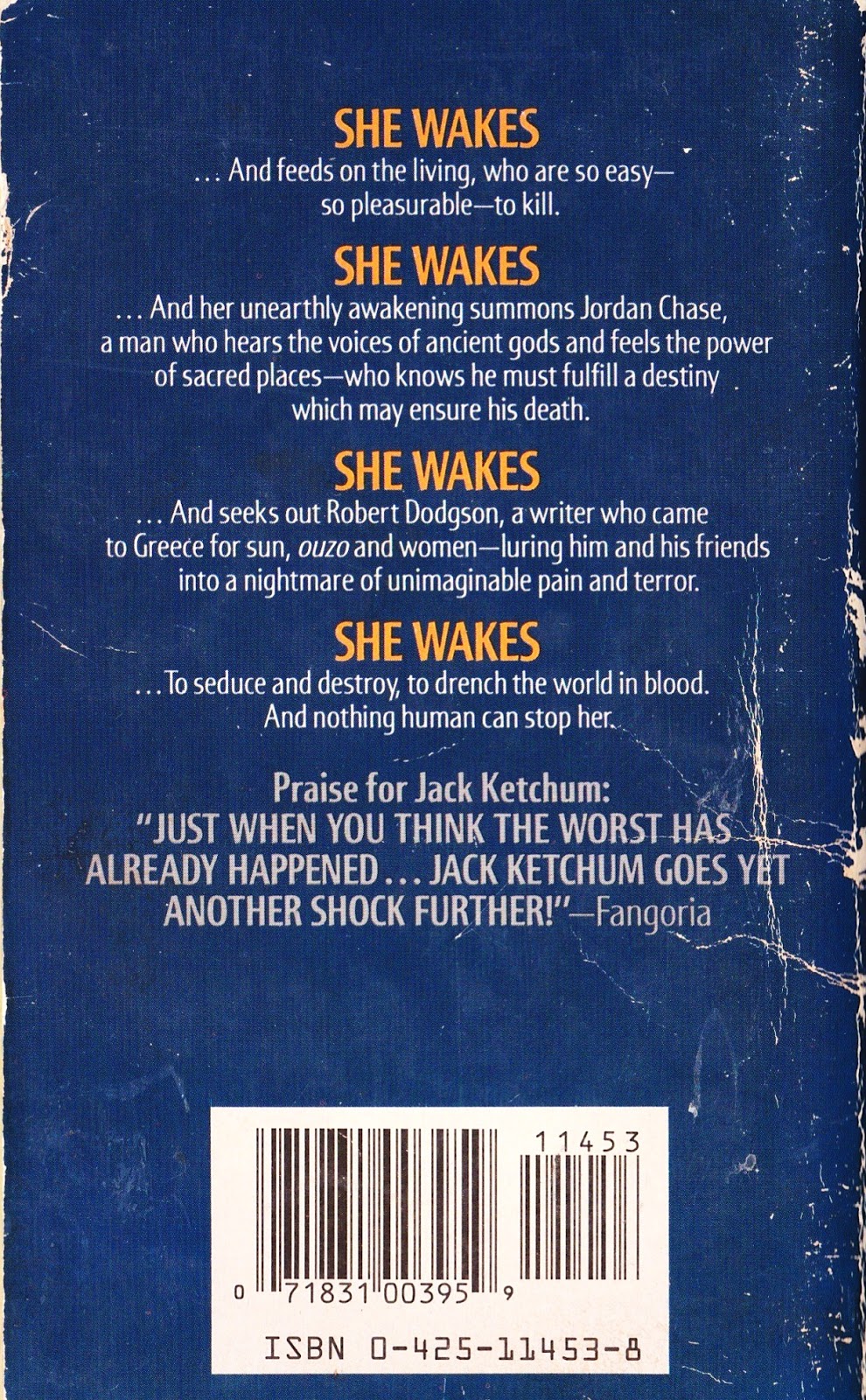
While at first I was kind of digging She Wakes, the late Jack Ketchum's novel from 1989 published by Berkley Books, as it neared its end I realized I'd long lost any sense of enjoyment. Pretentious and mean-spirited, Ketchum seems to be floundering a bit in this rather overlooked title in his oeuvre. A supernatural story set in a well-depicted Greece, the She of the title is of course an ancient scary goddess ravenous for sex and death in the guise of vacation fling. You know how it goes. Characterization is dull and hollow, prose is Hemingway lite, and scares and/or creepiness marginal. The unrelenting conviction that made Girl Next Door and Off Season such horror powerhouses is missing.

I do like the at times despairing tone of Ketchum's style—He felt a moment of impotent fury. These were all good people. They didn't deserve this. None of them did—because it gets at my understanding of horror: that terrible things happen to good people for no reason. I mean, that's life, right? I'm not crazy about horror in which awful people get a dreadful comeuppance; that seems a cheap satisfaction. And while zombies and gore and flesh-eating appear in the last quarter of the story (a few sex scenes are written pretty well too in a sort of erotic horror manner), they produce no horrific frisson; no, it's just there, and it did nothing whatsoever for me. Lots of time drawing characters together for what promises to be a doozy of climax, but it is dead on arrival, muted, overwrought, even distasteful in an ugly way.

Apparently Ketchum wanted to try his hand at a "Stephen King style" work instead of his usual non-supernatural fare, but She Wakes is NOTHING like a King work, so I don't know what he (or the publisher?) was thinking. The combo of Ketchum's clipped, existential sentences and malevolent mythology, intriguing at first, adds up to nothing. I'm not surprised Ketchum gained genre fame only years later; his style, affect, and approach were pretty much the opposite of what was going on in horror writing at the time (although I suppose it bears the vaguest similarities to Simmons's Song of Kali). Despite a few interesting tidbits scattered throughout—his evocation of the Greek landscape and its people is admirable, but I mean come on, it's no Colossus of Maroussi!—She Wakes is a real miss.

In late summer of last year, three men and two women came to Aubrey House, each seeking something intensely personal. Five separate houses, if you will, all of them haunted.

1983's Charter Books original A Cold Blue Light, by fantasy writing team Marvin Kaye and Parke Godwin, is a title I searched for awhile; I'm not sure exactly why. I think I liked the vibe the title and cover had, implying a chilly tale of atmospheric hauntings ("beckoning horror," anyone?). Another riff on Haunting of Hill House, you got your investigators all up in what was a summer rental for backstory folks who went mad. Back-cover copy really sells it:

Psychically speaking, it's a whole new equation. Good, Evil, God, Heaven or hell—I doubt that any of those words have much relevance in Aubrey House.

Didn't know anything about the authors, looked them up, they don't write at all the kinds of fiction I pay attention to. Which is ironic because Cold Blue is engagingly written, smart, insightful, sharp and observant—a party scene early in the story promised a bright, modern '80s novel of witty banter, solid characterization, believable motivation, paranormal skepticism, metaphysical ramblings (last two things not my favorite but I'll make an exception if there's some real creepiness to be had)—but there are absolutely no scares whatsoever until maaaybe the final couple pages. Cold Blue was a solid read otherwise, yet I can't recommend it as any kind of horror fiction. The authors were simply going through generic motions for commercial reasons. There's a sequel, I might buy it for completist reasons only.


Saturday, April 26, 2014

With Just a Touch of Her Burning Hand: The Cover Art of Rowena Morrill

With her very first paperback cover illustration - for Isobel (below, Jove Books, 1977) - artist Rowena Morrill showed an innate talent for depicting the lurid, the fantastical, the unimaginable, with bold eye-catching color and strikingly detailed monsters, heroines, wizards, and other genre-specific characters. Morrill rose to prominence throughout the late 1970s and onward, one of the few female artists to contribute greatly to the SF&F/horror paperback boom. Her cover art is unmistakably of its time, original and painstaking work readers don't often see today - which makes it so wondrously special and worth celebrating.

At top is Burning (Jove, May 1978), and it is easily one of my top 10 paperback horror covers: I love the blood-red title, the terrified women screaming, the house ablaze, all within a half-cube. And add that tagline - "A love that defied the grave"! Man I can't resist. Maybe one day I'll read it!

These two collections of Lovecraft, both Jove 1978, were some of her earliest work, and I must say that besides the famous Michael Whelan covers for Ballantine/Del Rey a few years later, they're simply the best HPL paperback covers. The orange and blue text, sure, but the bizarre creatures could only be painted by an artist who actually read the stories. Same goes for that Frank Belknap Long collection, as it depicts the title tale in all its muck and madness.

It wasn't till just the other day that I came across this Charles L. Grant title, Night Songs (Pocket, June 1984), and it got me started really looking for Morrill covers I hadn't seen before. Haven't read it but I'm gonna assume there's a mermaid involved....

Most of Morrill's covers were for the science fiction and fantasy genres, but we know how that line can blur. Below are just a few examples of her Timescape covers, a 1980s imprint of Pocket Books. Have you read George R.R. Martin's 1979 novella "Sandkings"? Holy shit, it truly is one of the great horror/SF tales of the '80s! The cover is perfect. And of course we all love our Clark Ashton Smith paperbacks, even though personally I have no time for reading about wizards or muscular shirtless heroes.

Perhaps Morrill's most iconic horror paintings were done for Pocket's Robert R. McCammon line. I can't imagine '80s horror without this imagery and vanishing point perspective. Swan Song (June 1987) is a staple of the era, and They Thirst (Oct 1988) is a particular fave cover of mine, Hollywood vampires oh yeah!
Another stunner is this motley crew of bloodthirsty night creatures, folks whose faces we all recognize. Wish I'd seen this when I was a kid, it's from '78 also and I would've killed for it. I was crazy for monsters in castles back then, just crazy.

And then there's The Haunt (Popular Library, April 1990), another book I'd never heard of till researching Morrill's covers. She loves her bats!

So much thanks to you, Ms. Morrill, for some of my favorite horror paperback covers ever.

The artist herself, c. 1970s one presumes

Monday, October 14, 2013

Post Mortem: New Tales of Ghostly Horror, ed. by Olson & Silva (1992): Come and Die with Me Forever

I don't believe in ghosts. And yet... ghostly doings in horror fiction tend to work their chills on me. What I find particularly effective are the emotions and psychological states the ghosts often represent: guilt, unrequited love, vengeance, regret, loneliness, grief, rage, even sexual longing. Becoming the external manifestation of characters' repression is an essential part of any ghost's (albeit fictional) existence. Same goes for haunted houses, which function as geographic representations of the mind and all its tortures. I'm a sucker for that stuff, even if my readings in the classic ghost stories of antiquary is rudimentary; it's those ideas I find satisfyingly creepy. 1989's Post Mortem: New Tales of Ghostly Horror (Dell/Abyss Jan 1992) contains solid examples of these ideas, from generally skillful writers with names both recognized and not.

While its paperback cover resembles nothing so much as classic '80s Slayer album art, Post Mortem doesn't rely on graphic or demonic excesses to frighten readers; there's hardly a broken bone or bloody wound or occult word in these entire 350 pages. None was an outright bomb but there are some ho-hum entries. Not all the stories even attempt horror; they can mostly be divided up between "hopeful" ghosts and "scary" ghosts. Although both Paul F. Olson and David B. Silva were editors of well-regarded '80s horror mags, Horrorstruck and The Horror Show respectively, I wasn't impressed with their metafictional introduction. Ditto Dean Koontz's afterward, which highlights exactly why I find him useless as any kind of horror authority. Koontz prefers, it seems, those "hopeful" ghost stories, the ones that confirm his belief that his spirit "will never die."

The opener "Each Night, Each Year," by Kathryn Ptacek, works well enough, and has some of the creepiest imagery in the book, but she overplays her hand at times by underwriting. When the haunted narrator states "It is my guilt that brings him here," it's already obvious, I think, that that's exactly what's going on, and stating it so baldly snaps the spell. I don't need to have my head grabbed and pointed right at the issue; a gentle handhold can be just as unnerving, no? The recently-late Gary Brandner brings a gruesome little ghost story in the simplistic "Mark of the Loser," solidly in the old-fashioned EC Comics style.

Next, "Timeskip," Charles de Lint's entry, is a modern urban fantasy with 20something protagonists; I know he's considered a pioneer in that subgenre, as his felicity with environs and character is obvious. Romantic ghosts promise meeting again. A similar encounter turns up in James Howard Kunstler's "Nine Gables," about a couple whose marriage is rekindled in the unlikeliest manner when they welcome guests into the titular inn they buy. From horror-writing couple the Tems, Steve Rasnic and Melanie, we get the terrific "Resettling." This is about the finest little haunted-house story I've read recently (after Michael Blumlein's "Keeping House"). It works every which way, a mature, insightful work that confronts family life's innumerable disappointments, with a true and bittersweet finale that oh-so-subtly upends ghost story protocol. The Tems really get - deliver - domestic horror.

Would an '80s horror antho be complete without Ramsey Campbell? Non. Utilizing a rare book of ghost-story author extraordinaire M.R. James, Campbell's "The Guide" is told in his usual slow-to-the-point-of-agony prose, but the payoff is claustrophobic and nightmarish, hinting at horrors scarcely imaginable: Imagine, if you will, a spider in human form with only four limbs, a spider both enraged and made ungainly by the loss, especially since the remaining limbs are by no means evenly distributed.

Visiting ghosts also appear to those whose pasts are unfinished. Sometimes these shades bring closure, as in Silva's "Brothers" or P.W. Sinclair's "Getting Back," but just as often bring a horrific justice. "The Ring of Truth" from Borderlands editor Thomas F. Monteleone is a longish tale of Vietnam survivors and insane murderous machismo. Hate burned like the heart of a star, and not even death can keep that feeling contained. The abused wife of Janet Fox's "The Servitor" escapes to an abandoned house in the country. Surprise: it's not so abandoned, and what's there demands a debt for its services. A finely-tuned depiction of a woman's desperate attempts to save herself, the story's final lines are chillingly pitiless.

Will it surprise regular readers of TMHF that my absolute favorite story in Post Mortem was Thomas Tessier's contribution "Blanca"? Here the ghosts are victims of historical/political tragedies. In Tessier's usual tone of detachment, dry wit, and maybe even resignation, his narrator begins:

When I told a few close friends that I was going to Blanca, their reaction was about what I had expected. "Why?" they asked. "There's nothing to see in Blanca. Nothing to do except disappear." Sly smiles. "Watch out you don't disappear." "Maybe that's why I chose it," I said with a smile of my own. "It might be nice to disappear for a while." 

Can there be any doubt the story will end the same way?

Another terrific story is the sensitive "Whisper of Soft Wings," by Melissa Mia Hall. It is very good but very sad: a little girl comes around to visit an elderly woman in a world that has less and less of a place for the old. With a rare sense of poignancy, Hall draws the two together in an intimate embrace. I will definitely be looking for more from Hall; but nothing new, I'm afraid, as she died several years ago.

Last, the somewhat interesting "Haunted World" - what if all the people who ever lived on earth came back to haunt us - is told in a cliched good ol' boy voice, which completely undermines the premise. The bland, obvious style of Robert McCammon proves to me once again why I have little interest in reading any of his novels, despite their seeming endless popularity with fans of '80s horror.

Final words: Post Mortem is a good but not truly essential horror fiction anthology. Fans of de Lint, Tessier, the Tems, Campbell, or Hall should find a copy, as their stories work in the classic ghost story mold but also are convincing and fresh in their modern settings and concerns. Me, I could've used a few darker tales, a few more nastier, eerie moments that lingered after I put the paperback back on my shelf. But it did reinforce my belief that nothing is so haunted as the human heart, and that the most unsettling ghost of all is the most recognizable, the one we live with every day, long before we die.

Wednesday, March 13, 2013

Cast a Cold Eye by Alan Ryan (1984): Blood Will Follow Blood

The late Alan Ryan really hit a high note with his Irish ghost story Cast a Cold Eye (Tor Books, Jul 1984/cover art by Jill Bauman). Contributing to its success is the vivid sense of place, somber prose, and convincing characterization, as well as a slowly mounting sense of dread reaching out from a horrific past which can never be forgotten. Yes, a ghost story that has its roots in the real-life horrors of the Great Famine.

Writer Jack Quinlan comes to the rocky, sea-lashed coastal Irish village of Doolin, meets a young lovely lass named Grainne at the local bookshop, and begins working on his book about the Famine. The developing relationship between the two is drawn well and truly by Ryan, and he handles their differences - he a well-traveled published New York author, she a Catholic virgin still under the yoke of her parents - with a sensitivity that speaks of experience. It's a relaxed give-and-take between two real people that really grounds the story.

Dark Harvest hardcover, 1984

But as Jack researches the Famine, he soon finds himself face-to-face with people who seem to have stepped whole and starving from that horrible era: a ragged man unconscious in the mud on the side of the road, vomiting green rot; a young girl who was only bone covered in skin in tattered clothes; tortured shapes milling through the cold fog and damp air and mud surrounding his cottage. He puts this all to his readings, an overworked imagination, but still dreams of facing his own corpse. Soon he meets Father Malcolm Henning, the local priest and seanachie, a sort of historian and storyteller in one. Father Henning wields a gentle hand over Doolin, both in church and in the pub: the two most popular places for these provincial people.

But Father Henning's tales in the pub are grim and foreboding, filled with gruesome "Monkey's Paw"-style ironies, although they seem to ease the aging pains of a group of old, old men Jack sees around the town. One in particular is John MacMahon, practically a cadaver now, who is treated with a deference that befits a mortal responsibility nearly impossible to bear. Jack is drawn into this circle when Henning confirms that the visions accosting him aren't simply... visions. Perhaps Jack isn't an interloper; perhaps Jack's Irish heritage means that he was meant to come to Doolin, meant for something greater than just writing a book, meant to be part of a ritual where blood is everywhere.

The whole book is a quiet horror, er, delight, despite its nightmarish source, and will make you seek out Ryan's other work (he published plenty of stories in various '80s horror anthologies like Whispers, Shadows, and Year's Best Horror; I've liked all the ones I've read). It'll also make you lament that Ryan didn't write another novel. It's much more effective than his previous work, 1983's Dead White, and evinces a cozy fireside feel one finds in the classic tales of the weird and uncanny. There are creeps and chills to be sure, but the real power lies in the setting and the characters. And I have to say there's a lovemaking scene - that's truly what it is, I can't phrase it any other way - that is about the best I've ever read in a horror novel.  

Cast a Cold Eye is a chilly, atmospheric read in which one can feel the salt spray of the ocean, the icy air working its way inside your clothes, the sense of real history in every stone building and rotting fence, and grasp the sad, earthbound horrors that lurk in the Doolin graveyard. "Blood is everywhere," Father Henning has said, and we will learn the truth of that all too well. I really appreciated this kind of fact-based historical horror, where unrelenting reality collides with our primitive notions of supernatural agents. The ghosts that haunt are the shameful memories of the diseased and the dead, our guilty conscience manifested in shades and shadows that seem to our hand and eye more real than our very selves. 

Friday, January 11, 2013

The Night Hunter Series by Robert Faulcon

Until today I had never heard of this series, Night Hunter, first published in the States in the late 1980s by Charter Books. Robert Faulcon is a pen name of respected British dark fantasy author Robert Holdstock. The series seems to be an odd mash-up of men's adventure novels and pulpy occult horror fiction. In the anthology I'm reading right now there's an ad for the series, so while I'm finishing that book and working up a review, check out these perfectly vintage paperback covers! Read a review here.