Showing posts with label '80s. Show all posts

Saturday, September 5, 2026

Hiding an Ungodly Horror: The Cover Art of Paul Stinson


The artist Paul Stinson (aka Paul E. Stinson) was born in New Jersey on this date in 1953. More prolific in the science fiction/fantasy fields, he also illustrated the cover art for a good handful of horror/suspense mass market paperbacks back in the day, including ones for well-known names like Graham Masterton, Ramsey Campbell, Bernard Taylor, and Kathryn Ptacek. Also, his work adorned most of the "psychic detective" Chill series, by Jory Sherman, which I featured here. Enjoy!


Tuesday, March 31, 2026

Disturb Not the Dream by Paula Trachtman (1981): Don't Try to Take My Knife Away


The only novel by author and teacher Paula Trachtman (1931-2019), 1981's Disturb Not the Dream (Ballantine paperback, July 1982) is middle-of-the-road mainstream bestseller pop fiction, competently written, with some mild Gothic atmosphere, and lots of cheap thrills. Although Trachtman's prose veers at times into a heightened purple, she keeps the narrative at pace with only a few slowdowns. A family saga set in a ritzy village in Long Island's Southampton, based around a Victorian home estate called Mulberry... and the bloody horrific things that happened there.

This is one of the least interesting paperback covers I've ever seen (which probably helped sell some copies) and its bland, generic back-cover copy seems to promise a by-the-numbers read. Shame the cover "art" is so uninspired, as several scenes within are gruesome and inventive enough to have provided some good lurid imagery for it. I mean, this book promises trash:


Yikes!

Admitted: I read a fair amount on autopilot; there's a lot going on but it's all rather dated: prologue with horrific domestic murders ("Eat it! Eat it, whore!"), then moving on to to early 20th century chapters, then after that to the modern Seventies. Part One of the novel centers on the unlikely, and quite dysfunctional, marriage of homely Evalynn Ambrose and rakish Evan Desmond, and their lives in the Mulberry home; Part Two introduces the Bradleys, who take residence in the same house, and quite dysfunctional in their own way. As sister says to brother early on, "Going to jerk off, sonny-boy?" Oh god, no, please no. My least favorite "horror" trope of the era, incest. And Trachtman is determined to get as much cheap shock value from it as she can, regaling us with an all-too-topical scene of sex parties ("the Kinky Klique," it's called) and filmed blackmail...

                                                                                    Crown hardcover, 1981

I gave up and skipped to the end, and was not surprised by what I found. A final recursiveness, a foregone conclusion, and ending from the beginning. Any experienced reader of horror will know the beats and the payoff. But, like a lot of vintage horror, if a reader was barely a teen, then yes, the climax will be a good, serious shock. To be fair, I did pick the book back up and read the parts I'd skipped, and while nothing was surprising, I do think Trachtman wrapped up her tale in a fair, if not terribly unique, manner.

Overall, despite the general readability and the graphic violence and illicit sex, it's all rather tiresome stuff. Typical affairs and locales, fodder for the unsophisticated reader who desires to read only what is already known from daytime television and commercials for domestic products like coffee and laundry detergent (i.e., a soap opera!). References to high fashion and culture for folks who went to college (a woman says something in her best "Seven Sisters voice" and when I looked it up I was like oh right, duh). Boring-ass nuns and Catholic nonsense such as found in hohum "horror" like The Sentinel and John Saul.

Paula Trachtman (pictured above in 1981) wrote no other novels, but apparently Disturb Not sold like half a mil in paperback, so not bad for a one-off piece of commercial product. This is the kind of midlist paperback that did the horror genre no favors, and there is even not one hint of real "horror" in it, not in the lineal sense of Poe, Blackwood, HPL, Matheson, Jackson, and so on and on. I'd link it more to imitation Gothic; and going by some online reviews, the subject matter of Dream is akin to the early novels of V.C. Andrews, whom I've still not read even after years of writing this blog. (Dare I...?)

Got to wondering if Trachtman had read some Gothics and horror novels of the Seventies and thought to herself, I can do better, or at least as good as, that! Common motivation, no? Plus in those days publishers were clamoring for these tales, so who can blame her, if that's the case? And after a quick Googling, I found an interview with her from 2019 in which she said: "One evening I read a best selling mystery novel, threw it across the room and told my husband it was stupid and that I could do better. ‘So do it,’ said he. So I did." Man, I just knew it!

Trachtman goes on, revealing more that my suspicions were true, and the book was conceived as market fodder: "I read Publisher’s Weekly for months and learned that successful commercial fiction often had 3 elements: horror, sex, and violence." This is the same formula John Saul (and his silent writing partner) used to come up with his unending bestsellers. I mean, sure, everybody wants to make money, and Trachtman does say Disturb Not the Dream is basically "a potato chip book." So, marks for honesty, but for true real horror fiction: none.

Friday, January 2, 2026

Cold Front by Barry Hammond (1982): Frozen Warnings

Published only in Canada in 1982 by the Canadian wing of Signet/New American Library, Cold Front is one of the rarest horror paperbacks of that era. I'd bet there are only maybe dozens of copies in existence, if that. For years searchers after horror have had to contend with copies being sold online for hundreds of dollars. The handful of readers who did dole out the bucks fortunately, or perhaps frustratingly, announced that wow, the book is actually pretty good. (Never assume that a book's high secondhand market pricing has anything to do with its quality, however). This made people want the damn thing even more.

Now, independent publisher Fathom Press, taking a cue from Valancourt Books' Paperbacks from Hell line, is going after white whales like this one. And this one was captured! Fathom was able to secure reprint rights from Canadian author Barry Hammond, who even contributed an explanatory and insightful afterword about the origins of his sole horror novel. (While writing, Hammond says he was playing difficult-listening albums by Lou Reed and Nico to capture the right vibe he was imagining, truly fitting.)

In Cold Front, Hammond doesn't even pretend to try to get you to identify with his three male leads. These guys are dumb, grimy, pig-ignorant losers who speak like it; no Tarantino pulp-crime pop-culture witticisms, no self-referential jokes, no self-aware callbacks. You're in the company of some real ugly drunken dum-dums, and it ain't fun. Hammond has a way of setting up a scenario that's pure no-way-out hopelessness. The almost-sole locale of the disgusting cabin in the snowy wilderness also functions as a kind of freezing existential locus, stripped of all extraneousness, few provisions, howling storm outside, confronting sex and terror inside this desolate dwelling that seems to exist in some netherworld, a purgatory hungry for lives to send on to Hell.

Sure, there's gonna be things to be grossed out by in a trashy Eighties horror paperback novel like this: the crude jokey racial comments, the "childlike sexuality" of the bizarrely pale white girl the men find hiding in the cabin's basement, the threat of rape and worse. Silent and mysterious, yet able to kick ass and defend herself, the young woman both attracts and repels each trapped man. The blurb on the back cover gets it right: it's not the girl they need to be afraid of... 


Fathom Press reprint
, Thanks for a copy! 
cover art by Stephen Andrade.

As I read, I got notes of Jim Thompson crime novels, and of Laymon/Ketchum in the simplicity of setup and prose style, grue and bloodshed. Our monster, hinted at throughout—and ably represented in the Signet cover art, by the great Tom Hallman—is underplayed till the end, which is quite the frigid whirlwind of death and mayhem. While I wouldn't say I "enjoyed" Cold Front, I absolutely appreciated its commitment to single-minded unease, disgust, and fatalistic despair. And thanks to Fathom Press, you can now "enjoy" it as I did as well!

With the sun full on them, they were the very centre of the horror before they realized what it was... Then the pieces of it hanging from the trees seared their eyes. They could see the silhouettes. Not understand them, but know who it was from the shreds of wool still attached to the raw, frozen meat. Not understand how such a thing was possible. Logic of human geometry had been thrown aside. That the human body could undergo such stretching, ravaging, seemed impossible. The image indelibly inked across their minds even when they closed their eyes. Hard to believe that such obscenity could exist in sunlight.

Monday, August 4, 2025

Orphans by Ed Naha (1989): We're a Happy Family

Now this is some serious paperback horror cover art. Such detail. Such care. Such skulls. What's this family portrait telling us? Maybe that there are few things more frightening for a child than the idea that her parents are not who they seem? Or perhaps this novel will expose the hypocrisies of the adult world, its shallow middle-class ambitions, its forced conformity, its ability to cover up even the most hideous horrors?

But Orphans is about none of these things. Published in November 1989 by Dell, this slim little novel by Ed Naha is competently, if unimaginatively, written, occupying that weird little subgenre space of kinda-sorta medical/science fiction horror (meh) with undead-gone-amuck (yay!). Naha is mostly in young adult fiction gear, writing at the most basic, one-dimensional level, refusing in any way to engage in insight or metaphor. Every character seems to be smiling all the time; indeed I have never read a book in which the word "smile" is invoked so often and so lazily, often several times on a single page. 

Naha, a horror/mystery screenwriter/novelist, keeps the story moving, sure, his evil kids creeping out our main teacher character, but I never felt involved or intrigued. References to fog aren't enough to evoke true atmosphere, and characters who exchange banal jokes and tired flirtations just drift off the page. However, once we learn what is really going on with these creepy kids around town, things start to get juicy. Bloody. Gory. In fact, it gets almost to Re-Animator-levels of ridiculous B-movie violence. Unexpected, after such a PG-rated buildup.

Recommended lightly, and solely for the last third or so when shit gets gnarly. Otherwise, unless you're as obsessed with the cover as I am, you could probably skip it. And speaking of that cover, can anyone make out the artist's signature? "R.S. Br__"? Bottom right corner? I'd be ever so grateful if any of y'all could help ID this guy!

Postscript: the artist has been discovered: R.S. Brown

Wednesday, October 16, 2024

Night Visions: In the Blood, ed. by Alan Ryan (1984): Growing into the Grave

Plucked this guy off my shelves at random, it's spooky season, right? The inaugural title in the long-running anthology series launched by specialty press Dark Harvest in November 1984, Night Visions 1 was intended as being a showcase for the best original short stories by the leading figures in both horror fiction and dark fantasy. Charles L. Grant was pretty well-established already as an author and editor, Steve Rasnic Tem had been a rising figure in genre fiction, publishing stories in various SF&F publications as well as Grant's Shadows series, and British fantasist Tanith Lee had already published two dozen novels by that year. Berkley Books reprinted the hardcover in paperback as Night Visions: In the Blood, in April 1988, named for one of Grant's stories. (Dig that cover art, totes appropriate, but I'll be damned if I can make out that tiny artist signature on bottom right; it looks so maddeningly familiar, so just out of reach. I'm determined to ID it however.)

In his erudite introduction, Alan Ryan (1943-2011) provides a background and the impetus for this anthology, making note of how the short story has always held a sort of precarious position in American letters, and how horror is often at its very best in the format. Writers who speak on panels at fantasy conventions very often find that their audiences are most knowledgeable and most vociferous when the subject is short fiction.

Grant (1942-2006) was famed for his understated, elusive, and whispered brand of horror fiction; for some readers, entirely too understated and elusive. His stories here, seven in all, read pretty much the same as all the other Grant I've read: sometimes good, sometimes meh, and a couple times excellent. My tastes have moved past Bradbury-esque small towns at night, cold winds blowing autumn leaves across empty streets and onto regular folks' porches and windows, with kids climbing trees, dads in the garage and moms in the kitchen, grampas in the easy chair. Sure, behind those windows lurk realistic "horrors" like the indignities of aging, disintegrating marriages, childhood nightmares, coming back home to family strife... but his touch is often too gentle, eschewing as he does most violence and bloodshed.

That said, I will note the highlights of his contributions. He's adept at putting in that final turnabout line that might give the reader an intellectual chill, and, especially in the title tale, ably describes the true aches and pains of loved ones' mortality: it was the dying he saw [in her] every day for a year, the wasting, the shrinking, the growing into the grave from the inside out.


Grant in 1981 (photo by Jeff Schalles, from Grant's FB page)

"That's What Deaths Are For" and "Family" well utilize his penchant for trapping his characters in a metaphysical hell, forced to relive/re-enact trauma for, well, eternity (at least, that's what I think is happening; Charlie Grant, master of elusion). "And We'll Be Jolly Friends" is a perfect example of Grant's melancholy M.O., and I'm not surprised it's the only story of his here that was reprinted, collected in his best-of Scream Quietly in 2016. Small town, parents, friendship, memory, wounding, death, and worse: present and accounted for, in Grant's slightly fractured, stream-of-consciousness prose:

go crazy
no, you ain't, you're just scared man, that's all
yeah, well, I don't wanna die
then stop bitching and hang on
jesus, i'm tryin', i'm tryin'


Tem in early 1980s, (photo by Karen Simmons, from Tem's FB page)

Next up are Tem's stories, also seven in number, and generally my favorites here. Tem's approach seems to me to be the most "modern," and one that other writers would employ as well. At times he can be, like Grant, a mite too obscure, but his mix of surreality and the quotidian hit me in the sweet spot. "The Men and Women of Rivendale" hides its menace till the end, hinting with imagery of mouths and red eyes again and again, subtle but insistent. "Spidertalk" won me over, with a frightened child, a caring teacher, and a menace both outside and inside the schoolhouse. The end of this one is shivery apocalypse, a common human fear becomes overwhelming both as symbol and substance; a perfect example of Eighties short horror fiction. But her fear was a living thing with a mind of its own,  that would not respond to her own sense of reason. 

In "Punishments," our father-narrator speaks disquietingly about his unfathomable daughter, ruminating on the alien nature of our offspring, how difficult it is to raise, nurture—and punish—these wayward creatures. When the baby moved away from us, crawling on the floor, she was back and head in her roomy flannel nightgown. I'd swear she was a crawling torso, born without arms and legs. And when I finally saw those little hands and feet I'd swear they were prosthetic appendages, so unnatural they seemed.

As gross as you might imagine, "Worms" finds a snobbish, racist, classist woman offended by her neighbors, and her comeuppance. Tem elevates this classic horror setup with his descriptive prose and quirky characterization. "The Overcoat" wowed me, a grimy glimpse into family strife and downtrodden lives, mixed with effective grue and imagery. In fact, to me, it is an almost proto-splatterpunk tale in that it highlights urban decay and uses it and its unfortunate denizens as a mirror for the human psyche, in stark contrast to the middle-class nuclear family units that generally populated the genre. It was always a case of when you should call the cops. Most of them time you didn't... You shut your door and turned up the TV. Pretty soon it was just white noise. I wasn't a saint.

With her darkly fantastical tales of myth, legend, and family legacy, prolific British author Tanith Lee (1947-2015) stands in contrast to the more grounded works of Grant and Tem. Her characters have names like Sephaina, Marcusine, Araige, Jenver, and one always wonders, are they gods? immortals? vampires? otherworldly creatures beyond our ken? Surely they cannot be merely human. Her style seduces, sucks you into a breathless world of high drama, high culture, secrets, lies, and illicit lusts between (sigh) family members. Only once had she ever discovered herself in the wish that Jenver were not her brother, that the notion of making love with him did not revolt her...

Loved "Simon's Wife," top-tier stuff, a realistic tale of modern love and adultery. A woman travels to a married man's home while his wife is away, and faces her fears head-on when Simon is called away on business for a few hours the morning after their consummation. Unnerving, at times unpleasant, but for me, a real winner. I wandered this house like a ghost, no familiar possession of mine in sight, a lost traveler without a landmark... landmarks of Simon's wife, whose name I did not yet know, whose picture I was forming by irresistible slow degrees.

Her other stories, "The Tree: A Winter's Tale," "The Vampire Lover" and something something about a unicorn, I mostly skimmed: Lee's writing is sure and strong, all blood-drenched—yet not particularly scary at all—fairy-tale vibes, but my taste for that kind of medieval lore and imagery is practically nil. Still, I'm sure others whose tastes do run in that direction will find them perfectly satisfying.

All in all, In the Blood is a perfect little starter for getting familiar with the more sophisticated styles of Eighties horror: literate yet chilling as it exposes the secret recesses we hide, highlighting those fears without resorting to excessive bloodshed or random limb-pulling (although there is a bit of that, here and there). You've got Grant's homespun domestic horrors of the everyday; Tem's sometimes surreal, sometimes esoteric, sometimes gritty entries; and Lee's lush, romantic, adult Gothic dark fantasies. Splatterpunk would come along in a year or two to rabble-rouse the grown-ups, sure, but much of what is written here is as about as good as horror fiction got back then. In the Blood will allow readers to look back and get a taste of these three authors' personal worlds of darkness, and what grave discoveries they have revealed.

Wednesday, January 24, 2024

Fine Frights: Stories That Scared Me, ed. by Ramsey Campbell (1988): A Feast of Fiends

Despite it coming out at the height of the Eighties horror boom and published by genre giant Tor Books, I have no recollection at all of Fine Frights: Stories That Scare Me. An anthology of short stories compiled by the great and prolific Ramsey Campbell, the subtitle is the seller here: a story that can frighten one of horror's premier authors will surely reduce regular readers to a slab of shivering Jello. I've owned my minty-fresh copy of the book—never reprinted—for well over a decade, after finding it a library book sale and paying a whopping single dollar for it. The Jill Bauman cover, while perhaps not one of her most accomplished, references one of the stories therein; and if you look closely at the bottom brick on the right corner, you can see her sig: "Jill."


Campbell in 1988, photo by J.K. Potter

Campbell has assembled a dozen stories that he has deemed his favorites, and are actually only "a sampling" of the short works that have scared him over the years. Some of the names readers of science fiction will recognize more than horror fans, some stories are decades old and virtually forgotten, while others are—were—contemporary of the time but had not yet made their bones. I can assure you that, whenever a particular story was written is of no matter; these are top-flight tales of terror, with (almost) each one containing masterful soul-freezing moments of fear, unease, or shock.

Not a moment is wasted as we begin: "Child's Play," by respected Danish literary author Villy Sorensen (pic above), worms right under the skin. Written in the early Fifties, its unassuming title belies the story's utter remorseless cruelties; it's underwritten in a sly, chilling manner, almost like child-speak. This is fitting, as we meet the two little brothers, never named, who happen upon a smaller boy named Peter. A highlight of the entire anthology. "Shut up! We must clear this up before mother gets home."

Two of the best authors of the day are represented: Karl Edward Wagner's classic "More Sinned Against" has been one of my personal favorite horror tales since I first read it back when I was in high school, when it appeared in David J. Schow's essential 1988 antho Silver Scream. Two people trying to make it in the sleazy show-biz environs of Eighties El Lay, with all the ups and downs that requires. This bit of comeuppance is rife with Hollywood grit 'n' glamour, and what happens after the glitter fades. The ending is a total banger, unforgettable lo these many decades later. Candace couldn't have endured it all if it weren't for her selfless love for Rick, and for the coke and smack and pills and booze.

Thomas Ligotti's "The Greater Festival of Masks" is from his Songs of a Dead Dreamer, just after its small press pub in 1985, but prior to the mass market release; only then would his name would gain more and more recognition. All the Ligottian trademarks are here: nameless city, crooked streets, eerie moonlight, shops of bizarre accoutrements, and reflections upon identity and reality. This is not my favorite Ligotti story, but its essence of the esoteric is so strong, so pervasive, its climax so uncanny, I can see why Campbell chose to include it. For these are the declining days of the festival when the beginning and the end, and the old and the new, the existent and the nonexistent all join in the masquerades.


One of the dozens of anthologies in which "Thurnley Abbey" appeared, 1984

Dating from the early years of the 1900s, both "Thurnley Abbey" by Perceval Landon and "The Necromancer" by Arthur Gray work wonders with the musty trappings of classic ghost stories. While the former has to be one of the most anthologized around, Campbell notes in his little intro that he found many of his readers didn't know Landon's story at all; Gray's work is a brief, erudite, M.R. James-style spooker. While these old-fashioned tales-within-tales can, to some modern readers, seem a little dusty and remote, I can assure you they retain their ice-cold powers. "I know that my heart stopped dead, and my throat closed automatically."

"The Fifth Mask" by British author Shamus Frazer (pic above) is certainly a precursor to the output of both Campbell and Ligotti. A nervous man reminisces over double whiskies about a frightful occurrence from his boyhood, when he and a pal, on the Fifth of November, were out and about pranking while wearing masks, which was the style at the time (published originally in 1957, there are several uses of the n-word to describe said masks here). But someone has beat them at their own game of disguise... The entire dank and anxious mood is one that must have affected Campbell greatly, because many of his works have precisely the same vibe. She was as thin as her voice, dressed all in black... there was a stucco wall behind her, patched and discoloured as a gravestone, and the ghosts of winter trees rising above and losing themselves in the twilight.

"The War is Over" by David Case is original to this anthology, so maybe Campbell commissioned it. It is grim. Case wrote two cult horror/Gothic novels, Fengriffen and Wolf Tracks (1971 and 1980 respectively, both back in print from, who else, Valancourt Books), but was not overly prolific. This tale is set just after WWII, but the main story is one of enemy soldiers. This one has teeth and no mercy. "The brave soldier was not then so brave. He pleaded, he begged. He called upon God. Soon he could no longer plead with words, for he had no tongue."

From 1963, "The Horror at Chilton Castle" by Joseph Payne Brennan (above) is, I believe, fairly well-known among horror aficionados. I first read it some 10 or 12 years ago, and haven't forgotten it. Brennan was a respected mid-century horror/fantasy writer whose work stretches back to the Weird Tales era; his "Slime" is one of the great novellas of pulp horror ever. Here, Brennan evokes time-honored horror tropes with his narrator traveling through Europe looking for his ancestors. He hopes to visit the legendary Chilton Castle, to which his family has distant connection.

In a pub nearby the castle on a storm-lashed night, he ruminates on its spectral legends, and chances to meet someone who can give him a tour of the place—and, well, things go on from there. Strongly and vividly written, "Chilton Castle" is another fine example of Fine Frights... and the inspiration for the cover art. It would've made one helluva an episode of "Thriller"!

There were variations of the legend. Without doubt the original tale had been embroidered down the centuries, but the essential outline of the story concerned a secret room somewhere in the castle. It was said that this room contained a terrifying spectacle which the Chilton-Paynes were obliged to keep hidden from the world.

The four remaining stories are from science fiction authors; I'm sure that Campbell was reading them in magazines in his adolescence. This is to be expected: before the Paperbacks from Hell era, and even well into the Seventies, horror itself was cloaked in terms of SF, mystery, thriller, suspense, Gothic, speculative, fantasy, et al. Still, the authors know how to pluck a nerve ending.
 
"Cutting Down" by Bob Shaw (above) is by far the most graphic story included, a piece of Eighties grue originally published in Isaac Asimov's Science Fiction Magazine. I have absolutely no idea how he rates as a science fiction writer, but as a horror writer he does admirably. An Irish author who got his start in SF fandom, here Shaw gets right at one man's disgust, and the lengths he goes to to relieve himself of this ill. Another tale of comeuppance, oh so vaguely reminiscent of Stephen King's "Quitters, Inc." He drove a roughly estimated cubic centimeter of the fluid into his wife's bloodstream, withdrew the needle and stepped back, his breath coming in a series of low growls which he was unable to suppress.

Okay, I kind of guessed where Peter Phillips's (above) "Lost Memory" was going, but still found it fairly gruesome. A Fifties SF tale through and through, in which awkwardly made-up words, clunky characters names, and stilted "scientific" dialogue and description run amok while information is clearly withheld from the reader solely for an effective twist at the end. Not really my kind of thing at all, but I can imagine being a kid back then reading it for the first time, yikes. Chur-chur was muttering to himself about the extreme toughness and thickness of the stranger's skin. He had to make four complete cutting revolutions before the circular mass of white-hot metal could be pulled away by a magnetic grapple.

Not last, but least: John Brunner's "The Clerks of Domesday" is not completely terrible, I get the chilling implications of the narrator's paranoid delusions, but found the execution tedious. Brunner was connected to the New Wave of SF of the late Sixties and Seventies with prophetic novels such as Stand on Zanzibar, The Shockwave Rider, and The Sheep Look Up, and while this story seems to fit his dour predictions and predilections, it was the only one I struggled to finish. It had never been published prior to Fine Frights and has never been reprinted again.

Our final story is from the mighty Philip K. Dick (above), an early work, dated 1954, entitled "Upon the Dull Earth." If at first it is obscure, it will become haunting and forlorn; Dick's powers at evoking an emotional response was there from the beginning of his career. A young couple, angels, stars, an alternate plane of reality; a myth of the underworld, and lost in it. Dick's long interest in spiritual lives, esoteric religion, heretical beliefs, day-to-day reality versus cosmic illusion: all here. It was a terrified reflection that showed out of the mirror above the bowl, a face, tear-stained and frantic. The face was difficult to catch—it seemed to waver and slide. Grey eyes, bright with terror.

There you have it! And it should be no surprise that Ramsey Campbell has assembled such a high caliber anthology; the various styles of horror represented gives the book a wide appeal. It's a no-brainer: Fine Frights is a fine feast, a repast of morbid morsels that belongs on the shelves of any and all paperback horror collectors.

Monday, November 27, 2023

The Revenant by Hugh Zachary (1988): The Night They Drove Old Dixie Down

Well, this was an unexpected treat. Long on my to-read list after the author's 1974 eco-horror Gwen, in Green become a personal favorite, Hugh Zachary's umpteenth novel The Revenant (Onyx, Aug 1988) is a respectable addition to the haunted house pantheon. The esteemed illustrator Richard Newton provides the stunning skull cover art, which perfectly illustrates the terrors within (while he is not credited on the copyright page, you can spy part of his signature just under "Zachary" on the dead soldier's collar). A top-tier paperback cover, thanks to its fine detail and delicate depiction of teeth and bone and hair. Only his hate and desire for vengeance were strong...

Zachary has written a charming haunted-house tale, readable and engaging, that has more in common with PG-rated horror than adult fare like Hell House (1971) or The House Next Door (1978). I'd say the tone is more akin to something to Eighties movies like Poltergeist or House: there are spooky/scary scenes to be sure, but  tempered by Zachary's good-natured style. And unlike the aforementioned Gwen, in Green, which was rife with sexual exploit, The Revenant is about as spicy as a vintage television commercial, coyly "fading to black" whenever the adults close the bedroom door. Jean got into the shower with Vance and washed his back—among other things—and for about thirty minutes forgot about ghosts...


Our protags are the Whitneys: husband Vance and wife Jean, and their two very young daughters, Ridey and Min. The girls are slightly precocious for their ages, but Zachary keeps them from becoming an annoyance to readers—like myself—who find children in horror fiction poorly depicted, by  verisimilitude. The girls' dialogue has the ring of truth to it, perhaps from Zachary actually listening to his own grandchildren, who are mentioned in the book's dedication. Younger Ridey has something akin to a psychic pipeline to the supernatural shenanigans going on, saying things like "He doesn't like it" or "He broked it" when the adults are discussing amongst themselves what in the world could be causing their unexplained problems. But Ridey has always been a little "off," born as she was with a rare, fortunately treatable, brain condition. The center section of the infant's brain had been a vast, frightening void.

There's more, though, but I don't need to go into it all. Gothic standards like hidden rooms, torture chambers, secret journals, evil secrets, all now exposed to the rational airs of the late 20th century. It got a bit Jebus-y for my taste at the end, with the psychic family friend arriving to provide spiritual assist as an amateur exorcist, well-worn Bible in her hand. Even though he's dealing in basic tropes of pulp haunted house horror, Zachary's prose, honed by decades of writing fiction of all stripes, is fresh, familiar, convincing. He keeps things lively right to the end. And while you'll run into a dated notion more than once—I suppose the marital politics aren't exactly progressive, he's like your granddad, isn't he?—he never devolves into crudity or idiocy, like so many other paperback horror originals.

I've read worse novels by more famous authors. With its tension well-mounted between modern people who just want to live in the now and seemingly still-fresh Civil War wounds from crimes committed long ago, The Revenant might not quite be a Southern Gothic, but it's not far off. Hugh Zachary brings a smooth, professional vibe to all the proceedings, even and especially when you notice the nicely time-worn notes of unease begin to be plucked. "You are not going to do this to us," she said softly, speaking to the night, to the sudden chill, to the feeling of uneasiness that had come over her so suddenly. This was her house, her home...

Thursday, March 9, 2023

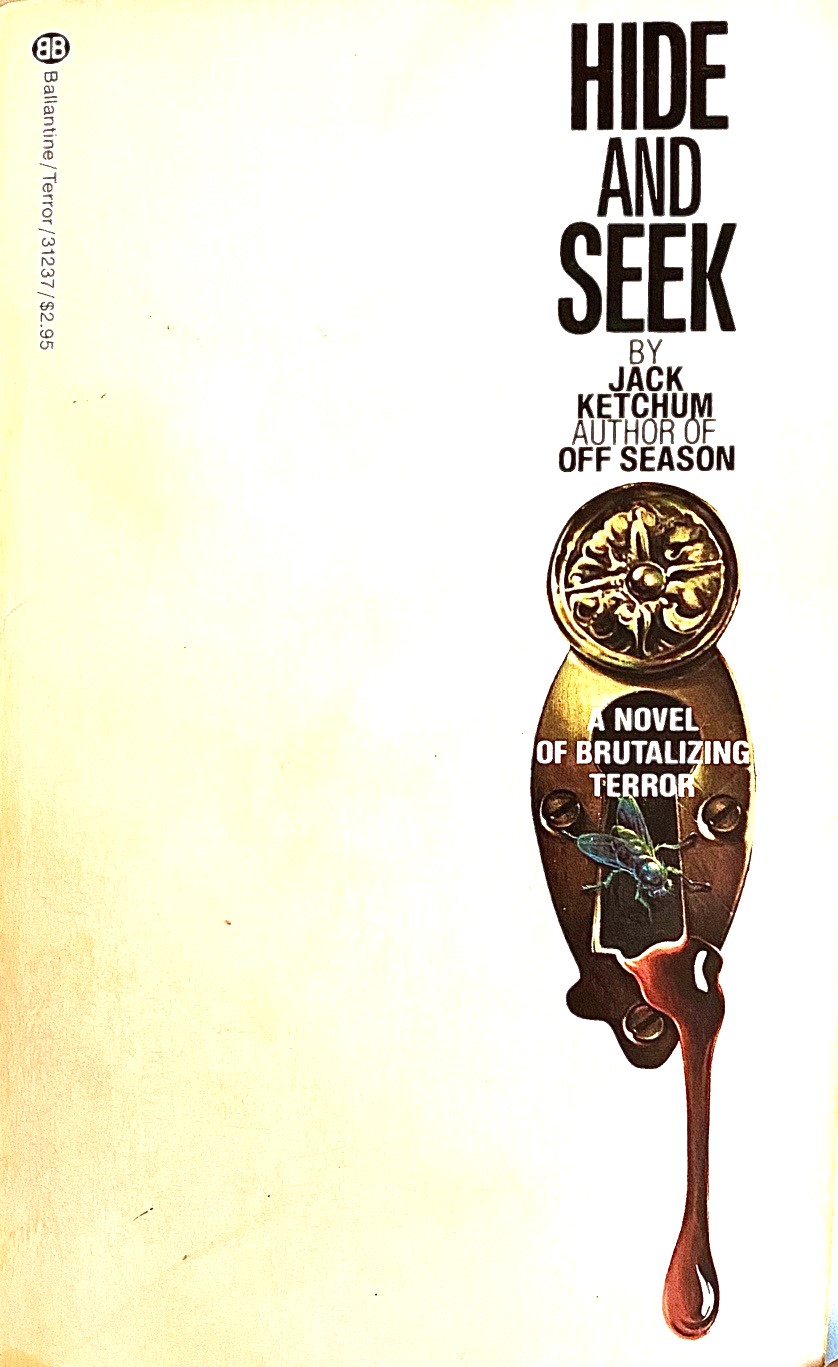
Hide and Seek by Jack Ketchum (1984): Linger on Your Pale Blue Eyes

A brief, stark coming-of-age tale of terror, Hide and Seek was the second novel from the late Jack Ketchum—famous pseudonym of author Dallas Mayr, who died of cancer in 2018 at age 71. Published as a paperback original by Ballantine Books in June 1984, this slim little book reads like a James M. Cain or a Jim Thompson crime novel, with a no-account narrator meeting an enticing woman far outside his league (I was way outclassed and I knew it), related in plain prose rife with hard-boiled philosophizing, a sense of unavoidable fate lurking behind the everyday facade. I don't believe in omens, but I think you can know when you're in trouble.

Set sometime in the Sixties, Hide and Seek is told in retrospect by Dan Thomas, a regular young guy living and working in a lumber mill in Dead River, Maine. Pretty much a dead-end town, he's in a dead-end job, but when he and another blue-collar friend are hanging out at the touristy local lake, Dan happens to meet three college "rich kids," Kimberly, Steven, and most intriguingly, Casey White. Casey, with eyes pale, pale blue that at first it was hard to see any color in them at all. Dead eyes, my brown-eyed father calls them. Depthless.    

Dan is of course completely besotted with Casey, and reluctantly hangs out with Steven and Kimberly too just to be with her. Steven loves Casey but has settled for Kimberly; this is a fact known by all. They drink beer, hit the beach, skinny-dip, shoplift, pull dumb pranks. They laugh a lot but nothing's really funny. Dan meets Casey's father, who seems a broken man, and learns of a horrific tragedy in the family' life. Dan and Casey have sex in a graveyard. Just like in a classic noir novel, Casey is the femme fatale, but she's most fatal to herself; that tragedy has caused her to be reckless, which is what  frightens, and yet attracts, our narrator. In the Middle Ages, they'd have burned her at the stake.

Ketchum builds tension well in the book's first half, with short declarative sentences, simplistic dialogue, and that sense of fatalism permeating everything—the kind of thing crime noir is known for. I appreciate his attempt at writing a horror novel that incorporates other genre elements, to infuse his stories with a grimy grindhouse slasher feel combined with tentative attempts at character detail, but to what end? I was really into the long fuse of the set-up, wondering what character flaw would trip the deadly spring I knew just had to be poised over the characters' heads. And then Ketchum reveals it, and all the goodwill built up by his careful tightening of the noose is spent. "Hide and seek. Just the way we used to play it when we were kids. But we play it in the Crouch place."

I'm going to talk freely about what happens in the second half of the story, so I guess a spoiler warning is warranted from here on. 

The Crouch place Casey is talking about is Dead River's haunted house, situated on a cliff above the sea, abandoned years before by the two owners, Ben and Mary Crouch. Rumored to be imbecilic siblings, they had lived in filth with their many, many dogs. Which the couple left behind, starving and near-mad, when the police pay a visit a month after they'd been evicted for not paying their mortgage. To be honest, all this became too Richard Laymon-style for me, this scenario of teens sneaking into an empty old creepy house at midnight to play a child's game, tying up one another with nylon ropes when "found." "How do you feel about bondage?" "I love bondage!" She finished buttoning her blouse.

The novel is too "talky" and 90% horror-free for a horror novel, while the origins of its violence too hokey for a crime novel. And Ketchum is so damn solemn about everything. Lighten up, Francis! He invests too much seriousness in that trite finale, a lot of po-faced silliness that squanders all that great suspense he worked so hard to build up. A giant dog in the caverns beneath the house eating people? Monstrous Ben and Mary Crouch living down there in the earth? In a schlockier horror novel, sure. But all this time spent laying down a prosaic reality, hinting at horrors in the future that cannot be avoided, alluding to human flaws that will lead to tragedy, and then it's just some B-movie monster ripping people apart in gory, yet somehow bland detail. It's not as dumb as Laymon, you can tell Ketchum cares a lot, but it's still thin gruel for a seasoned reader.

In the Eighties, fat horror novels were the rage; books that featured lots of characters, situations, settings, plots, conflicts, and blood and scary scenes splashed throughout. Ketchum bothers with none of that. Not even 200 pages, Hide and Seek is a novella padded out to get to even that length. With this bare bones approach, he must have felt like a man without a country back then. No one really wrote this style of book, and the reason is: it doesn't work. Hide and Seek just doesn't work, not as horror, not as crime, not as coming-of-age. Why push your readers through to an end where you rip the characters apart, ostensibly for the moral of "the world is a horrible place but I think I've learned to cope"?

I never heard of Ketchum till the early 2000s, around when The Girl Next Door was reprinted, and he published no short stories in the Eighties, which is where I learned about new writers then. I doubt I'd have enjoyed his books anyway, as I was looking for more challenging, more imaginative vistas, writers like Barker, Koja, Tessier, Lansdale, Brite, Ligotti, etc. people stretching the boundaries of horror into weird new realms. Novels trading in giant monster dogs and slasher cannibals like this novel would've seemed to me like tired retreads of tropes I didn't care about in the first place.

Ketchum has a great reputation in the field, as a mentor and as a mensch, and his death was mourned by everyone who loves the genre. But this second novel is failed ambition, a concoction that promises terrifying delights but in the end delivers little of real interest, almost negating itself. This was the fourth book I've read by Ketchum, and while not as bad as She Wakes, Hide and Seek is a step down from, and a little derivative of, his brutal and grueling debut, 1980's Off Season. The more I thought about it the more I felt it was like a writing exercise, a very first draft, a practice session to prepare for the real thing.

Eventually Ketchum would come into his own and define his own style with The Girl Next Door—the real thing—but I'm realizing I haven't liked even his books that I consider successful. From what I've read about his later novels, many seem to be extreme scenarios of sexual violence and cruelty mixed with that fatalistic philosophy and slow build-up. Never say never, of course, but I doubt I'll be picking up one of his other books any time soon.