Showing posts with label tor books. Show all posts

Wednesday, August 24, 2022

The Wells of Hell by Graham Masterton (1979): Rock Lobster!

Whenever I find myself picking up and then tossing aside paperback horror novel after paperback horror novel, dismayed and distressed at the author's inability to hook me to the narrative even in the first few pages; whenever it pains my soul that it's been months since I've read a good book; whenever I begin to despair of the genre I love and almost desire to leave it all behind—I know it is high time to get myself back to my trusty old authorial standbys. And Graham Masterton, thanks be to him, is one of those standbys.

For some time I've been hearing chatter, whether on Facebook or Instagram, Twitter or Reddit, about Masterton's 1979* novel The Wells of Hell, which I believe was his 12th (yep, a dozen novels since his 1975 debut!). Don't know how long I've owned a beat-up copy of the 1982 Tor/Pinnacle edition, which you see at the top there, lackluster cover art by artist unknown, and to be honest I never really gave it much thought till, as I said, hearing chatter about it. Good chatter. (After more than a dozen years running this blog, I've developed a second sense about that kind of thing).

After glumly returning for the fourth or fifth or hundredth time some or other books back to my shelves unread that had failed to impress, that chatter got louder in my head and I plucked Wells from my Masterton collection. Won't say I had high hopes, but I knew I was in good hands—probably. 

Aaand—I was! In good hands! Masterton's sure, sarcastic, first-person narration drew me into his tale in an instant, welcoming me back to the fold. Mason Perkins, our narrator, is a humble horror hero, once a college fella studying psychiatry but who dropped out to make a go at something more useful but no less essential when getting to the cause of a problem: plumbing! 

When we meet, Mason is driving along a rural road on a cold Connecticut afternoon with his cat, Shelley (named for the poet, a hint of his school days), to visit the Bodines. A young couple in a cozy country home, Jimmy and Alison hope Mason, reliable plumber extraordinaire, can determine why their well-water is coming out of the faucets an unappetizing yellow-greenish color (or "colour," as the British text in this American paperback has it) and smelling kinda fishy. 

After some foreshadowing conversation—a missing local child, Jimmy's recent dreams of drowning—Mason takes a sample of the water to his pal Dan Kirk, a scientist working at the town Health Department. There Mason makes cute talk with Dan's assistant, the "provocative" Rheta Warren. Mason delivers the corniest of come-on lines to Rheta—"Is this really a job for a girl like you?"—while Dan looks at the water sample under a microscope. No surprise: swirling through the liquid are tiny seahorse-shaped micro-organisms complete with twisted horns and crusty bodies, excreting a urine-looking substance. Disgusting!

 Tor Horror reprint, 1989. Charles Lang cover art

Things take a turn for the worst when, after Dan and Mason go out for dinner and drinks (Rheta has a date with a football player whom Mason mocks like a teenager) and return to the lab to find an unsettling sight: a single mouse, from the crevices of the lab's breakroom, afflicted by a crustacean/insectoid shell and claws on its rear half. They realize it must have drunk from the Bodines' water sample. Mason immediately tries to call the couple to tell them of this alarming development and warn them off the water, but to no avail. The two men make the trek to the Bodines' home, finding it dark, silent, and empty inside, yet dripping with water, as if the house had been submerged in the tide. In an upstairs bedroom, they find the incredible: the body of the Bodines' young son Oliver, impossibly drowned... and in the bath, the chitinous carapace of some kind of enormous insect, crab, or lobster. Disgusting!


Sphere UK, 1988.
Maybe if I put a little dish of butter sauce here with a nutcracker, it will run out the other side.


And, of course, from here more Masterton mayhem. In his classic style of breezy, no-rest-for-the-wicked narrative, he invokes Native mythologies and cosmic Lovecraftian lore as our cast of characters rush to solve the mystery of lobster-shelled locals and flooding waters, missing children and the meaning of "Pontapo's curse." Where are Jimmy and Alison? What lies in the deep crevices beneath the earth of New Milford? What caused the unaccountable drownings of the 1770s? Why is it happening again? Who is Ottauquechee? And last but not least: what the hell is in that well?! I won't spoil it for you, but as one of those creepy monstrosities says:

"I am everything and everyone. I am the servant of the god of times gone by and times yet to be. My name is everything and my face is everyone. I am preparing for the resurrection of the greatest of those who lived beyond the stars... The day will soon be here when the great god will rise out of the wells which have been his sleeping-place for so long, and when all men will bow down before him and offer themselves happily as sacrifice..."

Sphere UK, 1981. Terry Oakes cover art

Freaking awesome. There's a headlong sprint to the well-done, eerie subterranean climax, with Shelley (pun intended, one presumes) the cat playing an important role, which should please many readers. Despite his tongue-in-cheek approach, Mason comports himself well for being a simple plumber, bravely facing off with a nightmare nearly beyond comprehension. Wells of Hell may not be the most suspenseful horror novel you'll ever read, as its plot construction is by-the-numbers, and characters even talk about how real life is suddenly feeling a lot like Invasion of the Crab Monsters from the 1950s. But why quibble? This is all good familiar horrific fun.

Masterton has never wasted too much time on the rational understanding of events; his heroes tend to dive in the deep-end with pulp conviction. Nor does he bother making anyone speak American English, they all sound like proper (and not so proper) Britons, but that's part of the Masterton charm. As with his other books, many of which I've enjoyed, there's an almost first-draft vibe; I felt the very ending could've done with another polish. Oh well. Masterton and his Wells of Hell got me out of a summer-long reading slump, I can recommend it to lovers of vintage horror without a second thought, and I can't ask for much more than that!

*The copyright is dated as 1979, but I cannot ascertain which edition was published that year; there is conflicting info online. I know, I know: something wrong on the internet?!

Friday, November 12, 2021

Christopher Pike Born on This Date, 1954


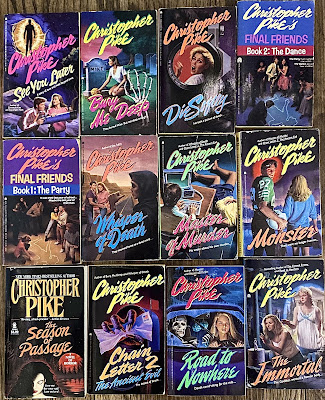
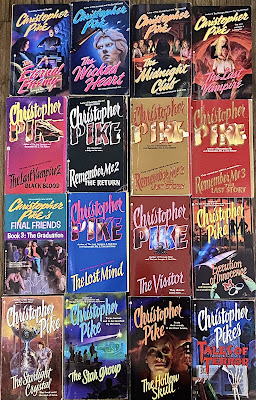
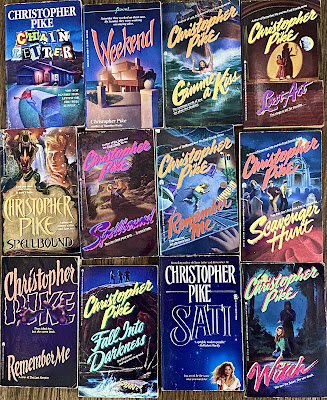
The pen name of New York City-born Kevin Christopher McFadden, Christopher Pike was one of the big-selling writers of young adult speculative fiction during the late Eighties and well into the Nineties. I well recall selling lots of these slim little paperbacks during my bookstore days back then. Published by Pocket Books under their YA imprint Pathway, his books popped off the shelves with his name featured in neon as well as distinctive, evocative cover illustrations, most by artists Brian Kotzky, Danilo Ducak, and Mark Garro. Die-cut peekaboo and stepback covers abound!

I was too old to read them myself, but I know Pike's books strike a real nostalgic chord for younger horror fans who later graduated to adult horror writers. Tor Books published his two adult novels, Sati (1990) and The Season of Passage (1992). Pike is famously reclusive, but a recent, illuminating interview can be found here. These paperbacks you see in this post are from my wife's collection; she's been buying them off and on for years!

Monday, February 3, 2020

Ancient Images by Ramsey Campbell (1989): The Wheat is Growin' Thin

Folk horror has been enjoying a resurgence in popularity in recent years, but it is certainly not a new subgenre. Fans have long spoken of the rustic, pagan, creepy charms of books and movies like Harvest Home, Blood on Satan's Claw, The Wicker Man (based on the near-forgotten 1967 novel Ritual by David Pinner), Witchfinder General, The Ceremonies, "Children of the Corn," "The Lottery," most recently Midsommar, and of course back to the greats like Arthur Machen. Rural landscapes, taciturn locals, primitive religious and cult practices, and doomed interlopers are the essential tropes that form the basis for this always-fascinating pocket of horror.

So I'm well chuffed to report that Ramsey Campbell's 1989 novel Ancient Images (Tor paperback, June 1990, art by Gary Smith) ticks all those boxes successfully. A measured, mature, and well-paced thriller that finds the prolific modern master Campbell plying his quiet horror trade in top form, I devoured this book in a matter of days, eager to get back to it every time I had to put it down.

Campbell in 1989, photo by JK Potter

Interestingly, the impetus here is utterly modern: the search for a lost (fictional) film. Tower of Fear stars horror icons Boris Karloff and Bela Lugosi, produced during the same era as their real dual-starrers like The Black Cat (1934) and The Body Snatcher (1945). Graham Nolan is a film critic for television news who has finally tracked down a copy of the film, suppressed and never released, after searching for it for two years. He invites his colleague, film editor Sandy Allan, from the TV station they work at, to watch it with him. When Sandy arrives at Graham's apartment that evening for the "premiere," she finds it's been ransacked, the film projector knocked over and empty film canisters strewn about... and no copy of Tower of Fear. Then she sees Graham on the roof of the adjacent building, and as Sandy rushes to an outer door, she can only watch in horror as he tries to leap back to his own building, but misses and falls to his death:

His mouth was gaping, silenced perhaps by the wind of his fall, and yet she thought he saw her and, despite his terror, managed to look unbearably apologetic, as if he wanted her to know that it wasn't her fault she hadn't been in time to reach him.

Upon learning of the rarity of the film, the police think that Graham chased a thief across the rooftops. Sandy thinks this makes as much sense as anything, and writes an obituary for Graham to be broadcast by the station, mentioning his search for Tower of Fear and its theft. A day later a snarky tabloid critic who knew Graham pays him a backhanded tribute in print, angering Sandy by the dent it makes in Graham's integrity. She confronts this pompous writer, Len Stilwell,  at a horror movie premiere with American film historian Roger Stone (our eventual love interest). Stilwell dismisses the two of them and their mission: "I write consumer reports, I've no time for cleverness. Nor to argue." Wow do you wanna smack the guy! (Was Campbell inspired by a real-life critic?!)

Armed with Graham's notebook that contains contact info of people who'd worked on and starred in the film so many decades before, Sandy begins tracking them down, determined to save Graham's reputation. The mystery grows, for director Giles Spence was killed in a car accident just after filming ended. Karloff and Lugosi themselves never spoke of it. Like so many novels before and since, this research quest is a pleasure to read. What sinister force made this movie such a troubled production, caused it to be banned, led its makers and stars into seclusion, secrecy, even death? I mean, I love this kinda shit!

Campbell shines as he creates the unique characters Sandy meets. To a one they seem agitated, even fearful, to have Tower of Fear brought up again and again; many principals are aging and their adult children don't want their parents bothered by some trash horror nonsense from long ago. Even Sandy's parents are put off by it, although Dad admits, "Neither your mother nor I have heard of it, though it's the kind of thing we would have lapped up before the war changed all that."

Legend Books UK, 1990

Sandy meets the editors and designers and and writers and actors who were involved with Tower of Fear, and as I said, it's a pleasure to read; Sandy is a smart and capable character. She even hangs out with a disreputable group of grungy young movie fans who put out a gore zine. His fictional cinematic creations and their intersection with real-life movie culture isn't cute or self-aware, nor is it pretentious or faux-intellectual (*cough* Flicker *cough*), it simply is.

But it's the creeping unease when dealing with those who helped make the movie, the paranoia and distrust, which Campbell conveys with such subtle mastery, that propels the novel forward. There are also notes of tragedy, particularly in the sad career of once-popular actor Tommy Hoddle, who'd provided the comic relief for Tower of Fear. Sandy tracks him to down at a beach resort town where he is playing in children's afternoon theater shows, this one a pathetic vampire spoof. She tries to engage him about the movie, to no avail, and succeeds only in terrifying the poor old chap...

Eventually, after much to-do that involves a burgeoning affair with Stone, professional pressures, and figures that flitter and caper just at the edge of perception—that hallmark of Campbell's off-kilter approach to chills and dread—Sandy finds the owner of the movie rights. This is Lord Redfield, of the township Redfield, known far and wide for its successful agriculture which provides the wheat for Staff o' Life bread, a popular brand whose commercials always seem to be playing in the background. Lord Redfield invites Sandy to his palatial home, and in Bond villain fashion, explains (almost) all to her. Political strings and newspaper ownership factor in, but there are still unsettling questions in Sandy's mind about the film and its relationship to Redfield... and sullen locals to avoid. She scales an historic tower, obviously the inspiration for the film, and traipses through the cemetery, where death dates have an uncomfortable 50-year regularity going back centuries. And that name: red... field. Uhhh, that can't be good. Folk horror fully engaged!

US hardcover, cover art by Don Brautigam

And I haven't even mentioned Enoch's Army. What's Enoch Army? It's a sort of leftover band of hippie revolutionaries who are trudging in a caravan through parts of England, looking for a safe haven to call home, but tabloids are biased against them (guess who owns one of those tabloids). Tensions are rising as no one wants these folks around. Campbell has them on a parallel with the search for Tower of Fear, both literally and figuratively. During her travels, Sandy comes across them in the road with police escort, but one of the children runs in front of her car and she nearly hits him and his mother. Apologetic, Sandy talks with them and then the leader himself, Enoch Hill. His words form the thematic core of the novel:

"Our way is to move on when the land wants to rest and dream, but the mass of men won't leave it alone. Man and the land used to respect each other, but now man pollutes the land...There'll come a day when the earth demands more of man than it ever did when man knew what it wanted... All fiction is an act of violence... Man can't resume his old relationship with the earth until we remember the tales that told the truth. We had a blueprint for living, and civilization tore it up."

Basically, Enoch himself made me think of Alan Moore.

UK hardcover

All these disparate elements are steadily making their way towards one another in Campbell's sure hand: Enoch's Army, those strange twig-like shadows hovering at the corners of the narrative, Lord Redfield, Tower of Fear, the harvest... step by careful unavoidable step. Beautifully paced, restrained, subtle, and intriguing, I've only sketched the aspects that make this such a satisfying read; it has to be one of Campbell's very finest works of the Eighties. It's also cool that Campbell is no mean film critic and fan himself, so you just know he had a high old time writing it (and he thanks our old pal Dennis Etchison in the notes for his help with cinematic minutiae).

Like the atmospheric black-and-white movies of the past that Campbell invokes, there is scarcely a drop of blood, but there is a great deal of suspense and mystery. If you love film history and behind-the-scenes accounts of film-making, the trappings of folk horror, or a sharp, well-crafted tale, this is a must-read. Ancient Images is also a great place to start if you've never read a Campbell novel. No doubt about it: this is a masterful piece of quiet horror. That quiet, however, just means you can't hear what's sneaking up behind you.

 She imagined the land was able to send something to hunt victims on its behalf...

Thursday, January 21, 2016

RIP David G. Hartwell (1941-2016)

From Tor.com:

"It is with profound regret that we confirm that David Hartwell, award-winning editor and anthologist, and a vital part of Tor for over three decades, has passed away. He was a warm, familiar, prolific, and iconic presence in science fiction fandom and publishing, beginning his career in 1971 as a consulting SF editor for Signet, co-founding The New York Review of Science Fiction in 1988, editing thousands of books and dozens of anthologies over the years. He was nominated for the Hugo Award forty-one times, winning the awards for Best Professional Editor in 2006 and Best Editor Long Form in 2008 and 2009, as well as editing Nebula and Hugo Award-winning novels."

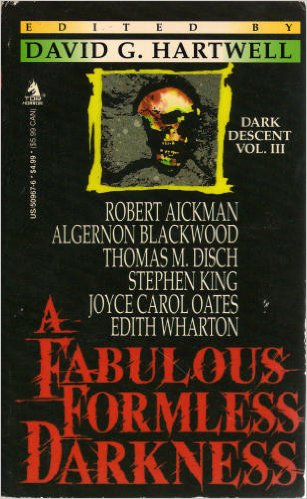
In addition to his SF contributions Hartwell edited two enormous horror anthologies, The Dark Descent (1987) and Foundations of Fear (1992).


Wednesday, February 25, 2015

The Kill Riff by David J. Schow (1988): Ain't It a Shame To Be Shot Down in Flames

Another re-read of a novel I loved back in the horror hey-day. There is no horror as fans know and love it in David J. Schow's 1988 novel The Kill Riff (Tor paperback published May 1989), despite it bearing the icon of Tor's horror line; this is a suspense thriller through and through. The most accurate blurb about is from Penthouse, that bastion of literary acumen, and it states the novel's high-concept succinctly: "Gives us the nightmarish psychology behind the systematic murders of a heavy-metal band." A dark nightmarish tune, Schow's first novel is all revenge and madness and the toll it all takes on the human psyche. Like lots of Schow's short fiction there is no supernatural element, and none is necessary. People can do crazy all by themselves.

Schow, early 1990s

Middle-aged Lucas Ellington, fresh out of a stint in a fancy, relaxing psychiatric "home," is attempting normalcy again. His beloved daughter was trampled to death at a performance by LA's heavy metal bad boys Whip Hand, Lucas went over the deep end and threatened Gabriel Stannard, the lead singer, but today, Lucas just wants to drive up to his cabin in the California wilds and chill, alone. He touches base with his business partner, Burt, with whom he runs an advertising company, as well as the female psychiatrist, Sara, who might be falling in love with him. Both think Lucas is well on his way to recovery... but he is not. In his still-fevered brain, Lucas wants to lay the members of Whip Hand to waste, kill 'em all, no mercy, and hidden in that secluded cabin is an arsenal direct from any Nam vet's worst nightmare... or wet dream.

The Kill Riff revels in a noxious stew of toxic masculinity. Lucas is obsessed with Whip Hand, stung by visions of his daughter's last moments worshiping at the rock'n'roll altar. He begins filling a room in that cabin with records and tapes and videos and posters of the band. Planning murder on large, media-saturated scale is a delicate and involved business, as the band has broken up and the members all play in different bands, so Lucas must navigate tour itineraries and concert hall logistics and backstage passes. His Nam experience make all that cake. Meanwhile we meet Gabriel Stannard, the cool and charismatic rock god who knows the whole circus is a sham to "make the teenies cream" but realizes, as his old bandmates are picked off one by one, that Lucas Ellington is gunning for  him, and that's as real as it gets. With the help of his bodyguard Horus and bald maniacal guitar player Cannibal Rex, Stannard amasses his own arsenal for a final showdown. Cue collision course straight for chaos in the final chapters, immovable object meets irresistible force.

There are some terrific moments of tension scattered throughout Kill Riff, scenes that Schow treats with loving care: Lucas stalking the catwalk of a concert hall while a metal band goes through its ear-splitting pyrotechnics and thousands of kids in screaming worship; an abused young woman standing up for the first and final time to her grinning terrorizer; an injured sheriff crawling to his patrol car to radio for help. Gripping stuff in Schow's singular, stinging prose. No surprise he began writing more crime thrillers later in his career long after that whole splatterpunk thing was over. He throws in some twists that are just devastating, devastating I tell you! That's what I remembered most about the novel: the unexpected events that change everything.

 UK paperback, 1990

But those twists aren't enough. The problem is that the scenes linking these set pieces vary in quality and reader interest level. Lucas discussing Whip Hand trivia with a cynical record shop manager rings true and cute, and Schow has a skill with detailing old friends Burt and Lucas and how they talk to one another. But rocker Stannard is a just a spoiled, posturing douchebag, so it's no fun listening to him expound on anything, and all his hanger-ons and bandmates are complete creeps. Why do I care if they stand up to Lucas? Anything to do with Stannard's slinky Euromodel girlfriend Sertha is just wasting time. Once Lucas's true self is revealed, the less of him the better. Minor characters pop in and out, often more interesting than the leads. You just want Lucas and Stannard to meet, draw their weapons, and kill each other, get it all over with! Blast away guys, nobody's gonna miss ya. Both men get what's coming to 'em, but will you still care by the end?

Schow loves the minutiae of subconscious motivation, self-reflection, repressed fears, idle speculations, and the contemporary (well, '80s contemporary) Los Angeles lingo of ad firms, psychiatry, and show-biz schmoozers. That's an area Schow has always mined in his short fiction, in his own particular style. His characters talk and talk and talk, diving deep into their own heads and trying to get inside others'. They are hyper-articulate but at times the reader will definitely think, People don't actually talk like that (unless everybody was snorting coke off-page; I mean the setting is 1980s LA). Between that and their dorky jokes, the dialogue alone can be exhausting. And Schow's experience as a men's adventure scribe mean lots of details about weaponry. This can be difficult to integrate into a narrative, and my personal tolerance level for gritty realistic odes to the AR-15, the M16, and the AK-47 is virtually nil. It's not that Schow doesn't work this stuff in well, it's that I tune out for it.

 UK hardcover, 1989

I wasn't too taken with Schow's depiction of the '80s metal music scene either. As a dedicated reader of Circus and Hit Parader from 1983 till about 1988 (basically a generation in pop music), I think I can call foul on some of it. He's got guys in metal bands playing keyboards, guys with bald heads and names from the punk scene, dudes with muscles and Mohawks. So he's not describing WASP or Motley Crue or Dokken or Iron Maiden or Judas Priest or Motorhead, but actually more a band like the Plasmatics. Which actually kind of makes sense, because out of all those folks the only person I can imagine taking up arms against a rabid, raging father bent on vengeance would be Plasmatics singer Wendy O. Williams. What, I'm supposed to think Vince Neil would do that? Ha! Hardly. Is that Schow's point, all these wannabe badasses in metal bands thought they were all walking the mean streets but at heart they were really just pussies? Maybe so. Gabriel Stannard, beholden to the bullshit bad-boy code, sure ends up paying a high price trying to prove he's the real deal. Ironic, no?

I really wanted to like Kill Riff on this reread, because I loved it way back when (even though I had the same complaints about the band stuff) but I only enjoyed the book in fits and starts, and can't really recommend it, even to readers, like me, who have loved his short stories. Oh well. And I haven't given up on Schow at all: what I really want to do now is track down a cheap copy of his 1990 horror novel The Shaft, which for whatever reason was never published in the States. I mean, you can't beat this cover:


Friday, February 13, 2015

New Series at Tor.com: The Evil Eighties

Over at Tor.com, Grady Hendrix and I have begun another series on horror fiction. This one is "Evil Eighties," and first up is my look at John Farris. Happy Friday the 13th!

Wednesday, December 17, 2014

The Face That Must Die by Ramsey Campbell (1979): I'm Determined and I'd Rather See You Dead

When it comes to horror titles, Ramsey Campbell's first two novels, 1976's The Doll Who Ate His Mother and 1979's The Face That Must Die, must be considered as some of the most provocative of their day; in their tasteless glories they shout like cheap tabloid headlines. Yet within the books readers will find an imagination that is fine and not crude; sensitive and not exploitative; authentic and not postured. Indeed, the introductory essay included with the 1985 Tor edition, "At the Back of My Mind: A Guided Tour," is Campbell's well-known account of his worsening relationship with his mother as she sank into dementia over many years. These days mainstream memoirs and fiction of life with crazy parents are a dime a dozen, but Campbell's piece has no distancing irony or comic effect. Harrowing and sad and enlightening, it is Campbell's explanation for ''why I write what I write," and readers can come to their own conclusions about how this influenced The Face That Must Die.

Campbell in 1980

Face is the story of the aptly-named Horridge, a nobody kind of fellow in a precisely-drawn Liverpool, whose growing paranoia is exacerbated by his obsession/revulsion with an overweight, effeminate older man who lives in his Liverpool neighborhood. After reading in the papers about a "man whose body was found in a Liverpool flat was a male prostitute" and studying the accompanying suspect police sketch, Horridge comes to realize "he had seen the killer three times now, in as many days. That was no coincidence. But what was he meant to do?" His conviction that random events are a secret code to him alone is unshakeable.

Horridge finds out the man's name is Roy Craig by searching through library records (and mildly creeping out library clerk Cathy Gardner, who with her long-haired boyfriend Peter actually lives in the same building as Craig), Horridge begins systematically stalking and harassing the man. Craig's homosexuality—Horridge is correct in his presumption—offends him to his core: "If he was a homosexual he was perverted enough for anything." Which of course means he will continue to kill, and must be stopped by any means necessary--actually he can be stopped by any means necessary, because Horridge is doing away with degenerates and doing society a favor.

Campbell does a solid job of making the reader feel uneasy. Everywhere, things seem off: conversations are snippy, irritated, impatient; graffiti stains walkways and alleys (Horridge keeps seeing the word "killer"); the wheezing buses are crowded and smoke-filled; twilight is always seeping into Horridge's apartment; his limp is painful and insistent; library customers are resentful, grumbling at the clerks wielding petty powers (in a scene Campbell admits is autobiographical); fog prevents everyone from seeing clearly. Liverpool is as much a character as Horridge or Cathy or Peter, and at times even seems conspire against Horridge; he sees the tower blocks, rundown flats, loud pubs, grimy gutters, grey skies, and bare concrete as one big institution, a prison ready for its cowed inmates. Everywhere the banal, the mundane, threaten to swallow the sane and insane alike; the suffocation is palpable.

Sometimes he thought the planners had faked those paths, to teach people to obey without questioning... the tunnel was treacherous with mud and litter; the walls were untidy webs of graffiti. All the overhead lights had been ripped out. He stumbled through, holding breath; the place smelled like an open sewer... A dread which he'd tried to suppress was creeping into his thoughts—that sometime, perhaps in fog, he would come home and be unable to distinguish his own flat.

Immersed in Horridge's psyche, the reader is also both fascinated and revolted by his thought processes as they cycle through mania and grandiosity, memories of a painful childhood, and his ever-present desire to clean up the filth (moral and literal) he sees growing everywhere around him. Every tiny detail, every sliver of dialogue, every simile, drips with an uneasy threat of everything about to fall apart, as if reality itself were trembling on the precipice of chaos. Campbell allows us a few views outside of Horridge's, but overall we feel as he does: threatened, maligned, powerless. Then he lashes out in anonymous—and unwittingly ironic—calls to Craig: "Just remember I'm never far away. You'd be surprised how close I am to you."

 1st UK paperback, Star Books Dec 1979

The novel also offers some insights into contemporary British life. Craig's backstory of his marriage breaking up is sad and all too common, I'm sure. His wife discovers his gay porn, is horrified, and her last words to him are, "I think I could have borne it if it been another woman." In his opening essay, Campbell talks about his non-use of illicit drugs, but he sure gets the details right describing the dregs of late '70s drug culture, the desultory nature of trying to score, the hangover of 1960s radical politics ("I bet he thought I'd have to be middle-class and polite. No chance, brother"), and the nagging suspicions that the Establishment is just waiting to pounce. Peter and Cathy are growing apart due to his continued use of marijuana and LSD; they're a counterculture couple suffering relationship ills of the bourgeois. They and Craig, along with bohemian artist Fanny who also lives in the building, will have their confrontations with Horridge, moments in which a razorblade flashes its brilliance in dingy rooms...

There is one scene I must point out. Horridge goes to the cinema to see a film, but the only title that resonates is the one that contains the word "horror" ("Horror films took you out of yourself—they weren't too close to the truth"). Check it out:
Was it supposed to be a musical? He'd been lured in under false pretenses. It began with a wedding, everyone breaking into song and dance. Then an engaged couple's car broke down: thunder, lightning, lashing rain, glimpses of an old dark house. Perhaps, after all—They were ushered to meet the mad scientist. Horridge gasped, appalled. The scientist's limp waved like snakes, his face moved blatantly. He was a homosexual.

This was a horror film, all right--far too horrible, and in the wrong way.
Yes: Horridge inadvertently attends a screening of The Rocky Horror Picture Show! One of the funniest and most telling—and most deserved—moments I've ever read in a horror novel (AFAIC all homophobes should have Tim Curry's Dr. Furter shoved in their faces and, yes, down their throats).

Scream/Press hardcover, Oct 1983, art by J.K. Potter

Campbell keeps the story moving quickly as Horridge's fears grow and grow. He's a bit of a walking textbook of serial killer tics and tactics, but it's not just serial killers who display these attributes. His hatred of homosexuality (his hatred of any sexuality: at one point late in the novel, Cathy is running after him, trips and falls, and Horridge hopes the breasts she flaunts have burst); his belief that society is degrading more and more; his hatred of foreigners and anyone different, gay or not; the shades of his disappointed parents hovering about him—is this an indictment of Thatcher-era England? All I know about English culture I learned from '70s punk rock, but this sounds about right. Campbell is also wise to draw a parallel between Peter and Horridge, who are both aware of how out of step they are with modern society and the paranoid fantasies this engenders in them.

Futura UK reprint, 1990

Readers who enjoy the experience of being thrust into the killer's mind will enjoy Face; no, it's no American Psycho or Exquisite Corpse, it's not nearly so deranged or explicit, but for its time it's a brutal expose. A more accurate comparison could be made to Thomas Tessier's Rapture; both books are able to make their antagonist's irrationality seem rational, which is where the horror sets in. Despite a meandering chapter here and there, The Face That Must Die is an essential read for psychological horror fans. Many times Campbell hits notes that only now are we beginning to hear and understand about the minds of Horridge and his like. When Horridge finds one of Fanny's paintings is of himself, he slashes it apart with his beloved razorblade (see the Tor edition's cover, thanks to Jill Bauman); somewhere inside he knows, but can never admit, that the face that must die is only his own.

Wednesday, November 19, 2014

The Horror Paperbacks of Ken Eulo

Newark-born author Ken Eulo celebrated his 75th birthday this past November 17th, and although I've never read nor own any of his books, they were quite big paperback bestsellers in the 1980s. Certainly I saw dozens of copies of these titles while working in a UBS in the early 1990s but I wasn't ever drawn to them. His trilogy of "Stone" novels--The Brownstone (Oct 1980); The Bloodstone (Oct 1981); and The Deathstone (Nov 1982), all from Pocket Books--are set in the urban enclaves of Manhattan, and today are available as ebooks.

According to ISFDB, there is no artist credit given for any of these titles, and you can tell there are cutouts in the covers so we're missing some nice stepback images. The only actual stepback art I could find online was for the second book, The Bloodstone--and you'll note its similarity to the iconic Flowers in the Attic (1979). That art was done by a woman named Gillian Hills. Not the Gillian Hills, I can hear you saying. Well, brace yourselves: it is the same Gillian Hills! Perhaps she was responsible for the Eulo trilogy as well.


I never tire of skulls with flowing locks; Nocturnal (Dec 1983) really goes for it, bone by bone. The Ghost of Veronica Gray (Aug 1985/cover art by Lisa Falkenstern) would appeal to teenage girls, I suppose, but certainly not to a teenage me.

Pocket Books stopped putting out horror fiction in the late '80s, so Eulo's next couple books were published by Tor. 1988's The House of Caine features a nicely sensual lady vamp, but according to some Amazon reviewers, it's fairly terrible. Then in 1991 came Manhattan Heat, which has an uninspired mainstream cover, very Joseph Wambaugh meets Jackie Collins. According to Eulo, though, it's "about New York City, the underground subways, and zombies." Read a good behind-the-scenes, where-are-they-now interview with Eulo here.

I end asking: anybody read any of these?