Despite it coming out at the height of the Eighties horror boom and published by genre giant Tor Books, I have no recollection at all of
Fine Frights: Stories That Scare Me. An anthology of short stories compiled by the great and prolific
Ramsey Campbell, the subtitle is the seller here: a story that can frighten one of horror's premier authors will surely reduce regular readers to a slab of shivering Jello. I've owned my minty-fresh copy of the book—never reprinted—for well over a decade, after finding it a library book sale and paying a whopping single dollar for it. The
Jill Bauman cover, while perhaps not one of her most accomplished, references one of the stories therein; and if you look closely at the bottom brick on the right corner, you can see her sig: "Jill."
 Campbell in 1988, photo by J.K. Potter
Campbell has assembled a dozen stories that he has deemed his favorites, and are actually only "a sampling" of the short works that have scared him over the years. Some of the names readers of science fiction will recognize more than horror fans, some stories are decades old and virtually forgotten, while others are—were—contemporary of the time but had not yet made their bones. I can assure you that, whenever a particular story was written is of no matter; these are top-flight tales of terror, with (almost) each one containing masterful soul-freezing moments of fear, unease, or shock.
Not a moment is wasted as we begin: "Child's Play," by respected Danish literary author
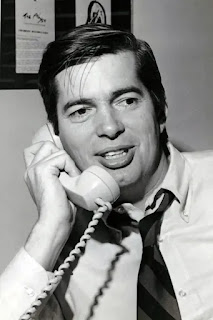
Villy Sorensen (pic above), worms right under the skin. Written in the early Fifties, its unassuming title belies the story's utter remorseless cruelties; it's underwritten in a sly, chilling manner, almost like child-speak. This is fitting, as we meet the two little brothers, never named, who happen upon a smaller boy named Peter. A highlight of the entire anthology.
"Shut up! We must clear this up before mother gets home."Two of the best authors of the day are represented:
Karl Edward Wagner's classic "More Sinned Against" has been one of my personal favorite horror tales since I first read it back when I was in high school, when it appeared in
David J. Schow's essential 1988 antho
Silver Scream. Two people trying to make it in the sleazy show-biz environs of Eighties El Lay, with all the ups and downs that requires. This bit of comeuppance is rife with Hollywood grit 'n' glamour, and what happens after the glitter fades. The ending is a total banger, unforgettable lo these many decades later.
Candace couldn't have endured it all if it weren't for her selfless love for Rick, and for the coke and smack and pills and booze.Thomas Ligotti's "The Greater Festival of Masks" is from his Songs of a Dead Dreamer, just after its small press pub in 1985, but prior to the mass market release; only then would his name would gain more and more recognition. All the Ligottian trademarks are here: nameless city, crooked streets, eerie moonlight, shops of bizarre accoutrements, and reflections upon identity and reality. This is not my favorite Ligotti story, but its essence of the esoteric is so strong, so pervasive, its climax so uncanny, I can see why Campbell chose to include it. For these are the declining days of the festival when the beginning and the end, and the old and the new, the existent and the nonexistent all join in the masquerades.

One of the dozens of anthologies in which "Thurnley Abbey" appeared, 1984Dating from the early years of the 1900s, both "Thurnley Abbey" by
Perceval Landon and "The Necromancer" by
Arthur Gray work wonders with the musty trappings of classic ghost stories. While the former has to be one of the most anthologized around, Campbell notes in his little intro that he found many of his readers didn't know Landon's story at all; Gray's work is a brief, erudite,
M.R. James-style spooker. While these old-fashioned tales-within-tales can, to some modern readers, seem a little dusty and remote, I can assure you they retain their ice-cold powers.
"I know that my heart stopped dead, and my throat closed automatically.""The Fifth Mask" by British author
Shamus Frazer (pic above) is certainly a precursor to the output of both Campbell and Ligotti. A nervous man reminisces over double whiskies about a frightful occurrence from his boyhood, when he and a pal, on the Fifth of November, were out and about pranking while wearing masks, which was the style at the time (published originally in 1957, there are several uses of the n-word to describe said masks here). But someone has beat them at their own game of disguise... The entire dank and anxious mood is one that must have affected Campbell greatly, because many of his works have precisely the same vibe.
She was as thin as her voice, dressed all in black... there was a stucco wall behind her, patched and discoloured as a gravestone, and the ghosts of winter trees rising above and losing themselves in the twilight. "The War is Over" by
David Case is original to this anthology, so maybe Campbell commissioned it. It is
grim. Case wrote two cult horror/Gothic novels,
Fengriffen and
Wolf Tracks (1971 and 1980 respectively, both back in print from, who else,
Valancourt Books), but was not overly prolific. This tale is set just after WWII, but the main story is one of enemy soldiers. This one has teeth and no mercy.
"The brave soldier was not then so brave. He pleaded, he begged. He called upon God. Soon he could no longer plead with words, for he had no tongue."From 1963, "The Horror at Chilton Castle" by
Joseph Payne Brennan (above) is, I believe, fairly well-known among horror aficionados. I first read it some 10 or 12 years ago, and haven't forgotten it. Brennan was a respected mid-century horror/fantasy writer whose work stretches back to the
Weird Tales era; his
"Slime" is one of the great novellas of pulp horror ever. Here, Brennan evokes time-honored horror tropes with his narrator traveling through Europe looking for his ancestors. He hopes to visit the legendary Chilton Castle, to which his family has distant connection.
In a pub nearby the castle on a storm-lashed night, he ruminates on its spectral legends, and chances to meet someone who can give him a tour of the place—and, well, things go on from there. Strongly and vividly written, "Chilton Castle" is another fine example of
Fine Frights... and the inspiration for the cover art. It would've made one helluva an episode of
"Thriller"!
There were variations of the legend. Without doubt the original tale had been embroidered down the centuries, but the essential outline of the story concerned a secret room somewhere in the castle. It was said that this room contained a terrifying spectacle which the Chilton-Paynes were obliged to keep hidden from the world.
The four remaining stories are from science fiction authors; I'm sure that Campbell was reading them in magazines in his adolescence. This is to be expected: before the
Paperbacks from Hell
era, and even well into the Seventies, horror itself was cloaked in
terms of SF, mystery, thriller, suspense, Gothic, speculative, fantasy,
et al. Still, the authors know how to pluck a nerve ending.
"Cutting Down" by Bob Shaw (above) is by far the most graphic story
included, a piece of Eighties grue originally published in Isaac Asimov's Science Fiction Magazine. I have absolutely no idea how he rates as a science fiction writer, but as a horror writer he does admirably. An Irish author who got his start in SF fandom, here Shaw gets right at one man's disgust, and the lengths he goes to to relieve himself of this ill. Another tale of comeuppance, oh so vaguely reminiscent of Stephen King's "Quitters, Inc." He drove a roughly estimated cubic centimeter of the fluid into his wife's bloodstream, withdrew the needle and stepped back, his breath coming in a series of low growls which he was unable to suppress.
Okay, I kind of guessed where
Peter Phillips's (above) "Lost Memory" was going, but still found it fairly gruesome. A Fifties SF tale through and through, in which awkwardly made-up words, clunky characters names, and stilted "scientific" dialogue and description run amok while information is clearly withheld from the reader solely for an effective twist at the end. Not really my kind of thing at all, but I can imagine being a kid back then reading it for the first time, yikes.
Chur-chur was muttering to himself about the extreme toughness and thickness of the stranger's skin. He had to make four complete cutting revolutions before the circular mass of white-hot metal could be pulled away by a magnetic grapple.Not last, but least:
John Brunner's "The Clerks of Domesday" is not completely terrible, I get the chilling implications of the
narrator's paranoid delusions, but found the execution tedious. Brunner was connected to the New Wave of SF of the late Sixties and Seventies with prophetic novels such as
Stand on Zanzibar,
The Shockwave Rider,
and
The Sheep Look Up, and while this story seems to fit his dour predictions and predilections, it was the only one I struggled to finish. It had never been published prior to
Fine Frights and has never been reprinted again.
Our final story is from the mighty
Philip K. Dick (above), an early work, dated 1954, entitled "Upon the Dull Earth." If at first it is obscure, it will become haunting and forlorn; Dick's powers at evoking an emotional response was there from the beginning of his career. A young couple, angels, stars, an alternate plane of reality; a myth of the underworld, and lost in it. Dick's long interest in spiritual lives, esoteric religion, heretical beliefs, day-to-day reality versus cosmic illusion: all here.
It was a terrified reflection that showed out of the mirror above the bowl, a face, tear-stained and frantic. The face was difficult to catch—it seemed to waver and slide. Grey eyes, bright with terror.There you have it! And it should be no surprise that Ramsey Campbell has assembled such a high caliber anthology; the various styles of horror represented gives the book a wide appeal. It's a no-brainer:
Fine Frights is a fine feast, a repast of morbid morsels that belongs on the shelves of any and all paperback horror collectors.