Saturday, September 5, 2026
Hiding an Ungodly Horror: The Cover Art of Paul Stinson
Sunday, July 13, 2025
Moths by Rosalind Ashe (1976): She Loves Naked Sin
This moody, erotically-charged cover art, by American romance illustrator H. Tom Hall, is perfectly fit for a sophisticated novel of doomed romance and obsession; I bought this paperback over a decade ago solely for its melodramatic atmosphere. I knew nothing of author Rosalind Ashe (1931-2006), and assumed the title, Moths, referred to the hapless male victims of a magnetic, alluring, possibly dangerous woman of incomparable beauty and passions. And... I was right.
The blurb comparison to Daphne du Maurier and her classic 1938 novel Rebecca is apt, though Moths doesn't reach the heights of suspense and emotional turmoil of that work. How could it? Yet this novel offers some good escapist fare, kind of what they're calling "romantasy" today, I think. The style, first person by an Oxford professor, is quite a bit plummy; I was constantly Googling his various allusions and references and poetic quotes to truly grasp and appreciate what was happening. Personally I find a lot of British culture, of whatever class, very interesting (piqued by decades-long obsession with the first wave of punk rock in the mid-Seventies), so this was fine and dandy for me. Other readers might take this as a warning, however, who don't have patience for an academic approach to such goings-on.

Penguin UK, 1977
There, also exploring the grounds, he meets the Boyces, a couple eager to make the place their own: James, another professor who is less committed to his work than to his mistresses; and his enchanting wife "Mo" (short for Mnemosyne, Greek for memory, and mother of the Muses, not too pretentious now!), who charms Prof. more than Dower House itself. Prof. Harry is able to befriend the two and thus finds himself invited into the home and their lives... and passions. James was her senior by ten years, a self-made academic... She was the last of a line of penniless aristocrats... In California, or on another social rung, she might have turned flower-child, perhaps Jesus-freak. As it was, she had an altogether unusual charm...
Ashe weaves a luscious stew of supernatural hints and erotic trysts in a delightfully dated Seventies style, very Jolly Old England, very gender-normative, very femme fatale. But is the femme fatale a ghost, a possession, an imagination? Who is this madwoman who, as the title explicitly implies, draws hapless men into her fiery embrace? Bodies turn up, cops are on the case, a diary is read revealing murder... poor Harry, can't he catch a break? This woman, Mo, (also called Nemo, which is Latin for "no one"—not too pretentious now!) is alluring, even unto death. Mood swings, migraines, to put up with her idiosyncrasies requires utmost submission, because you know the sex gonna be goood. Never had she been more lovely, more violently alive. The Regency actress who inhabited her seemed positively recharged by another victim: the dead thriving on the dead.
Thursday, June 12, 2025
The Snake by John Godey (1978): My, My, My Serpentine
Enter The Snake: a 1978 thriller from a writer named John Godey. This was the crime fiction pseudonym of Brooklyn-born author Morton Freedgood, who had worked in NYC's film industry for all the giant movie companies, like Paramount and 20th Century Fox. As noted on the cover of the 1979 Berkley paperback, Godey previously wrote The Taking of Pelham 1-2-3, which was made into a 1974 movie that also captured NYC at its most lawless. Letting loose a giant slithering atavistic reptile into the gleaming greenery of Central Park must have seemed like a no-brainer to the author, especially in the wake of Jaws. The cover of the original hardcover captures it nicely:
Godey seems to know every inch of the city, doling out places names and addresses like any reader will know exactly what he's talking about (ah, New Yorkers!), and I often plugged in such into Google Maps to get a clear view of the specific environs the action was happening in. His depiction of the titular creature is both scientifically sound and aesthetically unsettling. The reasoning for its arrival and escape is believable in its randomness, a backstory both intriguing but also blackly comical in a way, and very NYC-coded. "Two dead in less than twenty-four hours, that's one thing... People die all the time. But the other thing, the politics, that's serious."
Characters are familiar: the beleaguered cop, the cocky young herpetologist, the lovely journalist, the sweaty mayor, the religious nuts who make it their mission to find and kill the demonic reptile, plus various hapless victims introduced and dispatched with maximum suspense. Godey may be writing a slick bestseller, and he's a bit above the pulp pay-grade; still, lots of vulgar '70s slang and profanities and ethnic slurs you'll remember from the movies of the day, with less enlightened folks going about their daily grind in a city that can swallow you whole—and now even has the ability to inject fast-acting fatal venom right into your veins. New York City really has it all, don't it? "Any other city, if somebody got bitten by a snake, the public would blame the snake. Here they blame the mayor."
Thursday, December 26, 2024
Punish the Sinners by John Saul (1978): I Got a Catholic Block
But me, personally? I was never once interested enough in one of his paperbacks to pick one up, not with babies and dolls and cribs on the covers (very Mary Higgins Clark, no thanks). Working in bookstores used and new from the late Eighties to the late Nineties, I bemoaned the popularity of his work, even though I hadn't bother to read him. To me, all of his books looked, as is said today, mid. There were countless copies of his derivative-looking titles always around, jamming up the horror section, all read to tatters in the used paperback exchange I worked at in college, and later, upscale hardcovers for those eager and solvent enough to drop twenty-plus (!) bucks on his reheated hashwork.
Saul's books seemed to me fodder only; not truly horror fiction in its grand tradition, just disposable tchochkes for the less adventurous reader. And now that I’ve read one, let me tell you: my impression was absolutely correct. A duller, drier, more inconsequential book I have rarely read in the decade and a half that I've been keeping this blog. Punish the Sinners (Dell, June 1978) was Saul's second paperback original; maybe he got better, maybe he got worse. I'll never know, because I don't care. And although I have a few of his early paperbacks in my collection—these days, I do kinda appreciate the cover art—I'm in no hurry to read another.
This is the type of "horror" that my blog is a reaction to and against. While better writers sold fewer books, Saul's sold in the millions (and probably still do). I've always wanted to find the forgotten and the overlooked, the authors lost in the shadow of their lessers, shine a light on those who were worthy of rediscovery—not simply tread the same old worn-out ground of yesteryear's dusty bestsellers. Nobody needs to be told to read John Saul, and I rue horror fan pages on Reddit and Facebook and social media elsewhere in which his books are still recommended to innocent readers not around during his peak popularity and thus ignorant of the poverty of his imagination.
This kind of by-the-numbers banality is what the splatterpunks were rebelling against in the mid-Eighties. What any good, thoughtful horror writer of any stripe should be against (King rightly lambastes him a couple times in Danse Macabre). The folks spearheading the Dell/Abyss line also had to have Saul's books in mind as they stated in their manifesto.
Sinners exists in some netherworld, some purgatory, of the
undistinguished, a gray rock of a novel that requires no imagination or effort on the part of the reader. Two bloody characters walking
towards each other on the street of the small town at the "climax" was about the only unique, vaguely interesting moment in the whole 400-page slog. Oh, right, almost forgot, there's a graphic priest orgy, too, which Saul attempts to use as shock but in his slow-witted manner only manages to lazily disgust.
To sum up my feelings about this novel—in case you couldn’t tell!—I will quote from that other musty old tome, the biblical Book of Revelation: "So, because you are lukewarm, and neither hot nor cold, I will vomit you out of My mouth."
Tuesday, June 11, 2024
The Accursed by Paul Boorstin (1977): Coils of the Serpent Unwind
And who can forget that great line from the Scorsese version of Cape Fear, with deranged De Niro snarling, "Granddaddy used to handle snakes in church, granny drank strychnine"? I haven't seen that flick since the grunge era and yet have never forgotten it. I was reminded of it recently when I picked up a book that's long taken up residence on my bookshelves, The Accursed, a slim novel published by Signet in November 1977. With a perfectly-rendered cover of innocence and evil, reduced to their most primeval, Paul Boorstin's first novel is one of the many titles Signet put out that feature animals run amok. This time, the animals are snakes of various deadly varieties, all part of the worshipful country cult ceremonies held by one Preacher Varek. [He] seized a hissing Indian cobra, the scaly coils writhing in his grasp, its forked tongue, sophisticated sensor both taste and smell, flicking, bringing minute chemical particles back to be analyzed in the Jacobsen's organ above its jaws.
At the edge of Desperation Swamp in Clay-Ashland County, South Carolina, sits Thornwald Memorial Hospital, a time-worn edifice showing its age in the sweltering clime of mid-July. Run by a power-hungry administrator with no medical degree and rotating crew of indifferent, autocratic, and/or horny employees, the hospital is hardly a place one would want to spend any time in, much less perform as a doctor or recuperate as a patient. Unfortunately for Dr. Adam Corbett, a man of character and do-goodery vibes, perform here he must, and when he learns that the newborn baby of poor swamp denizen Mary Ann Cotter is suddenly and inexplicably dead, a baby he elivered, he is not convinced of the coroner's explanation of crib death: Adam would have to tread lightly or lose his job.
Early on, we learn that this crumbling hospital was built on the site of a Confederate infirmary that, in 1863, was attacked and laid waste by Yankee soldiers, forever a place where bloodshed and black powder had poisoned that strip of land overlooking the swamp forever... the only thing the property was good for was a hospital or a graveyard, take your pick. More than once I was reminded of the late great Michael McDowell and his Avon paperbacks, and the Southern territory, both physical and psychological, that he would mine in a few short years. Author Boorstin certainly doesn't have the meanness, the mercilessness, the weird vivid characters, the deadly droll narrative of McDowell's works, but that's fine; Boorstin acquits himself well in these proceedings.
We're not here for finely-wrought characterization of human foible, we're here for monster mayhem, and Boorstin has the skills for just that, getting right at the skin-crawling repulsion that coiling serpents engender in us: Man's world seemed a simple matter of neat geometry, straights lines precisely drawn to meet at sensible right angles. But this cold-blooded hunter curved, twisted, a devious, sinewy, supple being eluding rational explanations.
The paperback's bio page states that he was inspired to write The Accursed while "filming in the Amazon interior" and spending time in the hot South Carolina sun. Boorstin's experience is wide-ranging, a professional documentary filmmaker/producer and TV screenwriter; his father was American historian and author Daniel J. Boorstin. His next novel, Savage (which I own but have not read), also happens to feature some fantastic cover art:
The Accursed especially snaps to life when Preacher Varek, a giant of a man shrouded in black, [his] head shaved bald by a straight razor, is onstage. Suspense ratchets up when he comes into contact with Jean, Dr. Corbett's pregnant wife, rescuing her when her car gets stuck in the mire, and shames her for wanting to have, you know, her baby in a hospital with modern medicine and all. The preacher contradicted everything the young doctor stood for and Adam worried where Jean's naive belief in this swamp healer might lead.
Other unsavory characters abound, mostly snake fodder, and Boorstin isn't above the cheap thrills of the Seventies, like the sexy nurse who caresses
herself—not too tacky now!—and meets an inspired "sex and death" end in a bubbly bathtub. Unhooking her bra with one hand, she rubbed the icy champagne bottle along her bare, sweaty breasts, beds of moisture condensing around the enlarged crests of her nipples. Or the poor burn victim bastard who tries to get an old nurse to read him dirty magazines, utterly immobilized, a free meal for a ferocious reptile. Maynard's eyes peered over the coils of his murderer, the orbs nearly popping out of their sockets from the pressure...
Yeah, I gotta say, Boorstin has written some truly tasty scenes of serpentian gore and horror. There are two climactic scenes of confrontation; the first is good, yes, but the second is a fuckin' ripper, and I could easily see the fake blood flying and the mechanical snake writhing and roiling in a cheap TV-hospital set. Her blood mingled with the serpent's, to drench her nightdress in gory impasto.
Like the previous novel I read, The Night Creature, this book got better as it went on, doling out its suspense level in a workmanlike manner, crisscrossing plotlines, very much in a cinematic narrative. You're definitely getting you your dollar-ninety-five's worth of B-movie entertainment. Did Boorstin miss a few opportunities to imbue a little more, I dunno, gravitas here and there? Sure, I guess; there are several times when the author's voice rings out over the standard cliche melodramatic proceedings that you wish he'd have given this baby one more writerly polish. But even its more lackluster moments didn't last too long. Boorstin's adeptness at describing ophidian destruction makes The Accursed a satisfying pulpy read, and its inclusion on the very cover of Paperbacks from Hell is thus the perfect place for it.
The intruder seemed to congeal out of the moist and heavy air, gliding stealthily,
almost as if knowing this was a place of such fragility that it must trespass with infinite care.
Thick as a fire hose, it slithered slowly from the air-conditioning vent: five, ten, fifteen feet long, and still extending, an uninvited guest so out of place in the room it hardly seemed possible the interloper was there at all...
Friday, May 17, 2024
The Night Creature by Brian N. Ball (1974): She Rides
Fortunately it is the case for this 1974 novel The Night Creature (published in the UK as The Venomous Serpent), by British scribe Brian (N.) Ball. For several weeks I meandered through the first two-thirds of it. Not because it was bad, or uninteresting; Ball, a prolific writer of SF, is a capable author, if kinda dry (it's told in first person, a style I've found myself losing interest in over the years). No, I just found it all rather tame and indistinct; for every little aspect that made me perk up, I'd have another several pages of, sure, okay, whatever. The book would sit on my nightstand for days untouched, till last week. Dammit, I can finish this guy! Spurred on by a few positive reviews on Goodreads, I sat down early one afternoon determined to get to the end. And I did! And boy was I glad!
And thus follows standard procedure: Andy convincing Sally what he's seen, a visit to the ruined church where Sally first made the rubbing, learning the local lore of the people in said rubbing, intimidating locals warning them off the church property, cranky coppers (I was fool enough to call on our local policeman), and one truly old eccentric priest Andy tries to enlist in his aid when Sally disappears one day. The lady Andy seeks is one of the blood-drinking living dead: Undead, blood-crazed, monstrous thing from the tomb she might be, there was no doubting her beauty. Can he rescue Sally in time from the Lady Sybil?
Not unlike a contemporaneous Hammer horror film, The Night Creature is a mere wisp of a book at barely 150 pages. It truly does ramp up suspense and interest in the last third, so by the end, the tale has found that sweet spot, the one I personally truly adore and crave, and nuzzles there, suckling and secure.
Tuesday, December 5, 2023
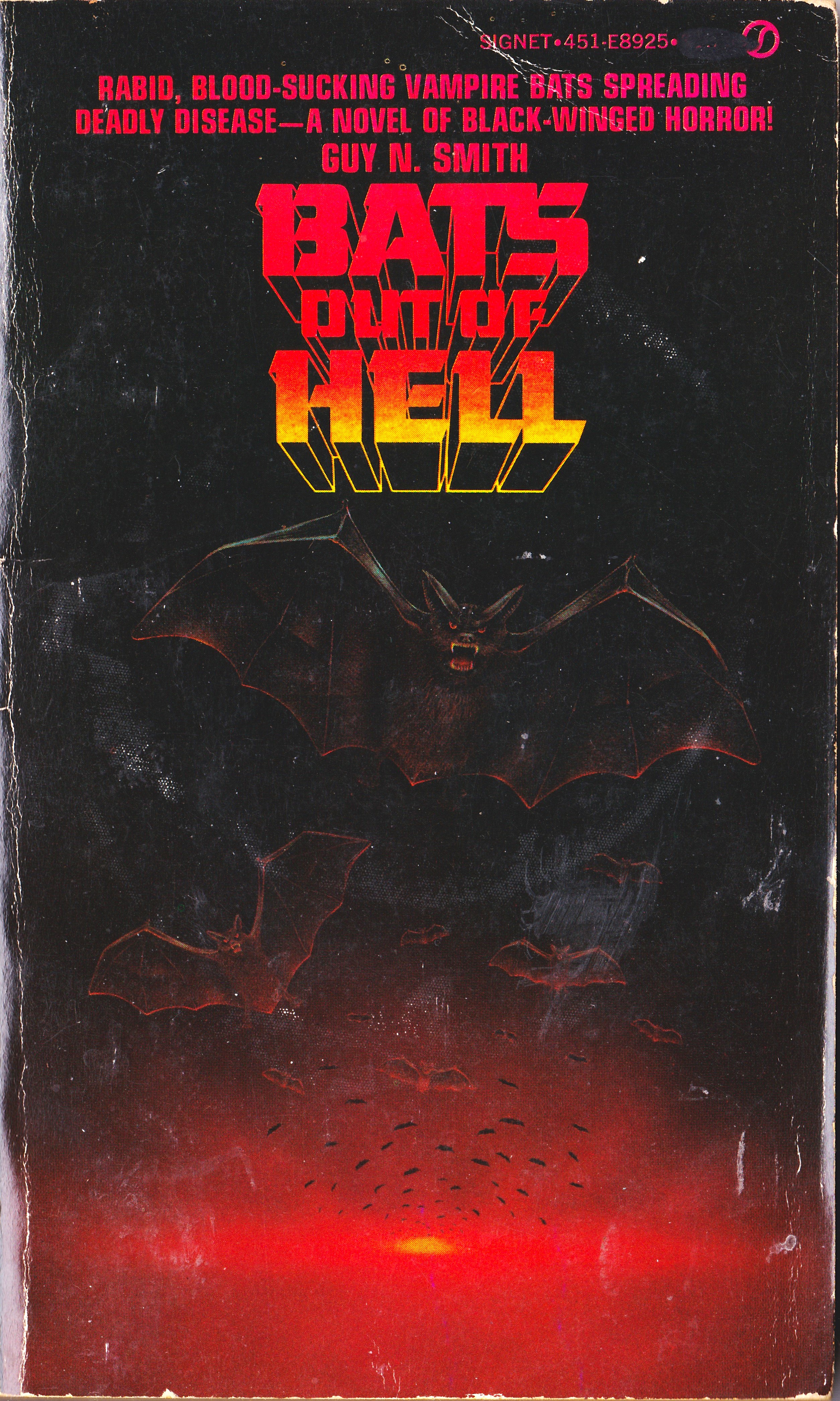
Bats Out of Hell by Guy N. Smith (1978): Wings of Pain Reach Out for You
We begin in a science lab at the Midlands Biological Research Center, smack-dab middle of beloved tourist spot Cannock Chase, acres of natural land. Against the wishes of the locals, this "ugly scar on the landscape" now is filled with scientists studying disease, ostensibly "to benefit the good of all mankind Except for... for this!" That emphatic "this" refers to the study subjects of Professor Brian Newman: bats. The poor experimental animals locked in cages, have been injected with disease, in a rage, flying futilely about, dying paralyzed, ugh, poor things. I'll let manly Prof. Newman himself explain the method to the madness:
"The virus is a mutated one caused by experimenting. I've tried to determine the difference between bacterial and viral meningitis... I've never known the disease lead to madness or such awful agony. And I have created a new horror. A mutated virus! God knows how it happened... my God, how far could it spread... even humans? It doesn't bear thinking about!"
Newman's pulp hysteria is calmed by sensible on/off gal-pal and fellow scientist Susan Wylie, as she notes this disease, is trapped inside the cages with the bats, surely nothing bad will happen, there's no way it can escape, they can wait till the creatures die off, be cremated, and Newman will admit to his superiors that his experiment was a failure. How big of him! Then Susan and he argue over their romantic entanglement after he breaks their date for that night; then Newman and his boss Haynes argue, all the while, many of the enraged bats are dying in agony beside them. Its eyes seemed to meet his, and they glittered accusingly, with sheer malevolence. Blaming Man, as though in its last seconds it understood.
I'm sure you can see where this is going...

1985 reprint, NEL, Terry Oakes cover art
Newman has broken his date with Susan to hook up with Fiona at a local pub, and of course Susan sees them together. Next morning at the lab, before Susan arrives, he notices the death rate of the bats has slowed and the creatures still alive seem more agitated than ever. Newman again ponders what he hath wrought:
Whereas earlier he had been repulsed, he now experience a morbid fascination almost to the point of being hypnotized. He had crated something, death in a form that had not hitherto existed. It was all his doing... This was different, exciting. Death could occur at any second.
Well, dear reader, here comes the part we've been waiting for. Susan arrives and is cool and dismissive towards him—how dare she! It's back to professional relationship only. Newman's masculinity is so shattered by this he of course cries "You bitch!" and cracks her in the face. Enraged, Susan attacks him, and Newman falls against the glass bat cage and breaks it wide open... and the last living disease-bearing animals have their escape at last. Wow, can you say toxic masculinity?
Smith now embarks on the time-honored tradition of vignettes of bat swarms attacking hapless British (specifically Birmingham) citizens in farms, banks, churches, wherever. Now, as noted, the bats are spreading a gruesome disease that causes agonizing pain, insanity, and paralysis; they are not blood-suckers out looking for a treat. Authorities are called in, Newman wants to accept responsibility—there's a novel idea!—as the bats wreak their havoc. The media have a field day and call out Newman by name, putting his life at risk. Vigilantes patrol the streets as thousands die from contagion. Cities burn, armored tanks fire upon citizens who try to gather in protest of the stay-at-home directive. Petty politicians rise up with conspiracy theories. What will it take to stop the bat epidemic? It's all a little unsettling to read these days!
There was no antidote.
Nothing on God's earth could save you.
Tuesday, February 21, 2023
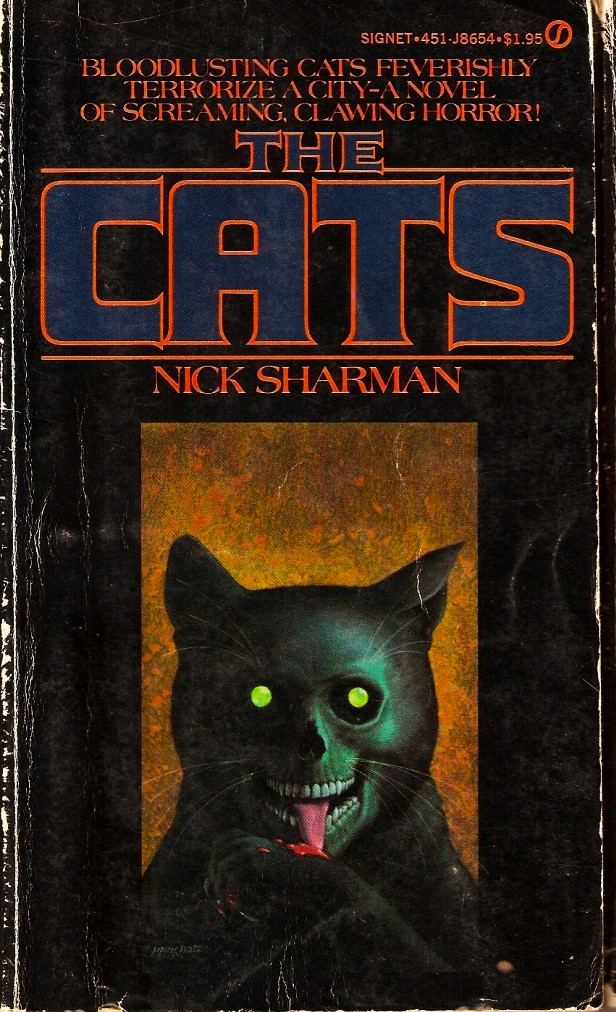
The Cats by Nick Sharman (1977): Apocalypse Meow
Scott Grønmark was his name and writing pulp horror paperbacks under the pseudonym "Nick Sharman" was his game. Born in Oslo, Norway, in 1952, he was working in the PR department of New English Library (which is why of course he had to use a pseudonym) when he began his published career with The Cats. It was originally published by NEL in 1977 (below), and then by Signet in America in May 1979. Subsequently he wrote six or seven novels, only one under his real name. Notoriety came Grønmark's way some years back when internet wags postulated that he was the person responsible for the infamous sleaze-horror "classic" Eat Them Alive, which wasn't so; you can read his response here.
An early entry into the animal attack publishing craze led, of course by Jaws and The Rats, The Cats offers up most, but not all, of the usual template, even though the subgenre had only been going on a couple years by 1977. Most characters are irritable, stuffy, smug, and/or macho. Or American, for no reason I could discern. Victims run the gamut of British society, briefly introduced, quickly dispatched. Requisite cynicism about politicians while the mighty military comes in swinging their dicks. Science is responsible for the poor kitties' condition. There isn't even a love interest, believe it or not, but there is an attempted rape—about the only woman who appears (the assault is prevented at the last second). Two sets of estranged fathers and sons lend a tad bit of character conflict. One human is afflicted by the same disease as the cats have, maybe there's a psychic connection too, an addition I found intriguing.
I wish Grønmark had attempted to give his rampaging cats a smidge of personality. We all know cats in our personal lives who are more interesting than some people in our social circles. Imagine if he'd spent just a chapter on the creatures themselves, even just a couple kitties, perhaps even inspired by then-bestselling juggernaut Watership Down—recall how Richard Adams did marvels with cuddly rabbits! That would've given this slight 154-page novel some much needed ballast as well as some empathy for innocent animals.
But that's not what this book is or wants to be. Despite several vivid attacks early on, Grønmark doesn't seem to have much energy to inject his tale with anything but the driest essentials. There's little spark in the proceedings, not even anything but the most workmanlike approach to feline slaughter. Prose is competent, serviceable, but lacking any real juice. He simply keeps the narrative going faster and faster but with diminishing results, I mean I've kind of already forgotten the specifics of the climax, such as it is, and the cute yet utter by-the-numbers final paragraphs fail to surprise. I did like the guy who tries in vain to fight back against the beasts with acid, is still overwhelmed, and croaks, as his last words, "Oh well, you can't win 'em all."
Previous Grønmark books I've read, The Surrogate and Childmare, were more entertaining, written with a bit more skill and conviction. As noted, The Cats was Grønmark 's debut novel, and I guess he simply didn't have the chops yet. (At least it led to a successful writing career, I'll give it that; he died in 2020 aged 68.) Unfortunately, I found The Cats lackluster, offering nothing fresh to the all-too-common cliches of animal-attack literature. If you're a collector, you'll want the Signet edition with that spectacular Don Ivan Punchatz cover, but unless you're an animal-attacks obsessive, you can probably leave the book on the shelf.


%20(April%201982)%20-%20Stinson%20cover%20art.jpg)


.jpg)