My tale had been called "The Attic Window," and appeared in the January, 1922, issue of Whispers. In a good many places, especially the South and the Pacific coast, they took the magazines off the stands at the complaints of silly milksops, but New England didn't get the thrill and merely shrugged its shoulders at my extravagance.
- Lovecraft, "The Unnamable" (1925)
In the early 1970s, a young military dentist named
Stuart David Schiff began a seeming inexhaustible labor of love by putting together a little magazine of original horror and dark fantasy stories, which he titled, in a nod to HPL,
Whispers. Finding the horror genre lacking in outlets for good writers, Schiff simply created one himself, was able to offer money, and attracted the attention of an impressive roster of scribes, both the classic -
Robert Bloch,
Fritz Leiber,
Manly Wade Wellman - and the (then) newly minted -
Dennis Etchison,
Karl Edward Wagner,
Ramsey Campbell, as well as folks never heard from again. Illustrators too, were welcomed, some hearkening back to the original Arkham House days, like
Frank Utpatel and
Lee Brown Coye - Schiff's editorial senses were impeccable.
Whispers #1, July 1973 - great cover art by Tim Kirk
Later in the decade anthologies of the best stories were published in hardcovers, and then, of course, came the paperbacks. In February 1977 the first
Whispers paperback was released, from Jove/HB. You can see the cover art below, by
Rowena Morrill, and how it features not a single real image of horror; it seems more fantasy-oriented, I mean, what is that, a dragon, and a princess? (Actually it's inspired by Wellman's adventure tale of Native American mythology, "The Dakwa").

At the top you see the June 1987 Jove reprint and its startling cover art by
Marshall Arisman, intimating distorted psychological states in the sleek metallic sheen of a modern world, terror for the end of the century. But that's not what
Whispers is; the terrors of
Whispers are of the comforting old-fashioned sort, evil fantasies vividly told, well-oiled engines of weirdness and frightful fun that invoke demons and devils, Lovecraftian entities, vengeful madmen, landscapes of legend and myth, and other staples of the much-loved pulps era... with a few new twists.
Editor Schiff today
Almost to a one, the stories Schiff has compiled are solidly entertaining.
Whispers starts off strongly with "Sticks." Originally written as a kind of horror writer's in-joke,
Karl Edward Wagner's (pic below) story mixes
Weird Tales art, anthropology, and vague cosmic malice to terrific effect, and it has become a classic in that Mythos; it won the 1975 British Fantasy Award for best short story and has been reprinted plenty (you'll also note its striking similarity to a popular indie horror movie that came along two decades later). Amazingly enough it was inspired by real-life events! A pulp horror artist comes across a strange collection of bundled lattices of sticks in the lonely woods of upstate New York.
It should have been ridiculous. It wasn't. Instead it seemed somehow sinister - these utterly inexplicable, meticulously constructed stick lattices spread through a wilderness where only a tree-grown embankment or a forgotten stone wall gave evidence that man had ever passed through.

And things just get worse from there. Really worse. Pretty great, unique, disquieting, although I could have done without the little explanatory afterword included, just a paragraph down from the story's final doom-laden lines.
Whispers #9, July 1976- eerie art by Steve Fabian
I've noted before that with the explosion of paperback horror in the 1980s the quality of the writing itself suffered much, but that in the '70s the genre was still populated by professional authors who could
actually and truly write. How refreshing! There is the delicate style of
Robert Aickman's (pic below) tale "Le Miroir," in which
the most complex of ordeals sometimes finds its own resolution, and now Celia sat before the beautiful mirror or looking glass, now in one new dress, now in another, and intermittently without troubling to put on a dress at all.

Dark fantasy elder statesman Fritz Leiber's penchant for horror set in the current day appears in "The Glove." A tale of rape and guilt written in a smartly casual manner, Leiber's narrator wonders,
Gloves are ghostly to start with, envelopes for hands - and if there isn't a medieval superstition about wearing the flayed skin of another's hand to work magic, there ought to be. Although I'm not a fan of sword-and-sorcery, and
Brian Lumley's "House of Cthulhu" is firmly in that field with its medieval vocabulary and dialogue (speaking in "ayes" and "Os" and names with lots of Zs, Hs, and Ys), the story began to charm me, especially because of its skin-crawl climax and Cthulhu references.
Weirdbook Press, 1984
Some comic relief too: Bob Bloch contributes a mordantly self-referential piece, "The Closer of the Way" (his first book was entitled
The Opener of the Way; get it?). "Mirror, Mirror" has a classic deal with the devil gone wrong,
Ray Russell's satiric swipe at vain Hollywood types. You'll dig the Cockney cannibal of "The Inglorious Rise of the Catsmeat Man" by
Robyn Smith. And
Richard Christian Matheson's "Graduation" is an epistolary tale of a college student's clever, insightful, but not-quite-self-aware letters home; he keeps mentioning
you-know-who but, sadly, I'm not quite sure who that was... but I don't think I'd want to be there when he comes home for spring break.
Matheson - Man I gotta find & reread his Scars
And
Whispers ends with a bang: "The Chimney," one of the best Ramsey Campbell stories I've read. A child learns of Santa in the worst way, much too young, a fiend on television:
I'd seen two children asleep in bed, an enormous crimson man emerging from the fireplace, creeping toward. They weren't going to wake up! "Burglar!" I'd screamed. "No, dear, it's Father Christmas," my mother said. "He always comes out of the chimney."
Perhaps if she'd said "down" rather than "out of"...
This is one of Campbell's straightforward tales of quiet creeping dread, and the payoff lingers, finding that our deepest childhood fears resonate throughout our - and perhaps others' - entire lives. Stellar stuff. And winner of the 1978 World Fantasy Award for best short fiction.
 Doubleday hardcover, 1977
And so many other satisfying tales of vintage weirdness, perfect for reading while curled up before the proverbial fireplace: "The Pawnshop" by
Charles Fritch; "Goat" by
David Campion; another with a good Lovecraft vibe, "The Willow Platform" by
Joseph Payne Brennan. There are darker, more realistic stories here too, especially Etchison's murder-on-coed-campus "White Moon Rising," which hints at the fragmented types of stories he'd produce for the next several decades. But mostly
Whispers presents carefully-crafted works that evoke the 19th and early 20th century masters, just the kind of horror that Lovecraft himself always loved.


 At the top you see the June 1987 Jove reprint and its startling cover art by Marshall Arisman, intimating distorted psychological states in the sleek metallic sheen of a modern world, terror for the end of the century. But that's not what Whispers is; the terrors of Whispers are of the comforting old-fashioned sort, evil fantasies vividly told, well-oiled engines of weirdness and frightful fun that invoke demons and devils, Lovecraftian entities, vengeful madmen, landscapes of legend and myth, and other staples of the much-loved pulps era... with a few new twists.

 And things just get worse from there. Really worse. Pretty great, unique, disquieting, although I could have done without the little explanatory afterword included, just a paragraph down from the story's final doom-laden lines.


 Doubleday hardcover, 1977
 This is issue #3 of Night Cry, with black-and-white illustrations by Paula Goodman. I like them lots better than J.K. Potter's from the previous post. The only story in this ish that I've read is David J. Schow's "The Woman's Version," which was in his fine collection Seeing Red. Pretty cool; you can see its illustration on the cover there, by Manuel Morales. I found that editor Alan Rodgers wrote a handful of Bantam horror novels in the early '90s that I recall seeing around, but never read. Anybody...?


 Update: Right now I'm halfway through a wonderful horror novel, one I'd almost choose to keep reading on and on, but that can't be, so I hope to have the review up by week's end. If you're jonesing for more than just magazine scans right now, do yourself a favor and hie on over to The Mighty Blowhole, and feast upon these nasty creature-feature delights!
 Few months back I found a handful of old Night Cry magazine issues, but I haven't read any of them. Night Cry was the digest-sized offshoot of Twilight Zone mag and didn't last too long; only 11 issues between '84 and '87 and this is issue #4. Lots of no-name authors mixed in there with bigger SF&F and horror folk. J.K. Potter, whose surreal collages adorned many a limited-edition horror work during that era, did all the artwork seen here. A nice snapshot of mid-'80s horror. You can pick up copies online for so-so prices; I scored mine for a buck apiece.


 Unused 1990 cover art by Tom Canty

 Original Twilight Zone mag art
 2002 reprint from Babbage Press

 X-- This day when it had light mother called me a retch. You retch she said. I saw in her eyes the anger. I wonder what it is a retch.
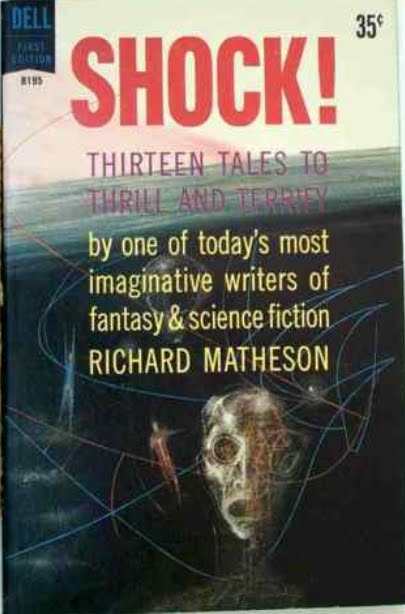
 These four different Shock collections gather those tales, and though long out-of-print they seem to be fairly widely available online in various editions: the original Dell publications from the early and mid-1960s, as well as the Berkley reprints from the late 1970s (cover art by Murray Tinkelman).


