Showing posts with label cthulhu mythos. Show all posts

Monday, May 1, 2017

Hunter of the Shadows: The Lovecraft Omnibus 1-3, 1985

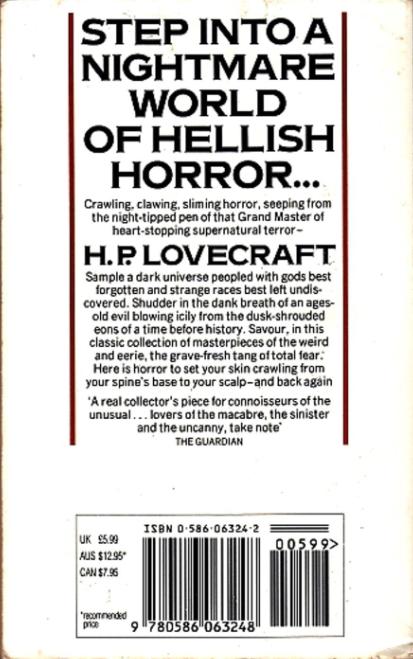
'Warning! You are about to enter a new dimension of utmost terror. When you open this book you will lost - lost in a world of dreadful nightmare brought to screaming life by the century's greatest master of adult fantasy and horror' - H.P. Lovecraft. Here is a collection of the most famous stories of this master of tomb-dark fear: "The Rats In The Walls", "The Call Of Cthulhu", "The Haunter Of The Dark", "Pickman's Model", "The Lurking Fear" plus other tales designed to haunt your dreams and bring you to sweat-soaked wakefulness in the darkest reaches of the night! "Terror in the fourth dimension! A master of cosmic horror"

Three giant collections of Lovecraft's stories, all published by Panther Books in the United Kingdom in 1985. The garish covers were done by Tim White, a British artist known for highly detailed science fiction art. While I can't deny that these are eye-catching and probably sold a ton, I can only imagine how displeased ol' Ec'h-Pi-El would've been with the explicit gore...


Thursday, July 28, 2016

Résumé with Monsters by William Browning Spencer (1995): Not My Place in the 9 to 5 World

Perhaps taking its inspiration from the Dell/Abyss line of the early 1990s, RPG publisher White Wolf introduced a line of kinda-sorta horror novels under the imprint Borealis. Beginning in 1994, these well-produced (and ecologically-minded!) paperbacks often featured cover art that resembled Dave McKean's cover art for Neil Gaiman's Sandman comics. At the time I was working in a bookstore in Raleigh, NC, and plenty of their titles caught my eye but, for whatever reason, I never read any (I did buy their reprints of the Borderlands series—with actual McKean cover art). How many times did I pick up a copy of Résumé with Monsters (April 1996), intrigued by that blurb about Woody Allen writing a Cthulhu Mythos novel? Plenty. Finally took the plunge and found William Browning Spencer's novel to be fun, smart, dark, sensitive, and ridiculous in near-equal measures. An engaging read, I enjoyed it more as a quirky little '90s novel than as a serious work of horror fiction.

As a satire of the insane, life-depleting demands office drudge-work makes of its "victims," RwM predated pop-culture giants like Office Space and "The Office," and so it might not have the same bite today as it did 20 years back. The novel uses Mythos ideas and terminology in an almost-too-glib manner at first; this might be a turnoff for some readers. Stick with it: Spencer fleshes the old ideas out with some new ones, giving them a contemporary weight and implication. Not scary or horrifying, mind you, just weighty. Heavy, man.

There's an autobiographical tone to the tale, which is fine with me; this story feels lived: it's set in Austin ("a laid-back town, the last refuge for hordes of aging hippies who drifted up and down the Drag, gray-bearded artifacts who knew all the lyrics to old Leonard Cohen songs"), our protagonist 45-year-old Philip Kenan, who works as a typesetter in a dreary industrial park office run by a micromanaging boss named Pederson, and pines mightily for his ex Amelia Price. Oh, yeah, also he's afraid of ancient encroaching entities Cthulhu and Yog-Sothoth.

His coworkers are drones, he has few friends, and his novel he's been writing for years, The Despicable Quest, seems to be unfinishable. Philip, as they say, can't catch a break. Looking for someone to help order his cluttered thoughts, he seeks help in the ads of a weekly paper and there finds Lily Metcalf, an aged hippy who lends a non-judgmental ear. She doesn't blanch when he blurts out that "Hideous, cone-shaped creatures from outer space are going to leap, telepathically, across six hundred million years and destroy human civilization."

Spencer provides flashbacks to Philip's past interspersed them with the present: a father who reads him Weird Tales but who hits Philip's mother when he's drunk; a neighbor who pays him to swim naked in his pool. Philip's first marriage was to Emily, a painter; together they'd lived a perfect kind of late '60s life: listening to Dylan, playing folks instruments, smoking dope, going to political protests in DC, trying to live as artists (he's gonna write a first novel that will make Norman Mailer jealous). This doesn't happen. Emily ODs and dies; Philip ends up at corporate giant Micromeg in Virginia. This is where he meets Amelia. This relationship is mostly wonderful but she hates hates hates the Lovecraftian novel he's working on and what it does to his psyche. Philip and Amelia split too; she heads to Austin and Philip follows, taking another desultory job at Ralph's One-Day Résumés. He and Amelia speak often in guarded, cautious words; she speaks mostly of her poor relationship with her sister, and oh, check it out, she got a job at Pelidyne, another faceless giant whose headquarters suggest hostile takeovers.

One of Philip's coworkers, Helga, is fired for getting physical in an argument with an "I Love Lucy" obsessive named Monica. Helga begins stalking Monica and one day runs her down in the parking lot with her car. Philip is also run down (of course), leg broken, hospitalized. Pederson calls: "If there's some way you could come in..." Unbelievably, Philip does go back to work before he's fully healed, sees mostly new employees (except for 60-year-old Al Bingham, a sanguine avuncular philosopher), but Monica is back too, stitched and scarred and utterly different. Nothing more about "I Love Lucy" and in fact she professes her love to Philip. Then she attacks him with a knife and Philip realizes, thanks to some nightmares, she is under an alien sway. Confrontation ensues—"an animate darkness, trembling with malevolent rage, it recognized Philip"—he blacks out, and wakes to find:

What happened to [him] was similar to the fate suffered by the narrator of Lovecraft's The Shadow Out of Time. The Great Race had, in the case of that unfortunate man (a professor at Miskatonic University), hurled him back across millions of years to reside in a monstrous, alien body.

In Philip's case, the time leap was only a matter of a few years, and he had landed in his own body.

O the ignominy! This means he's going to have to relive every crappy job he's ever had.

It's at this halfway point that the HPL stuff really ramps up, and we learn what really runs this corporate world, the one Philip's dad drunkenly called "the System." It's the mind-bending amorality of the Old Ones and their hunger for domination, it'll grind you down to a nothing, "Don't let the System eat your soul," or worse, make you a mindless slave working for the profit of a thankless leader. And just after he's gotten a call from one of the best independent publishers in New York interested in putting out his novel!

The second half of RwM gets a bit wonkier as Philip flips back and forth in his lifetime, a Christian terrorist shows up and must be stopped, Philip's novel is published and a comely fan arrives on his doorstep, and he continues his therapy with Lily (who's started a relationship with Al). There's some derring-do and more Mythos madness. But there is no attempt to truly imbue Lovecraftian awe in the story—which is fine; Spencer's usage of Mythos icons is unique: to satirize American corporate work culture. Wait till you get to the nameless rituals of the Xerox and fax machines!

In fact, the author I felt loomed largest was not HPL but another giant of genre fiction, and one who, like HPL, has seen his posthumous reputation grow and grow to world status: Philip K. Dick (oh, and in that cover blurb change "Woody Allen" to "Albert Brooks." Seriously). I'm not a PKD expert (even less so Vonnegut but he's peeking out of the pages too I believe) but over the years I've read at least half a dozen of his major works (as well as his biography Divine Invasions back in the early '90s), and the ones RwM put me in mind of are his later, even last, novels. These works feature lonely, literate, arty men and women searching for clues and symbols to understand their loneliness, their regret, the passage of their lives, while weird time-hiccups entwine themselves with the everyday. This was a welcome surprise to me while I read. There's a countercultural undercurrent too in RwM that reminds me of Dick, of that vague sense of having our revolutionary days behind us, and did they mean anything at all? Philip fights that self-pity, fights the worst monsters of our minds, fights against the meaningless of the cosmos, and realizes that even in the very name of Lovecraft there is the most profound meaning of all.

Tuesday, December 22, 2015

Lovecraft's Legacy, ed. by Weinberg & Greenberg (1990): A Debt No Honest Man Can Pay

What creative artist doesn't enjoy the opportunity to speak to those who inspired them, express their gratitude, and perhaps even engage in some flattering imitation? That's the impetus behind Lovecraft's Legacy (Tor hardcover, Nov 1990/St Martin's trade paperback 1996, cover art by Duncan Eagleson), an anthology celebrating the 100th anniversary of his birth. A baker's dozen of authors of various genre backgrounds contribute their literary thank-you notes (literally too in short afterwords appended to each story) to one of the most influential authors of the 20th century. I think one can state that pretty unequivocally these days, right? In the quarter-century since Legacy was pub'd, HPL's rep has grown to, well, cyclopean proportions, so... fuck it, yes one can. 

After an introduction by Robert Bloch, who as a teen corresponded with HPL (but you knew that), Mort Castle roars out of the gate with with the excellent "A Secret of the Heart," the narrator of which relates how he's made himself immortal thanks to the "Other Gods" revealed to him by his physician father over 100 years before. When the family's beloved adopted daughter succumbs to a gruesome painful death aged only 11, the father resorts to drinking and traveling far and wide, dabbling in black arts to ease his grief. Castle wrote one of my favorite horror stories, Still Dead's "Old Man and the Dead", and "Secret of the Heart" features the same kind of literary in-joke. What Castle does when he links a character to another fiction is especially apt and unexpected; the circle is complete, a circle I think Lovecraft would've been too humble to include himself in.


What about mixing up the highest of Elizabethan high culture with works almost forgotten in the grotty pulps of pre-WWII era? The reliable Graham Masterton presents us with "Will," a terrific little mashup of the Bard of Avon and the Gentleman from Providence: it seemed as if Shakespeare had achieved his huge success as a playwright by striking a bargain with 'Y'g Southothe,' which was some kind of primeval life force 'from a time when God was not.'" You can bet this reward comes at a price. Masterton's uses real Shakespeare history, of course, and some bold imaginative origins for the Globe Theater and the fire that destroyed it to create one of Lovecraft's Legacy best stories.

A highly-respected author of literate and challenging science fiction, Gene Wolfe (pictured) contributes "Lord of the Land," which contains some startling imagery deployed in a Faulkner-esque piece about a scholar's interview of a country patriarch for stories about the mythic "soul-sucker." What connection does it have to pre-Greek gods and rites? Hungry jackals, moonlit cities, starry alien skies, and mouthfuls of worms lend their welcome Lovecraftian flavor. The science fiction of Brian Lumley's "Big 'C'" brings to mind the Quatermass stories of the '50s and '60s and conflates one big C—cancer—with another you can probably guess. Not too bad, as Lumley has a hale, chummy style, and gets the humor in his gross, somewhat silly apocalyptic scenario.

Chet Williamson's "From the Papers of Helmut Hecker" is an epistolary piece about a snobby literary writer whose work keeps getting compared to Lovecraft's, which enrages him; he's the heir to Kafka and Borges, winner of the Booker Prize and Faulkner Award! Poor guy gets what's coming to him. "The Blade and the Claw" from Hugh B. Cave is set in Haiti, so it's nice to get out of the usual environs, but I found the story lacking in Lovecraftiana, and its happy ending dampens the horror. 

"Meryphillia" was easily my favorite tale in Lovecraft's Legacy. She is "the least typical ghoul in the graveyard," pining for a poet who visits this charnel yard to sing odes to his unrequited love. It's a tale of love and glory, of midnight feasts and the stench of decay; Brian McNaughton (above) writes with a noxious, devilish wit, regaling the reader with a Clark Ashton Smith-style bit of grave and grue, recalling HPL's own "The Hound" or "The Tomb." It's sweet, funny, gross, completely satisfying. I must have more McNaughton! And I kinda hope there are more stories of Meryphillia and her "coffin-cracking jaws."

Gahan Wilson's "H.P.L." is the most affectionate story included, a charming trifle of the writer still alive at nearly 100 and how he got that way. A fellow pulp scribbler visits Lovecraft at his home in Providence, and today he's a successful author living in his upkept childhood home that boasts an enormous two-story library. Wish-fulfillment at its finest—what HPL fan would not want to peruse that man's book collection? You'll be able to tell where Wilson's going but it's a worthwhile trip just the same.

Crime writer Ed Gorman delivers a killer serial killer tale, "The Order of Things Unknown," written in  no-nonsense prose and tersely invoking a "vile god" and a burial ground for sacrificial victims. Quite good; I'm gonna have to look into Gorman's crime novels I think.
He stood as if naked in the moonlight and looked up and saw the moon and the stars and sensed for the first time that beyond them, somehow, there was another reality, one few ever glimpsed, one that filled early graves and asylums alike. 
When he put the girl in the trunk, he was careful to set her on the tarpaulin. She had begun to leak.
The anthology closes with F. Paul Wilson's "The Barrens." Wilson wisely utilized the mysterious wilderness of his native New Jersey's Pine Barrens, into which the narrator and an old college friend venture so the latter can explore the legends of the Jersey Devil, and perhaps more. Strongly in "Colour out of Space" mode with a welcome lack of garbled phonetics, Wilson's rather pedestrian prose isn't up to the task of imbuing those dark forests and empty landscapes with dread or weirdness. He reaches for it, it's a good story, but it didn't quite get there for me; no frisson of Lovecraftian (or Blackwoodian) menace. Obviously the editors thought highly of it, and I've seen it referenced elsewhere. Maybe it's just me...

Lovecraft's Legacy is an easy recommendation: only a small number of stories are below par; a solid many are quite good, and three or four are terrific and deserve to be included in future Lovecraft anthologies not consisting of original material. Mythos fans probably already have a copy but if not, go for it. I got the hardcover as an Xmas gift back in the godforsaken year of 1990 and had only ever read a couple stories in it. Never got rid of it and so this scary solstice season I'm glad I finally went back!

Thursday, October 8, 2015

Throwback Thursday Yog-Sothothery

(An Amazon review I wrote back at the turn of the century...)

Finally, Howard Phillips Lovecraft seems to be getting some due from the mainstream literary world. First it was that long Joyce Carol Oates essay from 1996 in the New York Review of Books, than it was the "Annotated Lovecraft" updates from Ballantine/Del Rey a couple years later, and now Penguin Classics has seen fit to bestow the American reading public with The Call of Cthulhu and Other Weird Stories. Wow, I can't imagine what readers of Virginia Woolf, John Steinbeck, and T.S. Eliot will do when confronted with the likes of Yog Sothoth, the Goat with a Thousand Young, The Great Old Ones and that nasty ol' Cthulhu....

Seriously: this stuff is incomparable. Lovecraft's creation of the Cthulhu Mythos (or "Yog-Sothothory" as he referred to it in a charming light-hearted moment) heralded a new age in supernatural fiction. So vivid, so cosmic, so vast and imaginative, it is the equal of Middle Earth, of Oz or Wonderland. HPL's view of humanity and the cosmos is deeply, dark, nihilistic, and he used symbolic structures of his neuroses—political, sexual, racial, dietary—to portray that view.

As for the stories themselves, the cornerstones are "The Call of Cthulhu" (1926) and "The Colour Out of Space" (1927); they will still be read a hundred years hence for their controlled atmosphere of cosmic dread and awe. His skill at evoking a slowly dawning sense of terror is unparalleled in these tales. "The Shadow Over Innsmouth" (1931)—not too shabbily adapted in a 2002 film as Dagon—and "The Whisperer in Darkness" (1934) are later stories that are a bit wordy but still powerful, unsettling, and unforgettable. Man's place in the cosmos is revealed as paltry and inconsequential; his physical being rendered as mutated and degraded. Space and time become meaningless. The climactic chills will remain with you for ages.

Others in this collection include "Rats in the Walls," "The Outsider" and "The Hound." The latter two reveal his penchant for evoking Poe all too derivatively (although the erstwhile Poppy Z. Brite wrote a reverent Goth-punk update of "The Hound," "And His Mouth Will Taste of Wormwood"); "Rats" is one of his major early works, the artist coming into his own.

Lovecraft forced horror and supernatural fiction out of its old world infancy of vampires, ghosts, and devils and into the adult, modern world of a cold, uncaring, nearly malicious universe that we can scarcely comprehend. While Lovecraft's prose at times leaves much to be desired, the power of his imaginings is unique and convincing. This collection belongs on the bookshelf of serious readers everywhere. S.T. Joshi is a marvelous editor and biographer of Lovecraft, and his efforts should not go unheeded. Kudos to Penguin for finally adding H.P. Lovecraft to their catalog of Twentieth Century Classics.