Showing posts with label slasher. Show all posts

Saturday, March 23, 2019

Joyride by Stephen Crye (1983): Long After the Thrill of Living is Gone

Pity poor Robert James Atchison. Living in a California town known as America's preeminent burial ground, where the dead outnumber the living five thousand to one, he's a sensitive 17-year-old boy with a fondness for poetry, instilled in him by his dear departed mother, and he actually enjoys reading books like The Iliad for school. He may have good hair, vibrant eyes, and fine features, but all that's lost on his high school classmates: to them he's a gangly, awkward-limbed, tongue-tied goof who they've nicknamed "Coma Man" with an embarrassing crush on Carla, the prettiest girl in school. He's written Carla a poem and has two scarlet ribbons to give to her. What could go wrong?

And then there's Robert's widowed father, a cemetery caretaker paralyzed in a graveyard accident—sure, those things happen—who is a raging bastard in a wheelchair, demanding the same breakfast every morning at the same hour and wants Robert to continue the family tradition of being a raging bastard cemetery caretaker. But one morning Robert has had enough. He's had more than enough: I won't let him make me dead inside... I just want to live a normal life.

This 1983 paperback original from Pinnacle, one of the mainstay publishers of the era, is nothing more nor less than a slasher flick in book form. Joyride, by Stephen Crye (according to a post on Goodreads, the pseudonym of a Ronald Patrick, who also wrote a previous Pinnacle novel from 1978 called Beyond the Threshold). And while I'm no slasher fan—it's one of my least favorite types of horror—I have to say Joyride is a competent, no-frills novel that does what it does perfectly well. If it ain't Halloween, it's maybe at least The Burning.

You can see the setup cinematically: a group of dumb, horny, wise-cracking, junk-food-snarfing teenagers cruising around looking for a place to party one night ignores a No Trespassing sign outside the gates of All Saints Hill Cemetery and drives on in. Yep, that's the cemetery that our pal poor Robert is caretaker of; he's been living there in the years since high school, after lying to officials that he had an adult guardian staying with him. Nope. And ever since a tragic last-day-of-school fireworks accident—sure, those things happen—Robert has festered with his scars, both mental and physical, in this cemetery, dreaming his dreams of his high school princess and of vengeance:

He wondered if any of them really understood how deeply he had suffered because of their cruelty... how he had been forced to retreat into the loneliness and despair of total isolation just to avoid the endless succession of humiliating stares from people who could never understand... how he had thought of killing himself at least a thousand times since the accident...

Pinnacle, 1978

In his fevered mind, the killer thinks one of the girls, Priscilla, is his old teenage sweetheart Car-r-r-r-la, so after he burns her boyfriend alive he stuffs her in a sepulcher, hoping to teach her to love him. Don't make me hurt you, you made me do it, I didn't mean to hurt you, Cleats is thinking, a thought process which should surprise absolutely no one. He's also stalking her friends, wandering about in the cemetery and who by now have discovered the gates have been locked again and are too high to climb over. The kids get dead in various ways, as Robert—now dubbed "Cleats" because of, you know, his shoes—goes after them with various cemetery caretaking implements. The kills are graphic but not too graphic, just like in an R-rated flick: The blade cut deep into his skull, splitting it down the center like a ripe melon.

The fat kid (I didn't say there was a fat kid? there's a fat kid) who is of course called Twinkie, ends up searching for help in the caretaker house (why doesn't he look for a phone) and there finds an old gentleman sitting alone at a dining room table. Stepping forward, he craned his head around the edge of the chair to meet the eyes of the man who would liberate him from the clutches of All Saints Hill. Ah, can't you guess what's coming? Some final kids are left for the face-off in the time-honored slasher tradition, when the killer seems to be everywhere at once.

Sphere 1982. Sweeet Christ
(also: I feel like this is a still from maybe a British '70s horror...?)

At times Crye is tedious in his descriptions of dumb teens in a panic—Pleeeese don't kill me, oh my god oh my god, he's coming back! I hope he kills me fast I mean you can see EC Comics speech balloons—but occasionally he writes a passage like A shimmering mosaic of buttery morning sunlight filtered through the checkerboard of dusty windowpanes or Priscilla had eased her mind into a state of suspended rationality that others, for wont of a clearer understanding of her despair, would call madness and you'll be glad for it. I found the high school flashbacks more interesting than the teens flailing away in the cemetery more engaging, so I'll be honest and say I did skim some pages but I don't think I missed much.

Joyride is not original and doesn't intend to be anyway, but nor is it terrible at all: I've read more original novels that were worse-written, unreadable and charmless. At 250 pages, Joyride is brief and mostly brisk, won't insult your intelligence, and you can read it in a weekend. It's a tasty, mindless little morsel of slasher mayhem. Oh, and that glorious cover art at the top by Sonja Lamut and Nenad Jakesovic? Yeah that's in the book! O joy indeed.

Friday, March 25, 2016

Then I Took Out My Razor Blade Then I Did What God Forbade

I'm loving both these covers, I'm guessing from the early 1980s by the Warner Books cover prices, for Bob Ottum's 1976 thriller The Tuesday Blade. I don't know anything about the book except for what I learned online: sounds like Kirkus didn't give a shit ("It is to blench—line your stomach with Maalox before putting it in a sling") and an anonymous Yahoo reviewer says it ruined her for other books ("as long as I don't have to go through the 'Tuesday Blade ending syndrome' again.... I might wish it on an enemy"). Yikes. Don't it make you feel sick? 


Wednesday, December 17, 2014

The Face That Must Die by Ramsey Campbell (1979): I'm Determined and I'd Rather See You Dead

When it comes to horror titles, Ramsey Campbell's first two novels, 1976's The Doll Who Ate His Mother and 1979's The Face That Must Die, must be considered as some of the most provocative of their day; in their tasteless glories they shout like cheap tabloid headlines. Yet within the books readers will find an imagination that is fine and not crude; sensitive and not exploitative; authentic and not postured. Indeed, the introductory essay included with the 1985 Tor edition, "At the Back of My Mind: A Guided Tour," is Campbell's well-known account of his worsening relationship with his mother as she sank into dementia over many years. These days mainstream memoirs and fiction of life with crazy parents are a dime a dozen, but Campbell's piece has no distancing irony or comic effect. Harrowing and sad and enlightening, it is Campbell's explanation for ''why I write what I write," and readers can come to their own conclusions about how this influenced The Face That Must Die.

Campbell in 1980

Face is the story of the aptly-named Horridge, a nobody kind of fellow in a precisely-drawn Liverpool, whose growing paranoia is exacerbated by his obsession/revulsion with an overweight, effeminate older man who lives in his Liverpool neighborhood. After reading in the papers about a "man whose body was found in a Liverpool flat was a male prostitute" and studying the accompanying suspect police sketch, Horridge comes to realize "he had seen the killer three times now, in as many days. That was no coincidence. But what was he meant to do?" His conviction that random events are a secret code to him alone is unshakeable.

Horridge finds out the man's name is Roy Craig by searching through library records (and mildly creeping out library clerk Cathy Gardner, who with her long-haired boyfriend Peter actually lives in the same building as Craig), Horridge begins systematically stalking and harassing the man. Craig's homosexuality—Horridge is correct in his presumption—offends him to his core: "If he was a homosexual he was perverted enough for anything." Which of course means he will continue to kill, and must be stopped by any means necessary--actually he can be stopped by any means necessary, because Horridge is doing away with degenerates and doing society a favor.

Campbell does a solid job of making the reader feel uneasy. Everywhere, things seem off: conversations are snippy, irritated, impatient; graffiti stains walkways and alleys (Horridge keeps seeing the word "killer"); the wheezing buses are crowded and smoke-filled; twilight is always seeping into Horridge's apartment; his limp is painful and insistent; library customers are resentful, grumbling at the clerks wielding petty powers (in a scene Campbell admits is autobiographical); fog prevents everyone from seeing clearly. Liverpool is as much a character as Horridge or Cathy or Peter, and at times even seems conspire against Horridge; he sees the tower blocks, rundown flats, loud pubs, grimy gutters, grey skies, and bare concrete as one big institution, a prison ready for its cowed inmates. Everywhere the banal, the mundane, threaten to swallow the sane and insane alike; the suffocation is palpable.

Sometimes he thought the planners had faked those paths, to teach people to obey without questioning... the tunnel was treacherous with mud and litter; the walls were untidy webs of graffiti. All the overhead lights had been ripped out. He stumbled through, holding breath; the place smelled like an open sewer... A dread which he'd tried to suppress was creeping into his thoughts—that sometime, perhaps in fog, he would come home and be unable to distinguish his own flat.

Immersed in Horridge's psyche, the reader is also both fascinated and revolted by his thought processes as they cycle through mania and grandiosity, memories of a painful childhood, and his ever-present desire to clean up the filth (moral and literal) he sees growing everywhere around him. Every tiny detail, every sliver of dialogue, every simile, drips with an uneasy threat of everything about to fall apart, as if reality itself were trembling on the precipice of chaos. Campbell allows us a few views outside of Horridge's, but overall we feel as he does: threatened, maligned, powerless. Then he lashes out in anonymous—and unwittingly ironic—calls to Craig: "Just remember I'm never far away. You'd be surprised how close I am to you."

 1st UK paperback, Star Books Dec 1979

The novel also offers some insights into contemporary British life. Craig's backstory of his marriage breaking up is sad and all too common, I'm sure. His wife discovers his gay porn, is horrified, and her last words to him are, "I think I could have borne it if it been another woman." In his opening essay, Campbell talks about his non-use of illicit drugs, but he sure gets the details right describing the dregs of late '70s drug culture, the desultory nature of trying to score, the hangover of 1960s radical politics ("I bet he thought I'd have to be middle-class and polite. No chance, brother"), and the nagging suspicions that the Establishment is just waiting to pounce. Peter and Cathy are growing apart due to his continued use of marijuana and LSD; they're a counterculture couple suffering relationship ills of the bourgeois. They and Craig, along with bohemian artist Fanny who also lives in the building, will have their confrontations with Horridge, moments in which a razorblade flashes its brilliance in dingy rooms...

There is one scene I must point out. Horridge goes to the cinema to see a film, but the only title that resonates is the one that contains the word "horror" ("Horror films took you out of yourself—they weren't too close to the truth"). Check it out:
Was it supposed to be a musical? He'd been lured in under false pretenses. It began with a wedding, everyone breaking into song and dance. Then an engaged couple's car broke down: thunder, lightning, lashing rain, glimpses of an old dark house. Perhaps, after all—They were ushered to meet the mad scientist. Horridge gasped, appalled. The scientist's limp waved like snakes, his face moved blatantly. He was a homosexual.

This was a horror film, all right--far too horrible, and in the wrong way.
Yes: Horridge inadvertently attends a screening of The Rocky Horror Picture Show! One of the funniest and most telling—and most deserved—moments I've ever read in a horror novel (AFAIC all homophobes should have Tim Curry's Dr. Furter shoved in their faces and, yes, down their throats).

Scream/Press hardcover, Oct 1983, art by J.K. Potter

Campbell keeps the story moving quickly as Horridge's fears grow and grow. He's a bit of a walking textbook of serial killer tics and tactics, but it's not just serial killers who display these attributes. His hatred of homosexuality (his hatred of any sexuality: at one point late in the novel, Cathy is running after him, trips and falls, and Horridge hopes the breasts she flaunts have burst); his belief that society is degrading more and more; his hatred of foreigners and anyone different, gay or not; the shades of his disappointed parents hovering about him—is this an indictment of Thatcher-era England? All I know about English culture I learned from '70s punk rock, but this sounds about right. Campbell is also wise to draw a parallel between Peter and Horridge, who are both aware of how out of step they are with modern society and the paranoid fantasies this engenders in them.

Futura UK reprint, 1990

Readers who enjoy the experience of being thrust into the killer's mind will enjoy Face; no, it's no American Psycho or Exquisite Corpse, it's not nearly so deranged or explicit, but for its time it's a brutal expose. A more accurate comparison could be made to Thomas Tessier's Rapture; both books are able to make their antagonist's irrationality seem rational, which is where the horror sets in. Despite a meandering chapter here and there, The Face That Must Die is an essential read for psychological horror fans. Many times Campbell hits notes that only now are we beginning to hear and understand about the minds of Horridge and his like. When Horridge finds one of Fanny's paintings is of himself, he slashes it apart with his beloved razorblade (see the Tor edition's cover, thanks to Jill Bauman); somewhere inside he knows, but can never admit, that the face that must die is only his own.

Thursday, November 7, 2013

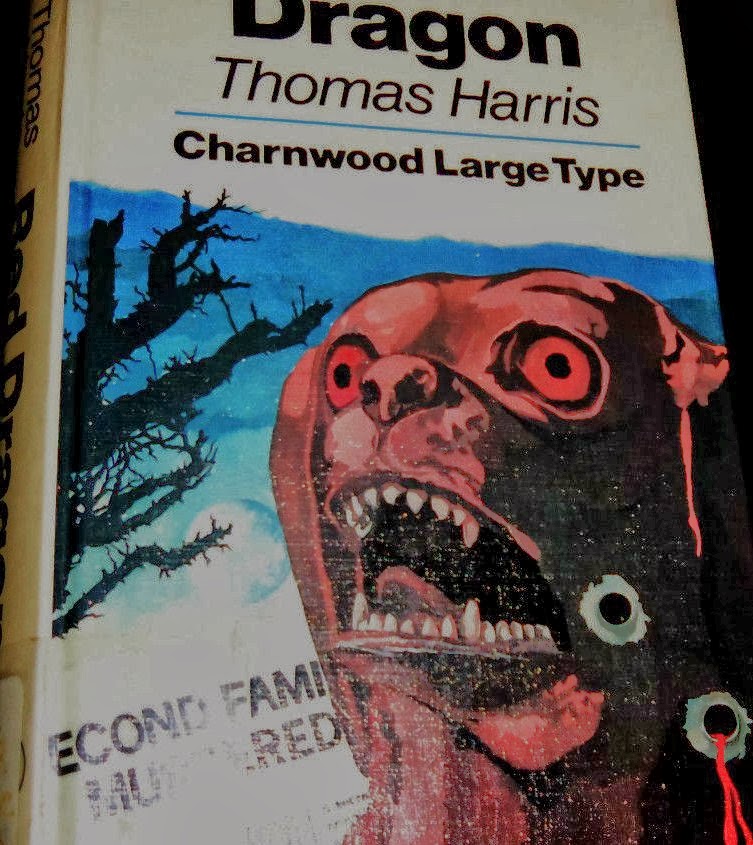
Red Dragon by Thomas Harris (1981): Terror the Human Form

Featuring the infamous first appearance of dreaded Dr. Hannibal "the Cannibal" Lecter, perhaps the most iconic, most powerful, most thrillingly nightmarish of modern pop-fictional villains, the bestselling Red Dragon is a police procedural par excellence, depicting the cutting-edge techniques of serial killers and their profilers with utmost clarity, thanks to the brilliant honed sheen of Thomas Harris's prose. I don't have the space to go into everything I enjoyed about Red Dragon; the entire story and characters are perfectly imagined and executed (sorry). We peer not only into the broken jagged minds of murderers driven mad by an early life of neglect and deformity, but also the brilliant, tireless lawmen who go after them no matter the personal consequences.

While The Silence of the Lambs is much more well-known both as book and movie, I'm sure many readers are on familiar terms with Red Dragon as well. Again, Lecter isn't necessarily the main villain. Will Graham, only 38, is an early-retired "special investigator" for the FBI, asked by his former supervisor, Jack Crawford, to help find the serial killer dubbed "The Tooth Fairy" (because of his biting fetish) who has just murdered two whole families in their homes. Graham left the force when he was very nearly killed by Dr. Hannibal Lecter several years earlier. Lecter was captured and imprisoned right after but Graham still lives with the scars, mental, emotional, physical. This is a brilliant backstory for both characters; putting such a dramatic event in the past is a stroke of genius on Harris's part. For Graham, going back into the field looking for a monster, just as he's started a new life with a woman and her son... well, it's beyond the last thing he wants to do.

Back cover of reprint, Bantam Mar 1987
No surprise, Red Dragon can be depressing reading, a grim, immersive experience one can get uncomfortably lost in, unable to come up from its suffocating depths for breath. Airless, without any attempt at a creeping atmosphere that would place it firmly in the horror genre (yet it is rightfully included in Newman and Jones's Horror: 100 Best Novels), this is realistic fiction told in a toneless prose that withholds judgment. It is amoral and matter-of-fact about the grossest of human depravities. This is precisely Will Graham's grotesque talent, what makes him the only man for the job, why Crawford is so desperate for his help: Will Graham can slip inside a killer's mind and see all from his perspective without the clouding effects of socialization, morality, and compassion:

 Often his thoughts were not tasty... His learned values of decency and propriety tagged along, shocked at his associations, appalled at his dreams; sorry that in the bone arena of his skull there were no forts for what he loved... His value judgments... could never keep up and direct this thinking.

Obsessed with an apocalyptic painting by English poet William Blake, from whose works the title comes, Francis Dolarhyde is the 42-year-old serial killer Graham is after. With grandiose fantasies of his Great Becoming, Dolarhyde is held in a strange thrall to Blake's painting The Great Red Dragon: Never before had he seen anything that approached his graphic thought. He felt that Blake must have peeked in his ear and seen the Red Dragon. For weeks Dolarhyde had worried that his thoughts might glow out his ears. When the narrative begins Dolarhyde has already murdered two families, the Jacobis and the Leeds - he chose them after seeing their home movies, which he develops in his day job at a film processing company - and is planning on a third (Families were mailing their applications to him every day). A classic if over-melodramatic psychopath, he is utterly detached from his victims; they are only a means to an end: becoming fully the Red Dragon itself. The dead were not people, they...

are not flesh, but light and air and color and quick sounds quickly ended when you change them. Like balloons of color bursting... they are more important for the changing, more important than the lives they scrabble after, pleading.

Dolarhyde bore screams as a sculptor bears dust from the beaten stone.

Original 1981 hardcover with Blake's conception of the Red Dragon
Francis Dolarhyde's dire childhood is relayed in all its sad and shocking array, a tale we know all too well now that serial killers are cultural mainstays (thank in large part to Harris's fiction). These may be the most gripping parts of the novel: born with facial deformities (he looked more like a leaf-nosed bat than a baby... Springfield in 1938 was not a center for plastic surgery. In Springfield you wore your face as it was), abandoned by his mother, left in an orphanage. Five years later, his grandmother comes for Francis. For the first time someone smiles when they see him. His deformed mouth makes speech nearly impossible. However, Grandmother Dolarhyde insists he tell her his name. We are shocked, heartbroken, and filled with the knowledge that it all begins here.

The child's face brightened. The big boys had helped him with this. He wanted to please. He collected himself.
"Cunt Face," he said.

And eventually, grandmother threatens to cut off his penis if he continues to wet his bed. Her mental health collapses. Francis learns to cope through killing chickens on his grandmother's farm (the peace was endless and all around him). The horrifying connection is made, the emotions become entwined in a waking nightmare: Francis sat silently at his place, opening and closing his hand on the memory of an eye blinking against his palm. Sometimes in bed he held himself to be sure he hadn't been cut. Sometimes when he held himself he thought he felt a blink. God god that line crawled up my spine. There are plenty others.

Original paperback, Bantam Oct 1982
Today we are also familiar with the people who chase these killers, the profilers who can parse out their identities from things insignificant to the untrained eye. The agents and detectives after Dolarhyde are professional men who, with icy resolve, do a very serious and very dangerous job. Underneath they are sick with fear that they will not find Dolarhyde before he slaughters another thriving American family. Harris engages in no cop-show hysterics, no macho thundering, no young hotshots fighting against the system and defying their by-the-book superiors. Nope. Jack Crawford, based on the first FBI profiling expert John E. Douglas, knows he has to stand back and let Graham do the ugliest work inside his head and at the scenes of the crimes, and he needs calm, reflective quiet. And a good chilled martini or three doesn’t hurt either.

Will Graham's bravery is a testimony to this commitment and seen early. At night he walks through the home of the Leeds family, the second group of murder victims, after investigators have left. What clues did they miss? All that's left are the bloodstains, whose patterns hold secret codes that Will must crack. He was an old hand at fear. He could manage this one. He simply was afraid, and he could go on anyway. He could see and hear better afraid... Walking around a bloodstained house at night in which people had been mass murdered only days before? Holy shit that freaked me out. Imagining myself doing it? Out of the fucking question.
 
Early '90s Dell reprint after Lecter became famous
It's no surprise Dolarhyde is a Lecter fan, and his letter to the good doctor is discovered just after Graham visits Hannibal in the Chesapeake Hospital for the Criminally Insane. This really sets the chase in motion. While not as dramatic or intimate as Clarice Starling’s visit to Dr. Lecter, Graham’s seeking out of him is an act he realizes that he must do if he is to stop the Tooth Fairy. Unlike Starling, Graham has a past with Lecter, so he's unnerved to talk with him again. Why wouldn't he be? Lecter makes the most of this time to fuck expertly with Graham's head: "Do you dream much, Will? Do you know how you caught me? The reason you caught me is that we're just alike!" Good God. I know that's become a cliche, killer and cop psychological twins, but Harris makes it work. We revisit how Graham realized Lecter was the killer he was looking for years before. It was this image, the Wound Man illustration from a Middle Ages surgical text, that was the final clue.

It's this kind of esoteric detail that makes Red Dragon an especially fascinating read, one that makes you want to - carefully! - Google asides in the story and dialogue, like references to medical textbooks and forensics methods and physical deformities and psychological tests and of course Blake's biblical art and poetry. Harris inserts tiny details about people's lives and possessions that read like real things observed with a restless mature eye, not simply made up on the spot and tossed into the mix. Even while writing of monsters, Harris is a fully sensitive humanitarian, taking a minor note - the rising color of someone's face, a deft hand on a shoulder, a speech tic, a particular lack of sympathy - and letting it bloom with import. Characters, even ones we meet a single time, live and breathe and exist; we can imagine them outside the narrative itself. Harris follows the stone-carved dictum for all creators of fiction: show, don't tell. Harris implies; the reader infers. Harris can do more damage with one understated sentence - "Cunt Face," he said - than many horror writers can do in a 400-page novel. The ending? Fine and deep and true and haunting. I fucking love it.

Wow. Maybe I need to start looking into large-print book covers too.
If not the equal of Silence of the Lambs, Red Dragon is as good a precursor to it as possible (I find Clarice Starling a more captivating and sympathetic protagonist than Will Graham). It is not a novel to approach lightly; it is not simply a popular bestselling thriller to kill a few hours on a flight or waiting at the dentist (oof). Yes, it moves with lightning speed but Harris never lets the reader to get lost in the settings. Whether it’s a film processing lab, an insane asylum, a police headquarters or a newspaper-printing press, Harris writes of them with an authenticity and economy learned from his days as an AP reporter. Sometimes the suspense is unbearable as we move between two worlds so effortlessly, sucked into a drama filled with moments we recognize - the frustrations of work, fraught relationships with spouses and offspring, even budding romance - and those we hope in a million eternities never to face.  

Red Dragon needs nothing supernatural or otherwordly to horrify, it simply and honestly confronts and exposes a nightmared world. It's one of those books whose unrelenting nature will snatch you up and carry you away, leaving you bleary-eyed and sleepless, an aching emptiness inside you from peering into all the darknesses people can hide... and the flesh- and mind-rending terror they can visit upon their fellow man without remorse.

Wednesday, December 5, 2012

Psycho by Robert Bloch (1959): Motel Money Murder Madness

Then the horror wasn't in the house... it was in his head.

Modern horror entertainment would not be what it is today were it not for the seminal work Psycho, the sixth novel by the vastly prolific Robert Bloch. The book's main character, Norman Bates, has become an immortal symbol of the madness hiding behind the banal, the prosaic, the mundane. It is horror rooted in the everyday; it does not haunt a crumbling Gothic castle, nor does it reside outside space and time. It's here and it's now and it's coming through the bathroom door...

Famously inspired by the Ed Gein case, Bloch pieced together the vague details he'd heard about his fellow Wisconsinite and created Bates, a fellow with, shall we say, mother issues. In the novel, Bates is balding, overweight, a voracious reader and somewhat of a drunk - one of the few changes Hitchcock and screenwriter Joseph Stefano made when they adapted Psycho for film. Another is - probably a major disappointment for readers hungry for violence; I know I was when I first read Psycho as a teenager - the infamous shower murder. Bloch dispatches the character in a single lurid, pulpy sentence; there is nothing that even hints of what Hitchcock would put on the screen.

And I must admit I found it difficult to keep from picturing Anthony Perkins, Janet Leigh, Martin Balsam, etc., in my head. Suspense and mystery are mostly muted when reading Psycho because of that classic movie. That's why I appreciated seeing how Bloch concealed the fact that Mother Bates is dead; I think those who read it before the movie would never have suspected she's an exhumed corpse. Bloch takes us right inside Bates's head, understanding the origins of his homicidal rage and impotent fury. The conversations between mother and son are ultimately one-sided, her vicious beratements taking on a pathetic poignancy, knowing as we do that they're Norman's own thoughts:

"I'm the one who has the strength. I've always had it. Enough for both of us. That's why you'll never rid of me, even if you really wanted to. Of course, deep down, you don't want to. You need me, boy. That's the truth, isn't it?"

Young Bloch in undated photo, from www.wisconsinhistory.org

One of my favorite parts was when Lila Crane is sneaking through the Bates home, looking for clues to her sister's disappearance, and finds Norman's library:

Here Lila found herself pausing, puzzling, then peering in perplexity at the incongruous contents of Norman Bates's library. A New Model of the Universe, The Extension of Consciousness, The Witch-Cult in Western Europe, Dimension and Being. These were not the books of a small boy, and there were equally out of place in the home of a rural motel proprietor. She scanned the shelves rapidly. Abnormal psychology, occultism, theosophy. Translations of La Bas, Justine. And here, on the bottom shelf, a nondescript assortment of untitled volumes, poorly bound. Lila pulled one out at random and opened it. The illustration that leaped out at her was almost pathologically pornographic.

Warner Books reprint (with stepback), 1982

We get some of Bloch's famous word play in that first line, as well as the "forbidden books" trope so popular in weird pulp fiction. Bloch wrote an unassuming little thriller that shows touches of real-life horror in places, and one that's as singularly important to the horror genre - pre-King of course - as anything by Lovecraft or Matheson or Levin. That it's overshadowed by its unparalleled film adaptation is no inherent fault, and Psycho should still be read and savored today. See more paperback editions here.

Friday, March 16, 2012

Headhunter by Michael Slade (1984): I Guarantee You That It Ain't Your Day - Chop Chop!

I got more than I bargained for with Headhunter, the debut novel from Michael Slade (a pseudonym for several Canadian criminal lawyers, mainly one Jay Clarke). It's much more complex and wide-ranging than I'd anticipated, less cheesy, smarter and more ferocious too. The Royal Canadian Mounted Police are after a brutal killer in Vancouver who decapitates women, sometimes sexually assaulting them, then places their heads on spikes... and then takes a picture of that to taunt the law with. The RCMP team is led by the haunted Robert DeClercq, a great and respected detective who retired after a tragedy involving his wife and daughter; he is now back doing what he does best. But at what price?

UK paperback reprint, 1993

What feels like dozens of characters and impressive set pieces of murder and fright are crammed into the 420 pages, as well as lots of detailed forensic and surveillance science. Decades-old events feature into the narrative, some more obviously than others. Great details of Vancouver city life, of New Orleans decadence, of frigid 19th century Canadian wastes are presented in which the reader can get lost. There's a voodoo ceremony and LSD trips and whole lot of graphic S&M and mutilation. The author(s) even throw in '70s British punk rock, using the Clash's tipply classic "Jimmy Jazz" as a clue (the lines "Cut off his ears and chop off his head/Police come looking for Jimmy Jazz...").

Overly-literal 1985 cover, Star Books UK

Slade's novel is a melange of behind-the-scenes police procedural, horror fiction tropes like decapitation and voodoo ceremonies, and true-crime serial killer exposé. But Slade definitely goes for a supernatural mood in several scenes despite writing a an otherwise completely realistic, if overheated, thriller. You won't find that in James Ellroy's works, when he upped the crime-horror ante with novels like The Black Dahlia and L.A. Confidential; I suppose that's why Slade's books were generally found on the horror shelves. The cover of this Onyx paperback from '86 is creepy but not all that eye-catching, although I'd say the quote from the author of Psycho is apt.


Anyway, there was lots to like about Headhunter, it definitely brings the '80s horror goodies, but by about page 300 I was a bit exhausted. I didn't mind the textbook-like pages on voodooism, serial killer psychology, the cannibalism of Native American tribes, even the international drug trade (this is one of those novels that includes a bibliography). But the scale, the twists, the complexity started to wear on me. Characterization is rich in some places and quite thin in others, and that narrative that skips about had me flipping back through pages, trying to remember someone's name or some plot point I might've only skimmed. Slade has continued in cult popularity, still writing, still publishing gruesome crime thrillers, and I remember seeing lots of his books around back in the day (Ghoul from 1987 seems to be a particular favorite of horror fans). Headhunter is pretty cool indeed but be prepared for some iffy acrobatics as Slade tries to keep you guessing to the very... last... sentence.

Saturday, August 13, 2011

The Psycho Paperback Covers: We All Go a Little Mad Sometimes

Today is the 112th birthday of Sir Alfred Hitchcock. I just wanted an excuse to feature some of the many paperback editions of Robert Bloch's immortal Psycho that have appeared over the years since its original publication in 1959. Now, if you're rather desperate to obtain some of these lovely paperback editions, why, I just know none of you would even hurt a fly. Enjoy...

The edition at the top is from Tor 1989, with cover art by Joe Devito. The one above is from Bantam 1969.

Warner Books 1982
Corgi UK 1962, 1977 and 1982

Crest Books 1960 and movie tie-in 1963
Don't be late...

Sunday, July 18, 2010

Claw Hammer by Paul Dale Anderson (1989): Got a Bad, Bad Brain

Wish I could recall how I'd heard of Claw Hammer - perhaps on a horror message board, an Amazon review, or maybe even a comment on this blog - but I'd expected a fun, gory, clever little read that I'd overlooked back in the early '90s. Filled with cliche after cliche, peopled with characters who stepped whole and cardboard from any cop show, and written in a style reminiscent of a middle-schooler's hastily-composed essay, Anderson's novel is easily the worst book I've read for Too Much Horror Fiction. There's nothing in it that the author couldn't have gleaned from any cheesy slasher flick of the '80s or "Nightline" serial killer investigation.

The hammer had severed her corpus calloseum and she was unable to coordinate the two halves of her brain. Though she recognized their questions and wanted to answer, that part of her brain which coordinates thought and speech had been irreparably damaged... On numerous occasions she'd tried to tear the flesh from her face with her fingernails, ripping and pulling as though trying to remove a Halloween mask that was glued to her skin. "It's not my face!" she wanted to scream. But the words came out of her mouth as, "How do you do? I'm pleased to meet you."

That's the sole paragraph I thought had any merit whatsoever. I shudder to recount the simple plot, which is chock full of stupid teenagers, ridiculously abusive families, and hilarious descriptions of women's lady parts. Faces get smashed with the titular instrument, bits of teeth choked on, screams die in throats, and vomit dribbles from the mouths of the people unfortunate enough to find the victims' bodies. Deformity, incest, teenage girls in bikinis, religious mania, loner cop on the case, lady pathologist with great boobs: Claw Hammer is a sad and angering example of the worst, most reductive kind of horror fiction; the kind that gives it and its fans a bad name. Anderson utilizes none of what makes the genre great: atmosphere, imagination, suspense, dread, shocking and unexpected violence, and realistic psychological depictions of people in very great danger.

Perhaps you might think I'm being too hard on what is meant to be a throwaway paperback original meant solely to waste a few hours, to give your brain a vacation... but I respect my brain much more than this "writer" does. This was only depressing - I have got to be more careful in choosing my next read! Avoid Claw Hammer at all costs.

Tuesday, July 13, 2010

Slob by Rex Miller (1987): Killing is His Business...

When I was in high school, a copy of Rex Miller's then brand-new debut novel Slob went around my (very) small circle of horror-fiction-fan friends rapidly and furtively, and was discussed with much glee. Can you believe this? Oh, man, that one scene! Damn, but what about--? I couldn't believe it when--! Now I don't know who first picked up this paperback original but one day it wasn't there and the next it was all we could do to not open it and keep reading during class. Let's see: The Mayor of Casterbridge, or a graphic, unrelentingly ugly pulp horror/crime novel about a rampaging homicidal psychopathic Vietnam vet and the alcoholic and aging cop who's after him?

Daniel Bunkowski is a 400-pound KILLING MACHINE. How do I know this? Because Rex Miller never stops telling you. Even in caps, he's telling you over and over how much Bunkowski, aka CHAINGANG - yes, all caps again - is an enormously obese sociopath who dreams endlessly of the foulest, most bone-crunchiest murder and mayhem. He's nearly superhuman in strength and feels little pain and no empathy nor remorse, an idiot savant (and a real whiz at snapping lengths of chain into the base of people's skulls). Discovered by the government in a maximum-security prison, the titular character is tapped to be a secret assassin in the Vietnam War. Once back in the States he simply kills. And kills. And kills again. Some authorities in that prison wondered if he was, like, the most killingest killer ever.

1990 sequel

Miller writes the sort of muscular yet oddly understated prose that so many crime writers who aspired to be Hemingway or Hammett affected at some point; lots of ands in long sentences that wend in and around human experience, both prosaic and profound. That's what Miller wants to sound like at least; the pages of Slob may be filled with long dense paragraphs but you can skim them because you won't find anything real; only an approximation, a litany of received cultural truths. But the book is fast-moving and gruesome, lots of graphic sex and violence both singly and together, so any weaknesses can be shot past as you try not to peek ahead to see what horrible thing comes next.

Third in series, 1992

Despicably violent, fairly readable, and at the crossroads of that grim world where crime and horror fiction meet, Slob also engendered several sequels all featuring charming Chaingang. However Miller's style and imagination have nothing on the L.A. Quartet of James Ellroy, those utterly bleak and violent and masterful crime novels which have the added bonus of being written by a master of the English language (I've written on The Black Dahlia elsewhere; it truly is more of a horror novel than many that purport to be; maybe I should include it on Too Much Horror Fiction one day). I wonder how Stephen King and Harlan Ellison, whose blurbs are all over this paperback, feel about Slob in 2010. Today I'd really only recommend Slob to completists of 1980s genre fiction.