The 1980s saw plenty of horror anthologies that sought to broaden the scope of the genre, to encourage its growth both as a literary force as well as a mode of delivering fear as entertainment. Horror fans will well recall anthologies like
Dark Forces (1980),
The Dark Descent (1987), and
Prime Evil (1988) as some of the most prominent and well-respected of their day; in 1986, editor
Dennis Etchison presented
Cutting Edge, which can stand near and perhaps above some of that heralded class.

Thoughtful and ambitious horror writers wanted their works to become more real, more penetrating, more relevant, and therefore more terrifying, than ever before and
Cutting Edge illustrates that effort. The stories Etchison collected subtly explore very adult concerns and are not much for the supernatural; serial killers and car crashes, drug trips and gender confusion, sexual abuse and Vietnam PTSD wend their way through all the stories. When I first read them as a teenager this approach perplexed me a little, but this reread was much more satisfying.
Etchison's longish yet insightful introduction serves as a shorthand lesson in the failures of genre fiction during the modern era: Tolkien, Heinlein, and Lovecraft impersonators who refused to engage with the fracturing world around them. It's obvious he sees this anthology as "explorations of the inscape," bold new writers unwilling to look backwards, who wish to forge unafraid into untamed territory without regard for genre limitations or, indeed, monetary reward. These stories fall through publication cracks: too raw and intense for the mainstream; not supernatural enough, perhaps, for horror fans bred on "haunted houses and fetid graveyards," as Etchison disparages. He is dead serious; there is none of that obnoxious chumminess that mars so many other anthology introductions. It's this dead seriousness that could seem to be pretension; this may be nearly unavoidable when writers try to class up any genre.
1986 Doubleday hardcover
Just what is "cutting edge"? Besides the obvious reference to mutilation and murder, it's about a style of horror that wants to explore human fear and pain without the typical generic conventions. It can be an experiment in language, as in
Richard Christian Matheson's unique "Vampire," a two-page story made up of one-word sentences; it can be the extreme sexual dysfunctions of
Karl Edward Wagner's "Lacunae" or
Roberta Lannes's "Goodbye, Dark Love"; or it can be the detonated bombscape psyche of Vietnam vets in
Peter Straub's excellent, sad, disturbing "Blue Rose" and
The Forever War author
Joe Haldeman's (pic below) "The Monster." Straub's long story deals with the worst kind of child death and its shattering effect on an already distant and emotionally volatile family and is part of a character cycle that includes his novels
Koko (1988),
Mystery (1990) and
The Throat (1993). His prodigious literary skill is part and parcel of this "cutting edge."
In one of the few stories to use a supernatural creature -
Clive Barker's "Lost Souls," with his
noir-ish detective Harry D'Amour - the demon is dismissed with a curt "Manhattan's seen worse," meaning, the horrors of a modern world belittle otherworldly chaos, not pale before them. Leave it to old grandmaster
Robert Bloch (pic below) to feature the Grim Reaper himself in "Reaper," in which an aging man attempts to deny the final disgrace of death. Classic Bloch, but also fitting in here, in that it confronts a man dismayed by growing old and who'll do anything to miss that last and final appointment.

Lots of us are mixed on
Ramsey Campbell but I found "The Hands" to be very good, albeit a bit dense. It's a tense, claustrophobic tale of a man who, after stepping into an old church to get out of the rain, is tricked into "a test of perceptions" by a strange woman with a clipboard, always a sign of officialdom. He's given a pamphlet with
the most appalling image of violence he had ever seen. With that vision spinning in his head as well as childhood fears of a vengeful deity, he tries to leave but gets lost in a nameless building and stumbles upon horror.
Drugs and sex figure largely in Wagner's "Lacunae," which is unsurprising, as he often wrote of the dangers of both in a way that spoke of real experience and not just a pose. There's a new drug that fills in the gaps of our conscious minds, all those lost moments finally regained, but perhaps we need those gaps to retain sanity, to keep apart dangerous, contradictory aspects of our most intimate selves. A few years after first appearing in
Cutting Edge, "Goodbye, Dark Love" by Lannes was collected in
Splatterpunks (1990)
, and for good reason: it's a short but extremely graphic story of a young woman exorcising the abuse she suffered at the hands of her father. Mixing this kind of psychological insight with unflinching sex and violence was splatterpunk's specialty; hoping for a catharsis instead of just the gross-out. I believe Lannes, and her female protagonist, succeeded.

In both "Lapses" and "The Transfer," by
Chelsea Quinn Yarbro and
Edward Bryant respectively, women try to deal bravely with random moments in life that open up to unexpected violence and our capacity for both committing and enduring it. There is darkest humor, however, in "They're Coming for You" by
Les Daniels and "Muzak for Torso Murderers" by
Marc Laidlaw. Other stories, by luminaries such as
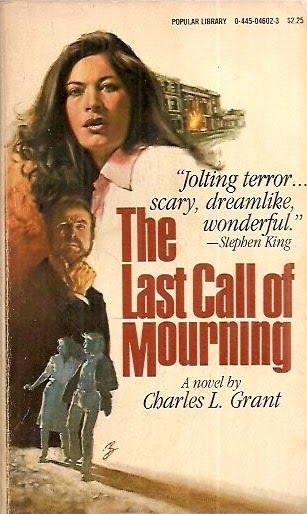
Charles L. Grant,
George Clayton Johnson, and original Playboy associate editor
Ray Russell, as well as newcomers like
W.H. Pugmire and
Nicholas Royle, are all worthwhile.
 Steve Rasnic Tem
(pictured) contributes "Little Cruelties," one of my favorites, which "excavates" the everyday hurts that we visit upon loved ones. But a father regrets more and more the pain he's caused, and reflects how anonymous cities have almost bred this carelessness inside us. Tem writes strongly and suggestively, with an affectlessness that heightens the prosaic horror.
The final story, "Pain," is
Whitley Strieber's mix of tinfoil-hat crankdom - UFOs, the Vril Society, pagan mythology - with a clear-eyed glimpse into the depths of a different kind of S&M. Waxing rather philosophical about death, "Pain" is one of the best stories in
Cutting Edge and the perfect end to the anthology, encapsulating as it does all that has come before it. A writer meets a fetching young woman who knows a thing or two about pain:
I wait as she comes scything down the rows of autumn. Although her call will mark the last stroke of my life, it will also say that my suffering is not particular, and in that there is a kindness. She comes not only for me but for those yet unborn, for the old upon their final beds, and the millions from the harvest of war. She comes for me, but also for you, as in the end for us all.

 Prolific British pulp-horror writer Guy N. Smith's second novel in his infamous Crabs saga - although the first published in the United States - is a slim and fast-moving account of seriously gigantic, man-eating crabs invading a resort island off Australia's Great Barrier Reef. Now you may not believe me and it may disappoint you to hear it, but Killer Crabs (Signet Dec 1979) is not the outrageously trashy and poorly-written horror novel I'd expected. Yes, it is trashy and yes, there's a lot of bad writing, but at no point did I practically exclaim aloud, "Get the fuck outta here with this shit!" or "You gotta be kidding me!" or some other bit of disbelief. Nope, Killer Crabs is just a run-of-the-mill '70s horror novel in the "giant monster" or "nature running amok" traditions. Pincers sever limbs, entrails are devoured, buildings destroyed, watch out, here they come: Click, click, clickety-click...

 1989 Dell Books reprint