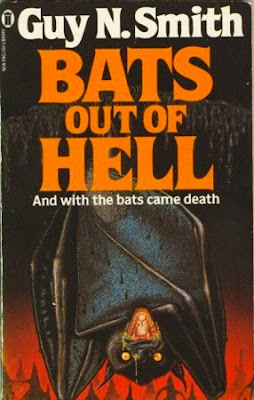
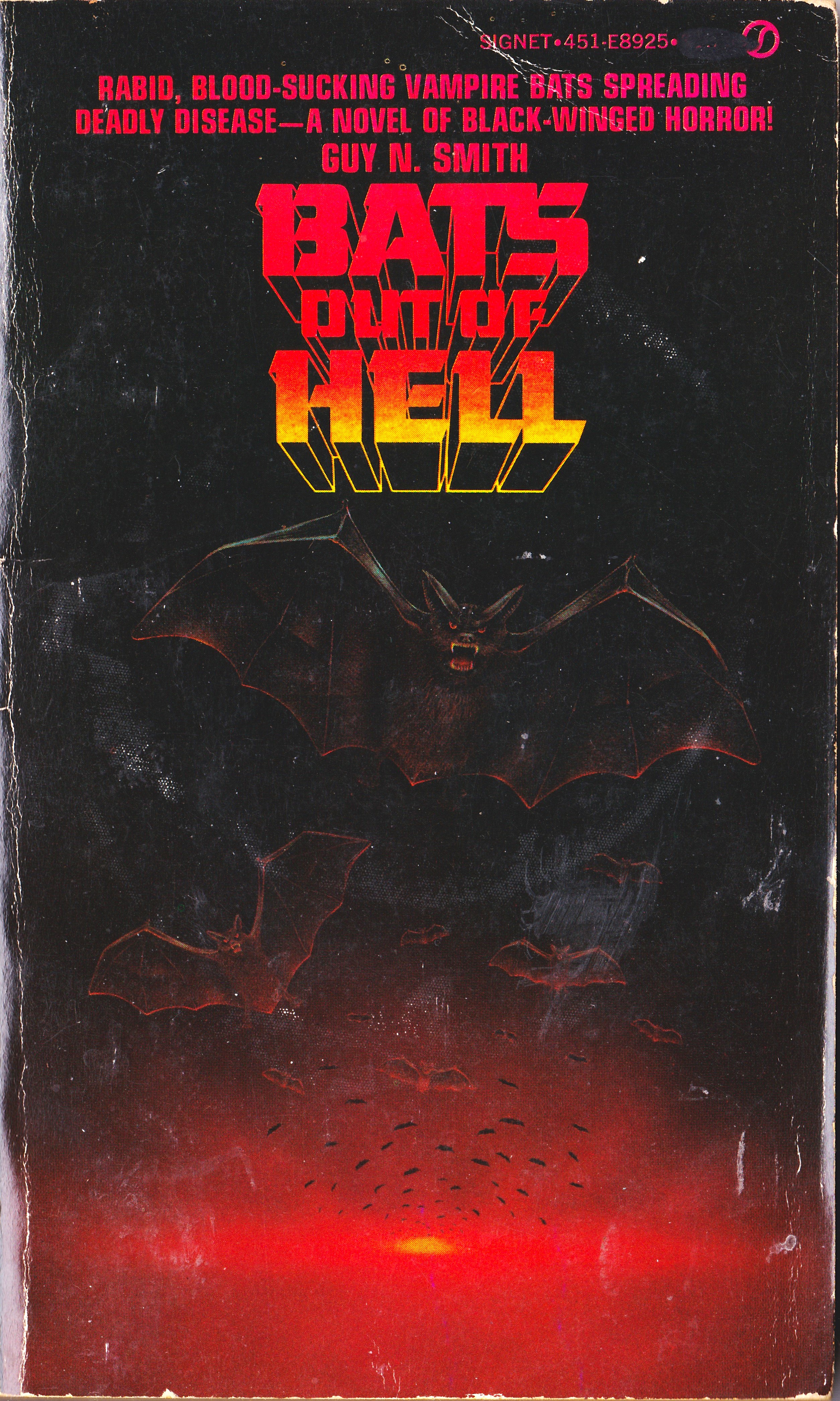
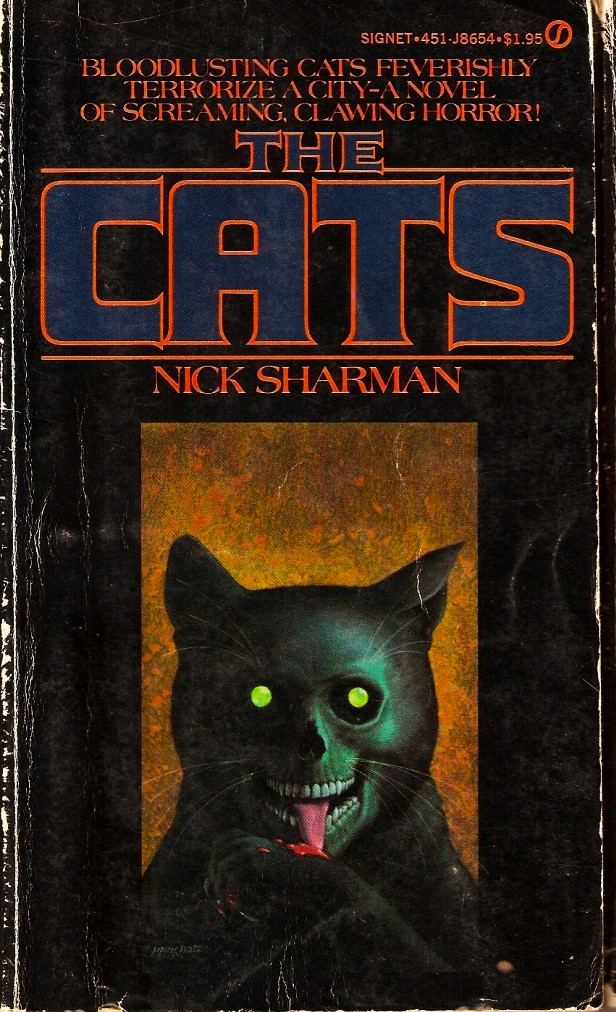
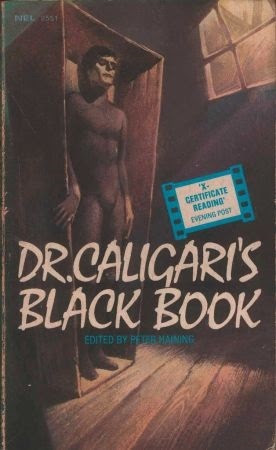
Still so many treasures to be found in paperback horror! I was rereading a Sphere book recently and noticed this back pages ad that I had previously missed, for a horror series I had never heard of before:
Immediately I got on the Google to see what I could see and lo and behold my faithful readers I was rewarded with these delightfully vintage softcore covers for The Witches, an eight-volume series of historical horror novels by one James Darke.
If you were around in the early '80s, then these covers bring back forbidden images of men's mags like Gallery, Oui, Hustler, Penthouse, as well as MTV video starlets and instructional aerobics programs. How the janky lighting, the fog machine, and cheap set design takes me back!
James Darke is, you won't be surprised, a pseudonym; in this case, for a writer new to me, Laurence James (1942 - 2000), who wrote mostly pulp apocalyptic science fiction. The Witches was never published in the States, which certainly accounts for my unfamiliarity with it.
The few reviews I've found online range from good to not-good, neither which makes me eager to read them, but I would not pass up an opportunity to add them to my shelves! If anyone's read them, please, do tell...
Showing posts with label british. Show all posts
Thursday, August 29, 2019
Sunday, July 28, 2019
Feast by Graham Masterton (1988): Stay Hungry
Published as a Pinnacle paperback original in 1988
with some fanfuckingtastic cover/stepback art by comic book artist Bob Larkin, Feast is today one of
the more sought-after books of its era, usually going for close to $100, alas. Graham Masterton, an author who churned out—who still churns out!—reliably gruesome and fast-paced horror novels, presents a tale about a cult of enormous proportions, and a man and his teenage son who become mixed up in it. I was able to find a copy online four or five years ago for only a few dollars—diligence and patience is the
key in collecting these vintage horror paperbacks—in very good condition. It's a sturdy one too, the spine held up
and didn't crack while I read it. O huzzah!
Charlie and Martin are father and teen son and not, as their names would suggest, two late-middle-aged men, eating in a palate-displeasing restaurant when the novel begins. Charlie, the father, is a 40-year-old divorced restaurant reviewer for a traveling salesman guidebook, and let me tell you, Masterton really gets his digs in when it comes to subpar cookery and presentation; I think it's personal. Martin, 15, is along for the roadtrip, but he's been living with his mother and estranged from Charlie, so said roadtrip has not been a roaring success. It's about to get worse, though, a whole lot worse than just a gloppy sauce on dried-out schnitzel.
While dining in The Iron Kettle, a dire New England restaurant with dismal food, their waitress casually mentions a rival spot called Le Reposoir. But Kettle proprietress Mrs. Foss takes much offense—"Don't you even whisper that name! Don't even breathe it!" Le Reposoir is actually the headquarters of a religious/mystical organization known as The Célèstines, or The Heavenly People. It's "a secret eating society," Charlie is told, made up of folks who eat what "they're not supposed to." Uh-oh. And they don't let in just anybody.
Run by our villains, the refined M. and Mme. Musette, this "dinner club" is in a Gothic-y old house out of an Edward Gorey illustration, a place spoken of with distaste and barely-disguised fear. In this town of Allen's Corner, teens have been going missing, and while people suspect the Musettes and their various hangers-on and acolytes having something to do with it, there are no hard facts for the police to investigate.
Intrigued, fascinated despite himself (and in a fit of pique because he may not be allowed in), Charlie and Martin find this disreputable restaurant and are promptly rebuffed at the gated entrance by M. Musette himself—who already knows who Charlie is: "We are a very exclusive society, and I am afraid that the presence of a restaurant reviewer would not by our membership with any particular warmth." Father and son go back to their hotel. After a desultory meal alone in the dining room, Charlie finds himself in the dimly-lit hotel lounge being chatted up by a woman named Velma, who is exactly the kind of woman you expect to find in dimly-lit hotel lounges:
After a night of torrid porno foreshadowing action with Velma—recall that Masterton wrote popular paperback sex guides in the 1970s!—Charlie returns to his room and finds Martin... gone. And no one he enlists to help him, neither desk clerk nor manager, neither maitre d' nor waiter, have any memory of seeing a teenage boy with Charlie. Two useless deputies arrive and one tells him that perhaps his son was "only riding along with you inside of your mind." Being a restaurant critic is exhausting work, maybe you overtaxed your brain and imagined your son with you, sure, it happens! Charlie suspects that he knows someplace where there'll be answers... and heads back to Le Reposoir.
Storming into the building, Charlie learns much: not just about his son, but about the believers themselves. As the beautiful yet near-fingerless Mme. Musette explains, in the most rational of tones, how the Célèstines came to believe that true communion with God could only be consummated by the eating of human flesh and the drinking of human blood... one's own, and others' freely given. Dig:
That's
right: people are eating themselves to get closer to God! In a twist everyone saw coming, Charles finds Martin holed up in the Célèstine compound and wants nothing more than to self-sacrifice himself and become one of the auto-cannibals. Even more disturbing, they are convinced the Second Coming is at hand, and Martin is an essential component to bringing it about. Convinced he's been brainwashed or worse, Charlie is hellbent on getting his estranged son out of the clutches of these crazies. He even begins to blame himself, surmising that these fanatics have appeal for young people because their parents' way of life holds no appeal... "I mean, what have we given our children that has any spiritual value whatsoever?" Masterton is trading on the '70s phenomenon of Manson, Jesus freaks, and teenage runaways, perhaps a bit of stale sociology by the late '80s when kids were besotted with MTV and home video games.
To get Martin out, Charlie enlists the help of Robyn Harris, a smart, capable, oh yes and beautiful, hot-to-trot local reporter. Events conspire, gruesome and graphic, that put the two on an escape route out of Allen's Corners, which includes a delightful reference to an Elliott Gould movie. Although the two lovebirds get in some quality banging while on the run and get to take a leisurely walk around lovely New Orleans, ground zero for the Célèstines, Charlie may have to commit the ultimate sacrifice himself to save his beloved son.
Writing with more control and restraint than one would think in a book about a cannibal cult, Masterton's traditional over-the-top approach has been corralled into a sleeker format. I've read some reviews and comments on Feast about it being "bonkers" and "outrageous" but I did not find it so; scenes of ritual self-destruction and consumption are depicted with clean, austere, I guess you'd say a spiritual precision. I was reminded of the films Dead Ringers and, especially, Martyrs:
Masterton is as always more than adept at keeping his story and characters trucking right
along, always introducing a new threat or character or situation at the
right moment—he's a pulp pro, and you'll enjoy the various skirmishes, confrontations, and well-described American settings (yet American characters still speak in British). But he never tries to scare you or present
you with an eerie chill; all the "horror" here is (mostly) limited to
scenes of cannibalism, or more accurately, self-cannibalism. What's more, this is a novel featuring skeletons on its cover and cannibalism inside, but
is not exactly, I feel, a horror novel. Hear me out.
Feast reads more like a paranoid suspense thriller (a genre in which he's written many novels) about a religious cult that's taken the Eucharist to its literal end. There is an ostensible kidnapping, fugitives on the run, a worldwide conspiracy angle competently executed but that's about all: Masterton's blocky explanations, his usual awkward dialogue, and exposition without any sense of humor or irony, actually undermine his setup, clever though it is. I wanted, like one of the cult acolytes, more.
Ira Levin would've used this scenario as comment on, say, faddish food trends, or cult-like psychologies, or the young generation's desire to escape their parents' hypocrisies and failures... but would have given us some real creeps and scares included in the recipe. And who can forget The Happy Man, the Eric Higgs novel that is surely the apex of '80s cannibal horror fiction that understands the bones beneath this flesh.
If Masterton had acknowledged the absurdity of his cult creation I think the fear quotient would've been great: what's scarier than something ridiculous that's dangerous (there's a psycho "dwarf" stomping around who hearkens back to Masterton's ludicrously horrific monstrosities in minor form)? And what about the ultimate irony (a delicious irony, one could even say), a restaurant getting back at a food critic by kidnapping his son and getting him to believe that cannibalizing himself is the ultimate act of achieving godhood?! Masterton moves so fast, as is his M.O., that he doesn't let himself ponder this concept.
I wish he had engaged with the satire/parody of religion, Christianity, and doomsday cults that seems to suggest itself from the start. Unfortunately, for this reader, he leaves all that untouched, which gives the book a half-baked feeling in its scenes about the beliefs and behaviors of the cult. Masterton plays it straight, almost too straight, po-faced and literal. The twist at the end comes from a misreading of Célèstines scripture, something Charlie alone figures out, but Masterton implies no larger irony in that. Which is fine, I guess, because everything still works as it is. The climax is fiery, explosive, satisfying... but there is of course more to come after. I'm not sure how much I was into that.
Oh, one biblographic fact that may help in your search for this work: Feast is the American title; in the UK it's known as Ritual, a distinction I feel is not much of a difference. I myself prefer this glorious Feast edition, not least because of that Larkin cover art and the presence of ITC Benguiat typeface, the premier horror typeface of the '80s. Either way, it might not be the tastiest Masterton treat you'll ever eat, but if you can find an inexpensive copy, dig right in.
Charlie and Martin are father and teen son and not, as their names would suggest, two late-middle-aged men, eating in a palate-displeasing restaurant when the novel begins. Charlie, the father, is a 40-year-old divorced restaurant reviewer for a traveling salesman guidebook, and let me tell you, Masterton really gets his digs in when it comes to subpar cookery and presentation; I think it's personal. Martin, 15, is along for the roadtrip, but he's been living with his mother and estranged from Charlie, so said roadtrip has not been a roaring success. It's about to get worse, though, a whole lot worse than just a gloppy sauce on dried-out schnitzel.
All my friends are gonna be there too
Run by our villains, the refined M. and Mme. Musette, this "dinner club" is in a Gothic-y old house out of an Edward Gorey illustration, a place spoken of with distaste and barely-disguised fear. In this town of Allen's Corner, teens have been going missing, and while people suspect the Musettes and their various hangers-on and acolytes having something to do with it, there are no hard facts for the police to investigate.
Intrigued, fascinated despite himself (and in a fit of pique because he may not be allowed in), Charlie and Martin find this disreputable restaurant and are promptly rebuffed at the gated entrance by M. Musette himself—who already knows who Charlie is: "We are a very exclusive society, and I am afraid that the presence of a restaurant reviewer would not by our membership with any particular warmth." Father and son go back to their hotel. After a desultory meal alone in the dining room, Charlie finds himself in the dimly-lit hotel lounge being chatted up by a woman named Velma, who is exactly the kind of woman you expect to find in dimly-lit hotel lounges:
She sat down and crossed her legs. Her shiny black dress rode high on her thighs. He recognized her scent: Calvin Klein's "Obsession." She blew smoke over him but he wasn't sure he particularly minded. The top three buttons of her blouse were unfastened and Charlie could see a very deep cleavage indeed. White breasts with a single beckoning mole between them.
Storming into the building, Charlie learns much: not just about his son, but about the believers themselves. As the beautiful yet near-fingerless Mme. Musette explains, in the most rational of tones, how the Célèstines came to believe that true communion with God could only be consummated by the eating of human flesh and the drinking of human blood... one's own, and others' freely given. Dig:
"Did
not Jesus say 'Take, eat, this is My body.' And did he not say 'Drink,
for this is the blood of My covenant.' The whole essence of Christianity
is concerned with the sharing of flesh and blood. Not murderously, of
course, but voluntarily—the devoted giving of one's body for the greater glory of all..."
To get Martin out, Charlie enlists the help of Robyn Harris, a smart, capable, oh yes and beautiful, hot-to-trot local reporter. Events conspire, gruesome and graphic, that put the two on an escape route out of Allen's Corners, which includes a delightful reference to an Elliott Gould movie. Although the two lovebirds get in some quality banging while on the run and get to take a leisurely walk around lovely New Orleans, ground zero for the Célèstines, Charlie may have to commit the ultimate sacrifice himself to save his beloved son.
Writing with more control and restraint than one would think in a book about a cannibal cult, Masterton's traditional over-the-top approach has been corralled into a sleeker format. I've read some reviews and comments on Feast about it being "bonkers" and "outrageous" but I did not find it so; scenes of ritual self-destruction and consumption are depicted with clean, austere, I guess you'd say a spiritual precision. I was reminded of the films Dead Ringers and, especially, Martyrs:
A young naked girl was... sawing through her own arm at the elbow. Her eyes were fixed and wild-looking. Her teeth were clenched on a rubber wedge to prevent her from biting her tongue. She had cut through the skin and muscle of her forearm with a surgical scalpel, and now she was rasping her way through the bones, radius, and ulna—bone dust mushing white into her bright leaking blood.
Sphere UK paperback, Aug 1989
Thriller from Tor looks almost like a horror paperback
Feast reads more like a paranoid suspense thriller (a genre in which he's written many novels) about a religious cult that's taken the Eucharist to its literal end. There is an ostensible kidnapping, fugitives on the run, a worldwide conspiracy angle competently executed but that's about all: Masterton's blocky explanations, his usual awkward dialogue, and exposition without any sense of humor or irony, actually undermine his setup, clever though it is. I wanted, like one of the cult acolytes, more.
Ira Levin would've used this scenario as comment on, say, faddish food trends, or cult-like psychologies, or the young generation's desire to escape their parents' hypocrisies and failures... but would have given us some real creeps and scares included in the recipe. And who can forget The Happy Man, the Eric Higgs novel that is surely the apex of '80s cannibal horror fiction that understands the bones beneath this flesh.
German paperback, 1988
If Masterton had acknowledged the absurdity of his cult creation I think the fear quotient would've been great: what's scarier than something ridiculous that's dangerous (there's a psycho "dwarf" stomping around who hearkens back to Masterton's ludicrously horrific monstrosities in minor form)? And what about the ultimate irony (a delicious irony, one could even say), a restaurant getting back at a food critic by kidnapping his son and getting him to believe that cannibalizing himself is the ultimate act of achieving godhood?! Masterton moves so fast, as is his M.O., that he doesn't let himself ponder this concept.
Severn House UK hardcover, 1988
Labels:
'80s,
bob larkin,
british,
cannibalism,
graham masterton,
new orleans,
novel,
pinnacle books,
read,
sphere books
Friday, May 24, 2019
Carnosaur by Harry Adam Knight (1984): Bang a Gong Get It On
I can't imagine it'd surprise you to learn that I was a pretty mean dinosaur fanatic when I was a kid in the 1970s. Visits to the local library were never complete without a stack of books on these fantastic creatures. Most of these titles were from the '50s and '60s and out of date by the time I was reading them, illustrated by timid little black-and-white pencil sketches of tail-dragging creatures, but I still recall with great fondness two from that actual decade:
A family trip to New York's American Museum of Natural History when I was in second or third grade allowed me to see the immense fossils in person. Relatives would ask me to name the various dinos, which I could rattle off pretty easily (I could also do the same with classic monster movies thanks to the infamous Crestwood series). There was this early '70s model kit. Lots of plastic toys. Factor in the original King Kong, movies like The Land that Time Forgot, oh and especially the bottom-of-the-barrel TV movie The Last Dinosaur, with a drunk Richard Boone battling a Tyrannosaurus and other baddies in a land at the center of the earth. Or how about the actual Journey to the Center of the Earth? Or The Lost World? And who can forget Bradbury's "A Sound of Thunder"? So. Yeah. Dinosaurs.
In 1993 I went to see Spielberg's adaptation of Jurassic Park twice the weekend it opened and was well rewarded: yep, that's the stuff I've been wanting to see since I was a kid. I even went to the mall afterwards and bought the T. Rex, the toy I had dreamed of all my childhood (just the right size have battled an alien or eaten a rebel!) and proudly displayed it in all my homes for over 20 years. All of this brings me to...
Harry Adam Knight was a pseudonym used for a small handful of pulp novels by John Brosnan (sometimes with the assist of Leroy Kettle), a prolific Australian author who also wrote nonfiction genre studies. A fleet-footed, old-fashioned thriller with plenty of gore, in the tradition of James Herbert, Carnosaur (Star Books, June 1984 UK/Bart Books, Feb 1989 US) is as solid a trashy paperback horror novel as one could want. Knight ticks all the boxes and doesn't muck about with the unnecessaries. This is pulp horror done right: mean, nasty, brutish, and short. Sometimes every character is so glum and rude you kinda think, Jeez, doesn't anyone have a nice polite word to say? Everyone's all Johnny Rotten all the time. Kill the lot of 'em. Unpleasant, ungrateful, folk fodder for the dinosaur. Right... now.
Our tale begins at 2:17 a.m. sharp when a poultry farmer is woken by his wife ("fat lazy cow" he thinks. See what I mean? What a turd) because their chickens are squawking up a ruckus. Of course, you're reading a book called Carnosaur so you know what's about to happen when Rudie McRuderson goes out to investigate. And it does. Then the action switches to two teens doing it in the backseat and it's more of the same, with some class-consciousness woven in as British pulp fiction seems to always do: "She'd been flattered to have been picked up by someone who was so upper-class. Well, sort of upper class."
Daytime: David Pascal is a late 20s guy working as a "journalist" at a newspaper that's barely a newspaper in the small English town of Warchester, "where nothing exciting ever happened." He's just dumped his wonderful girlfriend, a coworker named Jenny, because of his dreams of leaving for a job on a Fleet Street scandal rag. Who knows when that'll happen since those papers keep ignoring his applications. So here Pascal is, still working on a paper that's practically a local business flyer and having awkward moments with Jenny in the office. But you're reading a book called Carnosaur, so you know that Warchester is gonna offer up something soon that Fleet Street dared never dream.
Sir Darren Penward (erroneously referred to as "Sir Penward" throughout the novel) is Warchester's wealthy eccentric, the big-game hunter with his own personal zoo on his vast estate, filled with exotic and dangerous animals—including his ravenous nympho wife, Lady Jane. But again, you're reading a book called Carnosaur, and you know that Warchester will soon be under siege by animals much more exotic and dangerous than *yawn* tigers and panthers. The police begin their investigation, and "Sir Penward" blames the attacks on an escaped Siberian tiger. Pascal suspects a cover-up, and along with a reluctant Jenny, begins some investigation of his own. This leads him into the clutches of Lady Jane (aka Lady Fang, and looking "like something out of The Story of O"), well-known amongst the locals for her penchant of seducing younger men while her husband tends to his menagerie. Pascal realizes he can use her to get inside the zoo to peek around. That can't be a bad idea, can it?
Pascal has a confrontation with Penward in which all is revealed about how these extinct monsters are suddenly alive again: the painstaking genetic process that the obsessed Penward explains almost like a Bond villain, which leaves Pascal muttering, "Incredible. Chickens into dinosaurs." Brosnan's science when it comes to dinos sounds pretty spot-on to me from what I recall of more modern paleontology books, and the distinction between dinosaurs—terrestrial prehistoric creatures—and other ancient reptiles will prove more important than anyone but an actual scientist could imagine. But you're reading a book called Carnosaur so that shouldn't surprise you. I don't need to rehash the rest: Brosnan does nothing new with the plot—but that's entirely beside the point. This baby zips along with a confident rhythm and pacing precisely because the author doesn't try to add new twists or turns to his narrative (indeed I could have done with less "You've got to believe me, dinosaurs are in the streets, there's no time to explain!" but that is to quibble). Pulp is, in essence, comfort reading.
Harry Adam Knight was a pseudonym used for a small handful of pulp novels by John Brosnan (sometimes with the assist of Leroy Kettle), a prolific Australian author who also wrote nonfiction genre studies. A fleet-footed, old-fashioned thriller with plenty of gore, in the tradition of James Herbert, Carnosaur (Star Books, June 1984 UK/Bart Books, Feb 1989 US) is as solid a trashy paperback horror novel as one could want. Knight ticks all the boxes and doesn't muck about with the unnecessaries. This is pulp horror done right: mean, nasty, brutish, and short. Sometimes every character is so glum and rude you kinda think, Jeez, doesn't anyone have a nice polite word to say? Everyone's all Johnny Rotten all the time. Kill the lot of 'em. Unpleasant, ungrateful, folk fodder for the dinosaur. Right... now.
Our tale begins at 2:17 a.m. sharp when a poultry farmer is woken by his wife ("fat lazy cow" he thinks. See what I mean? What a turd) because their chickens are squawking up a ruckus. Of course, you're reading a book called Carnosaur so you know what's about to happen when Rudie McRuderson goes out to investigate. And it does. Then the action switches to two teens doing it in the backseat and it's more of the same, with some class-consciousness woven in as British pulp fiction seems to always do: "She'd been flattered to have been picked up by someone who was so upper-class. Well, sort of upper class."
Daytime: David Pascal is a late 20s guy working as a "journalist" at a newspaper that's barely a newspaper in the small English town of Warchester, "where nothing exciting ever happened." He's just dumped his wonderful girlfriend, a coworker named Jenny, because of his dreams of leaving for a job on a Fleet Street scandal rag. Who knows when that'll happen since those papers keep ignoring his applications. So here Pascal is, still working on a paper that's practically a local business flyer and having awkward moments with Jenny in the office. But you're reading a book called Carnosaur, so you know that Warchester is gonna offer up something soon that Fleet Street dared never dream.
Sir Darren Penward (erroneously referred to as "Sir Penward" throughout the novel) is Warchester's wealthy eccentric, the big-game hunter with his own personal zoo on his vast estate, filled with exotic and dangerous animals—including his ravenous nympho wife, Lady Jane. But again, you're reading a book called Carnosaur, and you know that Warchester will soon be under siege by animals much more exotic and dangerous than *yawn* tigers and panthers. The police begin their investigation, and "Sir Penward" blames the attacks on an escaped Siberian tiger. Pascal suspects a cover-up, and along with a reluctant Jenny, begins some investigation of his own. This leads him into the clutches of Lady Jane (aka Lady Fang, and looking "like something out of The Story of O"), well-known amongst the locals for her penchant of seducing younger men while her husband tends to his menagerie. Pascal realizes he can use her to get inside the zoo to peek around. That can't be a bad idea, can it?
Pascal has a confrontation with Penward in which all is revealed about how these extinct monsters are suddenly alive again: the painstaking genetic process that the obsessed Penward explains almost like a Bond villain, which leaves Pascal muttering, "Incredible. Chickens into dinosaurs." Brosnan's science when it comes to dinos sounds pretty spot-on to me from what I recall of more modern paleontology books, and the distinction between dinosaurs—terrestrial prehistoric creatures—and other ancient reptiles will prove more important than anyone but an actual scientist could imagine. But you're reading a book called Carnosaur so that shouldn't surprise you. I don't need to rehash the rest: Brosnan does nothing new with the plot—but that's entirely beside the point. This baby zips along with a confident rhythm and pacing precisely because the author doesn't try to add new twists or turns to his narrative (indeed I could have done with less "You've got to believe me, dinosaurs are in the streets, there's no time to explain!" but that is to quibble). Pulp is, in essence, comfort reading.
Brosnan, 1947-2005
Okay, okay, I'm getting to it: the "carno" part of the title. Well, gentle reader, you won't be disappointed. The residents of Warchester—the ones still alive—woke up to a world that was vastly different to the one they'd gone to sleep in. Brosnan serves up the grue that satisfies. Behold: Tarbosaurus, a T. Rex in everything but name, wreaks delightful havoc wherever it goes; Deinonychus, with its scythe-clawed foot that it uses like a prehistoric exponent of Kung-Fu, guts hapless farmers and other locals from neck to groin; and a plesiosaur joins a boating party that none of the invitees will soon forget: After a long, stunned silence a man's voice said, with an edge of hysteria to it, "Well, you've got to say one thing for good old Dickie; he sure throws a hell of a party..." Brosnan doesn't quite take it to ridiculous Dinosaur Attacks! levels, but pulp fans should still have plenty to chew on. Sex, violence, nerdy dino facts: Carnosaur has it all.
Above I mentioned Jurassic Park, and I can't leave this review without mentioning that Carnosaur features many facets that would become famous, indeed iconic, when Spielberg adapted Crichton's 1990 bestseller: chase scenes, close calls, and especially the scientific basis of resurrecting dinos are all first seen in this novel (itself adapted into a post-JP cheapie by Roger Corman). While I've never had much interest in Crichton's fiction, after reading this I feel I need to see if Crichton really did read a book called Carnosaur... or if it's simply a case of a great idea whose time had, like the dinosaurs, come again.
Labels:
'80s,
bart books,
british,
creature horror,
dinosaurs,
harry adam knight,
novel,
pulp horror,
read,
star books
Wednesday, June 14, 2017
Scorpion by Michael R. Linaker (1980): Animal Magnetism
Poor Old Blighty: the once regal lord of the world would, throughout the 1970s and '80s, find itself overrun again and again by hordes of vermin which laid waste to so many of its proud, if overly class-conscious, innocent citizens—in the pages of paperback horror fiction, of course. Blame James Herbert, of course (certainly the threat from the natural world could be traced back to Wyndham and Wells, but probably found its true footing in an unassuming 1952 tale by Daphne Du Maurier's blown up to existential proportions by one Alfred Hitchcock) but it was Big Bad Jim who unleashed The Rats in 1974 and truly made the country a feeding ground for all creatures great and small. America was of course overrun as well, but there was something in British culture that was especially ripe for the taking, suffering cats, dogs, crabs, slugs, and worse (gah, do teenagers count?!).
And so we come to Scorpion (Signet Books, Feb 1981), a very slim offering from author Michael R. Linaker (b. Lancashire, 1940). Originally a writer of Westerns set in America, he apparently gained the notice of someone at New English Library and was commissioned to write one of their popular horror novels. At least Linaker had a familiarity with the English language, and knew how to deploy it with some idea of suspense and efficient characterization.
Now I don't really have much to say about the storyline once you've read this back-cover copy. In fact it's about as big a spoiler as can be; intrepid characters go off in search of the cause of these mutated monsters when the answer is right there: radiation leak! Of course anyone with a rudimentary knowledge of evolution knows that radiation causes animals to grow from teeny-tiny critters to five-inch long death dealers with a knack for finding the tenderest parts of the human anatomy. I mean duh.
The cover art makes clear that sex-and-gross-death will be mingled and prevalent, and readers hoping for such lurid shenanigans will not be disappointed. At least by 1981 standards; MMV for readers raised on latter-day product of similar nature. Linaker isn't shy, as the novel progresses, with doling out the wretched horrors visited upon the helpless victims. And also of course they are drawn to only the hottest ladies, I mean otherwise why bother?
Sectioned into three parts (hey! just like a scorpion!), each with a pretentious title ("Encounters," "Engagements," "Invasion"), Scorpion follows the template of all books of its type. Characters are introduced, given a quick backstory (usually incredibly class-conscious; in fact the guy who identifies the culprits is a rough-hewn working stiff, "Er, whatcha call 'em, a scorpion!"), and then shuffled off this mortal coil posthaste. A scene in a supermarket, with scorpions marauding dozens of (female) shoppers, is a show-stopper. Two villain-types, involved with the responsible nuclear plant, are dispatched with max grody pain and suffering, so there's that.
Otherwise Linaker gives more depth to his expendable players than he does to his mains, so you might mix up some of the doctors perplexed by all the "bee sting" vics suddenly dying in excruciating, mystifying pain. Requisite love angle introduced, breakfast-in-bed scene during a lull in arachnid apocalypse, blame is placed at modern world advancements (though not as blatantly as in some novels; here's it's more a given), and quick wrap-up climax holds things at bay for now but... the sequel would scuttle from the darkness, and a third was perhaps promised by Linaker, maybe even with the scorpions arriving in the States, but it never happened. Whew!
And so we come to Scorpion (Signet Books, Feb 1981), a very slim offering from author Michael R. Linaker (b. Lancashire, 1940). Originally a writer of Westerns set in America, he apparently gained the notice of someone at New English Library and was commissioned to write one of their popular horror novels. At least Linaker had a familiarity with the English language, and knew how to deploy it with some idea of suspense and efficient characterization.
Now I don't really have much to say about the storyline once you've read this back-cover copy. In fact it's about as big a spoiler as can be; intrepid characters go off in search of the cause of these mutated monsters when the answer is right there: radiation leak! Of course anyone with a rudimentary knowledge of evolution knows that radiation causes animals to grow from teeny-tiny critters to five-inch long death dealers with a knack for finding the tenderest parts of the human anatomy. I mean duh.
The cover art makes clear that sex-and-gross-death will be mingled and prevalent, and readers hoping for such lurid shenanigans will not be disappointed. At least by 1981 standards; MMV for readers raised on latter-day product of similar nature. Linaker isn't shy, as the novel progresses, with doling out the wretched horrors visited upon the helpless victims. And also of course they are drawn to only the hottest ladies, I mean otherwise why bother?
The scorpions advanced from every direction, scuttling swiftly across the floor. A few became entangled in the long, silky blonde hair, and in their frantic efforts to free themselves began to lash out with their stings. Venom, injected into the soft flesh of Casey's neck, spread swiftly into the bloodstream. Numbing agony exploded inside Casey's body and she jerked helplessly as tortured nerves emitted spasms. The pain of the stings helped to alleviate the pain caused by the ripping, tearing pincers as other scorpions shredded warm flesh from her bare legs. Blood began to stream from the countless wounds, streaking the tanned flesh, pooling on the floor beneath her body.
Original New English Library ed, June 1980
Sectioned into three parts (hey! just like a scorpion!), each with a pretentious title ("Encounters," "Engagements," "Invasion"), Scorpion follows the template of all books of its type. Characters are introduced, given a quick backstory (usually incredibly class-conscious; in fact the guy who identifies the culprits is a rough-hewn working stiff, "Er, whatcha call 'em, a scorpion!"), and then shuffled off this mortal coil posthaste. A scene in a supermarket, with scorpions marauding dozens of (female) shoppers, is a show-stopper. Two villain-types, involved with the responsible nuclear plant, are dispatched with max grody pain and suffering, so there's that.
Otherwise Linaker gives more depth to his expendable players than he does to his mains, so you might mix up some of the doctors perplexed by all the "bee sting" vics suddenly dying in excruciating, mystifying pain. Requisite love angle introduced, breakfast-in-bed scene during a lull in arachnid apocalypse, blame is placed at modern world advancements (though not as blatantly as in some novels; here's it's more a given), and quick wrap-up climax holds things at bay for now but... the sequel would scuttle from the darkness, and a third was perhaps promised by Linaker, maybe even with the scorpions arriving in the States, but it never happened. Whew!
Allan crouched beside the woman's body. He couldn't help noticing, despite the mutilations, that she had been young and very attractive.
Labels:
'80s,
british,
creature horror,
james herbert,
michael linaker,
new english library,
novel,
read,
signet books
Sunday, May 7, 2017
The Surrogate by Nick Sharman (1980): Father Do You Wanna Bang Heads with Me
Malevolent doll alert! Yes indeed, that mainstay of '80s horror fiction is at it again, a supernaturally-possessed innocent child's toy goes on a murderous rampage, controlled by the evil whims of a man so hateful and angry and resentful that he operates from beyond the grave. Nick Sharman (aka A.G. Scott, both pseudonyms of Norwegian/British author Scott Grønmark) also wrote Childmare, an intensely grim novel of a teenage riot in the James Herbert tradition. I found that novel to be solid horror entertainment, so have been looking forward to The Surrogate (Signet Books, July 1980) for some time now. The cover is replete with the coming (and going) decade's hallmark imagery: solitary child, evil doll, leering old man. Oh, and the requisite King blurb at the top, too, almost literally overshadowing the actual author's name!
Unlike Childmare, Surrogate is an intimate affair, with only a few characters and smaller stakes. The prologue is a banger, with a defiant boy being locked in a cellar room with rats for disobeying his terrifying despotic father in their huge estate home. Next we meet 30-something Frank Tillson, that little boy now grown. He is a radio talk-show host and is raising his eight-year-old son Simon alone after the death of wife and mother Kathie. Frank is driving back to the family estate, which he has not visited in many years, after the death of his own mother. Summoned by long-time family caretaker Reece, Frank reluctantly goes to see the old man, now being ravaged by cancer and at death's door. The reason? Why, his father's riches, who is to inherit them? The thought of taking his father's money sickens Frank, but the old man has found a loophole: he will leave the fortune to Simon upon his 18th birthday. Frank thinks the man has gone senile, and flatly refuses to hear of this idea. "When you're gone there'll be no coming back," Frank responds (foreshadowing!). "What you've built dies with you. For God's sake don't try and involve the living."
For awhile Sharman is slow to boil the pot, letting the reader experience Frank's daily life as a single, attentive father and as a popular radio talk-show host. Simon is introduced, a well-meaning, polite boy who quietly still mourns the death of his mother. Watching him read endless comic books, Frank wryly hopes he's not "rearing a pop culture junkie." Frank has never told Simon about his hated relation, ever, and when he does now the boy seems uninterested... until he's accosted at school by a man he doesn't know speaking about an obligation. Frank is enraged but not surprised that his father would stoop to such a trick. He phones Reece, who tells him his father did take a drive, but it proved too stressful and he's now in a coma, death expected soon. "Phone me as soon as he dies, Reece, I want to know my son is safe."
Frank escapes into his work, where we meet his producer Eddie, a likeable, middle-aged man of slovenly appearance and hedonistic tendencies tempered by a solid work ethic. His assistant Angela, a timid woman that Frank holds in some contempt for her incompetence if not her sex (and the mystifying allure she holds for Eddie). Sella Masters, an American beauty, is a psychic guest on one of Frank's shows; Frank is amazed to learn she is sincere about it: "You can't believe all this psychic nonsense. We're all adults here you know. Level with us." She agrees to a demonstration of her sixth sense and, as any astute reader will expect, it turns out gut-wrenchingly horrible when she sees the car accident that killed Kathie as well as her funeral, and at the funeral an old man in black watching Simon...
Interrupting this scene of awkward horror there's a phone call for Frank: it's Reece. The old man is dead. One of the enjoyable aspects of the novel is the vintage manner in which everyone drinks and smokes after a shock or while debating supernatural phenomena, and that's just what happens now. And more mysterious events pile on: a spooky figure in some photographs (Frank's a cranky sort, thinks of complaining on his show about a shop that can't develop photos right); malfunctioning radio equipment that screeches in the voice of an angry old man; a wad of cash mailed to Simon; a terrible dinner with Eddie and Angela that leaves Angela screaming and saying she saw a corpse climbing out of the bath; all that sort of thing, all rendered in a staid, realistic style that's neither pulpy nor literary.
Soon, sadly, Frank begins to suspect Eddie and Angela are behind these spooky intrusions into his and Simon's lives, sort of Scooby-Doo style, even while Sella the psychic is telling him that Simon is in real danger from his grandfather who is now on the other side, or what have you. He will not be denied! Frank's not crazy about that explanation: "The supernatural doesn't fit into my pattern of beliefs." "Screw your beliefs, Frank!" Sella half-shouted. "We don't have time for that pompous bullshit. You've seen things, for Christ's sake. You've been attacked by a frigging doll!" Ah yes, the doll! Wow, I won't spoil it, but that attack scene is pretty sweet, written in that tone that refuses to acknowledge the ridiculousness of the scenario. Sharman goes it with dead seriousness, knowing that any wink will deflate the horror (The doll glided toward him along the carpet. There were no individual limb movements, it just... glided). The toy once belonged to Kathie when she was a child, so its possession is extra obscene.
The climactic confrontation between father and son successfully brings together all that has come before, and doesn't overstay its welcome. We learn some horrible stuff about Frank's parents' relationship, the death of his mother, that sort of thing. The supernatural explanation seems the only rational one after Simon disappears, and Frank has to make a final trip to the family home he so despises. Some violence and gore, racy sex scene, not bad. The final pages is dark stuff, man. "What's worse than death, Sella?" he demanded again, fury building up inside him. "The boy's alive, Frank," he heard...
Sure, the reader will notice lapses in believability, like even though Frank is desperate to find his son, there are moments when he's like, "Oh he's probably back at the apartment" or something along those lines. These child-in-jeopardy plots don't work today; we can't really exploit them for suspense any longer since the reality is so unbearable. Dialogue, too, is creaky, the old amateur mistake of having every character say each other's names a dozen times in one conversation. The novel would've made a cracking good flick during its day, certainly not a classic, maybe in the style of adaptations of The Sentinel and The Manitou, with a virile British lead (Alan Bates? Albert Finney?) and maybe Jane Seymour or Jenny Agutter as Sella (doing a half-assed Yank accent). The novel is barely 250 pages, and even that's padded out some, but for a diverting vintage horror read, The Surrogate is a solid choice.
Unlike Childmare, Surrogate is an intimate affair, with only a few characters and smaller stakes. The prologue is a banger, with a defiant boy being locked in a cellar room with rats for disobeying his terrifying despotic father in their huge estate home. Next we meet 30-something Frank Tillson, that little boy now grown. He is a radio talk-show host and is raising his eight-year-old son Simon alone after the death of wife and mother Kathie. Frank is driving back to the family estate, which he has not visited in many years, after the death of his own mother. Summoned by long-time family caretaker Reece, Frank reluctantly goes to see the old man, now being ravaged by cancer and at death's door. The reason? Why, his father's riches, who is to inherit them? The thought of taking his father's money sickens Frank, but the old man has found a loophole: he will leave the fortune to Simon upon his 18th birthday. Frank thinks the man has gone senile, and flatly refuses to hear of this idea. "When you're gone there'll be no coming back," Frank responds (foreshadowing!). "What you've built dies with you. For God's sake don't try and involve the living."
For awhile Sharman is slow to boil the pot, letting the reader experience Frank's daily life as a single, attentive father and as a popular radio talk-show host. Simon is introduced, a well-meaning, polite boy who quietly still mourns the death of his mother. Watching him read endless comic books, Frank wryly hopes he's not "rearing a pop culture junkie." Frank has never told Simon about his hated relation, ever, and when he does now the boy seems uninterested... until he's accosted at school by a man he doesn't know speaking about an obligation. Frank is enraged but not surprised that his father would stoop to such a trick. He phones Reece, who tells him his father did take a drive, but it proved too stressful and he's now in a coma, death expected soon. "Phone me as soon as he dies, Reece, I want to know my son is safe."
Frank escapes into his work, where we meet his producer Eddie, a likeable, middle-aged man of slovenly appearance and hedonistic tendencies tempered by a solid work ethic. His assistant Angela, a timid woman that Frank holds in some contempt for her incompetence if not her sex (and the mystifying allure she holds for Eddie). Sella Masters, an American beauty, is a psychic guest on one of Frank's shows; Frank is amazed to learn she is sincere about it: "You can't believe all this psychic nonsense. We're all adults here you know. Level with us." She agrees to a demonstration of her sixth sense and, as any astute reader will expect, it turns out gut-wrenchingly horrible when she sees the car accident that killed Kathie as well as her funeral, and at the funeral an old man in black watching Simon...
Interrupting this scene of awkward horror there's a phone call for Frank: it's Reece. The old man is dead. One of the enjoyable aspects of the novel is the vintage manner in which everyone drinks and smokes after a shock or while debating supernatural phenomena, and that's just what happens now. And more mysterious events pile on: a spooky figure in some photographs (Frank's a cranky sort, thinks of complaining on his show about a shop that can't develop photos right); malfunctioning radio equipment that screeches in the voice of an angry old man; a wad of cash mailed to Simon; a terrible dinner with Eddie and Angela that leaves Angela screaming and saying she saw a corpse climbing out of the bath; all that sort of thing, all rendered in a staid, realistic style that's neither pulpy nor literary.
1981 New English Library ed with different doll,
not sure why, does Raggedy Andy not translate?
The climactic confrontation between father and son successfully brings together all that has come before, and doesn't overstay its welcome. We learn some horrible stuff about Frank's parents' relationship, the death of his mother, that sort of thing. The supernatural explanation seems the only rational one after Simon disappears, and Frank has to make a final trip to the family home he so despises. Some violence and gore, racy sex scene, not bad. The final pages is dark stuff, man. "What's worse than death, Sella?" he demanded again, fury building up inside him. "The boy's alive, Frank," he heard...
Sure, the reader will notice lapses in believability, like even though Frank is desperate to find his son, there are moments when he's like, "Oh he's probably back at the apartment" or something along those lines. These child-in-jeopardy plots don't work today; we can't really exploit them for suspense any longer since the reality is so unbearable. Dialogue, too, is creaky, the old amateur mistake of having every character say each other's names a dozen times in one conversation. The novel would've made a cracking good flick during its day, certainly not a classic, maybe in the style of adaptations of The Sentinel and The Manitou, with a virile British lead (Alan Bates? Albert Finney?) and maybe Jane Seymour or Jenny Agutter as Sella (doing a half-assed Yank accent). The novel is barely 250 pages, and even that's padded out some, but for a diverting vintage horror read, The Surrogate is a solid choice.
Frank then saw another narrower passage leading off to the left. The stench was thickening. It was almost tangible, as though the basement complex were his father's diseased insides and he [was] approaching nearer and nearer to the center of corruption.
Labels:
'80s,
british,
nick sharman,
novel,
signet books
Wednesday, March 29, 2017
The Woodwitch by Stephen Gregory (1988): There's Fever in the Funkhouse Now
Well, there's nothing for it: another vintage horror novel read in 2017 that promised much but delivered little. Despite the endless reservoir of talent that Stephen Gregory shows with his ability to craft a tasty line of prose or pinpoint an indelicate bit of human psychology, The Woodwitch (St Martin's Press paperback/Nov 1989) is a frustratingly narrow story, insular to the point of absolute zero, and disagreeably disgusting. Gregory's first novel, 1986's The Cormorant, was a doom-laden, penetrating work of deep obsession. Woodwitch is that too, but less as well. Sure, there are lots of quoted encomiums printed front and back, accurate, sure, but what they leave out is that the book is mostly a grimy slog of a read.
Our protagonist is uber-clueless buffoon Andrew Pinkney, guilty of the worst kind of turd-human behavior: smacking his date in the head for laughing at his limp penis. And that's it: that's the impetus for this shortish novel about a man's spiraling descent into madness (and where it stops, nobody know—er I mean you can probably guess). I suppose for many men that would be plenty enough reason, penile humiliation is the worst thing ever of course, but reading a whole book about it? Whew. I mean there's no room to breathe, and every breath one can draw is poisoned by enough rot and maggoty decay as to test any reader's tolerance.
The tale begins in a Welsh forest with Andrew traipsing about with his dog, a small collie called Phoebe. Phoebe is his only companion, an eager, bright, sometimes willful dog (but I just described a dog, didn't I, any dog); together they discover a badger corpse in the woods. Of course Andrew picks it up and takes it back to the cottage they're staying in and hangs it in the work shed. "You're perfect," he says to it as it drips maggots. Of course. Next, a jog back to the beginning so we can get a full dose of the square courtship between Andrew and his solicitor colleague Jennifer, a severe older woman, an amateur artist and naturalist who, on their romantic walks together, likes to point out various flora and fauna in their Latin scientific names. Hot stuff! No, it's rather charming.
Finally they get down to it, miserably, and Andrew fails at being a man, because that's what a man is of course ("Was that it?" the woman asked. That was it. "Heavens! What a lot of fuss about nothing!") and she sees his failure and begins to laugh. And Andrew simply punches her right in the mouth. Horrified at what he's done, Andrew calls cops and an ambulance; Jennifer is whisked away (no damage which a little dentistry could not repair), while their boss vouches for Andrew's good name and behavior so he is not charged. Boss suggests time off for both, which angers Jennifer, but Andrew takes him up on the offer of using the boss's holiday cottage so "then he could come back whenever he liked, refreshed and wholly recovered from the shock he had had." Well I am certainly glad of that, imagine how awful and oppressive and traumatizing it must be to have to punch a woman in the mouth, you totally need a vacay after that shit.
As for Jennifer, who knows, she disappears from this madness. She will only continue to exist as a fantasy in Andrew's mind... because he's got this great idea about how to win her back. Her fascination with flora and fauna has subtly influenced his own behavior. How about a little joke at his expense, to show her he's not such a bad guy? He'll give her the gift of fungus! He'll grow it himself out of a blooming animal carcass. And not just any fungus, but the stinkhorn, or Phallus impudicus, a wretched-smelling thing sticking six inches up out of the earth, oozing oil-green and viscous black... the forest's unashamed caricature of the human phallus, at which the ancient peoples of the mountains had marveled for century after century... the object of their wonder and witchcraft, a totem, a thing to be prized and loathed and feared... What a great idea! Send her one of those, ha-ha, see I'm a fella can laugh at himself!
You won't believe how much mileage Gregory gets from describing the lewd, dripping stinkhorn fungus, the busy little maggots burrowing inside the badger and (later, after a trip to the grim seaside) the swan corpses, the damp, suffocating weather. It's overwhelming, it's disgusting (not in any moral sense, but literally so) and ultimately: boring. As. Hell. Even when Gregory turns an apt phrase about one of these aspects, the reaction is "Oh, well done," not "Holy shit, the implications of this for the character's mental state is now clearer and scarier!" Just page after page of this obsession, All there was in the world, in the entire universe, was the man and his dog, enveloped by the night. Sure, there are creepy sheep about, staring at them through the dense overgrowth, sheep that haunt Andrew's dreams like marauding women...
Things get more interesting when Andrews meets a teenage brother and sister who live on a nearby farm caring for the sheep and kennel with hounds for fox-hunting. They mock him to his face in Welsh, but the girl, Shan, calls him "Pinkie" and seems amenable to conversation. They have a few pints in a woodsy lodge bar, something seems off. The novel's best sequence takes place on Halloween night, a party at this hotel bar, and the drunken, hallucinatory chaos which ensues. Told prior by Shan that folks would be in costume, Andrew bedecks himself in the weakest, lamest excuse for a vampire outfit ever, then with Phoebe at his side he trods in his wellies through the woods to the bar. Shan is flirty, her brother moody, the crowd oddly desultory. Phoebe becomes pathetically sick, distressing and angering the other drinkers and the barkeep asks them to leave. This leads to a bizarre attempt at a tryst with young Shan back at Pinkie's cabin, encrusted in dirt and soot, enticing Andrew on; there's wine, drunkeness, mockery, humiliation, even animal cruelty, I mean really. You can imagine the outcome of this seduction.
This whole sequence is very unsettling, I mean even the fungus gets a voice: In its effortlessness, its arrogance, its brazen lewdness, the stinkhorn sneered at him and said, "Look at me, Andrew Pinkney, and compare your flaccid maggot of a cock with mine!" The story continues on, I put the book down for weeks, ugh, same thing, then when it all wraps up there's hardly a surprise. Sure, with novels of obsession (Campbell's Face That Must Die, Tessier's Rapture, McDowell's Toplin, Koja's Cipher) that's often the case. I guess this time I was just exhausted by the literalness.
Once I read a rock critic who said something like the double-entendre lyrics of AC/DC were so obvious they were single entendres. That's the issue here too: Gregory is so on-the-nose with the symbolism of the fungus it's not even symbolism any longer; his conceit takes away any work on the reader's part: In Wales, Andrew Pinkney, having failed dismally in his last attempt to rear a home-grown erection, could sit back and enjoy these surrogates as he relaxed beside the fire. The sexual psychology here is all too obvious. This book isn't truly terrible, it has its moments like many horror novels I've overall disliked, but wow is it a bleak, dismal, dreary read with little payoff. I still recommend The Cormorant, but The Woodwitch left me unsatisfied. Traipse this dank darkness at your own peril.
Our protagonist is uber-clueless buffoon Andrew Pinkney, guilty of the worst kind of turd-human behavior: smacking his date in the head for laughing at his limp penis. And that's it: that's the impetus for this shortish novel about a man's spiraling descent into madness (and where it stops, nobody know—er I mean you can probably guess). I suppose for many men that would be plenty enough reason, penile humiliation is the worst thing ever of course, but reading a whole book about it? Whew. I mean there's no room to breathe, and every breath one can draw is poisoned by enough rot and maggoty decay as to test any reader's tolerance.
The tale begins in a Welsh forest with Andrew traipsing about with his dog, a small collie called Phoebe. Phoebe is his only companion, an eager, bright, sometimes willful dog (but I just described a dog, didn't I, any dog); together they discover a badger corpse in the woods. Of course Andrew picks it up and takes it back to the cottage they're staying in and hangs it in the work shed. "You're perfect," he says to it as it drips maggots. Of course. Next, a jog back to the beginning so we can get a full dose of the square courtship between Andrew and his solicitor colleague Jennifer, a severe older woman, an amateur artist and naturalist who, on their romantic walks together, likes to point out various flora and fauna in their Latin scientific names. Hot stuff! No, it's rather charming.
Finally they get down to it, miserably, and Andrew fails at being a man, because that's what a man is of course ("Was that it?" the woman asked. That was it. "Heavens! What a lot of fuss about nothing!") and she sees his failure and begins to laugh. And Andrew simply punches her right in the mouth. Horrified at what he's done, Andrew calls cops and an ambulance; Jennifer is whisked away (no damage which a little dentistry could not repair), while their boss vouches for Andrew's good name and behavior so he is not charged. Boss suggests time off for both, which angers Jennifer, but Andrew takes him up on the offer of using the boss's holiday cottage so "then he could come back whenever he liked, refreshed and wholly recovered from the shock he had had." Well I am certainly glad of that, imagine how awful and oppressive and traumatizing it must be to have to punch a woman in the mouth, you totally need a vacay after that shit.
1989 UK paperback
As for Jennifer, who knows, she disappears from this madness. She will only continue to exist as a fantasy in Andrew's mind... because he's got this great idea about how to win her back. Her fascination with flora and fauna has subtly influenced his own behavior. How about a little joke at his expense, to show her he's not such a bad guy? He'll give her the gift of fungus! He'll grow it himself out of a blooming animal carcass. And not just any fungus, but the stinkhorn, or Phallus impudicus, a wretched-smelling thing sticking six inches up out of the earth, oozing oil-green and viscous black... the forest's unashamed caricature of the human phallus, at which the ancient peoples of the mountains had marveled for century after century... the object of their wonder and witchcraft, a totem, a thing to be prized and loathed and feared... What a great idea! Send her one of those, ha-ha, see I'm a fella can laugh at himself!
You won't believe how much mileage Gregory gets from describing the lewd, dripping stinkhorn fungus, the busy little maggots burrowing inside the badger and (later, after a trip to the grim seaside) the swan corpses, the damp, suffocating weather. It's overwhelming, it's disgusting (not in any moral sense, but literally so) and ultimately: boring. As. Hell. Even when Gregory turns an apt phrase about one of these aspects, the reaction is "Oh, well done," not "Holy shit, the implications of this for the character's mental state is now clearer and scarier!" Just page after page of this obsession, All there was in the world, in the entire universe, was the man and his dog, enveloped by the night. Sure, there are creepy sheep about, staring at them through the dense overgrowth, sheep that haunt Andrew's dreams like marauding women...
1989 US hardcover
Things get more interesting when Andrews meets a teenage brother and sister who live on a nearby farm caring for the sheep and kennel with hounds for fox-hunting. They mock him to his face in Welsh, but the girl, Shan, calls him "Pinkie" and seems amenable to conversation. They have a few pints in a woodsy lodge bar, something seems off. The novel's best sequence takes place on Halloween night, a party at this hotel bar, and the drunken, hallucinatory chaos which ensues. Told prior by Shan that folks would be in costume, Andrew bedecks himself in the weakest, lamest excuse for a vampire outfit ever, then with Phoebe at his side he trods in his wellies through the woods to the bar. Shan is flirty, her brother moody, the crowd oddly desultory. Phoebe becomes pathetically sick, distressing and angering the other drinkers and the barkeep asks them to leave. This leads to a bizarre attempt at a tryst with young Shan back at Pinkie's cabin, encrusted in dirt and soot, enticing Andrew on; there's wine, drunkeness, mockery, humiliation, even animal cruelty, I mean really. You can imagine the outcome of this seduction.
In the firelight, it looked as though some disgusting torture had been practised on the girl and was about to be resumed, for her body, skeletal and black, appeared to have been burned, branded and charred by the naked man who once again loomed over her
2015 Valancourt Books trade paperback
This whole sequence is very unsettling, I mean even the fungus gets a voice: In its effortlessness, its arrogance, its brazen lewdness, the stinkhorn sneered at him and said, "Look at me, Andrew Pinkney, and compare your flaccid maggot of a cock with mine!" The story continues on, I put the book down for weeks, ugh, same thing, then when it all wraps up there's hardly a surprise. Sure, with novels of obsession (Campbell's Face That Must Die, Tessier's Rapture, McDowell's Toplin, Koja's Cipher) that's often the case. I guess this time I was just exhausted by the literalness.
Once I read a rock critic who said something like the double-entendre lyrics of AC/DC were so obvious they were single entendres. That's the issue here too: Gregory is so on-the-nose with the symbolism of the fungus it's not even symbolism any longer; his conceit takes away any work on the reader's part: In Wales, Andrew Pinkney, having failed dismally in his last attempt to rear a home-grown erection, could sit back and enjoy these surrogates as he relaxed beside the fire. The sexual psychology here is all too obvious. This book isn't truly terrible, it has its moments like many horror novels I've overall disliked, but wow is it a bleak, dismal, dreary read with little payoff. I still recommend The Cormorant, but The Woodwitch left me unsatisfied. Traipse this dank darkness at your own peril.
Somewhere in the gloom, it seemed that something had crawled away to
die and now was being dismantled by the silently working teeth of the
maggots. The smell arose like a vapour exhaled by the earth itself, and
then it was gone again, as if Andrew had imagined it, as though the
stink were conjured in the darkest recesses of his own mind, to appear
and disappear like a memory.
Labels:
'80s,
british,
novel,
psychological horror,
read,
st martins press,
stephen gregory
Friday, January 27, 2017
Cold Hand in Mine by Robert Aickman (1975): The Image Within
It is probably a mistake to label Robert Aickman (1914 - 1981) a horror writer. While his stories have been featured for decades in a myriad of horror fiction anthologies, I believe he was uncomfortable with confining his output to any single tradition; Aickman preferred to label his works as "strange stories." To me, this seems right and apt. Another word I'd use to describe his stories is "uncanny," since they rarely adhere to generic conventions but instead move subtly around them, hinting at unconscious drives, highlighting how the real world and the real people in it may be illusions obscuring darker forces at work. Odd occurrences do not add up; the killer does not remove a mask and
identify himself, because we aren't sure there's a killer at all, but
only time and chance and that what might be called fate. You might not be surprised when I suggest Aickman is a bit of an acquired taste.
Aickman has long been a favorite of adventurous readers who search high and low for the forgotten or the overlooked, the challenging and the obscure; in recent years his reputation has grown and grown, and his books have been brought back into print by several publishers. After years of fruitless search myself, I recently bought, for a few dollars more than I generally like to pay for old paperbacks, a copy of Cold Hand in Mine (Berkley Books reprint 1979, cover art by Michael Whelan). The paperback's spine reads SCIENCE FICTION but that is ridiculous: these are quiet, literate tales of creepiness; the front and back ad copy oversell it and I wonder of buyers' remorse back in the day...
I bought a hardcover copy of Painted Devils (1979, never issued in paperback) years ago because, of course, Danse Macabre. And to be honest, I never really took to him: the few stories I read in that collection seemed affected, remote, intellectualized to a sanitary degree. Reading Aickman takes a little more patience than many readers are willing to give, perhaps; it's more akin to reading the classics of James, Blackwood, Machen, and that crew, even though he was writing through what I loosely call the modern era. That is to say, his type of fiction, was somewhat out of style. I mean, that Whelan cover art up there, there's nothing like that in the book, either in imagery or mood. As you can see below, the hardcover editions featuring Edward Gorey's macabre gentility reflect a bit more accurately the uncanny chills you'll find inside.
These stories generate little heat; no melodrama, no generic twist, no jump scares, no slow dawning of horrible realization. When the "horror" occurs, rarely does it overly alarm or unduly concern anyone. The polite thing seems to be to ignore it... for that whisper of other worlds, or even an intimation that our perception of this world is flawed and incomplete, not up to the task, is simply intolerable. Characters view these things askance, never head-on.
"Meeting Mr. Millar" was another high point of Cold Hand for me. A would-be literary pornographer relates his story of "a haunted man rather than of a haunted house." Mr. Millar moves his business into the house the narrator rents a room in. Now telephones are ringing constantly, people banging about all hours, but just who is Mr. Millar? He invites the narrator into his office for a drink of sherry but shows little of himself: "Though everything was in a sense wide open, nothing was revealed from first to last." At one point the narrator is wakened in the middle of the night and what follows is a terrific scene of a midnight creep through darkened halls to peer down a stairwell, the most "horror" moment in this whole book, and the climax, such as it is, horrifies as well.
After failing to engage with the final story, "The Clock Watcher," at any level, I went back to the beginning: "The Swords" is a major work (rightly collected in the 1987 anthology The Dark Descent, David G. Hartwell's towering anthology that traces the horror story's evolution through the 20th century), more immediately interesting and accessible perhaps to the general reader than some of Aickman's other more opaque tales. With its careful layering of social and sexual unease, set in a dreary English town that features a half-hearted amusement park, and the utterly perplexing ritual of the titular objects, "The Swords" is a haunting weird classic.
There were moments throughout Cold Hand in which I was reminded of Ramsey Campbell, of Dennis Etchison, but in general Aickman is a writer unto himself. This is not always a good thing. At its best, Aickman's craftsmanship is lovely, with care taken to ensure each word and phrase and parenthetical aside heightens the reader's understanding, illuminating even common thoughts and feelings with a fresh light. However other times I was left adrift, either disinterested in the details (foreign royalty, World War I, fancy boarding schools for sickly rich kids, clocks) or unsure of just what Aickman was trying to impart upon the reader. More than once I had to stop and reread passages several times to ascertain what exactly was happening. Stories would end and some small comprehension would be whisked away from me. Am I a poor reader, or is Aickman fucking with me? Or is this all an example of the uncanny? I still kinda don't know.
Aickman has long been a favorite of adventurous readers who search high and low for the forgotten or the overlooked, the challenging and the obscure; in recent years his reputation has grown and grown, and his books have been brought back into print by several publishers. After years of fruitless search myself, I recently bought, for a few dollars more than I generally like to pay for old paperbacks, a copy of Cold Hand in Mine (Berkley Books reprint 1979, cover art by Michael Whelan). The paperback's spine reads SCIENCE FICTION but that is ridiculous: these are quiet, literate tales of creepiness; the front and back ad copy oversell it and I wonder of buyers' remorse back in the day...
These stories generate little heat; no melodrama, no generic twist, no jump scares, no slow dawning of horrible realization. When the "horror" occurs, rarely does it overly alarm or unduly concern anyone. The polite thing seems to be to ignore it... for that whisper of other worlds, or even an intimation that our perception of this world is flawed and incomplete, not up to the task, is simply intolerable. Characters view these things askance, never head-on.
Anyway. First story I read in the collection was "The Real Road to the
Church," about a young woman’s rental home, her memories of the men in
her life, and a creepy country parson who hints at esoteric uses the
village had for her house. I found it weak, anemic, Aickman's style
doing more to obscure than illuminate, and the twist, as it were, was a
common one. Not off to a great start.
Next up, "Niemandswasser" (Aickman is nothing if not a continental author) was better, thank the gods. A young German prince stays at his family’s abandoned seasonal home on Lake Constance. Accompanied by a—friend? Lover?—the prince ponders the local legend of a dangerous something in a part of the lake called No Man’s Water. He consults an old professor of his, who intones, as old professors in these types of tales are wont to do:
Then come "The Hospice" and "The Same Dog," both highly readable, intriguing, with clearly delineated settings and such. The former is about a traveler who gets lost and winds up dining at a sort of hotel/waypost filled with overly-attentive aides and oddly-behaviored guests. The latter is a tale of a mundane childhood struck by tragedy. Neither story concludes with what you'd call a resolution, but their utter unwillingness to is what echoes in the reader's mind. "Pages from a Young Girl's Diary" is excellent, meticulously wrought; I'll give you a hint as to its contents: "It was really strange to have Mamma's blood in my mouth. The strangest part was that it tasted delightful; almost like an exceptionally delicious sweetmeat!" I believe this was my intro to Aickman, back in the late '80s/early '90s when I first read this anthology. Next up, "Niemandswasser" (Aickman is nothing if not a continental author) was better, thank the gods. A young German prince stays at his family’s abandoned seasonal home on Lake Constance. Accompanied by a—friend? Lover?—the prince ponders the local legend of a dangerous something in a part of the lake called No Man’s Water. He consults an old professor of his, who intones, as old professors in these types of tales are wont to do:
If
any man examines his inner truth with both eyes wide open, and his
inner eye wide open also, he will be overcome with terror at what he
finds. That, I have always supposed, is why we hear these stories about a
region of our lake. Out there, on the water, in darkness, out of sight,
men encounter the image within them.
"Meeting Mr. Millar" was another high point of Cold Hand for me. A would-be literary pornographer relates his story of "a haunted man rather than of a haunted house." Mr. Millar moves his business into the house the narrator rents a room in. Now telephones are ringing constantly, people banging about all hours, but just who is Mr. Millar? He invites the narrator into his office for a drink of sherry but shows little of himself: "Though everything was in a sense wide open, nothing was revealed from first to last." At one point the narrator is wakened in the middle of the night and what follows is a terrific scene of a midnight creep through darkened halls to peer down a stairwell, the most "horror" moment in this whole book, and the climax, such as it is, horrifies as well.
1988 UK paperback
After failing to engage with the final story, "The Clock Watcher," at any level, I went back to the beginning: "The Swords" is a major work (rightly collected in the 1987 anthology The Dark Descent, David G. Hartwell's towering anthology that traces the horror story's evolution through the 20th century), more immediately interesting and accessible perhaps to the general reader than some of Aickman's other more opaque tales. With its careful layering of social and sexual unease, set in a dreary English town that features a half-hearted amusement park, and the utterly perplexing ritual of the titular objects, "The Swords" is a haunting weird classic.
There was nothing in particular to be seen... The bed looked as if some huge monster had risen through it, but nowhere in the room was there blood. It was all just like the swords.
As I thought about it, and about what I had done, I suddenly vomited.
Faber & Faber 2016, Tim McDonagh cover illustrating "The Hospice"
There were moments throughout Cold Hand in which I was reminded of Ramsey Campbell, of Dennis Etchison, but in general Aickman is a writer unto himself. This is not always a good thing. At its best, Aickman's craftsmanship is lovely, with care taken to ensure each word and phrase and parenthetical aside heightens the reader's understanding, illuminating even common thoughts and feelings with a fresh light. However other times I was left adrift, either disinterested in the details (foreign royalty, World War I, fancy boarding schools for sickly rich kids, clocks) or unsure of just what Aickman was trying to impart upon the reader. More than once I had to stop and reread passages several times to ascertain what exactly was happening. Stories would end and some small comprehension would be whisked away from me. Am I a poor reader, or is Aickman fucking with me? Or is this all an example of the uncanny? I still kinda don't know.
Labels:
'70s,
berkley books,
british,
michael whelan,
read,
robert aickman,
short stories
Subscribe to:
Posts (Atom)