Showing posts with label fawcett pop lib. Show all posts

Monday, February 7, 2011

A Perpetual Halloween: Charles L. Grant's Oxrun Station Paperback Covers

While not as well-known as Lovecraft's Arkham and Innsmouth or King's 'Salem's Lot and Castle Rock, the fictional town of Oxrun Station created by Charles L. Grant was the setting for his many tales of quiet horror and dark fantasy. Beginning in 1979, when The Hour of the Oxrun Dead (1977) was published in paperback, the various editions of the series show an interesting evolution in the marketing of horror fiction. The first three were put out in hardcover by Doubleday, but as ever, it's only the paperbacks I'm interested in.

At the top you can see the Popular Library edition with the requisite comparison to 'Salem's Lot, and with artwork that combines then-popular Gothic and occult imagery as well as the gender-free author attribution "C.L. Grant," thus (I'm assuming) appealing to male and female readers alike.

1987 Tor Books

Throughout the late 1980s, the early Oxrun books were republished in paperback by Tor Books, with cover art by David Mann. These covers are a perpetual Halloween of old-timey scares: pumpkin-orange title fonts, full moons, inky night skies, swirling mists, dead trees, imposing old houses, and graveyards...

The second novel in the series, The Sound of Midnight (1978), we get a young woman on fire - flames were popular post-Audrey Rose - and another reference to a bestselling King novel. Now Charles gets his first name on the cover!

1979 Popular Library

1987 Tor Books

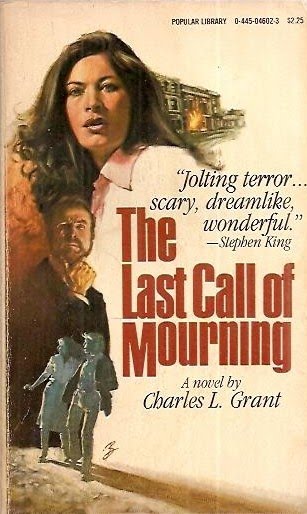
The ever-present King blurb now on a Nancy Drew-ish cover for The Last Call of Mourning (1979). I like the Tor edition, with a woman looking - expectantly? - out into the night and the growing fog...

1980 Fawcett Popular Library

1988 Tor Books

The Grave (1981) is a reductionist horror title if I ever heard one! Note the name on the tombstone of the Tor edition.

1981 Popular Library
1988 Tor Books

Now I dig this '82 cover for The Bloodwind: demonic face hovering over a quaint little town, quite a common image for horror paperbacks. The Tor edition is kinda cool as well, hinting at children gone missing into a creepy... well, bloodwind, I guess. Way to keep it literal!

1982 Fawcett Popular Library

1989 Tor Books

From my research it seems that Nightmare Seasons (1982) was the first Oxrun title that Tor published, though it was the sixth in series; we can assume this was the beginning of that stylized cover art. This one is actually a collection of several novellas set in Oxrun Station. The next book was The Orchard (1986), also a collection of novellas, which I read last year and reviewed here.

1983 Tor Books

And we start to move out of the vintage horror era with the two last books in the series, Tor's Dialing the Wind (1989) and The Black Carousel (1994), the latter boasting of Grant's "X-Files" novelizations. Can anyone explain why his middle initial would be excised?


These final three titles seem like a treat: Grant haunted his fictional town with the Universal Monsters! These first came out in hardcover from long-time specialty genre publisher Donald M. Grant, and then in paperback by Berkley Books. None are without a King blurb, of course. The artwork is a little on the nose for my tastes, perhaps, and Dracula doesn't look scary at all (is there perhaps a copyright on Lugosi's image?). They are: The Soft Whisper of the Dead (1982/1987), The Dark Cry of the Moon (1986/1987) and The Long Night of the Grave (1986/1988). A perpetual Halloween indeed!

Thursday, June 3, 2010

Rosemary's Baby (1967) and The Stepford Wives (1972) by Ira Levin: Only Women Bleed?

One of the great sequences in horror - literature or film - is when Rosemary Woodhouse, protagonist of Rosemary's Baby, uses the letter tiles from a Scrabble board game to discover the true identity of her kindly old neighbor. Polanski, in his film adaptation, underlines these utterly prosaic and harmless everyday items with portent, but it was author Ira Levin who first created such a richly creepy, and yet playful and knowing, scenario. All of them witches indeed.

Although Levin also wrote traditional suspense novels and popular plays (his Tony-winning Deathtrap from 1978 is still highly regarded and plays continually), and neither Rosemary's Baby (originally published 1967) nor The Stepford Wives (1972) are solely horror novels, he deserves recognition within the field for creating such lasting pop culture horror icons as a mother who gives birth to Satan's child (sorry, that wasn't really a spoiler for anybody, was it?), and especially in the latter's case where simply referring to someone as a "Stepford wife" - or, indeed, a Stepford husband or anybody else - means that person is an unwitting or mindless slave to conformity and empty bourgeois values.

Both books fall into the how-we-live-now style of fiction and address contemporary mores: secular versus spiritual lifestyles and motherhood in Rosemary's Baby, feminism and the role of women in the home in Stepford Wives. Their datedness - not nearly as prevalent as one might think - only enhances their charm. Levin is a master of economical prose, understatement, and sleight-of-hand misdirection as he doles out the clues and plot twists. Paranoia figures largely, out in the suburbs and within the city, and menace can be found anywhere, over idle chat and coffee, sitting in a doctor's waiting room, when your husband goes off to work. They never stop, these Stepford Wives... they work like robots all their lives...

I love that both novels can be read either as totally straight thrillers or as black-comedies-of-manners. And while a superficial interpretation might convince some that Levin disdains women, I think it's rather obvious that he is really condemning men and the fact that they think women with any kind of power will diminish their own. Irony: it's good for the blood, no?

I read Rosemary's Baby in high school, after I watched its masterful movie adaptation (surely the most faithful of all movie adaptations!); Stepford Wives only in the last few years after falling for Katharine Ross and (especially) Paula Prentiss in that bittersweetly vintage 1975 film adaptation. The novels can be undertaken in a couple sittings and offer up numerous pleasures, a few chills and ironic grins, and are easily found in used bookstores everywhere, so why you'd want to pay $14 for a new trade paperback edition of books around 200 pages long is a mystery Levin himself certainly wouldn't deign to write. Especially when you can get that ridiculous Gothic-romance version of Stepford Wives, because what all men secretly desire are women in shapeless gowns colored like M&Ms.

Tuesday, May 25, 2010

Falling Angel by William Hjortsberg (1978): Damned Damned Damned

Where do you search for a guy who was never there to begin with?

Hard-boiled crime writers like Dashiell Hammett, James M. Cain, and Raymond Chandler were vastly influential on a whole range of 20th century literature, except, I think, horror fiction. With their post-Hemingway style of terseness and understatement they seem to be the antithesis of horror writing. While these authors got their start in the pulp magazines of the pre-WWII era just like H.P. Lovecraft, it's only been within the last 10 or 15 years that Lovecraft has been taken seriously by more mainstream academics, literary critics, and taste-makers, while those crime novelists have been lauded for decades.

But I don't think it was until Falling Angel (Fawcett Popular Library 1982 edition above) that the genres of hardboiled crime and horror met, thanks to author William Hjortsberg. He has said he came up with the idea when in high school, winning an award for a short story whose first lines were "Once upon a time, the devil hired a private detective." Brilliant.

Set in a wonderfully-depicted New York City 1959, Falling Angel is the story of hard-boozing private detective Harry Angel ("I always buy myself a drink after finding a body. It's an old family custom"), hired by the mysterious Mr. Cyphre to find the missing '40s crooner Johnny Favorite, a big band star very much like Sinatra. Horribly injured physically and psychologically while serving as an entertainer in the war, Johnny ends up in a VA hospital, but then disappears one night...

Inside 1979 UK paperback

Angel tracks down Johnny's former doctor, who then turns up dead; next Angel speaks to an old band member of Johnny's, "Toots" Sweet (but of course) who tells him Johnny was mixed up in voodoo and the black arts, can you dig it, and crossed ethnic barriers no one dared cross in the 1940s when he became the lover of a voodoo priestess. Toots ends up dead too. Horribly dead. You get the picture. Angel ends up involved with the priestess's daughter, Epiphany Proudfoot, a carnally-driven young woman who believes acrobatic sex is how we speak to the voodoo gods. Awesome.

1986 Warner Books

There's more; much more. Falling Angel is, in a word, spectacular. It's inventive while playing by the "rules" of detective fiction; it's appropriately bloody and violent; its unholy climax in an abandoned subway station is effectively unsettling and graphic. Hjortsberg knows his hard-boiled lingo and the New York of the time and makes it all believable. This is no humorous pastiche or parody; it's a stunning crime novel bled through with visceral horrors of the most personal and, in the end, damning kind.

Saturday, March 27, 2010

The Haunting of Hill House by Shirley Jackson (1959): Who Are the Mystery Girls?

No live organism can continue for long to exist sanely under conditions of absolute reality; even larks and katydids are supposed, by some, to dream. Hill House, not sane, stood by itself against its hills, holding darkness within; it had stood so for 80 years and might for 80 more. Within, walls continued upright, bricks met neatly, floors were firm, and doors sensibly shut; silence lay steadily against the wood and stone of Hill House, and whatever walked there, walked alone.

Often cited as the greatest opening paragraph in horror fiction, Shirley Jackson's now-classic haunted house ghost story The Haunting of Hill House was a huge popular and critical success upon publication. And what a wonderful cover; this edition is dated March 1977 from the Fawcett Popular Library, from the era of Gothic romances: always heroines fleeing across windswept moors or down castle stairs, about them flowing their black hair, in diaphanous nightdresses revealing tasteful decolletage, an imposing house in the background with one single light burning in an upstairs room. Perhaps there is a dominant, darkly-shadowed male nearby as well, with the threat of sex looming. However I don't have much interest in Gothic romance except for the covers; there's a great selection here.

Viking Books hardcover, 1959

But then, all this talk of Gothic romance only applies to the cover of this particular edition of Hill House, as the novel is not really a Gothic romance at all. I suppose a literary historian could argue that all horror fiction is, at bottom, Gothic romance - I recall that argument being made by a professor of mine back in my very early college years - but Jackson's rational approach to her tale doesn't seem "romantic" at all. The "love story" might be between Eleanor Vance and fellow intrepid haunted house investigator, the psychic Theodora. Whose hand is Eleanor holding? Is it not Theodora's? What does Theodora see but won't tell Eleanor? I know this lesbian subtext is discussed as an undercurrent in the 1963 movie version, with its images of the two women embracing each other in bed - out of fear, true. But fear of what, exactly? Ghosts? Or something much more... intimate?

Warner Books paperback, 1982

So perhaps the romance is between Eleanor and, chillingly enough, Hill House itself. Journeys end in lovers meeting, she repeats to herself throughout, this timid, mousy young woman seeking a personality. I confess it's been about 15 years since I read Hill House, my memory might be off, and I'm a bit afraid to read this little old paperback I've got because it might not stand up to the strain.

This all reminds me of starting a new job at a used bookstore back in the late '80s, when my boss was showing me how the store was organized. He asked me, "Do you know what Gothic romances are?" I had to admit complete ignorance. What use would a teenage guy have for that? And he described it just the way I have above: a girl in a nightdress beneath a house with one light on upstairs. I think he told me the perhaps apocryphal story of one such Gothic romance title whose cover art had a house with no lights on at all; the book sold miserably. Fans of genre fiction tend to want things their way or no way at all. And there's no mystery about that.

Thursday, March 4, 2010

We Have Always Lived in the Castle by Shirley Jackson (1962): Everybody Has a Poison Heart

Shirley Jackson is one of the best "horror" writers ever and We Have Always Lived in the Castle (1962) is one of the best covers ever (thanks to artist William Teason). Something about the midnight blue and the girl's hands, her one staring eye and windswept hair, the kitty-cat ears and the title font (so reminiscent of Rorschach's journal) captivate me. Two young sisters, Merricat and Constance Blackwood, and their ill uncle live alone in an old house after the rest of the family had been poisoned years before. Slowly the real story of what happened to the family is revealed and why the townspeople view the Blackwoods with anger and suspicion. I love these kind of subtle chillers with creepy, maybe even murderous, young women as unreliable narrators.

See the black-and-white art of the current paperback edition with a more literal cover. Again, give me the strange evocative painting from the original paperback. "The Lottery" and The Haunting of Hill House are Jackson's more famous works, but We Have Always Lived in the Castle ranks right up there with them. A must-read!
Related Posts Plugin for WordPress, Blogger...