Showing posts with label kathe koja. Show all posts

Monday, July 28, 2014

The Summer of Sleaze Continues...

We continue with the Summer of Sleaze: my latest post, this one on '90s horror writer Kathe Koja and the late lamented Dell/Abyss line of paperbacks, went up on Tor on Friday. Fellow reviewer Grady Hendrix and I are only halfway through, so more to come. Hope you guys are digging the series!

Thursday, January 2, 2014

French Paperback Horror, Part Deux

Quelle horreur! And it continues, these covers for French translations of some terrific vintage horror (for more, much more of these as well as artist info, go here). For their splatterpunk magnum opus The Scream (1988), Skipp & Spector get a Heavy Metal-esque cover, pretty fitting considering the metal mayhem contained within.

Ah, The Cipher! Here, Kathe Koja's stunning debut novel becomes "Breach of Hell," fitting, although the cover image doesn't quite capture the amorphous quality of the cipher itself, which was basically a nothing... Still, creepy cool.

A simplistic, not too impressive rendition of Fletcher and Jaffe, the warring spiritual duo in Barker's 1989 novel of the fantastique, The Great and Secret Show.

Holy shit is that terrifying. And erotic. And terrifying. Nice work! Don't know this book by the recently late Gary Brandner, who is most famous for writing The Howling (1977).

A glorious rendition of the images contained in Poppy Z. Brite's essential 1993 short story collection, variously known as Swamp Foetus and Wormwood. I believe the title translates as "Stories of the Green Fairy," that being an old literary term for absinthe - clearly visible and ready for the imbibing. Watch out for Kali though!

This noxious cover reminds me that I really need to reread The Fog since I really member nothing about it; the James Herbert classic from 1975 is highly praised for being a pure pulp delight in Steve King's Danse Macabre. But you knew that.

A gorgeously Gothic and evocative work of art for Straub's 1980 novel. "La terre l'ombre," if my high school French serves, could've been the translated title.

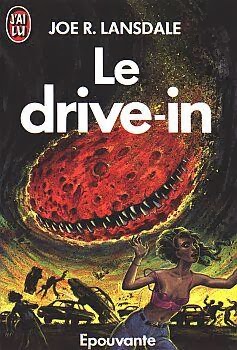
Last but not least, Lansdale! Lurid and lusty. Lovely!

Monday, December 30, 2013

Paperback Horror: French Editions

Mon Dieu! Imagine my delight upon discovering these French editions of classic horror novels. French covers seem more likely to feature art that corresponds to the novel they adorn. J'ai Lu ("I read") is a French publisher, while "Épouvante" means "terror," so you can guess what's going on here.

At top is Joe Lansdale's blistering The Nightrunners (1987), and its French title translates nicely as "Children of the Razor."

Although this cover might look generic - snakes n' skulls! - both title (translating as "Scales") and image are relevant to the story John Farris tells in 1977's All Heads Turn As the Hunt Goes By.

"Mindless" - a perfect translation of Bad Brains, Kathe Koja's second novel from Dell/Abyss, published in '92, about a failed artist whose vision and imagination are being assaulted by a silvery nightmare.

1980's Firestarter's title was simply changed to Charlie, the little girl's name, which I like a lot as it links up with Carrie, Cujo, and Christine.

The black-and-white photos here of blank-eyed men make me think of the various kinds of WWII survivors, which Clive Barker touches upon in his first novel The Damnation Game, from 1985.

I haven't read Ramsey Campbell's 1986 novel The Hungry Moon, but I love how this cover evokes his gloomy, opaque, quiet style of horror.

This is kinda-sorta what's going on in Brian Hodge's third novel Nightlife (another Dell/Abyss title, from 1991); while it does involve some creature transformation, I don't remember any boobs.

Sometimes the French covers aren't so accurate; Nightwalkers, from '79, is a somber, ambiguous "werewolf" novel, and the subtle prose of Thomas Tessier is rarely if ever used for this kind of graphic monster shock.

A severed head adorning this cover for Song of Kali, Dan Simmons's seminal 1985 work of exotic horror? Mais oui.

And androgynous punk vampires, no doubt about it - this has got to be Poppy Z. Brite's classic first novel from 1992, Lost Souls (the French title is a literal translation this time).

More, as they say, to come!

Tuesday, April 10, 2012

Bad Brains by Kathe Koja (1992): You Got the Silver

How fear the void when the void is where you live?

Ready for a long luxurious swim in the grimy waters of another Kathe Koja novel? Thought you were. March 1992 saw the publication of her second novel from Dell/ Abyss, that ambitious little imprint that wanted to put an experimental edge into horror fiction. Appropriately titled Bad Brains, it features an artistic, alienated, rather unsympathetic protagonist whose world is collapsing into a nightmare of surreality and neurological despair (much like Nicholas, the main character from Koja's 1991 Stoker Award-winning debut novel, The Cipher).

Depression would be a huge psychological improvement for Austen Bandy, a young man whose wife Emily has left him and who then finds so have his skill and passion for painting huge oil portraits of sphinxes and other human-animal hybrids. Once he accidentally cracks his head wide open - his grieving bitter head - he begins having seizures and sees things. Or rather, one thing that bleeds into everything, a dustdevil of fluid, liquid, mucus; silver, almost scalelike, delicate as fish skin and stretching out, elongating...

Think A Monstrously Decaying Blood-Limned Portrait of the Artist as a Young Man. Or think Cronenberg's films like Spider or The Dead Zone. For better or worse, Koja drills into Austen's every hurt and weakness and casts all in a drizzly grey light or a harsh winter cold. The atmosphere this creates can be suffocating, even tedious, in its insularity. Here, human interactions are stilted and ineffective (just wait till Austen visits mom!); grime and grease tinge every surface; homes and clothes are worn out, threadbare; food and coffee always foul; sex, ugh; hopelessness and hard-won creativity mingle to create a stew of incipient insanity. But is it Austen's psyche that's wounded, or is it his very brain?

Read the back of the paperback (such accolades!). It's pretty accurate but it only hints at the sanity-shattering silvery snotty serpent thing that threads and drips and convulses and glides now in Austen's vision, befouling corners, mirrors, faces, beer bottles, then out the nose and ears because it is inside Austen's brain. And when the brain, where our true self resides, surges silver and pink and rebels against its own best interests, why it will show you just what it's up to, when you look in the silvered mirror:

I am standing here seeing it, I am seeing it

and took off the top of its skull

where the brain is

and inside, the most delicate writhe, each lobe filigreed, threaded and girdled with silvery death in all its masques and manifestations, in all its irrevocable forms: the elegant pulse of an aneurysm, an extravagant clutch of tumors concealed like an oyster's pearl, clots like molded caviar and each molecule burning, shining silver light on the bone chips ragged and blood like the swirled center of a dubious treat; and nestled in the rich middle like eggs in a nest, eyes.

1996 Dell reprint

Minor spoilers ahead! But transcendence - come disguised as an illness - awaits. After finding no mere medical doctor can cure him, Austen embarks on a long squalid car trip to see his ludicrous mother, then finds a new friend with lunatic father issues, and on till Emily reappears, unsmiling, unsympathetic, certain that Austen can never get past all that Art 101 bullshit and accept the responsibilities of his life without her. Then Austen hears from a gallery owner acquaintance back home that he's sold some of Austen's old paintings, and they're all changing: but in everything one constant: the relentless drip of a color so pale it was nameless; but if he had to, Peter said, he would call it silver.

Cover & stepback art by Marshall Arisman

Soon they all find reclusive Dr. Quiet and Dr. Quiet can help, gets Austen painting in a frenzy again (I assume his portraits look much like the artist-unknown cover art), starts using terms like "the stone of folly" and "duende" and "limbic borders" or some such, and reveals through videotapes of monstrosities - some of the novel's best moments - that Austen might not be alone in his sore world. Or he might be. Everything Koja depicts, everything Austen encounters, could it all just be code for the blasted crumbling architecture of Austen's brain, starved of its art, its love, its vision, its power of creation, that machine of luminosity and magic...?

...to cross the border where the air itself is glass burned black... not only live and die for your art but become it, go past it, eat it bloody and alive and make it over to devour again and again like Cronus eating his children, ignoring their screams because what is is what must be and in all the rooms in the house of art there is only one altar, one half-seen silver priest and one demand

UK paperback 1993

As you see, Koja's prose style is all edge and poetic deconstruction, stripped bare and decorated in discomfort. A weird poet of the crumbling and the crazy. This is no epic novel of horrors human and hellspawned, but a novel of inner horror, which I find captivating; I like her anguished artist characters who suffer for their (lack of creating) art, who twist and turn helplessly through a worn-out world, insides spilling out as they search for answers to a madness that seems more than chemicals misfiring. However I understand not everyone is so enamored of arty characters engaging in what could be seen as self-indulgent self-pity... "Shut up and paint!" you want to yell at Austen at times, but he really does have a physical ailment, so that seems a bit impolitic, no?

I read and liked Bad Brains when it came out, as Koja's writing appealed to my growing appreciation for uncompromising non-horror authors like Burroughs and Ballard and Celine, and lately I'd been wondering if it would it hold up for a second read, over 20 years later. Well, I couldn't put it down for the last 70 or 80 pages, the nightmare ratcheting up, and a strange haunt lingered about me for days afterward... proof that Koja, for all her stylistic eccentricities and lack of providing a real plot (Austen himself has no plot), effectively creates dread, suspense, fear and, okay, bewilderment. But what finally awaits Austen and the people he's, let's face it, dragged passive-aggressively along with him - everything ends in silver: messy, unpredictable, bizarre - I hope haunts you too. But that's no big surprise.

Friday, February 25, 2011

Dell/Abyss Books: The Paperback Covers

It was 20 years ago this month that the Dell/Abyss line of contemporary horror fiction began publication. Yes, 20 years! Ah, I remember it well. This imprint from Dell Publishing was spearheaded by Bantam Doubleday editor Jeanne Cavelos in an attempt to give the paperback horror genre a boost of originality and conviction - and, of course, a boost in sales - as it had long been plagued by tired cliches and half-hearted imitations of better books and writers. The appropriately-named Abyss was intent on publishing works that plumbed dark depths of psychology and the supernatural not for cheap, exploitative, escapists thrills but for more disturbing and revelatory chills. This kind of horror was interiorized, found not in a Gothic mansion or small town overrun by vampires but in the blasted landscape of the human mind.

The Abyss paperback originals used striking cover design - haunting, creepy, anguished faces and tormented bodies, albeit perhaps sometimes a tad clumsy - to separate themselves from the anonymous bloody skulls, graveyards, and evil babies then on horror covers. The icon on the spine of its books was a mark of distinction; indeed, Abyss even had a mission statement:

Launched in February 1991 with Kathe Koja's stunningly bleak and unsettling The Cipher, Abyss published one title a month, ending up with more than 40 titles overall. Most of the authors were first-time novelists, or at least writers with only a few books under their belts, but in the case of MetaHorror (July 1992), an anthology edited by ever-present '80s author Dennis Etchison, the line also featured well-known horror masters. Women writers were plentiful - the most successful was easily Poppy Z. Brite - and guys like Brian Hodge and Rick R. Reed really got started here. What they all had in common was a desire to do something new with horror fiction. But, for various industry reasons, Abyss folded later in the '90s and my love of current horror pretty much went with it.

Obsessed, Rick Reed (July 1991)

Deathgrip, Brian Hodge (June 1992)

I'm not exactly sure how I first heard of the Abyss books; it may have been a Linda Marotta review in Fangoria, or maybe a review from the Overlook Connection catalog. Reading Koja, Brite, Hodge, and others back then was a revelation, one of the most exciting times I've had as a horror fiction reader. I doubt all the novels and two short story collections were as "cutting edge" as promised, but I always loved the ambition and the effort. Some writers launched new careers, others weren't heard from again. I've read a handful over the years but nothing could compare to Koja's first two novels, or Hodge's Nightlife (March 1991). Still, the Dell/Abyss line was a great moment in paperback horror, and deserves to be remembered today. Most titles are readily available used, cheap (ah, except The Cipher, which has now gone to collectors' prices!) on Amazon, eBay, ABE, and the like. The following are a random sample.

Whipping Boy, John Byrne (March 1992)

Facade, Kristine Kathryn Rusch (February 1993)

Lost Futures, Lisa Tuttle (May 1992)

Post Mortem, ed. by Paul Olson and David Silva (January 1992)

X, Y, Michael Blumlein (November 1993)

Anthony Shriek, Jessica Amanda Salmonson (September 1992)

Shadow Twin, Dale Hoover (December 1991)

The Wilding, Melanie Tem (November 1992)

Tunnelvision, R. Patrick Gates (November 1991)

Making Love, Melanie Tem & Nancy Holder (August 1993)

Dusk, Ron Dee (April 1991)

Dead in the Water, Nancy Holder (June 1994)

Bad Brains, Kathe Koja (April 1992)

Shadowman, Dennis Etchison (January 1993)

You can read here a long, detailed, scholarly look at the nuts-and-bolts of the Dell/Abyss line, "The Decline of the Literary Horror Market in the 1990s and Dell's Abyss Series": What makes the Abyss line a cultural phenomenon worthwhile of study is its self-conscious positioning within the declining horror market. Its marketing strategies, text selection, and construction of a commodity identity speak volumes on the horror market and its transformation at the time.

This image thanks to Trashotron
Related Posts Plugin for WordPress, Blogger...