Showing posts with label new york city. Show all posts

Saturday, June 22, 2019

Twins by Bari Wood & John Geasland (1977): I Against I

In the old country, they say twins are cursed... 
not one person, yet less than two...
 that's what they say. 
But we believe in escaping curses, don't we?... 
Two such fine boys... 
you want them to grow up to be individuals; 
husbands, fathers, menschen... 
separate them now, as much as possible
—or they won't grow up...

Several years before her wonderful novel The Tribe, Bari Wood wrote a different book about a small band of outsiders who form an insiders' bond for the sake of survival in an uncomprehending world. With medical writer Jack Geasland, she gave us Twins (Signet, May 1978), a deft and sure-handed shocker that became the basis for David Cronenberg's masterpiece 1988 movie Dead Ringers. Forget what you know about that film,  because Cronenberg used only the very basic concept: two men, twin gynecologists and their symbiotic relationship and gradual self-destruction (based, again loosely, on a true story). A horror-adjacent thriller, its penetrating portrait of these two (?) men will appeal to anyone who appreciates a deep dive into the genetic swamp and its attendant creep factor.

What makes Twins such a gripping read is the authors' expert plumbing of the labyrinthine psychological, emotional, and sexual underpinnings of the Ross brothers, David and Michael. Born in New York City in what is probably the late 1940s, the twins experience a blooming adolescence with the usual signposts of Jewish youth of the era: summer camp in the Catskills, tentative discussions with sympathetic dad about college and career, fumbling sexual encounters with promiscuous girls ("You're just little babies, ain't you?"), and being weirded out by old Jewish men who make frightening prophetic pronouncements to young boys, as in the quote at top. There's also the little matter of David and Michael being entirely too close: "When David guided Michael's hand inside his pajamas, Michael stroked David the way he wanted him to."  

Anyone who reads 1970s and '80s horror/thriller paperbacks is aware of their unsettling prevalence of incest, and in Twins we have the dreaded twincest. Generally I grit my teeth and plow through this kind of thing, but in Twins, the Rosses are so emotionally and psychologically twined together that their physical intimacy is a foregone conclusion: the scene I just quoted from is on pages 30-31, and it's hinted at on the back cover above: more-than-brotherly love.
 
Pan Books UK, 1978, cover artist unknown

The authors use subtle clues to the similar-yet-different natures of Michael and David, yet it is still apparent that David is the dominant brother and Michael the more sensitive—yet it is Michael who wants to live a life free of his lineage. It is Michael to whom that old man speaks; it is David who never though their identities "were a curse"; and it is David who sabotages Michael's attempts at attending a different medical school while Michael is ill. While in their early 20s, their relationships with women are, to put it mildly, rather sleazy, and the two very good-looking brothers develop an unsavory reputation for fucking... Everybody and anybody.

When Kathy Field, the girlfriend of a medical colleague piques Michael's interest, David is wary: "Still thinking about the shiksa? Anders' girlfriend could mean trouble for us, Michael..." But Kathy is fascinated by the twins, how could men look like that? and when Michael asks her out despite her boyfriend and despite David, she is delighted. Thus begins a romantic relationship between Kathy and Michael, and David can't stand the thought of his brother being alone with a woman (neither has ever been alone with a woman—that's their kink, being with women together or as couples). What's David do? Starts a homosexual relationship (David was impressed with the neatness of the experience) with another doctor, Romer, who wants David to go to Boston with him and open a practice. You can't stay with your brother your whole life, Romer tells him...

All this I've described is simply the beginning. There is a lot to unpack in Twins, which is what I really enjoyed about the book—the twisting betrayals, the complex interplay of David's possessive instinct, Michael's growing anxiety and his use and abuse of drugs and alcohol. The sexual aspect isn't erotic but it is a very strong undercurrent in the lives of everyone involved. Twins is an adult novel, which I found refreshing: there are hospital politics, medical discoveries, an awareness of class and sophistication and religion in the characters' lives, in how they speak and interact and navigate the wealthy New York and Boston worlds. We are shown that these are ambitious, intelligent, emotional people.

At one point, Michael becomes obsessed with the quietness of the cancer ward, and even begins an affair with one of the dying women. It is heartbreaking. Wood and Geasland get inside these complicated people in that smooth mainstream manner that is a balm to my often pulp-horror-addled brain. At one point David and Romer are staying at a Cape Ann beach home, and David muses at what a perfect gentile vacation spot it is, and recalls his father's words about how "gentiles are a different breed, the goyim never enjoy themselves unless they're uncomfortable... It'll be the same way with women, with your patients..."

French edition, 1990, cover by Marc Demoulin

So then Twins is not exactly a horror novel, but there is suspense and dread, for we know what is going to happen to these men. Kathy leaves Michael, who spirals into drug abuse, and it's hinted that David is orchestrating his brother's downfall. These men were doomed from the womb, a tragedy neither could have avoided but one tried and failed. Wood and Geasland have written a satisfying psychological thriller that I recommend to those who enjoyed The Tribe, the Cronenberg film adaptation, and also to fans of the chilly Neiderman novel Pin. If you can get past the utter squickiness of David and Michael's relationship, as I did because of the exceptional skill the authors used in telling their twisted story, you'll find Twins, in the parlance of the day, unputdownable.

Me reading Twins at Wallowa Lake

Thursday, April 11, 2019

Panther! by Alan Ryan (1981): The City is a Jungle and I'm a Beast

I don't know what kind of hopes I had for this Signet paperback original, featuring one of the great "animal attacks" covers of the era, a stunning tableau of Manhattan mayhem by the fantastic Tom Hallman. The late author Alan Ryan, a generally reliable editor and author, offers up his first novel Panther! with a solid set-up and serviceable prose and dialogue, but it all kind of puttered away to indifference for me. Fifteen panthers are brought by a rough'n'ready animal wrangler to NYC for a movie premiere—for a flick called Panther! of course—but they get loose and terrorize the city.

But it takes forever for this wonderful scenario to shift into gear and the panther kill scenes are printed in italics which makes it seem like they're taking place in some ethereal no-man's land and not on the mean streets of the city (I did like how one panther drags its victim into the doorway of the Russian Tea Room). It's all very straight-faced and square, lacking the pulp intensity, tastelessness, and energy of other novels of its ilk. This is one you buy for the cover art alone, alas.

Friday, January 26, 2018

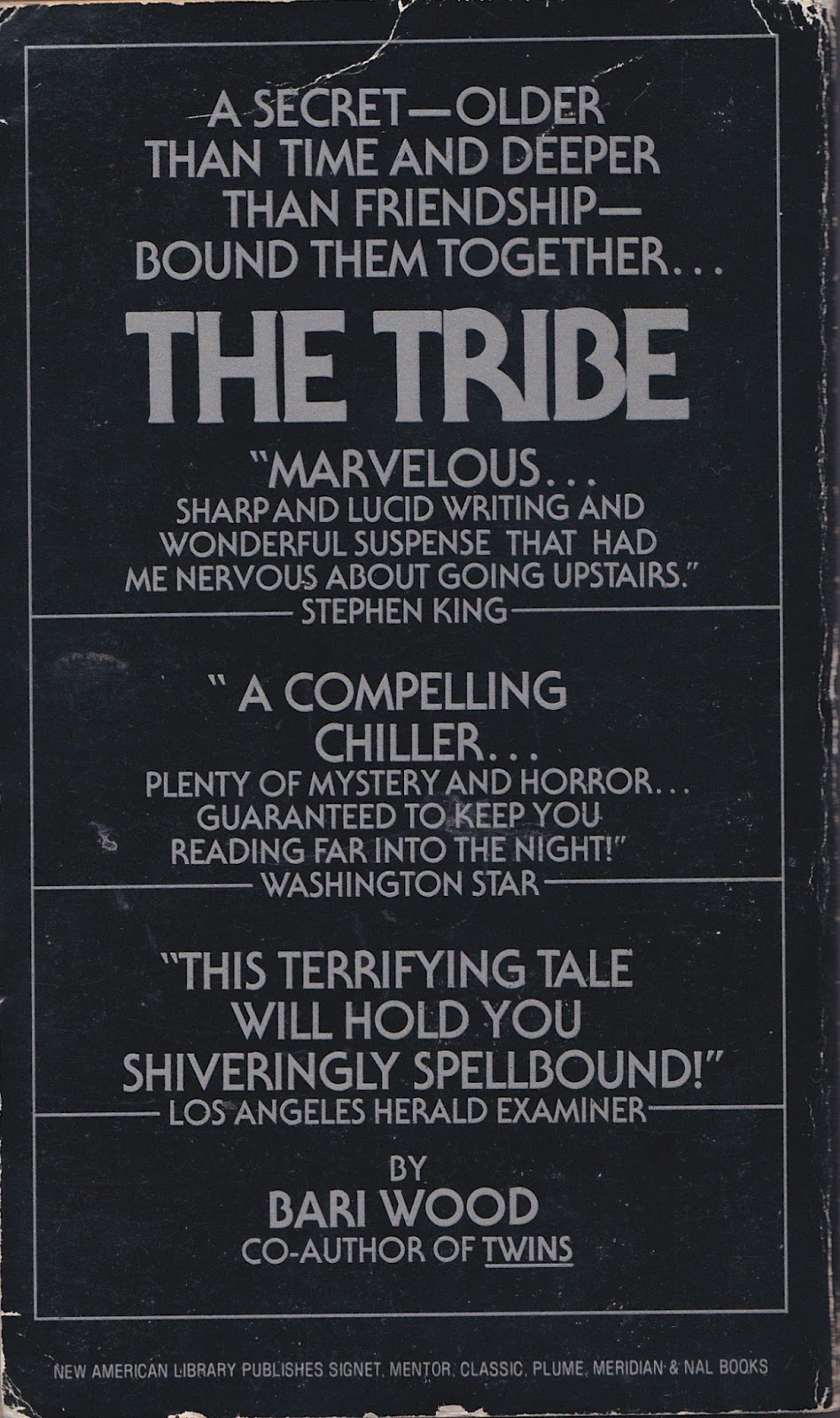
The Tribe by Bari Wood (1981): Ghetto Defendant

I'll be honest: Bari Woods's books are ones I've seen in used bookstores for decades—decades I tell you—and I have never been interested in them. I mean not ever. Titles like The Killing GiftAmy GirlDoll's Eyes, and even Twins, the basis for Cronenberg's masterpiece Dead Ringers, did nothing to whet my horror appetite. Actually I'm certain I wouldn't have really appreciated The Tribe (Signet Books, Nov 1981) when I was in my early 20s, World War II and Nazis, ugh I mean old news. It wasn't until I read Grady Hendrix's review a year or so ago that my interest was piqued. And what a delight it was to be so well-rewarded: The Tribe is a superb, thoughtful thriller about a series of gruesome murders over several years and a group of aging Holocaust survivors living in New York City.

Hardcover, Dutton 1981

A novel that uses one of history's ultimate horrors not as an exploitative stage already set, but as a window to peer into the evil that can live and thrive in even the kindest, most unassuming soul, The Tribe offers no groundbreaking advancement in the genre, nor is it a summation of it or anything so profound. Dare I even say it's horror? Stylistically it is more akin to The Exorcist or Silence of the Lambs (yet had no movie adaptation to launch it into the pop culture stratosphere): aimed squarely at that mainstream of general readers who've never heard of Lovecraft or Matheson or Bloch or Blackwood.

Wood (b. 1936)

Beginning with one of the strongest, most mysterious prologues I think I've ever read, it is a humane work, concerned with more than solely horrifying readers (although it absolutely does). And Wood, unlike many a genre author, writes like a true pro: she knows her characters, even minor ones, and imbues them with life, desire, and love, with a sense of duty and sacrifice, of overwhelming fear and hate and vengeance. The story's tempo reminded me now and again of a solid '70s film in its plot beats and character arcs, and in that sense The Tribe truly is of its time. And that's okay with me!

Oh that enigmatic prologue, it's a model of the form. American forces have liberated Polish death camp Belzec, and found the German officers near death while the Jewish inmates are healthy and well-fed. Major Bianco must know what happened, and he interviews Speiser, the Nazi commandant at Belzec. What Speiser tells him is obscured to the reader, but its suggests madness and the unbelievable, a vast and dark horror that drives that Nazi commandant to insane laughter even as he contemplates his execution after Nuremberg. Dang it's so good.

Author's first novel, Signet 1977

New York, 1970s-ish. A young Jewish professor named Adam Levy is mugged and murdered on the Brooklyn streets while on his way to visit his father, the rabbi Jacob Levy. This sad yet prosaic event—the one thing everyone knows about New York is how easy it is to get murdered there—sets all in motion. Roger Hawkins is a black cop and Nam vet who has long known Adam, and been a dear friend and something of an adopted son to Jacob, and it is he who breaks the terrible news to Jacob and Adam's young and pregnant wife, Rachel. 

Here Wood deftly interweaves the origins of this friendship between a middle-aged Jewish man whose son is away at the University of Jerusalem and a young black cop with ambition: their days discussing life and literature in Levy's small bookshop along with Levy's fellow survivor, big, handsome Isaac Luria, who generally has no time for Hawkins. Jacob Levy is the kind of unassuming man in whom others instinctively place their trust, love, respect, and honor; Luria may be jealous of Hawkins, or maybe he just hates black people. Later Hawkins and Adam will become friends, but Hawkins realizes he was some sort of substitute... yet that doesn't diminish his deep affection for Levy.

Onyx, 1988

Almost immediately five teenagers are picked up for Adam's murder, gang members who hung out in a filthy clubhouse, but the police find no evidence connecting them to Adam's murder. Hawkins is angry and frustrated, doubts they'll do any kind of hard time if they even are convicted... but then all five boys are found again in that clubhouse, only this time... they are dead, smashed, broken, torn apart, in a graffitied room splashed with blood and, oddly, gray slime and mud smelling of a swamp. His gorge rose but he made himself look. Femoral blood leaked slowly, marrow oozed out of smashed bone on the muddy cement floor. Hawkins retched and dropped the flashlight...

Some of Hawkins's fellow officers mention the obvious but the impossible: that Levy, or Luria, or others of their "clan," are responsible for the murders ("If you say that again," Hawkins says to one cop, "I'll tear your fucking head off."), but surely that is ludicrous. When a neighbor witness comes forward, Hawkins is afraid he'll describe Levy... but he doesn't. Instead, he describes three maybe white men he saw outside that clubhouse, and a fourth: "Oh God," he moaned, "the fourth one was bigger..." and improbably denotes a man nine feet tall and three feet wide...

Art by Don Brautigam, perhaps?

But this is all only Part 1 of The Tribe. Part 2 is about Rachel Levy, Adam's widow. She has Adam's baby, names her Leah, and she and her father-in-law move away from the city and learn how to care for the baby together. Time passes, and Rachel wonders about Hawkins, who'd been so close to the Levys prior to Adam's death. She remains horror-struck by what happened to the boys who killed her husband, but slowly tries to regain her life. She meets and begins to date well-to-do Allan, and spends time with new neighbor Willa Garner, a black woman who moves nearby with her doctor husband and their children, who take to Leah. All of this is written in a warm, knowing, familiar style—who doesn't find descriptions of Jewish home life and especially food, and all those Yiddish words peppering conversation, cozy and comforting?—but there is more darkness to come.

It's at this point that the reader learns of the silent specter haunting the novel. One day Rachel looking for canning jars in her attic, she comes across an old schoolbook of Jewish folklore, flips through it, then alights on something that piques her memory: Rachel read the first few paragraphs. It wasn't a man, but a monster shaped like a man. It was called a golem and it was made of clay. Clay. That was the connection. A child's horror story that must've given her nightmares, and that came back to her when Ableson [one of the investigating officers] said clay. That simple. She went back to the beginning and read the whole story...

Signet 1978

The golem, we learn along with Rachel, is a giant, silent, mindless creature made from mud through a series of occult rituals, and controlled by its maker. It is built by a rabbi at the bequest of an angel, the legend goes, in 16th century Prague to defend the Jewish ghetto from marauding Gentiles. It is a hellish story about playing God, an amoral fable of the long conflict between Jews and the rest of the world, about protecting one's people at any cost, and it chills Rachel to the bone with its mind-bending implication: And forever after that, the Jews in Prague lived in peace...

But this is put to the back of Rachel's mind when one of the Garner teens is involved in a fatal fight between black and white kids at the local high school. One of the dead is Isaac Luria's oldest grandson. The funeral is a travesty, and Rachel squares off almost literally down in the dirt against Luria, who let it be known is a real cocksucking sonofabitch, even if his grandson was just killed. From here we get into the tensions between the black community and the Jewish one, an uncomfortable contemporary issue in New York.

In grieving anger, Luria goes to Jacob Levy and demands Levy "Prove to me you loved my grandson!" Wood takes us back to Levy's boyhood in Krakow, when his father takes him to a Cabalist mystic living in the forest ("Cabala isn't dumbheads looking at palms and calling up demons"). What can this boy do to protect his family from the encroaching Germans? And here it all begins. Wood draws the past and present together, showing how the friendship between Levy and Luria hides many horrors, not all of them human.

More death is coming, the worst of the worst, and Rachel and Hawkins meet up again and maybe are falling in love and there's a Jewish gangster and more about what happened in Belzec and of course the past is not a precursor but woven into every part of life. Rachel and Hawkins slowly try to investigate the murders, trying to convince people of the impossible, that it is not only possible but actual. Please God, Rachel thinks as the enormity of the task ahead and all they must do to face it, rises in her mind, don't let me die tomorrow. I won't give away any more of the plot, so let me move on to general insights.

Signet 1985

There's a lot of cop politics for a horror novel, and a lot of "romance" for one too, and the ancient Jewish mysticism of Cabala, some of which I vaguely remember from my college days when I studied religious history. There's a warm humanism, a pragmatism, threaded throughout the novel that is not often found in horror fiction, so much so that, as I stated above, it makes me doubt this is actually a "horror novel." Using the smooth narrative rhythm of popular bestselling fiction, Wood eschews generic bloody excesses, clumsy graphic sex, and pulpy sensibility. Woods depicts the monstrous in the midst of a carefully-denoted reality, perhaps the key to any successful work of make-believe. Mundane details, like a drawn curtain or a child's pig lamp, are noted again and again. Also particularly good is the payoff for that prologue, stick around for that set-piece of horror mayhem.

I will say The Tribe is a helluva book for folks who like good reads. The characterization shines: rich, warm, and enveloping, the crossing currents of life, the threads that break and the ties that bind, the budding of romance and the rising of hate, the caustic stain of fear and the slow poison of bigotry, the primitive desire for vengeance, for retaliation, for identity: Wood is adept at depicting all in a mature, satisfying manner, how traumatic history affects the present, and I think she handled with good faith the racism and prejudice that plague even minorities. And this is a book about minorities, religious, racial, sexual, intellectual, and mystical, all those who must defend themselves against the larger world. I mean, the book is called The Tribe, after all. 


Friday, October 27, 2017

The Possession of Joel Delaney by Ramona Stewart (1970): Supernatural City

Published a year prior to epoch-making The Exorcist, this slim 1970 novel by Ramona Stewart (1922 - 2006) features a young man in thrall not to a demonic power of the netherworld but to a dead serial killer. I don't think The Possession of Joel Delaney (Bantam paperback/Oct 1971) is much talked-about these days in the small subset of people who talk about vintage horror novels; I can find little about Stewart herself online. She seems like a mainstream novelist who produced some other derivative minor thrillers (The Sixth Sense; The Nightmare Candidate; see below) that got some middling reviews and more middling cover art. None sound all that interesting to me.

1980 Dell reprint, Paul Caras cover art?

Happily for me, Possession is interesting: it's set in the Manhattan of the late '60s and early '70s, and is quite convincing at what it does. Stewart's depiction of the city, from the Upper West Side enclave in which our narrator Norah Benson lives to the rough-and-tumble neighborhoods of immigrants, is vivid, lived-in, and sympathetic but not overwrought or sanitized. Akin to Blatty's iconic novel, Stewart lays down a bedrock of normalcy and realism as Norah describes her life in plain terms in the opening pages:  It's when I'm skating along on smooth ice that the dark crack splits open at my feet.

Back cover gives you the low-down, 
good so I don't have to waste time rehashing it

The voice she provides for the story is refreshingly confident. Norah is self-aware, intelligent, and self-possessed, without an ounce of self-pity for her past. Our family hadn't been the cheery thing of children's books: her youth was made difficult by her wayward, somewhat grifter of a father and a mother who committed suicide leaving Norah to mostly raise her decade-younger brother Joel. She married a professor and left for the University of California, and feels lingering guilt about abandoning her brother. Now divorced, she maintains a civil relationship with her ex, raising two citified children with the help of Veronica, her Puerto Rican maid (this detail will become important).

 Dell Books 1980; Kirkus review here

Certainly, the night the trouble began with Joel, I had no prickling sense of the extraordinary. When Joel doesn't show up for dinner, she calls him but when the phone is answered no one is there, just music and a stranger's strangled voice. Concerned, she rushes to his downtown apartment, in an unsavory neighborhood ("Sure this is the place you want?" inquires the cabbie) and finds Joel on the floor, his face contorted like a man in a nightmare. He's off to the hospital, then Bellevue, you know it's the late '60s, maybe he's taking LSD. Norah speaks to the building manager, glimpses into his apartment: she recognizes an Espiritismo shrine, a religion invoking water and air spirits.

This will play a large part in the "possession" angle of the novel, as Norah investigates Joel's increasingly bizarre behavior with the help of a psychiatrist friend and a couple of professors. Together she and the reader learn about Tonio Perez, who lived in Joel's apartment before him, an immigrant teenager with a terrible childhood and a murderous hand, who suffers a ruthless death and who has struggled back from the other side... "There's a supernatural city all around you," Dr. Reichman said. "Belief working on thousands of psyches."

Okay: I have to note the ethnic tensions in the book. This is an indelicate matter. Thing is, Norah is the one who notices them; she is well aware of being an interloper into the minority community and its esoteric belief system (which may or may not be a sham/scam). Is Stewart/Norah evincing a fear of ethnic taint, of "white American culture" being far too influenced by a dangerous foreign one (literally possessed by it here)? If so, author/narrator seem ambivalent about their feelings, knowing that that's a secret fear one should keep bottled up; an irrational, unwarranted fear with no place in polite society. This could be taken the other way: that's what oblivious white people get for moving unwelcome into minority neighborhoods: taken possession of by murderers. The fear of the other, so often invoked in cultural horror criticism, isn't so high-minded or abstract: to each individual, everything is other/foreign/potentially dangerous, no? Anyway.

Dell Books 1981; Kirkus review here

There are several comparative religion lectures as a couple scholars talk about the long history of religion, possession, exorcism, and the occult in general dating back to ancient days. I'm always up for that!

Dr. Reichman seemed embarrassed. "My dear Mrs. Benson, it is not so simple. The history of exorcism is largely one of failure. Not only does it often increase the state of possession but the exorcising priests risk falling victims to the state themselves.... Even the spectators are liable to it. All over the world, in every culture, this is considered dangerous."

Stewart's narrative pace is snappy and her characters, intelligent and modern, believably drawn, although at times her descriptions of domestic detail borders on boring readers when they should be tingling with suspense. At its core its a novel of its era, showing the incursion of the supernatural into the everyday that broke from the ghetto genres onto the bestseller lists. The film version a few years later, with a perfectly-cast Shirley MacLaine as Norah, amps up the Fire Island climax to an unbelievable, uncomfortable degree but also offers some authentic scares. As a novel, Possession of Joel Delaney is an enjoyable minor work of mild occult thrills and a lovely window into vintage NYC city life. It is in no way better than Rosemary's Baby, nor The Exorcist, but as I said, Stewart's writing is clear and captivating and the backstory of the serial killer is heartbreakingly horrifying. Those readers who appreciate the quieter vibe of pre-Stephen King horror might dig it.

Friday, July 14, 2017

Burnt Offerings by Robert Marasco (1973): Ride Ride Ride in a Long Black Limousine

The house was absolutely essential, 
a vital part of herself 
which she recognized immediately. 

There's no getting around it, and if you've read  it (or seen the movie adaptation), I'd wager the most memorable aspect of Burnt Offerings (Dell Books/Mar 1974) by Robert Marasco has to be that chauffeur driving a limousine, a suave harbinger of luxurious death. One of the "four horseman" of the early 1970s horror apocalypse—you see the other three guilty parties named on this cover—Burnt Offerings is remembered only by the die-hard horror fans, but I'm not sure how beloved it is. Marasco's novel is a staid, stately, slow-burn exploration of domestic ruin; it offers the mildest of chills with the very occasional horror set-piece. It's a modified haunted-house novel; there are no ghosts, no rattling chains, but an overarching evil power nonetheless.

Marasco (1936 - 1998)

New York City sucked in the '70s and it sucked especially in the summer back when A/C wasn't a commonplace household item. Everyone was looking to get out (a bit of a theme in vintage horror) and if you could afford it, renting a summer home was tops. Knowing she can't spend another sweltering season in their Queens apartment, Marian Rolfe finds and shows her husband Ben an ad in the paper about a countryside home to rent "for the right people," (Ben hears a dog whistle and comments racist pigs but Marian is not dissuaded). Along with their young son David in tow, they drive the couple hours upstate, out of the city, and find a home, a mansion, an estate really, set back in foresty wilds. Towering above them, ballustraded and pavillioned and mullioined and multi-storeyed, it leaves the Rolfes with jaws agape. Yet on close inspection there is much wear and tear; a mortal sin, Marian thinks.

Once inside—even more astonishing than outside—they meet the caretaker Walker and then the eccentric Allardyce siblings, sixty-ish, who chat and charm and finally do the hard sell:

"And, God, Brother!" Miss Allardyce said, "—it comes alive—tell them that, tell them what it's like in the summer." 
"They wouldn't believe it... It's beyond anything you ever seen..."

But they needn't have bothered for Marian, and they even raise the price from the unbelievably low $700 for the summer to a still-unbelievable $900. And then comes the hitch, the hitch Ben has suspected: the Allardyces' "dear darling" Mother, "a woman solid as this rock of a house." She lives in an upstairs room, locked away, and will remain so even while the Rolfes live there. All you have to do, the Allardyces explain, is leave her a meal tray three times a day. They'll never even see her. No one who rented the house in previous summers—and there have been plenty!—ever saw her either. Surely there is nothing to be concerned about? Marian can sense the greatness beneath the disarray and disuse, the greatness that she can bring out and restore over their stay. And stay they do, even inviting along Ben's old yet still lively and independent Aunt Elizabeth.

Ben remains aloof from the house; an introspective, rational English teacher, he hopes to prepare for his fall courses but never seems to get around to it. For too long he cannot put his finger on the change in Marian's behavior. Marian becomes fascinated by the extensive photos of faces from Mother Allardyce's past which decorate her sitting room; Marian will sit there in a wingback chair when she delivers meals, rarely touched, to the old woman's bedroom door. That door is carved with elaborate decoration (referenced in cover art), shifting in the light, almost hypnotic. Soon Marian lies to both Ben and Aunt Elizabeth that she's actually spoken to and seen Mother, and then even begins eating her food....

Marian spends hours cleaning, polishing, dusting, rearranging, bringing the house to life, as it were. Clocks begin ticking again, the pool filter starts working, the neglected gardens spring back to lushness. A rift begin in the Rolfes' marriage ("Christ, it's a rented house, it's two months...." "Don't remind me."), and their sex life dissolves in several rather unpleasant scenes that are too tame to be truly disturbing (All Marian could think was "Let him come, for Christ's sake let him come. Now."). Things aren't good between little David and his parents: he and his father are playing around in the pool when Ben suddenly gets seriously violent, shocking poor Aunt Elizabeth who watches helplessly till David has to practically wallop his dad in the mouth with a diving mask. Afterwards, Ben feels like he's hallucinating, as an old image haunts him in reality:

There was a dream—the playback of an image really—which had been recurring, whenever he was on the verge of illness, ever since his childhood. The dream itself was  symptom of illness, as valid as an ache or a queasy feeling or a fever. The details were always the same: the throbbing first, like a heartbeat, which became the sound of motor idling; then the limousine; then, behind the tinted glass, the vague figure of the chauffeur.... What's death? —he'd have to say a black limousine with its motor idling and a chauffeur waiting behind the tinted glass.

1974 French edition

And poor little Davey! The astute reader will wonder why more emphasis wasn't put on his view of the proceedings. He hurts himself climbing on some rocks the very first visit to the house, his dad tries to kill him playing in the pool, his mom's hair turns grey then white, his beloved Aunt Elizabeth is showing her fragility more and more. One night, somehow, the gas in his room is turned on and he almost dies (again!) in a harrowing bit. Marian suspects Aunt Elizabeth, who's actually a sweet character and you hate to see her so upset by Marian's hints. Things don't go well for Elizabeth after that, but that does provide one of the novel's few shock scenes.

In distressed vain Ben watches his wife drift from him, the house assuming a larger and larger psychic area in her mind and in her life: "It is the house. As crazy as it sounds, I know it's the house." "How is that possible, Ben?" "I don't know." "If it were true, darling, if I could believe what you're saying—God, don't you think we'd leave? I'd drag us all out of here so fast. But it's a house, nothing more than a house...." So yes, as the novel begins its descent into the maelstrom, as it were, and we wonder like Marian what the deal is with Mother Allardyce, we're rather drained by all the steps we've taken to get here. We will meet her, in a way, and I found the climax—"Burn it! Burn it out of me!"—and denouement to be a satisfying, eerie conclusion, open-ended but fair play to the final line.

We have to remember this was a mainstream novel aimed at general readers who gobbled up, I dunno, Jonathan Livingston Seagull, Love StoryValley of the DollsThe Flame and the Flower, you know the names, and not just those other apocalyptic horsemen. Modern readers may be frustrated with the holding-pattern narrative: too many implied threats, too many indecisive arguments, and experienced horror fans already know what's going on, what's been going on, but Marasco is not a genre writer, and there's nothing in Burnt Offerings that would make you think he'd  read any horror.

I felt the same about Blatty and The Exorcist, but Blatty is a much more powerful, visceral writer. Ira Levin would've used this scenario to score some ironic points about the expected role of women in married life, or the perils of being a renter. Tom Tryon might not have kept Mother Allardyce hidden away, or delved deeper into the physical and psychological obsessions. But as it is, Robert Marasco has written a quiet, polite "horror" novel decidedly of its time, with barest minimum notes of blood and madness. And I mean the bare minimum. I wish he'd gone darker, deeper, with the chauffeur and the limo; it's quite a creepy concept but still feels somehow reserved.

Personally I don't rate or enjoy Burnt Offerings as much as those three other works of the same era, nor as highly as similar titles like The House Next DoorThe Shining, or The Elementals. When I first read it back in 1994, I was deeply unimpressed. Then again I was reading some powerhouse stuff at the time: Haunting of Hill HouseOur Lady of DarknessGrimscribe, as I recall. This reread, I found it to be more agreeable, but it is not gonna scare the bejabbers out of you, nor is it unputdownable or scarifyingly chilling—all those quoted blurbs are so much PR hot air—but it is an integral work of the pre-King horror-bestseller era. Perhaps it is subtler and more sophisticated than I'm giving it credit for and my brain muscles are just atrophied from reading too much, well, horror fiction. While not a forgotten masterpiece, Burnt Offerings is a work that can reward the patient, thorough reader, and remains in print today. You could spend your summer worse places.

Valancourt Books, 2015

Friday, December 2, 2016

The Sentinel by Jeffrey Konvitz (1974): Call for the Priest

A mainstream horror bestseller in the wake of the far better novels The Exorcist, Rosemary's Baby, and The Other, 1974's The Sentinel (Ballantine paperback, January 1976) offers similar ominous occult/religious horror trappings but brings nothing new to the proceedings. I don't know what Jeffrey Konvitz did before he wrote this, his first novel, but afterwards he produced B-movies and wrote a couple more shlocky novels (one, a sequel to The Sentinel called The Guardian, was similarly unimpressive). Today it's less remembered than the also-shlocky yet star-studded 1977 movie adaptation.

Allison Parker is a fashion model returning to New York City after her father's funeral in Indiana, a place she'd fled years before due to some icky stuff going on at home. Now she's struggling with some guilt issues due to the fact that her boyfriend, big-shot lawyer Michael Farmer, was the husband of her friend Karen, who killed herself because he was having an affair... with Allison, unbeknownst to her. This soap-opera set-up is slowly parceled out to the reader, and later the "icky stuff" with her father is revealed. The Sentinel begins with Allison moving into an apartment building on the Upper West Side to get her life back in order, but the other residents she meets prevent that.

Back cover copy gives you the inside skinny.

Also featuring is a grizzled city cop chomping on a cigar who's convinced that Michael actually killed Karen for her family's money and is setting Allison up the same way. Boring and predictable, neither scary nor suspenseful (unless under-pacing and ending sections with characters' faces bearing looks of terror count as suspense), The Sentinel stands not with the aforementioned classics of early '70s horror fiction but with dullards like The Searing. This is pretty much hackwork that utilizes TV cop-show tropes and the Latinate mysteries of the Catholic church liberally dosed with Dante's Inferno. Konvitz's prose is literate but not illuminating, and I can see why it was a bestseller. The climax mixes violence with otherworldly demonic forces in the guise of people from Allison's past. Not terrible, mind, but nothing really special either.

Kinda cool stepback art, nothing so dramatic inside
Requisite note of better novels 

I read The Sentinel with indifference mixed with impatience over several weeks, meandering through it without really caring. This is not horror fiction as we fans know it and love it. It is solely marketing fodder branded by its betters, a hash cobbled together from commercials, soap operas, and several other pieces of extremely popular culture; it's a work of mainstream dullness that will bore and frustrate long-time readers of the horror genre thanks to its crass origins. The Sentinel's unique image is for me not even the blind priest that so unimaginatively adorns the cover. For me it's that tasteless yet effectively creepy moment of two women fondling themselves and then one another in front of Allison, a bit of unexpected shock-value that works as it transgresses social norms. It's the only moment of unsettling frisson (no pun intended) in the entire work (and yes, it's in the movie). Utterly missable and inessential despite the implied menace of the title (which really isn't that menacing when you think about it), The Sentinel will make a nonbeliever out of you.

1976 Star Books UK paperback

Wednesday, November 19, 2014

The Horror Paperbacks of Ken Eulo

Newark-born author Ken Eulo celebrated his 75th birthday this past November 17th, and although I've never read nor own any of his books, they were quite big paperback bestsellers in the 1980s. Certainly I saw dozens of copies of these titles while working in a UBS in the early 1990s but I wasn't ever drawn to them. His trilogy of "Stone" novels--The Brownstone (Oct 1980); The Bloodstone (Oct 1981); and The Deathstone (Nov 1982), all from Pocket Books--are set in the urban enclaves of Manhattan, and today are available as ebooks.

According to ISFDB, there is no artist credit given for any of these titles, and you can tell there are cutouts in the covers so we're missing some nice stepback images. The only actual stepback art I could find online was for the second book, The Bloodstone--and you'll note its similarity to the iconic Flowers in the Attic (1979). That art was done by a woman named Gillian Hills. Not the Gillian Hills, I can hear you saying. Well, brace yourselves: it is the same Gillian Hills! Perhaps she was responsible for the Eulo trilogy as well.


I never tire of skulls with flowing locks; Nocturnal (Dec 1983) really goes for it, bone by bone. The Ghost of Veronica Gray (Aug 1985/cover art by Lisa Falkenstern) would appeal to teenage girls, I suppose, but certainly not to a teenage me.

Pocket Books stopped putting out horror fiction in the late '80s, so Eulo's next couple books were published by Tor. 1988's The House of Caine features a nicely sensual lady vamp, but according to some Amazon reviewers, it's fairly terrible. Then in 1991 came Manhattan Heat, which has an uninspired mainstream cover, very Joseph Wambaugh meets Jackie Collins. According to Eulo, though, it's "about New York City, the underground subways, and zombies." Read a good behind-the-scenes, where-are-they-now interview with Eulo here.

I end asking: anybody read any of these?
 

Friday, August 29, 2014

Lyrica by Thomas F. Monteleone (1987): She Loves Naked Sin

A minor erotic horror novel that's neither sexy nor scary, Lyrica (Berkley/Jan 1987) travels back and forth in time following the seductive adventures of a lamia, a mythical creature who drains the life from the men she sleeps with (that's not really how the ancient myth goes, Lyrica is technically a succubus, but whatevs). I really wanted to like Thomas F. Monteleone's novel, his eighth, since I dig the cover and found a mint copy during my recent cross-country trip. The back-cover copy makes the book sound like an excellent read...

In her human form Lyrica Rousseau snakes her way through the ages, hooking up with brilliant, accomplished men like Mozart, Keats, and James Crichton, fucking them superbly, then leaving them as they, of course, die, withered and emptied of their particularly potent life force... which Lyrica needs to live her eternal life. She's repeatedly described as gorgeous, obviously, with a rampant sexual vibe no man can resist (one character can, and when you find out why, yikes), but we don't feel it, we just get characters talking about it, or Monteleone telling us how hot she is--at one point, she shrugs "sexily." What?!

The modern setting is New York City and show biz, as Lyrica comes to the New World and almost instantly gets an agent (he doesn't chomp a cigar but he might as well) and is on her way to becoming a huge star. Thinly-veiled real life men pop up--is that Stephen Sondheim? Frank Sinatra? Yep!--and she bones all of them. That's right, she kills a guy as famous as Frank Sinatra! Don't monsters know they gotta stay under the radar? On her trail is a guy who's written lots of books on pseudoscience, and of course he's found out the lamia, or succubus, is real! So with the help of the one guy who can resist Lyrica's charms they go after her with a silver sword made in midtown.

Well, there ya go.

I wasn't much impressed with Lyrica herself. For a woman of endless desire and vast powers, one who's part demonic snake and another a temptress from hell, who masters men and controls her own destiny with a fierce and iron will, Lyrica sure smiles and giggles a lot. Ugh. She comes off as more like a young girl playing adult-sexy, say Pretty Woman Julia Roberts rather than, um, I'm gonna go with Body Heat Kathleen Turner.

Monteleone, probably known more for his brilliant editorship of the Borderlands anthology series of the 1990s, has written what could have been a steamy, sultry, sensual historical horror novel about the dangerous allure of an evil woman; instead Lyrica is an unremarkable, by-the-numbers paperback horror novel. It's not a bad story at all and the historical details feel right, but Monteleone just tells everything--there's no showing. While it has a few scenes of graphic sex, it's neither erotic nor sleazy; mostly I found it all dull and suspense-free. No twists, no irony, no atmosphere. But, surprise surprise, the epilogue was a nice and I suppose believable touch--the proverbial happy ending.

Related Posts Plugin for WordPress, Blogger...