Showing posts with label fawcett crest books. Show all posts

Wednesday, June 22, 2016

Ammie, Come Home by Barbara Michaels (1968): That Ghastly Thing in the Parlor

It may not surprise you when I say I only read Ammie, Come Home because I really dug the cover art for this 1969 Fawcett Crest paperback. The eerie landscape and the floating girl, her barefoot vulnerability and that blackening sky beyond, really struck me in a positive way, even though 1960s Gothic novels are not my thing. Venerable paperback artist Harry Bennett hooked me into reading a novel I never would have otherwise! Well-done sir. Author Barbara Michaels is one of the pseudonyms of Barbara Mertz (1927 - 2013), a prolific writer and Egyptologist; her most famous nom de plume was Elizabeth Peters, under which she wrote dozens of mysteries I remember from my old used bookstore days. Anyway, Ammie is a pleasant enough read, nothing earth-shattering, perhaps even too mild for some contemporary readers. Here and there a jagged edge appears, a moment or a scene of black dread and emotional distress, a slow build-up of the supernatural; the evil deeds of the past wending their way through history only to end up at the tag-end of the groovy generation-gapped 1960s!

Ruth Bennett, widowed, mid-40s, lives in a stately Georgetown, Washington DC home built in the 1800s, inherited from an elderly aunt. Her college-aged niece Sara is boarding with her while attending a nearby school; the novel begins with Sara introducing her aunt Ruth to Professor Pat MacDougal. Big, blunt, brilliant, Ruth isn't sure she likes him. Right off the bat I'm a little iffy on this set-up because it's the stuff of romance novels, in which the two foreordained lovers hate each other on sight... until they don't. It's a generic convention I personally can't abide. Fortunately Michaels doesn't dwell on it overmuch. Prof has a tendency to bloviate and condescend, no surprise, but will prove a formidable foe in the soon-to-come battle against otherworldly forces. Also along is young Bruce, one of Sara's friends, a not-really-boyfriend who today would probably bitch and moan about his being friend-zoned. He's kind of a hipster doofus too, but like the Prof, he really steps up when strange things are afoot.

A black smoky shadow appears in a dream of Ruth's one night, but, as one other unlucky lady once put it, "This is no dream, this is really happening!" She hears someone calling "Come home, Sammie" and thinks maybe a neighbor is looking for their cat. This event is set aside as MacDougal invites Ruth to his mother's home for a society soirée, the main event of which is, can you dig it, a séance. Ruth thinks it's a scam, this medium Madame Nada conjuring up long-dead folks from the Revolutionary War (still kind of a big deal in tony Washingtonian circles). What's funny in a modern problems way is that Ruth invites both Mac's mom and the medium to a dinner party in her own home! Motivated more by social duty than true warm-heartedness, this dinner party turns into one bizarre affair. No good deed, etc.

Meredith Press hardcover, 1968

After a discussion on the paranormal between Bruce (he accepts it), Mac (he doesn't), and Ruth (she's unsure), Mac parses Ruth well: "You are fastidious," he tells her. "You dislike the whole idea, not because it's irrational but because it's distasteful." Oh snap! The author will well note the strain  supernatural occurrences put on daily living; it's difficult to keep up appearances when one's niece is suddenly a conduit to a crime committed in one's own house two hundred years earlier. Bruce endeavors in good faith to plumb the mystery, researching Ruth's home in town archives while Mac argues from the viewpoint of scientific rationality. Poor Sara, when not being possessed, kind of lounges about in a miniskirt, getting disapproving looks from  her aunt and opposite ones from the Prof (ew!). Every now and again she'll pop in with a stray observation (it's not Sammie, it's Ammie!) but otherwise she's only a pawn in the possession game. Unspoiled, modern, guileless; she's around but not all there, I suppose, a vessel for the plot but not in and of herself; how could she have character if she is unsullied?

 
 Uber-lame reprints

Experienced travelers in the realm of horror/supernatural/occult fictions will recognize familiar notes in the story. I find this rather comforting. I appreciated the author's efforts at detailing the banal everydayness that co-exists with the crazy: food, traffic, clothing, cleaning. The turbulent 1960s are noted here and there as Ruth is ambivalent about Bruce and his college-bred revolutionary airs and his designs on Sara. Ammie is also, as many of these pop novels are, charmingly dated: endless miniskirts, dudes with long hair, Ruth's old-lady attitudes (she's only in her 40s! She's never eaten pizza!), Bruce's hip-academic pretensions. Sometimes this aspect is less charming: gender normativity/misogyny out the wahoo in Prof's not-so-subtle lechery, and the time Bruce declares there are "women you rape and women you marry." Yee-ow.

Barbara Mertz (1927 - 2013)
aka Barbara Michaels, aka Elizabeth Peters

As the origins of the possession become clearer, our narrative becomes tauter: Bruce learns more about the home and its literal foundations ("the whole house is rotten with hate"). A friendly Father figure is enlisted to aid in an exorcism and this goes poorly. Then the old Prof isn't so above-it-all as he'd like to appear; is he part of what seems to be a historical reenactment from beyond? The back-story is satisfyingly unsettling; you'll agree it's a crime that deserves retribution through the ages. Ammie, Come Home ends on a note of sentiment, but it is only the beginning in a three-book series that Michaels continued into the 1990s. I found the novel to be decidedly okay and won't be reading the rest; go ahead and check it out if you think you'll dig a quaint snapshot of the supernatural '60s and a helluva generation gap.

Postscript: for two other takes on the novel, check out Dark Chateaux and The Midnight Room. And thanks for the pix guys!

Thursday, October 22, 2015

Harvest Home by Thomas Tryon (1973): What No Man May Know Nor Woman Tell

All I recall about my reading of this paperback of the bestselling Harvest Home (Fawcett Crest/June 1974) in the late 1980s is that there was one scene that left me breathless with horror, but I have never been able to remember specifically what happened in that scene. Rereading it recently proved no help, as there were several scenes that now left me breathless with horror. Well, maybe not breathless exactly, but in a state of extreme suspense. Actor-turned-author Thomas Tryon (1926-1991) continued his success after 1971's The Other, another tale of quiet down-home horror.

Long a well-known pre-Stephen King bestselling horror novel, I assume most readers of TMHF are familiar with Harvest Home's set-up: New York ad-exec Ned Constantine wants to paint full-time, so he and his family (wife Beth and sulky asthmatic teen daughter Kate) buy, through some coincidental luck, an 18th century home in New England's Cornwall Coombe. This pocket of "heart's desire" is of course as picturesque a country town as one could imagine, a veritable rural Shangri-La of endless cornfields and dark woods. The Constantines settle in, welcomed by some, looked at askance by others, but generally find things satisfying. Life revolves around corn here, everything is tied to its cycles ("the eternal return"); these people are an ancient agrarian culture living in the 20th century. Most welcoming to them is aged matriarch Widow Fortune, a bespectacled black-skirted dowager who dispenses down-home wisdom and tends her farm with the energy of someone half her age. She speaks in that maddening country way in which answers only raise more questions.


"Just what is Harvest Home?" I asked.
"Harvest Home?" [the Widow Fortune] peered at me through her spectacles. "Why, I don't think I ever heard a pusson ask that before. Everybody knows what Harvest Home is."
"I don't."
"That's what comes of bein' a newcomer. Harvest Home's when the last of the corn comes in, when the harvestin's done and folks can relax count their blessin's... It means success and thanks and all good things. And this year's the seventh year."
"The seventh year?"
"Ayuh. For six years there's just feastin' and carryin' on but the seventh's a special one. After the huskin' bee there's a play, and—well the seventh year's particular for us. Harvest Home goes back to the olden times."
"When does it come?" "She looked at me as if I were indeed a strange species. "Never heard a pusson ask that either. Harvest Home comes when it comes
all depends."

Ned and family learn all about this Harvest Home business as they meet the inhabitants of Cornwall Coombe. Tryon does an able job of introducing characters and keeping them distinct personalities, like Justin Hooke, the Harvest Lord (a traditional role in the festival with many perks and only one downside); his wife Sophie, chosen to be the Corn Maiden; Tamar Penrose, seductive postmistress who spells trouble for Ned, mother of little Missy, creepy little Missy who makes creepy little pronouncements about the future; Jack Stump, local ragamuffin man with a big mouth; the Soakses family, dangerous hillbillies out in them thar woods; Robert Dodd, a blind, retired college professor; and Worthy Pettinger, a rebellious, reluctant teen who has been chosen (by Missy in a creepy little scene) to be the next Harvest Lord. You'll spend a lot of time with these folks, and more. Bit by tiny bit Tryon ratchets up mystery and foreboding, and the downhill swing begins when poor Jack Stump gets his... well, I won't spoil it.

Ned becomes close with young Worthy, who may have innocent designs on Kate, and finds that Worthy is none too happy about being the next Harvest Lord. It's more than just teenage surliness; Worthy seems almost panicked and eventually leaves town, trusting only Ned. This is a huge disgrace to the Pettinger family. And the more Ned tries to learn about Cornwall Coombe, the more mystified he is, especially after he notices the gravestone of one Gracie Everdeen, outside the cemetery proper. What happened to her? How did she disrupt Harvest Home years earlier? Did she really kill herself? This unsettling tale swirls beneath everything that happens, a dark secret Ned pieces together himself.

 TV-movie tie-in, Fawcett Crest 1978

The hinge of Harvest Home is that readers must be in as much perplexity as Ned himself; I'm not sure they are, at least today. Those worldly smarts of a city slicker, his arrogance and condescension, mis-serve him in the environs of Cornwall Coombe and he misapprehends much, till it's too late. Of course. It wouldn't be a horror novel if he figured out what Harvest Home really was all about 20 pages in, would it?! The long climax I think works, secrets and horrors and suspicions piling up till a final reveal that satisfies (it put me in mind of "The Rats in the Walls" actually), and must have even more shocking in the early '70s. Tryon writes a composed line of prose, thoughtful, literate, upper-class; this lends a gravitas to the proceedings which enhances the horrors.

Relying a little too easily on cultural stereotypes—the simple ways of countryfolk, their unthinking allegiance to tradition, their lusty women, their secrets and their distrust of outsiders as well as insiders who don't conform, the bloody rituals of paganism—Harvest Home could seem dated to the modern general reader. Gender politics may grate: Beth and Kate are somewhat under-characterized, Tamar is an evil vamp, yet Widow Fortune emerges as one of the great characters of '70s horror fiction (no surprise she was portrayed by the venerable Bette Davis in the TV-movie!). While touted as a horror novel, Harvest Home is not just that; the tactics of suspense loom larger than generic horror conventions. Some might not have patience for the hundreds of pages of country livin'.

Those looking for a roller coaster ride of shock and violence would well remember that this novel predates King and his progeny on the bestseller lists. Aside from a few moments here and there the tone is one of taste—at one point Ned goes to a doctor for fertility test and the exact mechanics of that go completely unmentioned! The lone violent, overheated sex scene, promised in early chapters and delivered near the last, was sure to please adventurous readers who wanted some well-written salaciousness between the hardcovers.

One bit of cleverness I noted on this reread: is the name "Constantine" a little in-joke for the history buff? Constantine the Great, the Roman Emperor who converted and stopped the persecution of Christians and heralded its spread over the Western World, hastening the end of pagan rites and worship as he and his heirs destroyed their holy sites. Ned is confounded by the villagers' atavistic beliefs and rather than overcoming them, he is overwhelmed, very nearly killed by the same kind of believers his namesake persecuted: a bit of literary comeuppance, perhaps? Perhaps.

As I said, Tryon takes his time setting up scares but boy does it pay off. This leisurely approach makes Harvest Home that kind of read that's perfect for fall—for summer too if you need to take the heat off—providing hours of cozy chills as the season of the dead approaches, as it does every year, as it will continue, forever, the Eternal Return, for thus it was since the Olden Times.

Sunday, April 12, 2015

Someone Else Was Living in Her Body

Don't know anything at all about Anima, a 1971 novel by one Marie Buchanan and originally titled Greenshards. There's a whole Wikipedia article on it but it looks all spoiler-y. I dig the blue/brown/green eyes and yet find it odd that the paperback celebrates the fact that it's from the same publisher as The Other!

Friday, November 28, 2014

Twelve Tales of Suspense and the Supernatural by Davis Grubb (1964)

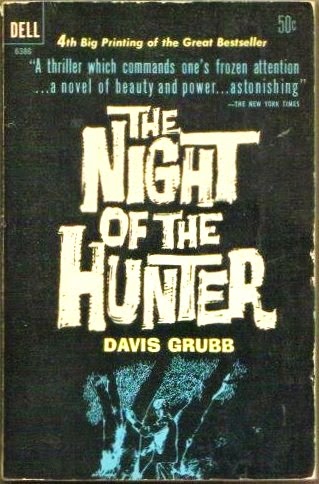
Known for penning the novel The Night of the Hunter upon which the classic 1955 movie was based, Davis Grubb (1919-1980) was a West Virginia native well-versed in the pride, poverty, tribulations and superstitions that were endemic to that region. This collection of short stories ranging over 20 years, Twelve Tales of Suspense and the Supernatural (paperback edition from Fawcett Crest, June 1965) includes some Weird Tales works as well as tales first published in popular magazines like Ellery Queen, Nero Wolfe, Woman's Home Companion, and Collier's: you know, all the middlebrow publications of the mid-century that your great-grandparents might have read of a TV-less evening (Cavalier too, but that was probably Grandad's privy reading).

Grubb's style has a slightly melancholy, forlorn (the variant "lorn," which I have never come across before, appears in places) note to it and his scenarios are decent time-passers, characters familiar: drawling ne'er-do-wells, laconic sheriffs, expansive judges, tempting women, shrewish wives, innocent children, cool killers. The aptly-titled "Moonshine" got me thinking of those Gold Medal paperbacks from the 1950s of Southern sleaze and backwoods ribaldry. That sensibility is everywhere, but not overwhelming; I wouldn't really call it Southern Gothic, but there is just a hint of it at the edges.

 From hardcover edition, 1964

While reading these stories I couldn't help but think of Grubb's contemporaries in short genre fiction. While his stories aren't quite as sensitively-wrought as Charles Beaumont's or as matter-of-fact believable as Richard Matheson's, as cold and cruel as Shirley Jackson's, Twelve Tales still has appeal. Readers fond of Fredric Brown and Gerald Kersh, two other unclassifiable writers whose fiction has strong echoes of crime, science fiction, suspense, and horror, should take note as well.

Most stories end with a ingenious image of violence, perhaps that's even the tale's raison d'étre, but we all know this is the pulp template. Nothing cuts too deep or too sharp, but you can see the bone in "One Foot in the Grave" and "The Horsehair Trunk," two good and grim revengers that echo Robert Bloch's punning but without that author's black humor. "Busby's Rat" and "Radio" could have served as minor entries in Ray Bradbury's October Country, and "The Rabbit Prince" is at once sad and sweet as a spinster schoolteacher is given a glimpse of wild abandon that could have come from his pen when he was feeling kinder. "Nobody's Watching!" is set in the high-tech world of TV production, and it's the kind of thing I could imagine Harlan Ellison writing about his early days, the dangers of the mediated image on the human mind... and body.

Hangin' with Bob Mitchum in the '50s. Lucky!

Orphaned children populate several of the short stories; of course endangered siblings form the crux of Night of the Hunter (which, goddammit, I must read!). Grubb has a particular sympathy for them--as who wouldn't?--but he doesn't present them mawkishly as a lesser writer would. "The Blue Glass Bottle" highlights how children misunderstand the grownup world about them. "Murder. It was a word. You heard the men say it at Passy Reeder's Store. Murder. It was black marks on the colored poster at the picture show house where the man clutched the red-haired girl by the throat." Grubb's writing shines here, with a slight To Kill a Mockingbird vibe, and the final lines quite affecting.

One of the oddest stories is "Wynken, Blynken, and Nod," which evokes the famous child's rhyme to a macabre end. You may find the reveal a tad ridiculous but it's handled nicely: "There is a moment--perhaps two--in the lifetime of each of us when the eye sees, the mind recoils, and all conscious thinking rejects what the eyes have seen." You might even think of Daphne du Maurier.

Grubb can imbue a phrase  like "not so much as a single scratch" with the most unsettling of implications. That's from "Return of Verge Likens," one of my faves, two brothers who react quite differently to the murder of their father. It was self-defense! claims the killer, and the cops agree. Too bad the man who did the deed was Ridley McGrath, "the biggest man in the whole state of West Virginia! Why, don't Senator Marcheson hisself sit and drink seven-dollar whiskey with Mister McGrath in the Stonewall Jackson lobby very time he comes to town? Don't every policeman in town tip his cap when Mister McGrath walks by?"

"That don't matter a bit," said Verge.

Arrow UK paperback, 1966

The collection concludes with the "Where the Woodbine Twineth," which was adapted for an episode of "Alfred Hitchcock Presents" and included in Peter Straub's excellent anthology for the Library of America, American Fantastic Tales (2010). A little girl whose parents have been killed now lives with her father's sister Nell, who will not tolerate any dreamy foolishness from her new charge (all probably the fault of her brother's "foolish wife"!). Young Eva natters on about the "very small people who live behind the davenport," you know, Mr. Peppercorn and Mingo and Popo! Aunt Nell will have none of this, but when Captain Grandpa or whatever his name is arrives on a steamer from New Orleans with a Creole doll for Eva, things get interesting. Despite the use of an unwelcome (but context-accurate) racial slur, "Woodbine Twineth" ends on a clear, classic, sparkling note of pure unadulterated horror.

Twelve Tales offers old-fashioned pleasures for genre readers; not a classic by any means, but I think a handful of stories--generally, the last half of the book--are  worth checking out. There's nothing as terrifying as Robert Mitchum lurking inside with love and hate tattooed on the knuckles of his hands, but then again... I'm kinda relieved there's not.

Tuesday, August 5, 2014

A Koontz by Any Other Name

A handful of suspense/thriller novels Dean R. Koontz wrote under various pseudonyms before he became a brand-name author. I've heard a few of 'em are pretty good even! You can see a few more here.

Even though I'm not a Koontz fan, they'd probably be worth adding to my paperback horror collection in the name of completion (I buy Laymon's old original paperbacks too). It's a curse!

Tuesday, July 23, 2013

Jeff Jones: The Paperback Covers

These stunning covers illustrations by the late Jeff Jones help confirm that 1960s and 1970s horror-fantasy paperbacks were a world unto themselves. Like his comrade-in-ink Frank Frazetta, Jones reveled in the mythical past, but it was one perhaps darker, more Gothic, less heroic. Rather than hulking loincloth primitives and armor-clad villains, though, Jones's covers here showcase a misty nighttime world of sorcerers and shadowy cults, of masters of occult powers and animal familiars, the hungry undead and their victims. My faves? Definitely The Vampire Women (Popular Library, 1970) and The Curse of the Undead (Fawcett Gold Medal, 1970). But could the books themselves deliver as well as their covers...?

Sunday, October 21, 2012

The Gerunding of Horror Fiction

 
In the dark wake of Stephen King's breakthrough horror novel The Shining came countless titles with that same linguistical form; i.e., the gerund: take a verb and turn it into a noun. In the late '70s and on into the '80s virtually every paperback publisher issued their own versions of a title considered one of the seminal texts of its era, if not the entire horror genre. I can't imagine any of them have even a tenth of the power of King's and these types of titles are beyond ripe for parody. I've gathered but a smattering - natch - of those books here. The Changing and The Feeding easily have the best - or the "best" - cover art, although the monstrous fetus of The Reaping has a kind of tasteless charm to it too.