Showing posts with label '60s. Show all posts

Wednesday, June 7, 2017

Something Evil by Arthur Hoffe (1968): Oh, Sister

After half a dozen chapters I knew Something Evil (Avon Books, Sept 1968) wasn't gonna be evil enough for me. The opening prologue, in italics—which I kinda hate—is set literally on a dark and stormy night with a guy sneaking up to a spooky old house, finding creepy statues in a stable, and then hiding when a woman comes running in... followed by another who then, to the man's horror, stabs the first woman! O horrors. Dude books off into the "murky blackness":
A flash of lightning illumined her face as she stared in fury after the retreating figure. Her eyes, in the light of the electric bolt, were deep, piercing, wild—the eyes of a thing gone mad.

Following chapters are set on the foggy New England coast, it's the 19th century, and you'll meet a cast of characters from any period melodrama, engaged in boilerplate soap operatics with the Gothic flair (moodiness, gloominess, doominess, craziness, drunkeness, murderousness) and one morning reading over coffee I realized the twist. I skipped to the final pages and, lo and behold, there it was. There's an incest angle (god again?) and a Psycho angle and a nice wrap-up with all the ugliness politely put away.

My impression is that most Gothic paperbacks of this era followed, as strictly as any Harlequin romance or detective series, the most restrictive of conventions, with nary a whiff of originality or uniqueness (I believe in some cases publishers had writers sign contracts to this effect). Now I'm always looking for something, anything, to relieve this conformity of genre, but Something Evil doesn't have it. Even searching for author Arthur Hoffe turns up precisely nothing other than this tome. Out of the void and back into the void.

But I was happy to find the cover artist acknowledged on the copyright page, one Bob Foster. Since Something Evil has always been a minor fave cover (I mean who doesn't love baby alligators, altho' I didn't read enough to see if they're actually in the book), I was happy to look up Foster and find his resumé includes lots of '60s and '70s science fiction paperback covers, along with other illustrations of the day. So let's say something good came out of Something Evil.


Saturday, October 22, 2016

A Vast Sadistic Feast

Got to love a pile of severed limbs! Added this one to my to-read list but the 1968 Bantam paperback is going for collectors' prices and I refuse to pay that. So who knows...


Saturday, October 1, 2016

The Gothic Cover Art of Victor Kalin

These 1960s paperback covers comprise only a fraction of the output of American-born illustrator Victor Kalin (1919-1991). The man was incredibly prolific, with his work appearing first in the slick magazines of the 1940s, then thriving during the paperback boom of the 1950s and '60s. In the later '60s and into the 1970s Kalin moved on to painting record album covers. His art really is iconic for each decade it appeared in; you've seen plenty of his work without, perhaps, even knowing his name!


Thursday, September 29, 2016

Tuesday, August 23, 2016

The Smell of Evil by Charles Birkin (1965): Who Could Write This Book of Cruel

I rather wish that the stories in The Smell of Evil were more in line with the moody, melancholy vibe of the paperback cover for the 1969 Award Books edition. Instead, British-born author Charles Birkin (1907 - 1985) offers up blistering contes cruels with a kind of demented genius; there's not a moment of moodiness or atmosphere anywhere at all. Editor Dennis Wheatley perceptively notes in his intro, however: "Young writers are always sadly handicapped by lack of experience; whereas anyone who has been through a war, met a great many people in all walks of life and had to face a number of crises on their own, must have automatically acquired a wide knowledge of places, events, unusual happenings and varied emotions. Charles Birkin has this advantage...."

This is all true, no doubt. The wide-ranging settings and types of characters are a pleasure appreciated (in fact I was put in mind of Barker's approach to Books of Blood 20 years later) and well-deployed. The baker's dozen of tales contained are ingenious clockwork toys, ready to snap and trap hapless folks within their merciless jaws. Which story element, I wondered while I read, will be the tripwire? I wanted to like the stories more than I did; I didn't mind that for many I could guess the twist; or the dated sociopolitical stances; or the lack of the supernatural (featured in a couple tales, and not very original at that). What I minded was the unremitting cruelty, the vagaries of fate that scoop characters up to dash them upon the rocks, the utter misanthropic (and often sexist and racist and homophobic) nature of each and every tale.

It's not that I dislike that merciless ironic last sentence-style reveal of an unimaginable horror; Birkin does it very well. But a whole book full of them makes for some dispiriting reading. Perhaps if I'd read a story here and there—indeed, I first read the title story over two years ago and enjoyed it on its own—I'd have been more satisfied. I don't know. Anyway, there were some positives. In "The Smell of Evil" a novelist on an island holiday learns of a horrific scheme to bilk a young mute heiress out of her inheritance. It's the only first-persona narrated work in the collection; its denouement benefits greatly from the technique, a reaction of rage against an unconscionable breach of trust.

"Text for Today" is a silly trifle of literal cannibalism set in Papua New Guinea; "The Godmothers" is kitchen-sink realism without mercy as it puts a child in grave danger. "Green Fingers" was my favorite of all: a well-observed story of a WWII Nazi officer and the unsuspecting woman he coolly romances. The twist crept up on me slowly as Birkin takes his time setting it up with an unforgiving depiction of self-deception and willful delusions. The original nature of zombies features in "Ballet Nègre" but feels icky for other reasons. "The Lesson" is kind of like a "Mad Men" party gone horrifically wrong (don't get drunk around children), while "'Is Anybody There?'" flirts with ghosts and psychic drama in an agreeable way. The brutal climax of "The Serum of Dr. White" is bitter and hopeless as a mysterious doctor attempts to treat a disfigured young girl.

Tandem UK edition, 1965

The teenage ruffians of "'Dance Little Lady'" could be right out of Saturday Night, Sunday Morning, but they go down one of the darkest paths known to humanity. The whisper of otherworldliness works well in "Little Boy Blue," another family on a holiday that ends in tragedy. "The Cornered Beast," meh, freak-show escapee. "The Interloper" is quite good in and of itself but its sexual politics are, um, troublesome: a tropical island of lesbians who've left civilization and men behind deal with a wounded man who stumbles ashore. At first it seems Birkin is showing some sympathy to women who've endured such humiliation and violence at the hands of men; the climax reveals otherwise, I think.

The final story, "The Cross," is a predictable bit of science-fiction that uses nonsense words to hide its turnabout. It's been done before. Throughout, Birkin's prose is unfailingly British: crisp, precise, mature, stuffy sometimes and irreverent at others. Fine with me. It's just that, as I said, the unforgiving quality, the bleak ends and meaningless deaths, the utter lack of humor, scares, wit, and/or creepiness (that Tandem UK paperback cover is irrelevant as well) add up to a work I'm not sure I'd recommend to readers of traditional horror fiction. Proceed, if at all, with caution.


Wednesday, June 22, 2016

Ammie, Come Home by Barbara Michaels (1968): That Ghastly Thing in the Parlor

It may not surprise you when I say I only read Ammie, Come Home because I really dug the cover art for this 1969 Fawcett Crest paperback. The eerie landscape and the floating girl, her barefoot vulnerability and that blackening sky beyond, really struck me in a positive way, even though 1960s Gothic novels are not my thing. Venerable paperback artist Harry Bennett hooked me into reading a novel I never would have otherwise! Well-done sir. Author Barbara Michaels is one of the pseudonyms of Barbara Mertz (1927 - 2013), a prolific writer and Egyptologist; her most famous nom de plume was Elizabeth Peters, under which she wrote dozens of mysteries I remember from my old used bookstore days. Anyway, Ammie is a pleasant enough read, nothing earth-shattering, perhaps even too mild for some contemporary readers. Here and there a jagged edge appears, a moment or a scene of black dread and emotional distress, a slow build-up of the supernatural; the evil deeds of the past wending their way through history only to end up at the tag-end of the groovy generation-gapped 1960s!

Ruth Bennett, widowed, mid-40s, lives in a stately Georgetown, Washington DC home built in the 1800s, inherited from an elderly aunt. Her college-aged niece Sara is boarding with her while attending a nearby school; the novel begins with Sara introducing her aunt Ruth to Professor Pat MacDougal. Big, blunt, brilliant, Ruth isn't sure she likes him. Right off the bat I'm a little iffy on this set-up because it's the stuff of romance novels, in which the two foreordained lovers hate each other on sight... until they don't. It's a generic convention I personally can't abide. Fortunately Michaels doesn't dwell on it overmuch. Prof has a tendency to bloviate and condescend, no surprise, but will prove a formidable foe in the soon-to-come battle against otherworldly forces. Also along is young Bruce, one of Sara's friends, a not-really-boyfriend who today would probably bitch and moan about his being friend-zoned. He's kind of a hipster doofus too, but like the Prof, he really steps up when strange things are afoot.

A black smoky shadow appears in a dream of Ruth's one night, but, as one other unlucky lady once put it, "This is no dream, this is really happening!" She hears someone calling "Come home, Sammie" and thinks maybe a neighbor is looking for their cat. This event is set aside as MacDougal invites Ruth to his mother's home for a society soirée, the main event of which is, can you dig it, a séance. Ruth thinks it's a scam, this medium Madame Nada conjuring up long-dead folks from the Revolutionary War (still kind of a big deal in tony Washingtonian circles). What's funny in a modern problems way is that Ruth invites both Mac's mom and the medium to a dinner party in her own home! Motivated more by social duty than true warm-heartedness, this dinner party turns into one bizarre affair. No good deed, etc.

Meredith Press hardcover, 1968

After a discussion on the paranormal between Bruce (he accepts it), Mac (he doesn't), and Ruth (she's unsure), Mac parses Ruth well: "You are fastidious," he tells her. "You dislike the whole idea, not because it's irrational but because it's distasteful." Oh snap! The author will well note the strain  supernatural occurrences put on daily living; it's difficult to keep up appearances when one's niece is suddenly a conduit to a crime committed in one's own house two hundred years earlier. Bruce endeavors in good faith to plumb the mystery, researching Ruth's home in town archives while Mac argues from the viewpoint of scientific rationality. Poor Sara, when not being possessed, kind of lounges about in a miniskirt, getting disapproving looks from  her aunt and opposite ones from the Prof (ew!). Every now and again she'll pop in with a stray observation (it's not Sammie, it's Ammie!) but otherwise she's only a pawn in the possession game. Unspoiled, modern, guileless; she's around but not all there, I suppose, a vessel for the plot but not in and of herself; how could she have character if she is unsullied?

 
 Uber-lame reprints

Experienced travelers in the realm of horror/supernatural/occult fictions will recognize familiar notes in the story. I find this rather comforting. I appreciated the author's efforts at detailing the banal everydayness that co-exists with the crazy: food, traffic, clothing, cleaning. The turbulent 1960s are noted here and there as Ruth is ambivalent about Bruce and his college-bred revolutionary airs and his designs on Sara. Ammie is also, as many of these pop novels are, charmingly dated: endless miniskirts, dudes with long hair, Ruth's old-lady attitudes (she's only in her 40s! She's never eaten pizza!), Bruce's hip-academic pretensions. Sometimes this aspect is less charming: gender normativity/misogyny out the wahoo in Prof's not-so-subtle lechery, and the time Bruce declares there are "women you rape and women you marry." Yee-ow.

Barbara Mertz (1927 - 2013)
aka Barbara Michaels, aka Elizabeth Peters

As the origins of the possession become clearer, our narrative becomes tauter: Bruce learns more about the home and its literal foundations ("the whole house is rotten with hate"). A friendly Father figure is enlisted to aid in an exorcism and this goes poorly. Then the old Prof isn't so above-it-all as he'd like to appear; is he part of what seems to be a historical reenactment from beyond? The back-story is satisfyingly unsettling; you'll agree it's a crime that deserves retribution through the ages. Ammie, Come Home ends on a note of sentiment, but it is only the beginning in a three-book series that Michaels continued into the 1990s. I found the novel to be decidedly okay and won't be reading the rest; go ahead and check it out if you think you'll dig a quaint snapshot of the supernatural '60s and a helluva generation gap.

Postscript: for two other takes on the novel, check out Dark Chateaux and The Midnight Room. And thanks for the pix guys!

Thursday, October 1, 2015

Wednesday, September 9, 2015

Unholy Trinity by Ray Russell (1967): The Grandest Guignol of All

This little Bantam paperback from 1967 seems slight and cheapthe Halloween-costumed models beyond silly, although making specific reference to the three novellas withinbut it packs a solid wallop of historical horror. Unholy Trinity collects Ray Russell's three greatest tales of the neo-Gothic, "Sagittarius," "Sanguinarius," and of course the much more well-known "Sardonicus," which was made into a 1961 film by notorious showman William Castle. Long a TMHF favorite, Russell was fiction editor at Playboy magazine during its height of 1960s influence, publishing Vonnegut, Bradbury, and others, so, you know, class (quite unlike the sleazy delights of his 1976 novel, the infamous Incubus). And class is what Russell brings to the proceedings, a triumvirate of history's most monstrous: Countess Bathory, Gilles de Rais, and Jack the Ripper (what, you say, no Vlad III? Nope) all appear. These monsters may be garbed in the finest raiment, but beneath they are as ghoulish, as diabolic, as unspeakable, as ever they have been.

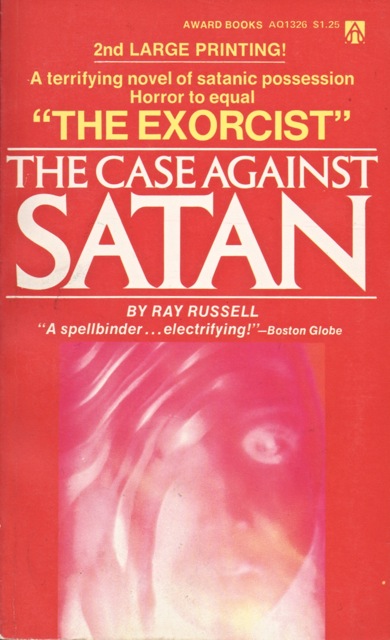
As one can surmise from a 1985 dust-jacket photo of the author, his style is at once saturnine, urbane, regal even, with a wicked vein of dark humor and irony winding through. His work suggests a sophisticate's interest in pain and debasement, mitigated by the mists of history but also given weight by the fact these the events described actually happened (for the most part; "Sardonicus" is Russell's own literary conceit). Therefore it can be stated that one's sadism is sated while using the cloak of respectable historical detail as disguise... if you even care about that.

We begin with "Sanguinarius"—actually no, wait, we begin with an intro essay by Mr. Russell, "The Haunted Castle: A Confession." He recounts a taxing day as an editor in a modern office and upon returning home, exhausted by the existence of television, telephone, Dictaphone, typewriter, etc., and reading "smart, savvy stuff full of bright slang and hip allusion," he wants to relax with "one of those good old aromatic baroque tales, told in an unhurried, leisurely, painstakingly structured way, with plenty of unashamedly elaborate language." Of course Russell's read everything like that on his shelves (giving credence to Harlan Ellison's cry, "Who the hell wants a library full of books they've already read?"), so what's he do? He begins writing one himself! "Fevered with compulsion, totally absorbed," he produces first "Sardonicus," and within a short time the other two works within. Huzzah!

And so: "Sanguinarius" is a fictionalized first-person account of Countess Elizabeth Bathory, written in faux-16th century hand, detailing her descent into blood lust. From her entombment in a high Castle Csejthe room she writes this memoir, beseeching her Lord to hear her now that she's being punished for unimaginable deeds. In the village below, she writes, "no soul will dare display a thing of crimson." The marriage of the Bathory and Nadasdy lines brought together Hungarian royalty; she is expertly wooed by Count Ferencz Nadasdy (although it was probably an arranged marriage). Imprisoned Elizabeth writes of her and Ferencz's lovemaking, which gets Russell's pen flowing:

...for indeed to peaks of pleasure Ferencz led me, slowly to start with, step by timorous step, then setting out with more audacity, striving together, each succouring the other, climbing, first to one ledge, then to a higher, and then to yet a higher more dizzying ridge, finally to soar as if on wings to attain, both in the same heart-bursting moment, that cloud-capp'd ultimate point.

When Ferencz is called off to battle, Elizabeth mopes and mourns, unconsoled by "faithful old servant" Ilona, till one day Dorottya arrives. A beautiful young "woman of the wood" with the knowledge of healing herbs and ointments, she offers her services to the lonesome Countess. Things turn... heady. Ilona hears illicit cries in the night. You know how it goes. When Dorottya asks Elizabeth if she might bring others to cheer her, the Countess agrees, although slightly hesitant. What follows when of course Ferencz's sudden arrival home interrupts proceedings. Will it surprise the reader to learn that Dorottya is Ferencz's long-time mistress in unholy arts, that he sent her to Elizabeth at her time of weakness, and she was to be his wife's teacher in torture?

"And let us lead thee onward," added Dorottya, "to keen delights far stranger and more bold than those thou  has already savour'd..."
"Ay, wife" said Ferencz, "and be thou Bathory not but in name, but in hot deed, as well!"
"And let us seal this compact with a solemn pledge," Dorottya said, "a ceremonial bath to signalize our fealty to sin."

I think you know what kind of ceremonial bath is to follow. Russell doesn't attempt to make her a sympathetic character. Self-serving, oblivious, even if at times regretful, Bathory blames her husband  and Dorottya for developing her taste for blood and torture (even if such traits ran in her family). The little twist at the end is welcome, however; welcome, appropriate, refreshing even.

 "For who would be disposed to smile under the same roof with him who must smile forever?"

Sandwiched in the middle of the book is Russell's most famous work, "Sardonicus." In 18— (I've never been able to ascertain why that dash was used in dates in pre-20th century literature...) one Dr. Robert Cargrave, an esteemed English physician, is called to a mountainous region of Bohemia by an old friend, Maude Randall. She is now married to a man who calls himself Sardonicus and together they live in a castle, a "vast edifice of stone... cold and repellent... of medieval dankness and decay" which "strike[s] the physical and the mental eye as would the sight of a giant skull." Of course they do! Once there, Cargrave and Maude strike up their old friendship (never consummated) and then she introduces her husband, Mr. Sardonicus.

"The gentleman before me was the victim of some terrible affliction that had caused his lips to be pulled perpetually apart from each other, baring his teeth in a continuous ghastly smile. It was the same humourless grin I had seen once before: on the face of a person in the last throes of lockjaw. We physicians have a name for that chilling grimace, a Latin name... risus sardonicus."

 German edition, 1971

Sardonicus's backstory is a clever one, reaching back to creepy Eastern European folklore. He then reveals himself to be a diabolic mastermind, enlisting Cargrave's medical prowess to cure his wretched face while dangling a promise of bliss with Maudeor, failing in this, Sardonicus threatens the tortures of the damned for his platonic wife:

"Perhaps now you will better understand the necessity for this cure. And perhaps also you will understand the full extent of Maude's suffering should you fail to effect the cure. For, mark me well: if you fail, my wife will be made to become a true wife to me—by main force, and not for one fleeting hour, but every day and every night of her life, whensoever I say, in whatsoever manner I choose to express my conjugal privilege!" As an afterthought he added, "I am by nature imaginative."

It may not surprise you to find that Russell's attitude is one firmly set in the 1960s it was written in; the subtext of "Sardonicus" is like a recasting of the Playboy philosophy, that libertine stew of sex, sophistication, and rationality, in terms of the Gothic. In the end modern urban bachelor Cargrave outwits the violent, boorish cad and wins the woman. Sardonicus's comeuppance is utterly terrible and unutterably fitting. As I said: Playboy! Philosophy! No, really: whether you agree with my reading or not, "Sardonicus" is superb.

Playboy Press, 1971

The final piece, "Sagittarius," is a tale-within-a-tale, two men in an upper-class club exchanging bon-mots over cigars and Scotch. You know the scene. Elderly Lord Terrence and young Rolfe Hunt converse of "the series of mutilation-killings that were currently shocking the city, and then upon such classic mutilators as Bluebeard and Jack the Ripper, and then upon murder and evil in general..." You know, the yoozh. Lord Terry then launches into speculation: what if Mr. Hyde, of Stevenson fame, were real? And supposing that, what if he had sired a son? Then that conversation, about the twists and turns of good and evil in one soul, turns into Lord Terry's reminiscences about his younger days in turn-of-the-century Paris, when he knew a famous actor of Le Théâtre du Grand-Guignol named Sebastien Sellig.

Ah, the Grand-Guignol! Theatrical performances of death and dismemberment, madness and the macabre, that drew standing-room-only crowds to witness buckets of stage blood spurting about. A terrific setting for a horror tale, and for Russell to show off his erudition. Into this brew he mixes Hyde, Jack the Ripper, and as a pièce de résistance, Gilles de Laval, Baron de Rais, that 15th century butcher of children and occult dabbler, compatriot of Joan of Arc and a man of—but of course—wealth and taste. Mystery piles upon mystery, and young Rolfe Hunt has, in the story's final sentence, a mind-freezing realization...

In the street, I felt I had to make some utterance. "To think, I said, "that her last evening was spent at the Guignol!"
Sellig smiled sympathetically. "My friend," he said, "the Grand Guignol is not only a shabby little theatre in a Montmartre alley. This—" his gesture took in the world "—is the Grandest Guignol of all."

I spent several days entranced by Russell's imagination, the twists and insights, the decadence of an aesthete's intelligence, enchanted by his delicate yet precise prose used to describe the indescribable. Russell's affection for the wormy tropes of Gothic literature is clear; his facility with them dexterous; his ironic repositioning of them enlightening. Thus I can recommend Unholy Trinity without hesitation (in print as Haunted Castles). High-minded, cultivated, blackly ironic and delighting in the debauched and the deranged from the vantage point of the mighty, Russell is a trustworthy guide through this netherworld populated by crumbling castles, dank dungeons, torture chambers, bleak landscapes, and most terrifying of all, the unfathomable cruelties of the human mind.

Not from God above or Fiend below, 
but from within his own breast, his own brain, his own soul.