Showing posts with label f. paul wilson. Show all posts

Tuesday, December 22, 2015

Lovecraft's Legacy, ed. by Weinberg & Greenberg (1990): A Debt No Honest Man Can Pay

What creative artist doesn't enjoy the opportunity to speak to those who inspired them, express their gratitude, and perhaps even engage in some flattering imitation? That's the impetus behind Lovecraft's Legacy (Tor hardcover, Nov 1990/St Martin's trade paperback 1996, cover art by Duncan Eagleson), an anthology celebrating the 100th anniversary of his birth. A baker's dozen of authors of various genre backgrounds contribute their literary thank-you notes (literally too in short afterwords appended to each story) to one of the most influential authors of the 20th century. I think one can state that pretty unequivocally these days, right? In the quarter-century since Legacy was pub'd, HPL's rep has grown to, well, cyclopean proportions, so... fuck it, yes one can. 

After an introduction by Robert Bloch, who as a teen corresponded with HPL (but you knew that), Mort Castle roars out of the gate with with the excellent "A Secret of the Heart," the narrator of which relates how he's made himself immortal thanks to the "Other Gods" revealed to him by his physician father over 100 years before. When the family's beloved adopted daughter succumbs to a gruesome painful death aged only 11, the father resorts to drinking and traveling far and wide, dabbling in black arts to ease his grief. Castle wrote one of my favorite horror stories, Still Dead's "Old Man and the Dead", and "Secret of the Heart" features the same kind of literary in-joke. What Castle does when he links a character to another fiction is especially apt and unexpected; the circle is complete, a circle I think Lovecraft would've been too humble to include himself in.


What about mixing up the highest of Elizabethan high culture with works almost forgotten in the grotty pulps of pre-WWII era? The reliable Graham Masterton presents us with "Will," a terrific little mashup of the Bard of Avon and the Gentleman from Providence: it seemed as if Shakespeare had achieved his huge success as a playwright by striking a bargain with 'Y'g Southothe,' which was some kind of primeval life force 'from a time when God was not.'" You can bet this reward comes at a price. Masterton's uses real Shakespeare history, of course, and some bold imaginative origins for the Globe Theater and the fire that destroyed it to create one of Lovecraft's Legacy best stories.

A highly-respected author of literate and challenging science fiction, Gene Wolfe (pictured) contributes "Lord of the Land," which contains some startling imagery deployed in a Faulkner-esque piece about a scholar's interview of a country patriarch for stories about the mythic "soul-sucker." What connection does it have to pre-Greek gods and rites? Hungry jackals, moonlit cities, starry alien skies, and mouthfuls of worms lend their welcome Lovecraftian flavor. The science fiction of Brian Lumley's "Big 'C'" brings to mind the Quatermass stories of the '50s and '60s and conflates one big C—cancer—with another you can probably guess. Not too bad, as Lumley has a hale, chummy style, and gets the humor in his gross, somewhat silly apocalyptic scenario.

Chet Williamson's "From the Papers of Helmut Hecker" is an epistolary piece about a snobby literary writer whose work keeps getting compared to Lovecraft's, which enrages him; he's the heir to Kafka and Borges, winner of the Booker Prize and Faulkner Award! Poor guy gets what's coming to him. "The Blade and the Claw" from Hugh B. Cave is set in Haiti, so it's nice to get out of the usual environs, but I found the story lacking in Lovecraftiana, and its happy ending dampens the horror. 

"Meryphillia" was easily my favorite tale in Lovecraft's Legacy. She is "the least typical ghoul in the graveyard," pining for a poet who visits this charnel yard to sing odes to his unrequited love. It's a tale of love and glory, of midnight feasts and the stench of decay; Brian McNaughton (above) writes with a noxious, devilish wit, regaling the reader with a Clark Ashton Smith-style bit of grave and grue, recalling HPL's own "The Hound" or "The Tomb." It's sweet, funny, gross, completely satisfying. I must have more McNaughton! And I kinda hope there are more stories of Meryphillia and her "coffin-cracking jaws."

Gahan Wilson's "H.P.L." is the most affectionate story included, a charming trifle of the writer still alive at nearly 100 and how he got that way. A fellow pulp scribbler visits Lovecraft at his home in Providence, and today he's a successful author living in his upkept childhood home that boasts an enormous two-story library. Wish-fulfillment at its finest—what HPL fan would not want to peruse that man's book collection? You'll be able to tell where Wilson's going but it's a worthwhile trip just the same.

Crime writer Ed Gorman delivers a killer serial killer tale, "The Order of Things Unknown," written in  no-nonsense prose and tersely invoking a "vile god" and a burial ground for sacrificial victims. Quite good; I'm gonna have to look into Gorman's crime novels I think.
He stood as if naked in the moonlight and looked up and saw the moon and the stars and sensed for the first time that beyond them, somehow, there was another reality, one few ever glimpsed, one that filled early graves and asylums alike. 
When he put the girl in the trunk, he was careful to set her on the tarpaulin. She had begun to leak.
The anthology closes with F. Paul Wilson's "The Barrens." Wilson wisely utilized the mysterious wilderness of his native New Jersey's Pine Barrens, into which the narrator and an old college friend venture so the latter can explore the legends of the Jersey Devil, and perhaps more. Strongly in "Colour out of Space" mode with a welcome lack of garbled phonetics, Wilson's rather pedestrian prose isn't up to the task of imbuing those dark forests and empty landscapes with dread or weirdness. He reaches for it, it's a good story, but it didn't quite get there for me; no frisson of Lovecraftian (or Blackwoodian) menace. Obviously the editors thought highly of it, and I've seen it referenced elsewhere. Maybe it's just me...

Lovecraft's Legacy is an easy recommendation: only a small number of stories are below par; a solid many are quite good, and three or four are terrific and deserve to be included in future Lovecraft anthologies not consisting of original material. Mythos fans probably already have a copy but if not, go for it. I got the hardcover as an Xmas gift back in the godforsaken year of 1990 and had only ever read a couple stories in it. Never got rid of it and so this scary solstice season I'm glad I finally went back!

Wednesday, July 15, 2015

Borderlands 2, ed. by Thomas F. Monteleone (1991): It's a Long Way Back from Hell

"The stories which follow don't have to be read on a dark night, with glowing embers banked in the fireplace, and a dark wind howling across the moors. You can read these tales under the clear light of day and pure reason... None of the tired old symbols which have defined the genre for far too long will be found here."
 Editor Thomas F. Monteleone, introduction

How could any editor put together such a trailblazing anthology as 1990's Borderlands and not desire to follow it up with another volume? Again, Monteleone has gathered together stories by writers both (in)famous and not, stories that don't fit comfortably under the generic rubric of "horror," or any other either. Borderlands 2 (Avon Books, Dec 1991) treads a dangerous line: in its efforts to present horror/dark fantasy/suspense/science fiction stories that fit no mold it risks pretension, ambition outstripping execution (Prime Evil, anyone?); stay too close to identifiable territories and it is simply another paperback horror anthology cluttering up the shelves. The original Borderlands is one of my top favorites ever precisely because it tight-roped that line perfectly. Can Monteleone (pic below) and cohorts do it again?

For the most part, yes.

 
Disturbing is a word I'd use to describe the fictions herein; disturbing, unsettling, poignant, grotesque. Horror is normalized; lived with, understood as a fact of life, and isn't really scary anymore. Here there are moments struck in which I felt my flesh turn inside out, my shoulders shivering with revulsion, while my brain was engaged by a story's central idea, or an image or an implication. A writer who can do that to me—delight my mind while revolting my body—will have my undying devotion. And the story here that completely knocked me out, kept me glued to the page with a well-told tale and imagery of primal horror, was "Breeding Ground," by a man named Francis J. Matozzo

I doubt you know that name. He had a story in the original Borderlands, "On the Nightmare Express," which was kinda cool. In this one he details three seemingly disparate events: a man undergoing surgery for excruciating craniofacial pain, an amateur archaeological expedition, a woman estranged from her husband. It's how Matozzo fractures the story and then pieces it back together, building suspense, that really won me over. Also, I dig evolutionary biology and that figures in here too, both literally and as analogy. Skin-crawlingly disgusting and sadly effective, "Breeding Ground" succeeds at all levels.

Another strong work is Ian McDowell's "Saturn," which is not a reference to the planet but to the Roman god who, well, devours his children. It is filled with grim wit and ends on one of the darkest notes in the anthology. Yes, I killed Michael. And buried his head, hands, feet, and bones in the geranium bed, after eating the rest. I can't even honestly say I regret it, although I'm sorry you have to find out. 

One of the longest stories is "Churches of Desire" by the late Philip Nutman (pictured above at an archaic contraption known as, I think, "typewriter"). Clearly inspired by Clive Barker, a film journalist wanders through Rome, marveling at its filthy wonders and trying to pick up young men for anonymous trysts when he's not futilely attempting to interview an aging exploitation filmmaker. The "church of desire" is a porno theater, of course, and our protagonist eventually succumbs to its offerings, a depraved celluloid vision that would make Pasolini blush. While it may be too beholden to Barker, especially in its final paragraphs, "Churches of Desire" satisfies. The Church would welcome fresh converts that night and there would be new films to watch, new stories to tell, his own among them. In the name of the Father and the Son the congregation would sing silent praises to the Gods of Flesh and Fluids.

Sexual politics are a prominent feature in Borderlands 2, as the culture at large was beginning to deal with them in the early 1990s. The lead-off story, from F. Paul Wilson (of whom I am no fan) is "Foet," a so-so satire of high fashion and the absurd lengths to which people go in order to be stylish. You can probably guess the gimmick from the title. As with his notorious "Buckets," I found the approach over-done and the effect reactionary, which mitigates the shock factor. Better: "Androgyny," by Brian Hodge (pictured above), a sympathetic and relevant fantasy about a marginalized people, while Joe Lansdale's "Love Doll: A Fable" is an unsympathetic portrayal of someone who enjoys marginalizing those less fortunate, or simply those not born straight white blue-collar male.

"Dead Issue," from Slob author Rex Miller, doesn't have enough moral weight to justify its graphic sexual violence. Pass. "Sarah, Unbound," from which the Avon paperback chose its cover image, is Kim Antieau's solid contribution about a woman exorcising her real-life demons (She hated him so much. She had loved him. Why had he done it?) by counseling an imaginative yet abused child.

Borderlands Press hardcover, Oct 1991, Rick Lieder cover art

David B. Silva, the late editor of Horror Show magazine, returns to Borderlands with the final story, "Slipping." Like his award-winning "The Calling," "Slipping" is about real-life fears: in the former it was cancer, here it is aging. A hard-working ad man finds moments of his life disappearing from his memory, hours, then days. One moment he's at work, the next he's on the phone with his ex-wife, then he's having lunch with a colleague, with no conscious memory of how he got to any of those points. Silva makes the reader feel the terrible incomprehension of being aware of that incomprehension... but being powerless to stop it. Excellent. The physical distress of aging also appears in Lois Tilton's "The Chrysalis"; a character's dawning horror at its climax was a favorite moment of mine.

Children are horrible, aren't they? A classic horror trope. Facing the sins of our past, our guilt unassuaged by time or deed, is central to Paul F. Olson's "Down the Valley Wild," a sensitive, painful rumination on a childhood 40 years gone. It also contains some well-rendered moments of shock; overall it was a highlight of the book for me. "Taking Care of Michael" is only a page and a half long but J.L. Comeau's prose cuts deep and ugly, presenting madness under the guise of innocence.

White Wolf reprint, Oct 1994, Dave McKean cover art

All that said, Borderlands 2 also includes a handful of stories I found middling, so this volume doesn't quite reach the heights of its predecessor. These stories—"The Potato" by Bentley Little, "For Their Wives Are Mute" by Wayne Allen Sallee, "Apathetic Flesh" by Darren O. Godfrey, "Stigmata" by Gary Raisorhave their peculiarities, their moments of squick and dread, sure, but lack a certain edge to really sledgehammer the reader. Of course mileage may vary; other than Rex Miller's story none of them outright suck, and I think most readers will find much of Borderlands 2 to be an excellent usage of their time. Monteleone wisely continued the series for several more volumes, most of which I read as they were published through the mid-'90s—I clearly recall buying this one upon publication, eager and excited to delve into "steaming, stygian pools of unthinkable depravity"—and I hope to own them all again one day soon. Rest assured that all my future trips to "uncharted realms of bloodcurdling horror" will be documented and presented here, trespassing be damned.


Friday, May 9, 2014

Hot Blood, ed. by Jeff Gelb & Lonn Friend (1989): Heaven's on Fire

It's a no-brainer that horror and sex  are a popular pairing. A thrill is a thrill as far as our central nervous systems are concerned, and we can look to Freud and other psychologists and philosophers to intellectualize the seeming contradiction. As for as our beloved horror fiction goes, vampirism is the most obvious, and dare I say popular, manifestation of this theme. Fangs penetrating flesh and the sucking out of lifeblood barely counts as symbolism! But for 1989's Hot Blood anthology  from Pocket Books (alternately subtitled Tales of Provocative Horror or Tales of Erotic Horror), editors Jeff Gelb and Lonn Friend have chosen no real vampire stories... which I think was smart. Other horny creatures are slinking through the night, sure, but no Draculas or Lestats here. There've always been anthologies of great tales of vampire action, but the "erotic horror" market was, as a separate publishing entity back in the '80s, barely existent. Way to find a hole and fill it guys.

The authors included are a veritable who's-who of '80s horror fiction, which meant I was on top of this release immediately back in the day, although I don't recall reading it all. However I certainly never associated McCammon, Etchison, or Wilson with erotic horror, but I was willing to give 'em a shot. I liked seeing Harlan Ellison in a horror anthology, as his stories of adult relationships seemed always tinged with a loneliness and a darkness that, if presented just so, could be horrific. Ramsey Campbell had already produced his collection Scared Stiff, while Gary Brandner, Ray Garton, and Graham Masterton had all written overtly sexual horror fiction (hell Masterton was once an editor at Penthouse and had written a handful of popular sex manuals!). So, on we go...

 
First up is "Changeling" from old pal Mr. Masterton.  Set-up you've heard: Englishman away from home on business, meets too-hot-to-believe woman who - shock of shocks! - wants to fuck him. He can't stop himself. What horror ensues may be too literal but Masterton's  approach to sexual politics and gender identity - "Because it doesn't matter how beautiful a woman you are, or how rich a woman you are... Not even the poorest, most downtrodden guy in the whole world has to endure what women have to endure" - seems almost prescient today. A solid start to the anthology.

Signet '75... but of course

"The Thang" from all-American boy Robert McCammon kinda comes off like EC Comics porn: it's juvenile and silly, there's no reason for the extreme punishment for a guy who's just lookin' to... well. I think other readers will like it more than I did, though, because it does exhibit a ridiculous kind of charm. At the other end of the spectrum is  Richard Christian Matheson's "Mr. Right," which exists in that uncomfortable world of non-PC desires and behavior. Like most of his fiction, it's barely three pages long, but packs an illicit wallop. Indeed, one woman's horrifying Mr. Wrong...

Not all the stories are original to Hot Blood; Gelb and Friend looked backward as well. From 1962, "The Likeness of Jenny" by the estimable Richard Matheson is a cool, calm and plainly written story of (prefiguring King tales like "Nona" and "Strawberry Spring") an undeniable criminal urge. The comeuppance is implied, and the more chilling for that.

Major SF/F author Theodore Sturgeon appears with "Vengeance Is." (period included), a 1980 story that might be the best in the anthology. Told with muscle and imagination mostly through dialogue, it's a harrowing story of sexual assault, with a perfect reveal in the final line, like so much of vintage genre fiction. Modern readers might think it a bit gimmicky, but I felt Sturgeon's style mitigated that. Another 1980 tale from a major SF/F/and whatever else author is Harlan Ellison's "Footsteps," written in the front window of a bookstore (a stunt he performed many times). Claire is a woman of the world, and now is in the City of Light, preparing for a meal...

Her orgasm was accompanied by a howl that rose up over the Seine and was lost in the night sky above Paris where the golden sovereign of the full moon swallowed it, glowing just a bit brighter with passion.

 
 1989 chapterbook

Unmistakably Ellison, it is beautifully written, darkly witty, expertly conveying Claire's loneliness and fear and hunger. A winner for sure, even with an ending that might leave some scratching their heads.

Masques editor and prolific author J.N. Williamson gives us "The Unkindest Cut," which concerns a vasectomy *shiver*. Not bad, but it simply reminded me of  an anecdote Stephen King tells in Danse Macabre about an old Arch Oboler radio program and an unfortunate day at the dentist... Editor Gelb himself contributes "Suzie Sucks," in which we get a pure example of a primal male fear (an image that appears in a couple stories here, bet you can guess what).

"Aunt Edith" by the recently-late Gary Brandner, whose first novel The Howling was powered by a very strong and effective erotic charge, sets up a scary/sexy scenario. A young man meets his girlfriend's voodoo-practicing aunt, who turns out to be well-nigh irresistible. It all ends as a dirty tasteless joke but it actually works. F. Paul Wilson, who I'm not a fan of, presents "Ménages à Trois," about a crippled old woman and the young man and young woman who tend to her, and her shocking manipulation of their teenage desires. Not bad, standard '80s fare with that little zing at the very end.

Several entries I was familiar with: Dennis Etchison's story from '73 before as it was included in his collection The Dark Country. May I quote myself? "I adored 'Daughter of the Golden West,' which begins as a Bradbury-esque fantasy of three college-age men (the collection is dedicated to Bradbury) and ends with a revelation of one of California's greatest tragedies." Exactly the same goes for Les Daniels's "They're Coming for You" (in Cutting Edge), Lisa Tuttle's "Bug House" (in Nest of Nightmares), and David J. Schow's "Red Light" (in Lost Angels). All fine, good stuff!

"Punishments" is the most depressing story, another of Ray Garton's broadsides against the oppressive Seventh-Day Adventist faith he was raised in (and later rejected). No stranger to the mingling of sex and horror - not erotic horror - Garton presents a sad, fatalistic short that reveals how abuse is handed down, how it exploits ignorance, how its effects pervert a healthy curiosity, how the innocent are made to be guilty through not fault of their own. It pulls no punches. Ouch.

Other stories by the usual horror suspects - Campbell, Bloch, Skipp and Spector, Rex Miller - who twine sex and death in their own recognizable styles, the effects of which range from quite good to simply okay. Then there was the sensitive if perplexing "Carnal House" from the generally reliable Steve Rasnic Tem... necrophilia right? Oh well.

2004 Pinnacle Books reprint

Successful enough that it became the first of a long-running series, Hot Blood provides decent horror entertainment, with a smattering of true gems. These gems understand the id of our sexual selves from experience, not just fruitless imaginings. Several of the stories, while not outright duds, combine sex and horror in a clumsy, even trite, manner and aren't erotic at all (provocative, I suppose, yes). Some use an easy narrative trick, to greater and lesser effect, to get men understand what it's like to be a woman, that of physical or emotional transference. And I certainly would have appreciated a Thomas Tessier or Poppy Z. Brite entry (Tessier appears in a later volume, and female writers appear as well), two writers whose tales of eroticized horror are smart, sly, and modern, and lack that regrettable obsessive adolescent tone that mars the underwhelming stories here. But rereading it 20-odd years later, I still think Hot Blood is a worthwhile addition to the groaning shelves of '80s horror anthologies.

Tuesday, January 7, 2014

The Keep by F. Paul Wilson (1981): Just One Deathless Night

Nazism will forever be the benchmark by which all other human evil is measured (well, until something worse comes along). So what do you get when you pit the SS against an unimaginably malevolent supernatural force that, with their stubborn reliance on "rationality," they can scarcely comprehend? You get The Keep, the first horror novel from New Jersey physician/author F. Paul Wilson, who spent the 1970s writing science fiction tales when not practicing medicine (and apparently has spent the decades since writing a series that began with The Keep). There is nothing resembling science fiction in this highly-regarded (going by reviews on Goodreads and Amazon) "novel of deep horror," and it's dedicated to pulp horror/fantasy icons Lovecraft, Clark Ashton Smith, and Robert E. Howard. This is no surprise - The Keep's fictional grimoires, subterranean lairs, manly adventuring, and even some sword-and-sorcerering, find Wilson emulating those classic writers but not slavishly imitating them. After finishing the novel, and at various moments throughout, I wished he had emulated those guys more. Much, much more.

A few words to preface this review: I read Wilson's short story collection Soft and Others couple years back and mostly hated it because his writing was so one-dimensional, dull, and tone deaf. Honestly, I think Wilson can be a downright terrible writer, so I was relieved to find when I began reading The Keep he'd seemingly improved (how could he not?). What keeps the reader glued to the pages is the sheer power of the story. I mean it's Nazis, in a keep - a type of fortified tower built within castles during the Middle Ages by European nobility, Wikipedia tells me - battling an evil entity who slaughters Nazis handily. I'm in!

Or... am I?

 Original 1981 hardcover

So we've got a German army, led by Captain Klaus Woermann, stationed in a keep high in the Alps of Romania, to protect precious oil fields needed for the Nazi war effort. But when two grunts dig into the fortification trying to find out if the oddly-shaped metal crosses embedded in the stone walls everywhere in the keep are made of real gold and silver, they find behind those stones an opening that leads to... Well, evil and darkness and decapitation. And unsolvable impossible deaths follow after, each night for a week, till an exhausted, reluctant Woermann sends for help from the Nazis, whom he regards with skepticism and distrust, himself too old to have been seduced by the charismatic Hitler (I found this detail quite satisfying). He words his missive carefully: Request immediate relocation. Something is murdering my men... That ought to get their attention!

Enter SS Major Erich Kaempffer, an honest-to-God Nazi, and his einsatzkommandos, reinforcements for the beleaguered soldiers, to find out what the hell that something is that's killing Woermann's men. Kaempffer is eager to begin his post as commandant of a coming-soon death camp in Ploiesti, and feels this assignment is almost beneath him, but must impress his superiors. If he succeeds in discovering the murderer, he knows he will make Woermann look like an ineffective fool - something he's longed to do since Woermann witnessed an unfortunate incident of cowardice on Kaempffer's part in the Great War. The two men barely tolerate one another, and their conflict, well-done by Wilson in the first third of the novel, propels much of the story.

But Kaempffer has no luck sniffing out the killer even though he scoffs at notions that it might be a supernatural agent of some kind - surely it's just local guerrillas. Then his men start turning up dead, two of them even walk right into his room from their post, their throats torn out, and collapse before him (all kinda cool). Reluctantly he accepts the advice of the local innkeeper - after terrorizing him and threatening to kill the nearby villagers he's taken into the keep - and brings in Theodore Cuza, an old sick man who lost his position as an esteemed professor because of his Judaism. Cuza is an expert on the history and folklore of the region. Along with Cuza comes his 30-ish daughter Magda, his caretaker, beautiful and untouched. Meanwhile, a strange scarred unnamed red-headed man is doggedly traveling miles across land and sea, avoiding wartime danger zones, for some unknown reason to meet an evil in Romania he thought had been vanquished ages before...

And now The Keep begins to crumble. One prominent weakness is the thoughtless, cliched romance that grows between Magda and that redheaded man - Glenn, at first - a relationship practically clipped with scissors out of a cheap historical or Harlequin romance novel, seemingly inserted to make the novel fit the bestseller mold: She had found the man unattractive in the extreme; in addition to his odor and grimy appearance, there was a trace of arrogance and condescension that she found equally offensive. Ugh! There is no originality, no human insight, just gross lazy simplifications about men and women and sex. Would that Wilson had just left this part out completely, or rewrote the passages another time or two to tone down the rank sexism, or at least evince a sort of detached or ironic attitude about it. Or something to make it palatable, anything!

And the depiction of Nazis and their reign of terror - an easily exploitable topic, a hack writer's dream! I like tasteless exploitation/horror when done right, but Wilson doesn't rise - or sink - to the occasion. The Nazis are barely cardboard - as the novel goes on, all the characters become cardboard pieces. When we first meet the god-like evil denizen of the keep, a baddie named Molasar, there are the de rigueur horror moments, such as his "friendship" with Ol' Vlad Tepes back in the day and talk about feeding off the evils of humanity. But Molasar is dressed like a comic-book villain and speaks like one too: "I have my own means of moving about which does not require doors or secret passages. A method quite beyond your comprehension."  My God, who knew evil was so dorky?

 Map of the Keep itself

(Some spoilers) Other faults: Wilson makes an interesting observation about vampire lore when Cuza, a devout Jew, sees Molasar's fear of the Christian cross - does that mean that faith is the true one, and not Cuza's Judaism? He agonizes over his own potential loss of belief, but for Wilson, it's only a dead end. Later Cuza gets Molasar all riled up when he informs him what "death camps" are and that the Nazis are planning on rounding up Molasar's Wallachian "people" and exterminating them. So Malasar decides he's going to kill Hitler and his crew, with Cuza helping out as daytime dogsbody, getting out of the keep and up into Hitler's shit. Yep, that hoariest of tropes, KILL HITLER, seems too convenient a turnabout (to be fair this novel is over 30 years old so I guess the trope wasn't as hoary then). Molasar's gonna gain power from all that Nazi badness, don't you know, then take over the world...

1983 Dutch edition - creepier than any scene in the book

I haven't even mentioned the thudding dialogue, unimaginative scenes of violent mayhem, the climax of ageless good v. evil, and the sappy, unearned epilogue, all of which have been seen a hundred, a thousand times before. It all adds up to the reader never feeling that tingle, that can't-turn-pages-fast-enough vibe that makes this kind of mainstream bestseller work. There's a notable lack of atmosphere too, which makes The Keep deadly dull in places: I mean, the setting is a fucking castle in the mountains of Romania occupied by terrified Nazis because a mysterious monstrous vampire is trying kill them all! You gotta work it hard in the opposite direction to suck the creepy out of that set-up. And Wilson, unfortunately, is up to the task.

Yes, even as the bodies piled up and the mystery deepened, I struggled with this one. You'd think a horror novel like this would be pretty bad-ass and the ever-popular "unputdownable," but it's not at all. I'd put it down for a few days, a week, and almost forget I'd been reading it. I'd pick it up and start yawning after a couple pages, since Wilson's prose style overall is vapid. That dedication to HPL, Howard, and Smith becomes ludicrous - this is some of the lamest "pulp" I've read, and trying to excuse its lameness by calling it pulp doesn't help. If Wilson weren't such a trite, banal writer - Never had the supernatural been so real to him. Never would he be able to view the world or existence itself as he had before -  he could've produced a richly detailed novel of historical horror and eternal evil. But neither his handling of the supernatural nor of the natural has enough conviction or weight; the story is there, and like the proverbial sculptor who knows his subject is hiding in that hunk of marble, all F. Paul Wilson has to do is find it. But most often he doesn't, or he can't; The Keep is a boring blank surface that, while sometimes interesting in and of itself, refuses to reveal the true horror novel that resides within.

Thursday, May 17, 2012

Soft and Others by F. Paul Wilson (1989): I Don't Want a Baby That Looks Like That

Known primarily as the author of the Adversary Cycle and Repairman Jack series of supernatural thrillers, Jersey-born physician F. Paul Wilson (born today in 1946) also made fairly regular appearances in various genre anthologies throughout the '70s and '80s. The Keep from '81 is probably his most famous novel (made into a woefully misbegotten film I watched last year on Netflix Instant and has about 20 seconds of goodness in it), and I've got a copy of it here on my desk but haven't read it yet. I'd heard very good things about this out-of-print short story collection, Soft and Others - very high ratings on both Amazon and Goodreads - and recalled liking a couple of his stories back in the day. It was on my must-buy list for ages, and I was excited to find a mint paperback copy (Tor July 1990) at a huge book sale last month.

And the verdict... Soft is kinda really meh. Which kinda sucks. No way around it: despite some really inventive and unsettling scenarios, Wilson's pedestrian, humdrum prose and tin-eared dialogue dampened any enthusiasm I originally had. His writing isn't terrible, no, just bland, flavorless, middling. Some readers don't mind this and don't read horror to be challenged literarily, but I'm not a fan of letting my brain coast through fiction, and sometimes his "style" is so flatfootedly clunky it snapped me right out of a story. That's the last thing a writer should want. Arranged chronologically, this collection starts off with some ho-hum science fiction tales from the early '70s and finishes up with some trite and obvious '80s horror.

Sorry 'bout the shitty review on your birthday 

The titles are stark and simple, which makes them sound menacing: "Traps," "Buckets," "Muscles," "Cuts." Problem is, he's stuck in that cliched EC Comics manner of telling simple, one-dimensional revenge stories, or nasty ones that simply dispatch the protagonist for no other reason than to have a "Twilight Zone" twist at the end, in final sentences which are too hacky to have any real impact. I didn't mind the SF tales "To Fill the Air and Sea," a charming sort of alien Old Man and the Sea, and "Green Winter," which vaguely mines Planet of the Apes territory, they're well-imagined, if derivative. The less we say about the two rock'n'roll pieces, "The Last 'Oldies Revival'" and "The Years the Music Died," the better. Cringeworthy.

Oh Lansing State Journal, my most trusted source of horror lit criticism!

Straight horror can be found in "Ménages à Trois" - which I read years ago in the first Hot Blood anthology - and "Cuts," again, a story I remember from Silver Scream. Straight horror, yes, if more than a little cheesy and predictable. "Traps" is pretty dumb and one-note although the final line strikes a sadly thoughtful moment of real fear and helpless despair. Kirkus may have loved "Dat-Tay-Vao" but I sure didn't; the main character is such a cowardly shitheel I never believed he was a real person. The titular tale works really well even if underwritten in places; it's graphic in just the right and disturbing way and has gained itself many fans in the intervening decades since its first publication in 1984's Masques. Honestly, I had no idea what it was about, and... I'm not inclined to spoil it for y'all! Even the ebook cover won't give it away:
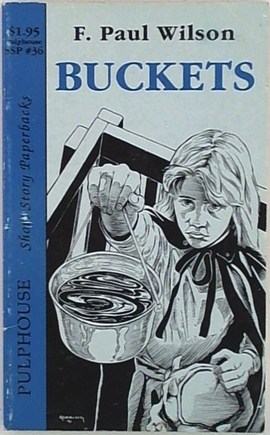

You may have heard of "Buckets," as it achieved some minor notoriety in horror fiction circles for its, uh, indelicate subject matter (it was chosen by Karl Edward Wagner for inclusion in Year's Best Horror Stories 18 and published as a standalone chapbook in 1991 - bought a copy back then, never read it, now can't find it). Now "Buckets" sorta works as a standard horror tale of comeuppance, with a foolish and self-important "protagonist" receiving his just deserts. The problem is in the execution. The touchy topic should have been dealt with in a deft and sure and perhaps even ironic hand - which ain't the case here.

Pulphouse chapbook, 1989

A 50-ish gynecologist - presented as vain and self-regarding - faces the "ghosts" of the children he's "killed" performing abortions (guess what's in those buckets). All kindsa conundrums here render the story's reactionary point moot. It made me posit a ludicrous question: can there be ghosts of people who never existed? How can those who never were rage about never being? Is this some bizarre alternate reality tale? "Buckets" is as clever, as subtle, as insightful as a raving anti-abortionist's misspelled placard decorated with a photo of a bloody aborted fetus. About as brave, too. Fuck that.

Man, now I'm not looking forward to reading The Keep at all.