Showing posts with label alfred hitchcock. Show all posts

Wednesday, December 5, 2012

Psycho by Robert Bloch (1959): Motel Money Murder Madness

Then the horror wasn't in the house... it was in his head.

Modern horror entertainment would not be what it is today were it not for the seminal work Psycho, the sixth novel by the vastly prolific Robert Bloch. The book's main character, Norman Bates, has become an immortal symbol of the madness hiding behind the banal, the prosaic, the mundane. It is horror rooted in the everyday; it does not haunt a crumbling Gothic castle, nor does it reside outside space and time. It's here and it's now and it's coming through the bathroom door...

Famously inspired by the Ed Gein case, Bloch pieced together the vague details he'd heard about his fellow Wisconsinite and created Bates, a fellow with, shall we say, mother issues. In the novel, Bates is balding, overweight, a voracious reader and somewhat of a drunk - one of the few changes Hitchcock and screenwriter Joseph Stefano made when they adapted Psycho for film. Another is - probably a major disappointment for readers hungry for violence; I know I was when I first read Psycho as a teenager - the infamous shower murder. Bloch dispatches the character in a single lurid, pulpy sentence; there is nothing that even hints of what Hitchcock would put on the screen.

And I must admit I found it difficult to keep from picturing Anthony Perkins, Janet Leigh, Martin Balsam, etc., in my head. Suspense and mystery are mostly muted when reading Psycho because of that classic movie. That's why I appreciated seeing how Bloch concealed the fact that Mother Bates is dead; I think those who read it before the movie would never have suspected she's an exhumed corpse. Bloch takes us right inside Bates's head, understanding the origins of his homicidal rage and impotent fury. The conversations between mother and son are ultimately one-sided, her vicious beratements taking on a pathetic poignancy, knowing as we do that they're Norman's own thoughts:

"I'm the one who has the strength. I've always had it. Enough for both of us. That's why you'll never rid of me, even if you really wanted to. Of course, deep down, you don't want to. You need me, boy. That's the truth, isn't it?"

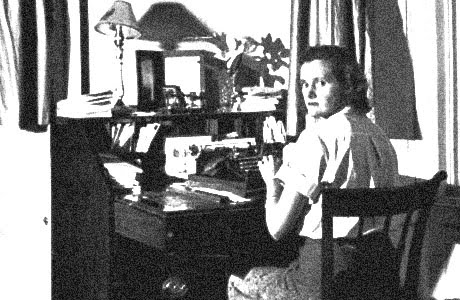
Young Bloch in undated photo, from www.wisconsinhistory.org

One of my favorite parts was when Lila Crane is sneaking through the Bates home, looking for clues to her sister's disappearance, and finds Norman's library:

Here Lila found herself pausing, puzzling, then peering in perplexity at the incongruous contents of Norman Bates's library. A New Model of the Universe, The Extension of Consciousness, The Witch-Cult in Western Europe, Dimension and Being. These were not the books of a small boy, and there were equally out of place in the home of a rural motel proprietor. She scanned the shelves rapidly. Abnormal psychology, occultism, theosophy. Translations of La Bas, Justine. And here, on the bottom shelf, a nondescript assortment of untitled volumes, poorly bound. Lila pulled one out at random and opened it. The illustration that leaped out at her was almost pathologically pornographic.

Warner Books reprint (with stepback), 1982

We get some of Bloch's famous word play in that first line, as well as the "forbidden books" trope so popular in weird pulp fiction. Bloch wrote an unassuming little thriller that shows touches of real-life horror in places, and one that's as singularly important to the horror genre - pre-King of course - as anything by Lovecraft or Matheson or Levin. That it's overshadowed by its unparalleled film adaptation is no inherent fault, and Psycho should still be read and savored today. See more paperback editions here.

Tuesday, September 13, 2011

Someone Like You (1953) and Kiss, Kiss (1960) by Roald Dahl: Keeping It Creepy

World-famous for his singular children's fiction, Welsh author (and WWII fighter pilot) Roald Dahl was born today in 1916. But fans of the dark and the disturbing also celebrate his short stories: blackly comic, unsparingly ironic, finding fatal foibles in the class and taste distinctions of post-war British life. Dahl's language is plain but precise, scalpel-sharp, cool and confident, in stories that are sometimes suspenseful, sometimes playful, but all generally quietly creepy.

They were often published in The New Yorker, Collier's, Harper's and other top periodicals of the day. Unsurprisingly, Alfred Hitchcock adapted half a dozen of Dahl's tales for his own television show in the late '50s and '60s, all six can be found between these two collections, Someone Like You and Kiss, Kiss: "The Landlady," "Dip in the Pool," "Man from the South," "Lamb to the Slaughter," "Mrs. Bixby and the Colonel's Coat," and "Poison." Also recommended: "Royal Jelly," "Taste," "The Great Automatic Grammatisator."

Original Dell publications

Somewhat more recently, Stephen King included these two in his recommended reading list in the appendix of Danse Macabre, noting their importance to the horror genre specifically. Which is - surprise, surprise - why years ago I sought out and read these nicely vintage paperbacks from Pocket Books, reprinted in 1972 (old book smell included!). Perhaps some of Dahl's twist endings can be seen coming today as we've had decades of that kind of thing in our entertainment, but many of the stories here are still deadly delights, disarmingly nasty stories of human depravity. Those of you who enjoy the short fiction of writers like Shirley Jackson, Fredric Brown, Harlan Ellison, Charles Beaumont, Gerald Kersh, and/or Richard Matheson will find much to enjoy in Roald Dahl's work... if you haven't already, of course!

Here's something I just learned: back in 1961, Dahl hosted his own CBS TV show, "'Way Out"! His macabre humor and utter Britishness was very much in the Hitchcock vein (heh) and the show was paired with "Twilight Zone" on Friday nights. It only lasted one season, though. Oh man, I had never heard of this till just today. Full episodes are on YouTube; at least check out Dahl's droll intros.


Saturday, August 13, 2011

The Psycho Paperback Covers: We All Go a Little Mad Sometimes

Today is the 112th birthday of Sir Alfred Hitchcock. I just wanted an excuse to feature some of the many paperback editions of Robert Bloch's immortal Psycho that have appeared over the years since its original publication in 1959. Now, if you're rather desperate to obtain some of these lovely paperback editions, why, I just know none of you would even hurt a fly. Enjoy...

The edition at the top is from Tor 1989, with cover art by Joe Devito. The one above is from Bantam 1969.

Warner Books 1982
Corgi UK 1962, 1977 and 1982

Crest Books 1960 and movie tie-in 1963
Don't be late...

Tuesday, March 8, 2011

Echoes from the Macabre by Daphne du Maurier (1978): No Future for Me, No Future for You

"Tales of quiet terror" is the descriptor on the cover of Echoes from the Macabre, and it's perfectly correct. This collection from Daphne du Maurier, most famous for penning Rebecca (1938), contains her two most famous long tales, "Don't Look Now" (1971) and "The Birds" (1952). Yes, each story is the basis for the respective movies of the same name. They are richly rewarding in their own right, however, as are the other half-dozen works here, all originally published in various hardcover editions in the '50s and '70s. This is the Avon paperback edition of the book originally published by Doubleday in hardcover in 1976.

Filled with disquiet and unease, creeping doubt and slow-dawning horror - a du Maurier trademark - these stories of the uncanny share other similarities than just quietness. Each precisely-described character defect will be an undoing; each note of suspicion will come true in the most unexpected manner. Vacationers abroad should have never left home, while home offers its own miseries. Her style is tough-minded, unsparing, carefully wrought. Cold and cruelly calculating, du Maurier dooms her men and women to humiliating defeats (what a bloody silly way to die...).

"Don't Look Now," the lead story, is justly famous in the horror field; editor David G. Hartwell chose it for his enormous Foundations of Fear anthology in 1992. A married couple who have recently lost their young daughter are vacationing in Venice in order to ease their minds; wife Laura is befriended, of sorts, by two elderly female twins. One is a blind psychic who tells Laura that their daughter is still with them, laughing and carefree. While this news fills Laura with happiness, it distresses husband John. What follows is the darkest comedy of errors, which leads to fateful absurd tragedy. The way du Maurier slowly closes the circle around one of her characters is breathtaking.

Another man desperate for a vacation appears in "Not After Midnight." In Crete to paint its lovely seascapes and hoping to stay far from his fellow travelers, boys' schoolteacher Mr. Gray inadvertently attracts the attention of a fat drunken lout of an American who informs him that the cabin in which Gray is staying was previously occupied by an unfortunate fellow who drowned and washed up on shore, half-eaten by octopuses. In a very vague way it reminded me of Lovecraft's "Shadow Over Innsmouth." But get out your Hamilton's Mythology for this one, gang. Old gods do not die quietly.

1972 Avon paperback

Set at the beginning of a cold hard winter on the grim English seaside, "The Birds" is a matter-of-fact tale of nature gone horribly, irrevocably wrong. Hitchcock's adaptation retained the matter of birds attacking humans but du Maurier's version is all her own. There is suspense and dread and human failing, and a pervasive sense of futility. While most other aspects of the movie are absent in the story, there is actually no need for them here. Whatever human drama there was before the birds came is rendered moot.

In "The Pool," a pubescent girl finds that a new life for her means that something else must die after offering a sacrifice to the promising body of water in her grandparents' garden; a driven hunter obsesses over "The Chamois" (a rare type of goat in the central European wilds) while his wife fears their secret shames might both be symbolized by the animal. The natural world, as presented in Echoes, is one that must be appeased or acquiesced to; there seems to be no harmonious living with it.

Back in the city, post-war English life is well-drawn in "Kiss Me Again, Stranger," but it's not a life for everyone. And "Blue Lenses" tells us that hospital stays are always disorienting; while this isn't quite a story about eye trauma, it is, in its own way. Horror always reminds us that people are not often what they appear to be; in this story, perhaps they are. Which is even worse.

Not all the stories are overtly macabre, as it were; some have wistful, dreamy moments while others offer more psychological insights, particularly of the marital kind, as in "The Apple Tree." The cover art has its source in one of my favorite stories here but I won't spoil it for a first-time reader. If you are fan of the merciless and misanthropic ironies of Roald Dahl, Patricia Highsmith, or Shirley Jackson then one is advised to pick up this collection posthaste; I've seen cheap copies of it for sale all over the internet. Worldly and sophisticated, Echoes from the Macabre is the literary equivalent of, if not a knife, then a dull club in the chest from a dearest, albeit well-traveled, loved one.

Thursday, November 11, 2010

Robert Bloch: The Paperback Covers of the AUTHOR OF PSYCHO!!!

No reader of horror fiction needs an introduction to Robert Bloch. Once asked how he had the energy to be such an endlessly prolific writer, Bloch replied, "I have the heart of a small boy... in a jar on my desk." A groan-inducing pun? Yes, but that type of macabre, old-man humor is one of Bloch's trademarks. Since his teenage days in the 1930s as a personal correspondent of H.P. Lovecraft's, Bloch's countless novels and story collections have mined black humor and pathological criminal behavior. His works have been printed and reprinted for decades by various publishers with all different styles of cover art, but one thing was virtually a constant after a certain 1960 movie: the phrase "author of Psycho" beneath his name.

Early works like the crime novel The Scarf (1947), or The Opener of the Way (1945) originally from Arkham House, have it on their later mass market paperback resissues. And it's really no surprise, is it? Bloch had ostensibly created (with a filmmaker's assist, of course) the most iconic murder in all of horror - and crime - fiction. Publishers were not about to let reading audiences forget that.

A UK edition of Opener of the Way (1976), as well as Mysteries of the Worm (1981), collect Bloch's Weird Tales/Cthulhu Mythos stories of the 1930s, which he admits were maybe just a little too amateurishly Lovecraftian to be of much interest years later.

The Dead Beat (1960) and Firebug (1961) are suspense pulps with the appropriate cover art. Dig how the match flame is burning up Psycho...

Pleasant Dreams (1960/1979), Nightmares (1961), Strange Eons (1978), and The Skull of the Marquis de Sade (1963) collect Bloch's short stories. Yes, that's Peter Cushing examining the Marquis skull in the 1965 movie The Skull.

Terror (1962) and Horror-7 (1963) don't really go out of their way in the title department but know that a terrified woman is simply irresistible to horror fiction readers. Or at least a woman who seems slightly perplexed and pissed by her situation.

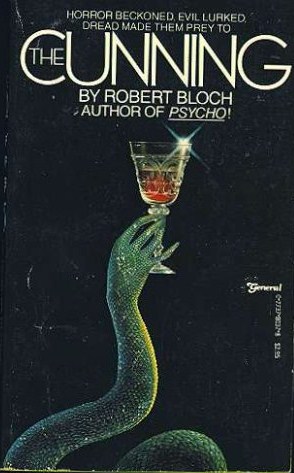
Novels like Night World (1972) and The Cunning (originally published as There is a Serpent in Eden in 1979 with a completely incongruous cover) followed. By the 1980s Bloch was being published by the Tor horror line, who even went way back to 1954 with its reprint of The Kidnapper. "Better than Psycho!" it exclaims. One seriously doubts that claim. The Night of the Ripper (1984) and Lori (1989) look like any other mass market horror paperback of the era; the latter title part of Bloch's boundless fascination with Jack the Ripper, whom he first wrote about in his classic short story "Yours Truly, Jack the Ripper" way back in '43. I read it way back in '89 or so and yet remember nothing about it.

By the time of his death at age 77 in 1994, Robert Bloch was, of course, considered a grand master of genre fiction. One wonders just what became of that small boy's heart in a jar on his desk...

Monday, March 1, 2010

Psycho (1959) by Robert Bloch: A Boy's Best Friend...

Sneaky old Hitch bought the film rights to Psycho for a couple grand back in the day but made sure Robert Bloch didn't know who was signing the check. Oh well, things turned out great for everyone involved. I've tried finding a paperback edition of this that came out before the movie but to no avail; I'm assuming there wasn't one. You can see on the first edition hardcover (which I don't own) the classic font of the title.