Showing posts with label award books. Show all posts

Wednesday, June 8, 2022

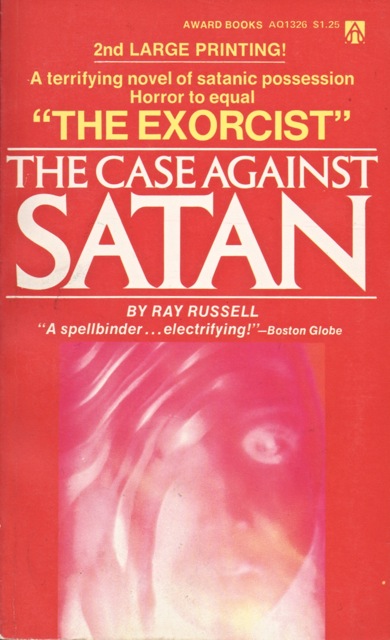
The Case Against Satan by Ray Russell (1962): Hell is for Children

There was a rattling, gagging sound from the girl, and they turned to watch in pity and loathing as she retched violently, her body curling in spasms, her fingers and toes clenched, her gaping mouth spewing jet after jet of reeking substance that covered her and splattered the wall and ran sluggishly in long viscous tendrils down to the floor.
 
A young teenage girl in unbearable torment of unknown origin. Her beleaguered parent. Two priests with competing ideas about their belief in God and Satan. A harrowing test of wills against a force the modern world has forgotten...
 
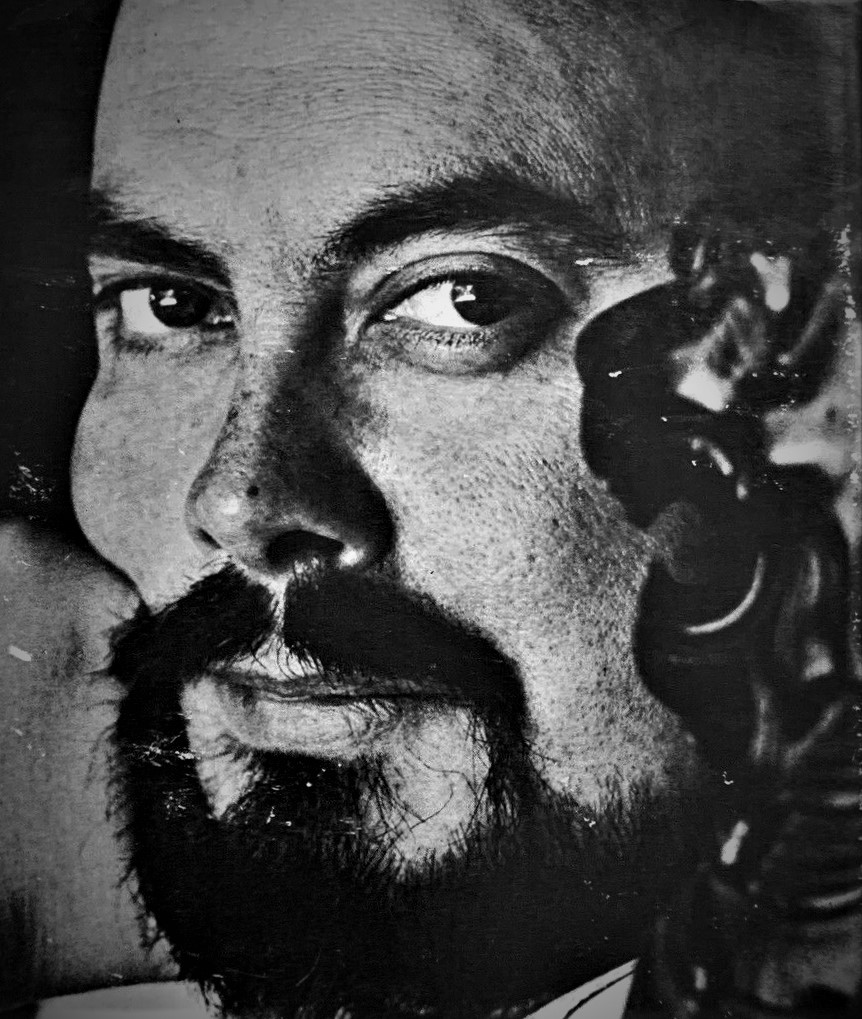
Modern horror would be a poorer thing were it not for the book and film The Exorcist—that's not an overstatement. William Peter Blatty's thrilling, chilling tale of innocence soiled and faith tested, of doubt, guilt, and ultimately of sacrifice, has touched the popular horror imagination at that same primal archetypal level as Dracula and Frankenstein. But as it was with those two monstrous icons, The Exorcist also had its own forgotten precursor. I'm talking about the 1962 novel The Case Against Satan, by the late great Ray Russell (1924-1999, seen below in an undated photo, but probably late Sixties or so).

You may recall I've written positive reviews of several of Russell's works over the years, I'm absolutely a fan, happy to see all his horror Gothics back in print today. His adeptness at combining a dark, literate sophistication with "distasteful" genre elements, which might seem beneath his skill set, is admirable. Grand Guignol bloodiness in works like "Sardonicus" and Incubus is polished by his steady pen in prose both accessible and lively, often delivered with an ironic tone, a devilish wink. As editor for Playboy magazine in its early days, he no doubt sharpened that pen and that penchant for macabre philosophy when working with writers like Ray Bradbury, Charles Beaumont, Kurt Vonnegut, and others of that sensibility.
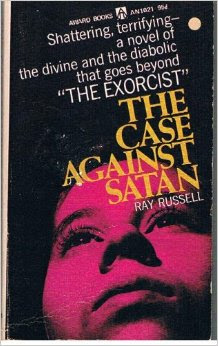
 
Russell's dialectic in his genre fiction, and first seen in this novel, is one of superstition versus rationality, of tradition versus modernity, of enlightenment versus religion, as one reviewer of Case Against Satan notes. Indeed, this kind of against-the-grain approach was also part and parcel of the Playboy "philosophy," if you will: unshackling our minds (and bodies!) from the strictures of the past, strictures too often rooted in myth and superstition (i.e., religion). From such conflict does Russell approach demonic possession in the modern world. And no surprise that sex is suspected at the root of the "possessed" girl's problem: repressed sex, of course, a great raw force that seethed and snarled for release.
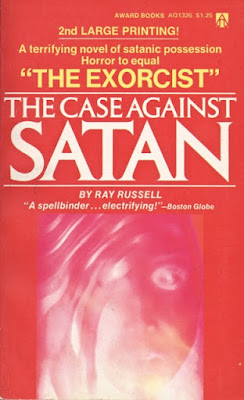
 
As tête-à-têtes go, here Russell is in the "both sides" camp, a final answer which Russell leaves open-ended. The first chapter is titled "The Two Sides of Midnight"—indeed, all the chapter titles seem to predict black metal songs!—and that gets right at Russell's views about the difficulty we have perceiving even what we see right in front of us. "The Hand of God is quicker than the eye," as one character quotes.
 
Russell combs through history and literature to find some delicious, torturous horrors, as is his wont, easy enough to do with the Catholic Church. Intellectual talk between the two conflicting priests, Father Halloran and Father Sargent, when they're not actually exorcising poor young Susan Garth is stimulating; the cranky teetotaling anti-Catholic John Talbot was a hoot, with his scandalous insight that the Church and communism are opposed to one another solely because they are both totalitarian... Total power, total control. Control over everything—over the body, over the mind.
 
Compact and tightly-wound at around 150 pages, Case is deceptively simple, but still dramatic and lurid at times; like The Exorcist it is not necessarily a novel of horror but one about belief, doubt, conviction, redemption, but are these antiquated ideas in the 20th century? The concept of God and Diabolous struggling for the human soul is accepted only if it is translated into Freudian jargon—the superego and the id struggling for human reason.
 
I can’t say for sure but it seems like, for all the similarities, that Blatty took Russell's book and blew it up to bestselling mass-appeal status. Case does not have the scorching vulgarisms, the relentless throb, that all-hell-breaks-loose energy that kept millions upon millions of Exorcist readers turning pages and unable to sleep. Its dry-as-dust title perhaps an inkling to what's inside, Case didn't wow me like Russell's other works; he always has his characters talk a lot but the theological discourses here can wear on the reader. 

Yet the author's intelligence, subtlety, and psychological astuteness can make up for some of the drier sections, as he uses a sensational topic to illuminate the darker regions of the human mind. Ray Russell is the kind of just-maybe-smarter-than you pal you enjoy talking with over a bottle of good booze late into the darkening night... but just maybe you've heard this particular story before.

But have any of you ever heard and wondered at strange sounds in Catholic rectories? In the Unholy Hours, past the witching time of night, have you ever heard sounds that seem like the screams of poor girls in mortal agony? Have you ignored them? How long will your conscience let you ignore them?

Thursday, November 19, 2020

Where Satan Dwells: The Kitty Telefair Gothic Series by Florence Stevenson (1971-1977)

If you've been following Too Much Horror Fiction or have read Paperbacks from Hell, you're likely aware of the scarcity of some of the titles talked about and the oft-times inflated prices online booksellers afix to those books. These disposable artifacts from a bygone age often are going for $75 to $100, and even more in some cases. To be blunt, it sucks. Mea culpa, and all that. Certainly collectors of all stripes run into this issue.
 
I also want to say that these inflated prices in no way reflect the "literary" quality of those books. Like, at all. The cost only reflects the scarcity and a near-mint condition (at least one hopes). Any good collector must be well aware of this, and proceed accordingly when opening the wallet. Don't expect that dropping 50 bucks on a rare book will get you the reading experience of a lifetime... alas.

 
Which brings me to these Florence Stevenson (1922-1991) Gothic paperbacks, the virtually impossible to find Kitty Telefair series. According to the much-missed blogger Curt Purcell, this occult series features terrific vintage Sixties and Seventies flavor while engaging in classic horror tropes like vampires, sorcerers, and past lives. Rare and good? Mmm-boy, sounds delicious!

According to Purcell, Kitty herself is a kind of psychic Nancy Drew, but what I really dig about these books is, of course, the cover art (all uncredited except Horror from the Tombs, by a George Bush). Candles, castles, bats, spooky windows, flowing gowns, widened eyes, sexy Seventies women, mustachioed mystery men, blurbs about The Exorcist: all the Gothic accoutrements one could ask for.

Also impossible to find is any info on Ms. Stevenson herself, which kinda drives me crazy. A few of these titles turn up very occasionally on Abebooks if you have a sharp eye and email alerts—same goes for many of her other Seventies Gothics; I myself only own two of her Eighties horror titles—but these are the kinds of paperbacks for which you must haunt thrift stores, garage sales, and junk heaps, cursed for eternity.

Tuesday, August 23, 2016

The Smell of Evil by Charles Birkin (1965): Who Could Write This Book of Cruel

I rather wish that the stories in The Smell of Evil were more in line with the moody, melancholy vibe of the paperback cover for the 1969 Award Books edition. Instead, British-born author Charles Birkin (1907 - 1985) offers up blistering contes cruels with a kind of demented genius; there's not a moment of moodiness or atmosphere anywhere at all. Editor Dennis Wheatley perceptively notes in his intro, however: "Young writers are always sadly handicapped by lack of experience; whereas anyone who has been through a war, met a great many people in all walks of life and had to face a number of crises on their own, must have automatically acquired a wide knowledge of places, events, unusual happenings and varied emotions. Charles Birkin has this advantage...."

This is all true, no doubt. The wide-ranging settings and types of characters are a pleasure appreciated (in fact I was put in mind of Barker's approach to Books of Blood 20 years later) and well-deployed. The baker's dozen of tales contained are ingenious clockwork toys, ready to snap and trap hapless folks within their merciless jaws. Which story element, I wondered while I read, will be the tripwire?

I wanted to like the stories more than I did; I didn't mind that for many I could guess the twist; or the dated sociopolitical stances; or the lack of the supernatural (featured in a couple tales, and not very original at that). What I minded was the unremitting cruelty, the vagaries of fate that scoop characters up to dash them upon the rocks, the utter misanthropic (and often sexist and racist and homophobic) nature of each and every tale.

It's not that I dislike that merciless ironic last sentence-style reveal of an unimaginable horror; Birkin does it very well. But a whole book full of them makes for some dispiriting reading. Perhaps if I'd read a story here and there—indeed, I first read the title story over two years ago and enjoyed it on its own—I'd have been more satisfied. I don't know.

Anyway, there were some positives. In "The Smell of Evil" a novelist on an island holiday learns of a horrific scheme to bilk a young mute heiress out of her inheritance. It's the only first-persona narrated work in the collection; its denouement benefits greatly from the technique, a reaction of rage against an unconscionable breach of trust.

"Text for Today" is a silly trifle of literal cannibalism set in Papua New Guinea; "The Godmothers" is kitchen-sink realism without mercy as it puts a child in grave danger. "Green Fingers" was my favorite of all: a well-observed story of a WWII Nazi officer and the unsuspecting woman he coolly romances. The twist crept up on me slowly as Birkin takes his time setting it up with an unforgiving depiction of self-deception and willful delusions.

The original nature of zombies features in "Ballet Nègre" but feels icky for other reasons. "The Lesson" is kind of like a "Mad Men" party gone horrifically wrong (don't get drunk around children), while "'Is Anybody There?'" flirts with ghosts and psychic drama in an agreeable way. The brutal climax of "The Serum of Dr. White" is bitter and hopeless as a mysterious doctor attempts to treat a disfigured young girl.

Tandem UK edition, 1965

The teenage ruffians of "'Dance Little Lady'" could be right out of Saturday Night, Sunday Morning, but they go down one of the darkest paths known to humanity. The whisper of otherworldliness works well in "Little Boy Blue," another family on a holiday that ends in tragedy. "The Cornered Beast," meh, freak-show escapee. "The Interloper" is quite good in and of itself but its sexual politics are, um, troublesome: a tropical island of lesbians who've left civilization and men behind deal with a wounded man who stumbles ashore. At first it seems Birkin is showing some sympathy to women who've endured such humiliation and violence at the hands of men; the climax reveals otherwise, I think. The final story, "The Cross," is a predictable bit of science-fiction that uses nonsense words to hide its turnabout. It's been done before.

Throughout, Birkin's prose is unfailingly British: crisp, precise, mature, stuffy sometimes and irreverent at others. Fine with me. It's just that, as I said, the unforgiving quality, the bleak ends and meaningless deaths, the utter lack of humor, scares, wit, and/or creepiness (that Tandem UK paperback cover is irrelevant as well) add up to a work I'm not sure I'd recommend to readers of traditional horror fiction. Proceed, if at all, with caution.

Friday, October 2, 2015

Jack Finney Born on this Date, 1911

Milwaukee-born author Jack Finney published the iconic science fiction/horror/thriller novel The Body Snatchers in 1955. It's become one of the seminal genre texts of the 20th century (and beyond, one presumes), along with the likes of I Am Legend and Stepford Wives: works that have permeated mass cultural consciousness, concepts—here, "pod people"—known to people who haven't even read the source material. There have been plenty of paperback editions over the decades, most including the prefix "Invasion of" after the 1956 film adaptation was released. A sampling:


Wednesday, September 24, 2014

Charles Birkin Born Today, 1907

Charles Birkin was a long-time editor and author of horror tales, putting together the popular Creeps Library anthology series in England throughout the 1930s. In the 1960s he began publishing collections of his own short stories, many which were published in the States. The most famous of these seems to be The Smell of Evil (Award Books/1969). This summer I was able to buy a copy and read the title story--it was cruel, macabre, delicious! For a bibliography of his many books, refer to the Vault of Evil. For a new trade paperback edition of Smell of Evil, buy it at Valancourt Books. Birkin died in 1985.


Thursday, September 18, 2014

Victim of Agony: The Horror Paperbacks of Florence Stevenson

I am not much sure who Florence Stevenson is but going by these paperbacks of hers written throughout the late '60s, '70s and into the horror heyday of the 1980s, she wrote the gamut: quiet horror, Gothic horror, witches, vampires, even cat lady horror--I love Ira Levin's blurb on Ophelia (Signet/Apr 1969): "fresh, delectable, refinedly sexy."
Amazon lists dozens of her paperback novels. The cover art on all of these offers much to be enjoyed, from the creepy-kid vibe of A Feast of Eggshells (Signet/Dec 1969--and don't miss that body at the bottom of the stairs) to the proto-paranormal romance imagery of Moonlight Variations (HBJove/Jan 1981), or the delicious bosomy Gothic of The Curse of the Concullens (Signet Gothic/Nov 1976) and The Witching Hour, to the luridly overdone '80s covers for Household (Leisure/Mar 1989) and The Sisterhood (Leisure/Oct 1989).


I found only the most basic biographical info on a romance site; if anyone knows anything more, let us know. And oh yeah, if you've read any of these too!