Saturday, May 26, 2012

Robert W. Chambers Born Today 1865

Born and bred in Brooklyn, USA, artist and author Robert W. Chambers left a legacy of horror lauded by Lovecraft (although with some reservations) and other lovers of supernatural fiction. Me? I read and kinda liked okay "The Repairer of Reputations" a gajillion years ago, in Hartwell's The Dark Descent (1987), and now a copy of the 1982 Ace paperback (boring cover at bottom) of his major work, The King in Yellow (1895), sits unread upon my shelf. That's cool at least.

Mr. Chambers, how do?

Thursday, May 24, 2012

Frigid Horror Fiction: The Cool Out

Anyone else in need of some chilling horror fiction with appropriate cover art to fend off the coming summertime blues? I've said before that freezing temperatures and blinding snow are settings for great horror. Two classic tales from the first half of the 20th century, At the Mountains of Madness and "Who Goes There?", help prove my point, while two classics of the vintage era, The Shining and Ghost Story, nearly secure it. But wait - there's more. Ahh, that's the stuff.

Thursday, May 17, 2012

Soft and Others by F. Paul Wilson (1989): I Don't Want a Baby That Looks Like That

Known primarily as the author of the Adversary Cycle and Repairman Jack series of supernatural thrillers, Jersey-born physician F. Paul Wilson (born today in 1946) also made fairly regular appearances in various genre anthologies throughout the '70s and '80s. The Keep from '81 is probably his most famous novel (made into a woefully misbegotten film I watched last year on Netflix Instant and has about 20 seconds of goodness in it), and I've got a copy of it here on my desk but haven't read it yet. I'd heard very good things about this out-of-print short story collection, Soft and Others - very high ratings on both Amazon and Goodreads - and recalled liking a couple of his stories back in the day. It was on my must-buy list for ages, and I was excited to find a mint paperback copy (Tor July 1990) at a huge book sale last month.

And the verdict... Soft is kinda really meh. Which kinda sucks. No way around it: despite some really inventive and unsettling scenarios, Wilson's pedestrian, humdrum prose and tin-eared dialogue dampened any enthusiasm I originally had. His writing isn't terrible, no, just bland, flavorless, middling. Some readers don't mind this and don't read horror to be challenged literarily, but I'm not a fan of letting my brain coast through fiction, and sometimes his "style" is so flatfootedly clunky it snapped me right out of a story. That's the last thing a writer should want. Arranged chronologically, this collection starts off with some ho-hum science fiction tales from the early '70s and finishes up with some trite and obvious '80s horror.

Sorry 'bout the shitty review on your birthday 

The titles are stark and simple, which makes them sound menacing: "Traps," "Buckets," "Muscles," "Cuts." Problem is, he's stuck in that cliched EC Comics manner of telling simple, one-dimensional revenge stories, or nasty ones that simply dispatch the protagonist for no other reason than to have a "Twilight Zone" twist at the end, in final sentences which are too hacky to have any real impact. I didn't mind the SF tales "To Fill the Air and Sea," a charming sort of alien Old Man and the Sea, and "Green Winter," which vaguely mines Planet of the Apes territory, they're well-imagined, if derivative. The less we say about the two rock'n'roll pieces, "The Last 'Oldies Revival'" and "The Years the Music Died," the better. Cringeworthy.

Oh Lansing State Journal, my most trusted source of horror lit criticism!

Straight horror can be found in "Ménages à Trois" - which I read years ago in the first Hot Blood anthology - and "Cuts," again, a story I remember from Silver Scream. Straight horror, yes, if more than a little cheesy and predictable. "Traps" is pretty dumb and one-note although the final line strikes a sadly thoughtful moment of real fear and helpless despair. Kirkus may have loved "Dat-Tay-Vao" but I sure didn't; the main character is such a cowardly shitheel I never believed he was a real person. The titular tale works really well even if underwritten in places; it's graphic in just the right and disturbing way and has gained itself many fans in the intervening decades since its first publication in 1984's Masques. Honestly, I had no idea what it was about, and... I'm not inclined to spoil it for y'all! Even the ebook cover won't give it away:


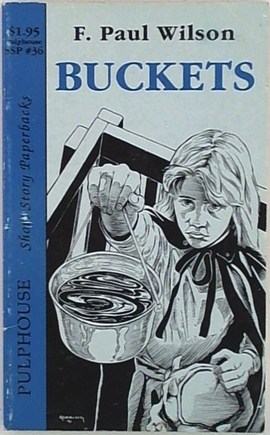
You may have heard of "Buckets," as it achieved some minor notoriety in horror fiction circles for its, uh, indelicate subject matter (it was chosen by Karl Edward Wagner for inclusion in Year's Best Horror Stories 18 and published as a standalone chapbook in 1991 - bought a copy back then, never read it, now can't find it). Now "Buckets" sorta works as a standard horror tale of comeuppance, with a foolish and self-important "protagonist" receiving his just deserts. The problem is in the execution. The touchy topic should have been dealt with in a deft and sure and perhaps even ironic hand - which ain't the case here.

Pulphouse chapbook, 1989

A 50-ish gynecologist - presented as vain and self-regarding - faces the "ghosts" of the children he's "killed" performing abortions (guess what's in those buckets). All kindsa conundrums here render the story's reactionary point moot. It made me posit a ludicrous question: can there be ghosts of people who never existed? How can those who never were rage about never being? Is this some bizarre alternate reality tale? "Buckets" is as clever, as subtle, as insightful as a raving anti-abortionist's misspelled placard decorated with a photo of a bloody aborted fetus. About as brave, too. Fuck that.

Man, now I'm not looking forward to reading The Keep at all.

Tuesday, May 15, 2012

The Infernal World of Daphne du Maurier: The Avon Paperback Covers

 
This week saw the birthday of Rebecca du Maurier, the esteemed British author of the darkly romantic popular novels Rebecca (1938) and Jamaica Inn (1936), as well as the classic short stories "The Birds" and "Don't Look Now" (movies all, of course). In the early 1970s, Avon Books reprinted much of her catalog in loverly vintage paperback editions with moody, Gothic-y cover art—most by American illustrator Gene Szafran—just brimming with menaced '70s ladies and virily sideburned men. Love the covers, the colors, and the author's name featured so prominently in a distinctive font.

Kiss Me Again, Stranger, a collection of her wonderfully written and icily macabre short stories, features some ghostly birds up to no good. Another collection, Echoes of the Macabre, was one of my fave reads last year. In 1969 du Maurier became a Dame of the British Empire, so, you know, fancy!


Wednesday, May 9, 2012

"Hell vomits up the damned..."

Can't really beat that tasty tagline can you? I've never read Pranks (Leisure 1993) but it's one of those books that I seem to find in all the used bookstores I haunt. I can't bring myself to purchase it, not with one of the most uselessly ludicrous covers ever. But I had to share it, and you can thank me later. Cinema Somnambulist reviewed it awhile back, see what he says here.

Unrelated note - or maybe it is related, as I'm featuring a cover for a book I neither own nor have read - I'm reading a couple horror short story collections this week, almost finished one, and should have a review up soon. I'll give you a few story-title hints: "Buckets," "Soft," "Cuts"... Stick with me now!

Friday, May 4, 2012

Evil is a Quiet Word by Theodus Carroll (1975): Don't You Ever Call On the Unspeakable


Couldn't find anything out about Evil is a Quiet Word, a Warner Books gothic horror novel by someone named Theodus Carroll. The stepback art is the same as the cover but the tagline is priceless: 
A
novel
that
murmurs
oh 
so
softly
of 
unspeakable
horror


If anyone's read this, let us know: is the horror truly unspea--


Tuesday, May 1, 2012

Friday, April 27, 2012

Fawcett Horror Paperbacks of the 1980s

 
By the early 1980s, Fawcett seemed to have moved on from the moody, studied paperback cover art they used in the 1970s. Perhaps the growing horror field of the new decade gave them more competition and those books didn't sell as well any longer. Perhaps talented artists who worked in paints and canvases and good old-fashioned suggestive spookiness were too expensive. These covers are simpler, more direct, not as impressive, and in a couple cases just corny, tasteless without being quite ridiculous enough for a laugh. The three volumes in The Howling series, Gary Brandner's werewolf saga, (1977/1981/1985 respectively) utilize the same monstery font and stylization; I do kinda like the "one fang/two fangs/three fangs" motif.

 
When Paul Schrader remade the 1940s classic B&W Val Lewton horror film Cat People in 1982, Brandner wrote the novelization. Sure, this cover has the same image as the movie poster, but what an image! Truly one of my favorite horror ladies of all time.

Vampire Notes (1989) and The Keeper (1986), Robert Arthur Smith. No idea who Smith is, but he got some of the better '80s covers from Fawcett. 

Killing Eyes, John Miglis (1983) Yikes. I mean, look away! Those eyes are so unsettling, I missed the bullet hole first time I saw this cover.

 
The Boogeyman, B.W. Battin (1983) This kind of simplicity actually works: the child's scawl, the bloody fingerprint that looks almost real...

 
The Beast, Walter J. Sheldon (1980) Move along, nothing to see here folks.

Death Sleep, Jerry Sohl (1983) He sure sounds like Freddy Krueger...

Falling Angel, William Hjortsberg (1978) - Yeah, it's from '78, but I'm throwing this in as a freebie. I've featured this cover before, in my review; it's absolutely one of my favorite books that I've read for this site! I even sent an effusive fan email to Hjortsberg a month or two ago (drinking and the internets don't mix), but luckily received an appreciative reply. Whew.